
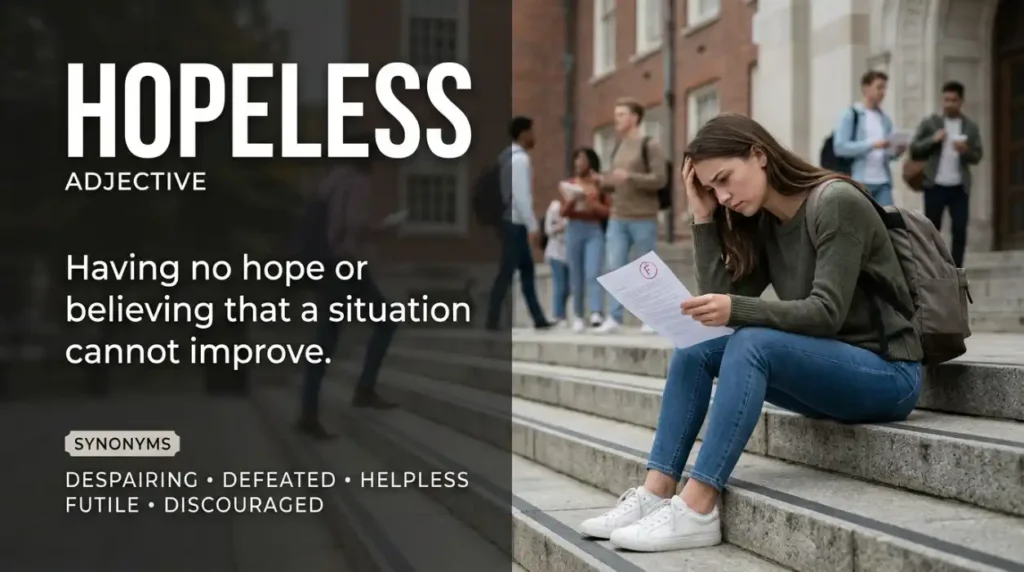
A synonym for hopeless is a word that describes someone or something without hope, a situation that seems impossible to improve, or a person who feels discouraged. Common alternatives include desperate, helpless, futile, bleak, impossible, and discouraged. The best choice depends on the context.
Imagine studying for an important exam while believing you cannot succeed. You may search for a synonym for hopeless or describe yourself as discouraged. Both suggest difficulty but convey different feelings.
A synonym for hopeless helps communicate disappointment, uncertainty, and a lack of expectation more precisely. The right alternative also makes your sentences clearer, more natural, and less repetitive in context.
The word hopeless appears in everyday conversations, books, education, relationships, and professional discussions. Its best alternative depends on whether you describe specific emotions, a difficult situation, or an unlikely outcome.
Students, bloggers, content writers, and English learners can explore each synonym for hopeless to build vocabulary and express ideas naturally. These alternatives make communication more accurate, varied, and engaging.
What Does “Hopeless” Really Mean?
Hopeless means having no hope or expecting little chance of success, improvement, or recovery. It can describe a person who feels discouraged or a situation that seems impossible to fix.
It is an adjective. Native English speakers commonly use it in two main ways:
- Emotional meaning: Someone feels hopeless when they believe things will not improve.
- Situational meaning: A situation is hopeless when there seems to be no realistic chance of success.
It can also describe a person who lacks a particular ability. For example, someone might say, “I’m hopeless at remembering names.” This informal use means they are very bad at that activity.
The word can sound serious or emotional when discussing a person’s feelings. In casual conversation, it can also be humorous or self-critical.
Connotative Meaning of Hopeless
(Connotation means the emotional feeling or association that a word creates beyond its basic dictionary meaning.)
Positive tone: Hopeless itself is rarely positive. However, alternatives such as challenged or uncertain can describe difficult circumstances without making them sound completely negative.
Negative tone: Words such as desperate, futile, helpless, and doomed communicate discouragement, failure, or a lack of control.
Neutral tone: Alternatives such as unlikely, impractical, and unpromising can describe situations objectively without expressing intense emotion.
Etymology of Hopeless
The word hopeless comes from the Old English noun hopa, meaning hope or expectation, combined with the suffix -less, meaning without or lacking.
The suffix changes the meaning of hope into its opposite: without hope.
Old English (450–1100)
The Old English word hopa referred to hope, expectation, or confidence about something that might happen. The suffix -lēas was used to express the absence of something.
Middle English (1100–1500)
During Middle English, the forms of hope and -less continued to develop. The word hopeless became a way to describe a person or situation lacking hope or expectation.
Modern English (1500–Present)
In Modern English, hopeless is used for emotional states, unsuccessful situations, and a lack of ability. It can describe anything from a disappointing plan to a person’s feeling that circumstances will never improve.
Pronunciation of Hopeless
- US: /ˈhoʊp.ləs/
- UK: /ˈhəʊp.ləs/
Syllables
hope-less: 2 syllables.
Affixation Pattern of Hopeless
- Root: Hope
- Prefix: None
- Suffix: -less
- Word formation: Hope + less = Hopeless
The suffix -less means “without” or “lacking.” It changes the noun hope into an adjective describing the absence of hope.
Synonyms List
The alternatives below cover different shades of meaning. Some describe emotional discouragement, while others refer to situations with little chance of success. They are not interchangeable in every sentence.
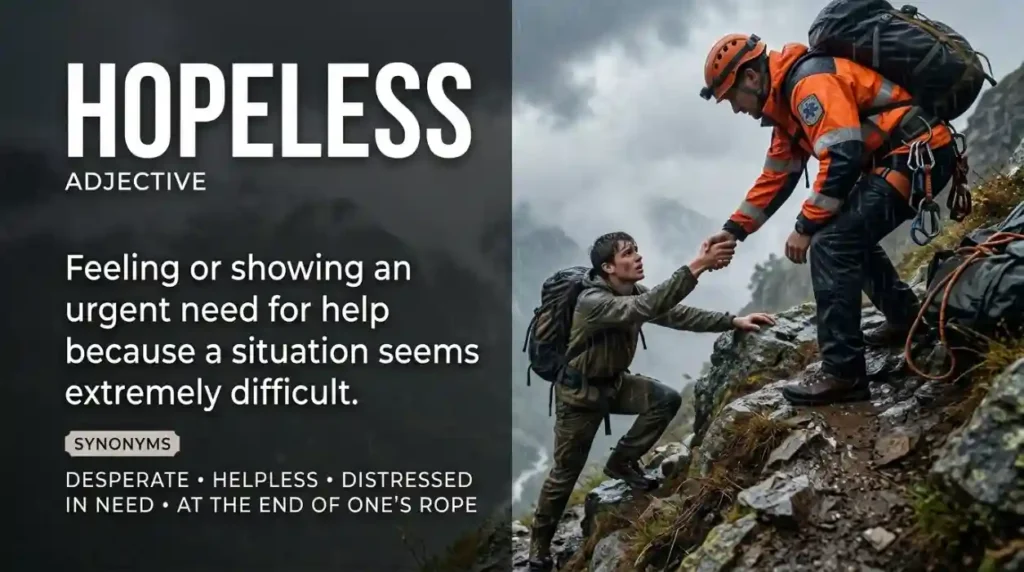
1. Desperate (Adjective) — US /ˈdes.pɚ.ət/ | UK /ˈdes.pər.ət/
Meaning: Feeling or showing an urgent need for help because a situation seems extremely difficult.
Tone/Register: Strong, emotional, negative.
Examples:
She felt desperate after receiving another rejection.
The family made a desperate attempt to save their home.
2. Helpless (Adjective) — US /ˈhelp.ləs/ | UK /ˈhelp.ləs/
Meaning: Unable to control a situation or do anything effective to improve it.
Tone/Register: Emotional, neutral to negative.
Examples:
He felt helpless when his car broke down in the storm.
The parents were helpless as they watched the fire spread.
3. Futile (Adjective) — US /ˈfjuː.t̬əl/ | UK /ˈfjuː.taɪl/
Meaning: Unlikely to produce a useful result or achieve the intended purpose.
Tone/Register: Formal, academic.
Examples:
Arguing about the decision now would be futile.
Their efforts to repair the damaged equipment proved futile.
4. Despondent (Adjective) — US /dɪˈspɑːn.dənt/ | UK /dɪˈspɒn.dənt/
Meaning: Feeling very unhappy and discouraged because you have lost hope.
Tone/Register: Formal, emotional.
Examples:
She became despondent after several failed interviews.
The disappointed students looked despondent after the results.
5. Discouraged (Adjective) — US /dɪˈskɝː.ɪdʒd/ | UK /dɪˈskʌr.ɪdʒd/
Meaning: Having less confidence or motivation because of difficulties or failure.
Tone/Register: Neutral, conversational.
Examples:
He felt discouraged when his application was rejected.
Don’t get discouraged by one difficult assignment.
6. Desolate (Adjective) — US /ˈdes.ə.lət/ | UK /ˈdes.əl.ət/
Meaning: Feeling extremely lonely, unhappy, or without comfort.
Tone/Register: Literary, emotional.
Examples:
She felt desolate after moving away from her friends.
The empty house gave him a desolate feeling.
7. Bleak (Adjective) — US /bliːk/ | UK /bliːk/
Meaning: Showing little possibility of improvement or success.
Tone/Register: Neutral, serious.
Examples:
The economic outlook looked bleak after the announcement.
Their chances of reaching the final seemed bleak.
8. Dismal (Adjective) — US /ˈdɪz.məl/ | UK /ˈdɪz.məl/
Meaning: Very poor, disappointing, or unlikely to improve.
Tone/Register: Negative, descriptive.
Examples:
The team had a dismal record that season.
Sales remained dismal throughout the winter.
9. Despairing (Adjective) — US /dɪˈsper.ɪŋ/ | UK /dɪˈspeə.rɪŋ/
Meaning: Showing a complete loss of hope or confidence.
Tone/Register: Emotional, literary.
Examples:
He gave her a despairing look after the bad news.
Her despairing words showed how deeply the setback affected her.
10. Pessimistic (Adjective) — US /ˌpes.əˈmɪs.tɪk/ | UK /ˌpes.ɪˈmɪs.tɪk/
Meaning: Expecting negative results rather than believing things will improve.
Tone/Register: Neutral, conversational.
Examples:
My brother is pessimistic about the job market.
She remained pessimistic about their chances of winning.
11. Doomed (Adjective) — US /duːmd/ | UK /duːmd/
Meaning: Certain or very likely to fail, end badly, or be destroyed.
Tone/Register: Strong, dramatic.
Examples:
The poorly planned project seemed doomed from the beginning.
Without enough support, the campaign was doomed to fail.
12. Unpromising (Adjective) — US /ʌnˈprɑː.mɪ.sɪŋ/ | UK /ʌnˈprɒm.ɪ.sɪŋ/
Meaning: Showing little sign of future success or improvement.
Tone/Register: Neutral, formal.
Examples:
The first results were unpromising.
They decided not to invest in the unpromising project.
13. Impossible (Adjective) — US /ɪmˈpɑː.sə.bəl/ | UK /ɪmˈpɒs.ə.bəl/
Meaning: Not capable of being achieved, completed, or made possible.
Tone/Register: Neutral, direct.
Examples:
Finishing the entire report in five minutes was impossible.
The narrow road made it impossible for the truck to pass.
14. Hopelessly Lost (Adjective Phrase) — US /ˈhoʊp.ləs.li lɔːst/ | UK /ˈhəʊp.ləs.li lɒst/
Meaning: Completely unable to find the correct direction or understand where to go.
Tone/Register: Informal, descriptive.
Examples:
We were hopelessly lost in the unfamiliar city.
He felt hopelessly lost without the map.
15. Powerless (Adjective) — US /ˈpaʊ.ɚ.ləs/ | UK /ˈpaʊə.ləs/
Meaning: Having no control or authority to change a difficult situation.
Tone/Register: Emotional, neutral.
Examples:
She felt powerless to stop the unfair decision.
The residents were powerless against the sudden flooding.
16. Pointless (Adjective) — US /ˈpɔɪnt.ləs/ | UK /ˈpɔɪnt.ləs/
Meaning: Having no useful purpose or chance of producing a worthwhile result.
Tone/Register: Informal, negative.
Examples:
It seemed pointless to continue the argument.
He thought another meeting would be pointless.
17. Unworkable (Adjective) — US /ʌnˈwɝː.kə.bəl/ | UK /ʌnˈwɜː.kə.bəl/
Meaning: Not practical or possible to put into operation successfully.
Tone/Register: Professional, neutral.
Examples:
The manager rejected the unworkable schedule.
Their original plan became unworkable after the budget changed.
18. Unattainable (Adjective) — US /ˌʌn.əˈteɪ.nə.bəl/ | UK /ˌʌn.əˈteɪ.nə.bəl/
Meaning: Impossible or extremely difficult to achieve or obtain.
Tone/Register: Formal, academic.
Examples:
The deadline seemed unattainable with the current team.
She refused to believe that her dream was unattainable.
19. Lost (Adjective) — US /lɔːst/ | UK /lɒst/
Meaning: Feeling confused, uncertain, or unable to see a clear way forward.
Tone/Register: Conversational, emotional.
Examples:
He felt lost after changing schools.
Without clear instructions, the new employee was completely lost.
20. Despairing of (Verb Phrase) — US /dɪˈsper.ɪŋ əv/ | UK /dɪˈspeə.rɪŋ əv/
Meaning: Losing hope that someone or something will succeed or improve.
Tone/Register: Formal, literary.
Examples:
She was despairing of finding a suitable apartment.
The coach was despairing of the team’s chances after another defeat.
21. Dejected (Adjective) — US /dɪˈdʒek.tɪd/ | UK /dɪˈdʒek.tɪd/
Meaning: Unhappy and disappointed because something has gone wrong.
Tone/Register: Emotional, descriptive.
Examples:
He looked dejected after missing the final shot.
The players walked off the field with dejected expressions.
22. Downhearted (Adjective) — US /ˌdaʊnˈhɑːr.t̬ɪd/ | UK /ˌdaʊnˈhɑː.tɪd/
Meaning: Feeling sad and discouraged because of an unpleasant experience.
Tone/Register: Gentle, conversational.
Examples:
She felt downhearted after receiving the rejection letter.
The children were downhearted when the picnic was canceled.
23. Desperate-Looking (Adjective Phrase) — US /ˈdes.pɚ.ət ˈlʊk.ɪŋ/ | UK /ˈdes.pər.ət ˈlʊk.ɪŋ/
Meaning: Appearing extremely worried or in urgent need of help.
Tone/Register: Informal, descriptive.
Examples:
The desperate-looking traveler asked for directions.
A desperate-looking expression crossed his face.
24. Fruitless (Adjective) — US /ˈfruːt.ləs/ | UK /ˈfruːt.ləs/
Meaning: Producing no useful result despite effort or time.
Tone/Register: Formal, neutral.
Examples:
Their search for the missing document was fruitless.
We made several fruitless attempts to contact the office.
25. Unlikely (Adjective) — US /ʌnˈlaɪ.kli/ | UK /ʌnˈlaɪ.kli/
Meaning: Not expected or not likely to happen.
Tone/Register: Neutral, everyday.
Examples:
It is unlikely that the train will arrive on time.
A quick recovery seemed unlikely after the injury.
26. Hopelessly Inadequate (Adjective Phrase) — US /ˈhoʊp.ləs.li ɪnˈæd.ə.kwət/ | UK /ˈhəʊp.ləs.li ɪnˈæd.ɪ.kwət/
Meaning: So insufficient that it cannot meet the needs of a particular situation.
Tone/Register: Formal, critical.
Examples:
The available equipment was hopelessly inadequate for the task.
Their preparation was hopelessly inadequate for the final exam.
27. Unsuccessful (Adjective) — US /ˌʌn.səkˈses.fəl/ | UK /ˌʌn.səkˈses.fəl/
Meaning: Not achieving the intended result or goal.
Tone/Register: Neutral, professional.
Examples:
Their first attempt to repair the machine was unsuccessful.
The company made an unsuccessful effort to enter the market.
28. Ineffectual (Adjective) — US /ˌɪn.ɪˈfek.tʃu.əl/ | UK /ˌɪn.ɪˈfek.tʃu.əl/
Meaning: Not producing the desired effect or making a meaningful difference.
Tone/Register: Formal, critical.
Examples:
The warnings proved ineffectual against the repeated delays.
His ineffectual response failed to solve the problem.
29. Impractical (Adjective) — US /ɪmˈpræk.tɪ.kəl/ | UK /ɪmˈpræk.tɪ.kəl/
Meaning: Not sensible or realistic to carry out in a particular situation.
Tone/Register: Neutral, professional.
Examples:
Traveling across the country in one hour was impractical.
The team abandoned the impractical proposal.
30. Beyond Repair (Adjective Phrase) — US /bɪˈjɑːnd rɪˈper/ | UK /bɪˈjɒnd rɪˈpeə/
Meaning: So damaged that it cannot be fixed or restored.
Tone/Register: Neutral, descriptive.
Examples:
The old laptop was beyond repair after the accident.
Their damaged relationship seemed beyond repair.
31. Unsalvageable (Adjective) — US /ʌnˈsæl.vɪ.dʒə.bəl/ | UK /ʌnˈsæl.vɪ.dʒə.bəl/
Meaning: Too damaged or unsuccessful to be saved or recovered.
Tone/Register: Formal, technical.
Examples:
The fire left the building unsalvageable.
The team considered the damaged files unsalvageable.
32. Incurable (Adjective) — US /ɪnˈkjʊr.ə.bəl/ | UK /ɪnˈkjʊə.rə.bəl/
Meaning: Unable to be cured or eliminated, especially when referring to a disease.
Tone/Register: Medical, serious.
Examples:
The doctor explained that the condition was incurable.
Researchers continue to study ways to manage incurable diseases.
33. Irredeemable (Adjective) — US /ˌɪr.ɪˈdiː.mə.bəl/ | UK /ˌɪr.ɪˈdiː.mə.bəl/
Meaning: Impossible to improve, correct, or make acceptable again.
Tone/Register: Formal, strongly negative.
Examples:
He believed his mistake had made him irredeemable.
The critic described the film’s final act as irredeemable.
34. Insoluble (Adjective) — US /ɪnˈsɑː.lə.bəl/ | UK /ɪnˈsɒl.jə.bəl/
Meaning: Impossible or extremely difficult to solve.
Tone/Register: Academic, formal.
Examples:
The students faced an insoluble mathematical problem.
The disagreement appeared insoluble without outside help.
35. Intractable (Adjective) — US /ɪnˈtræk.tə.bəl/ | UK /ɪnˈtræk.tə.bəl/
Meaning: Extremely difficult to manage, control, or solve.
Tone/Register: Formal, academic.
Examples:
The committee struggled with an intractable problem.
The conflict became increasingly intractable over time.
36. Dire (Adjective) — US /daɪr/ | UK /daɪə/
Meaning: Extremely serious, dangerous, or likely to have very bad results.
Tone/Register: Serious, dramatic.
Examples:
The hospital faced a dire shortage of supplies.
The report warned of dire consequences if action was delayed.
37. Grim (Adjective) — US /ɡrɪm/ | UK /ɡrɪm/
Meaning: Very serious or worrying, with little reason to expect a good outcome.
Tone/Register: Serious, descriptive.
Examples:
The latest report presented a grim picture of the economy.
Their chances of recovery looked grim after the accident.
38. Adverse (Adjective) — US /ædˈvɝːs/ | UK /ˈæd.vɜːs/
Meaning: Unfavorable or harmful to a desired outcome.
Tone/Register: Formal, professional.
Examples:
Adverse weather conditions delayed the outdoor event.
The company faced adverse market conditions.
39. Precarious (Adjective) — US /prɪˈker.i.əs/ | UK /prɪˈkeə.ri.əs/
Meaning: Uncertain or unstable, with a strong possibility of failure or danger.
Tone/Register: Formal, descriptive.
Examples:
Their financial situation became precarious after the job losses.
The climber stood in a precarious position.
40. Hopeless Case (Noun Phrase) — US /ˈhoʊp.ləs keɪs/ | UK /ˈhəʊp.ləs keɪs/
Meaning: A person or situation believed to have little or no chance of improvement.
Tone/Register: Informal, often negative.
Examples:
He jokingly called himself a hopeless case in the kitchen.
The broken device looked like a hopeless case.
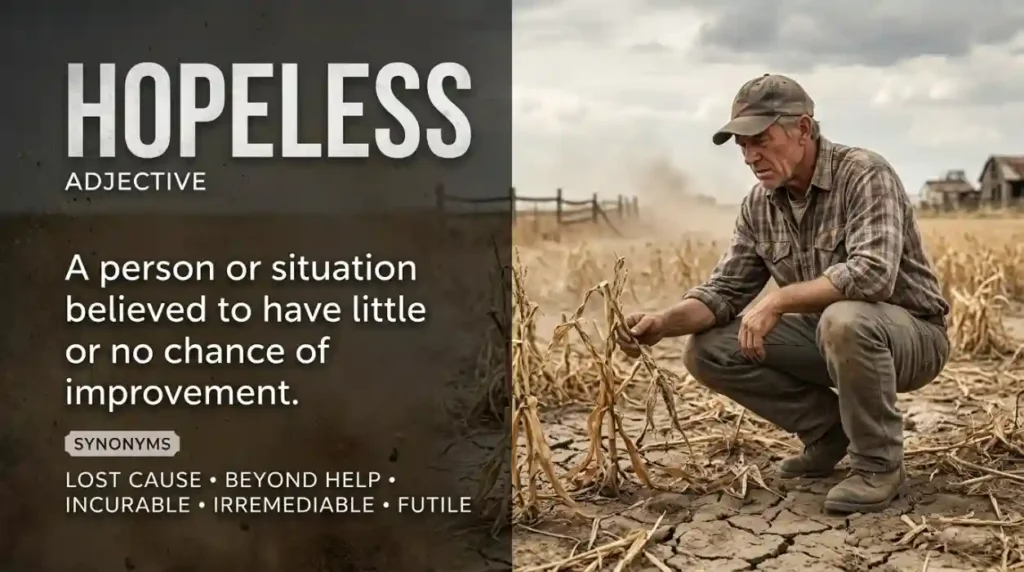
41. Lost Cause (Noun Phrase) — US /ˌlɔːst ˈkɔːz/ | UK /ˌlɒst ˈkɔːz/
Meaning: A person, effort, or situation that seems impossible to save or make successful.
Tone/Register: Informal, negative.
Examples:
They feared the old project had become a lost cause.
Don’t assume your language-learning goal is a lost cause.
42. Beyond Hope (Adjective Phrase) — US /bɪˈjɑːnd hoʊp/ | UK /bɪˈjɒnd həʊp/
Meaning: So difficult or damaged that improvement seems impossible.
Tone/Register: Dramatic, literary.
Examples:
The abandoned building appeared beyond hope.
He feared their friendship was beyond hope.
43. Unrecoverable (Adjective) — US /ˌʌn.rɪˈkʌv.ɚ.ə.bəl/ | UK /ˌʌn.rɪˈkʌv.ər.ə.bəl/
Meaning: Impossible to restore, regain, or bring back to its previous condition.
Tone/Register: Technical, formal.
Examples:
The deleted information was unrecoverable.
The damaged files became unrecoverable after the system failure.
44. Unfixable (Adjective) — US /ʌnˈfɪk.sə.bəl/ | UK /ʌnˈfɪk.sə.bəl/
Meaning: Impossible or too difficult to repair or correct.
Tone/Register: Informal, neutral.
Examples:
The mechanic said the engine problem was unfixable.
They discovered an unfixable error in the old design.
45. Unsalvaged (Adjective) — US /ʌnˈsæl.vɪdʒd/ | UK /ʌnˈsæl.vɪdʒd/
Meaning: Not recovered or saved from damage, loss, or destruction.
Tone/Register: Technical, descriptive.
Examples:
The unsalvaged equipment was removed from the site.
Several damaged items remained unsalvaged after the flood.
46. Unredeemable (Adjective) — US /ˌʌn.rɪˈdiː.mə.bəl/ | UK /ˌʌn.rɪˈdiː.mə.bəl/
Meaning: Not capable of being improved, corrected, or made worthwhile.
Tone/Register: Formal, negative.
Examples:
The reviewer considered the proposal unredeemable.
She refused to believe that one mistake made her unredeemable.
47. Hopelessly Complicated (Adjective Phrase) — US /ˈhoʊp.ləs.li ˈkɑːm.plə.keɪ.tɪd/ | UK /ˈhəʊp.ləs.li ˈkɒm.plɪ.keɪ.tɪd/
Meaning: So complicated that finding a solution seems extremely difficult.
Tone/Register: Informal, descriptive.
Examples:
The instructions became hopelessly complicated after the update.
Their travel arrangements were hopelessly complicated.
48. Infeasible (Adjective) — US /ɪnˈfiː.zə.bəl/ | UK /ɪnˈfiː.zə.bəl/
Meaning: Not possible or practical to achieve under the available conditions.
Tone/Register: Formal, business, academic.
Examples:
The original construction plan was financially infeasible.
The researchers considered the proposed schedule infeasible.
49. Unviable (Adjective) — US /ʌnˈvaɪ.ə.bəl/ | UK /ʌnˈvaɪ.ə.bəl/
Meaning: Not capable of working successfully or continuing in a practical way.
Tone/Register: Formal, business.
Examples:
The company closed its unviable branch.
The proposal became unviable after the funding was withdrawn.
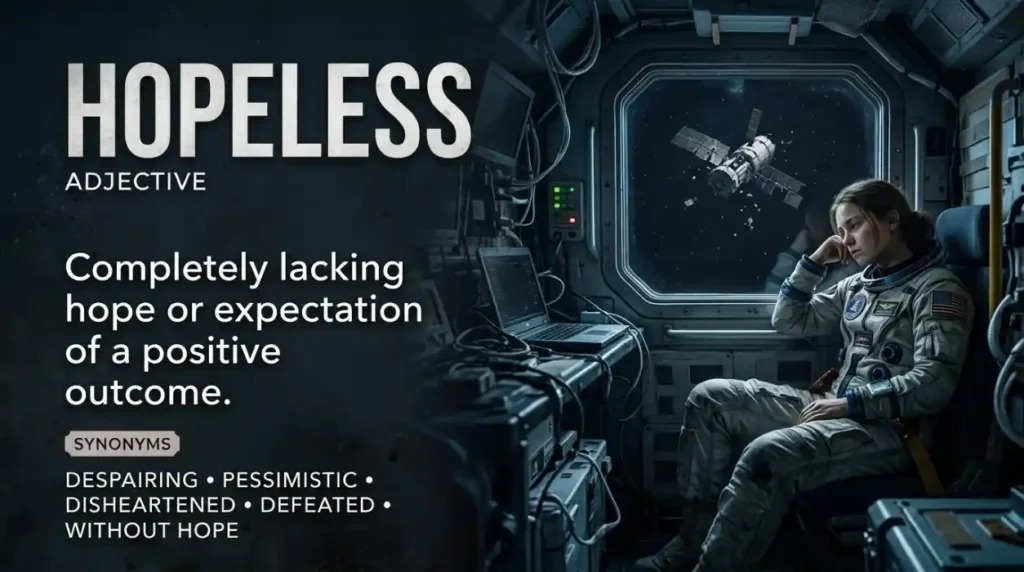
50. Devoid of Hope (Adjective Phrase) — US /dɪˈvɔɪd əv hoʊp/ | UK /dɪˈvɔɪd əv həʊp/
Meaning: Completely lacking hope or expectation of a positive outcome.
Tone/Register: Formal, literary.
Examples:
The final chapter describes a community seemingly devoid of hope.
He felt devoid of hope after the repeated setbacks.
Synonyms by Tone
Choosing a synonym based on tone helps you express the right level of emotion. A word used in a personal conversation may sound too dramatic in a professional report.
Positive or Less Negative Alternatives
These words do not directly mean hopeless, but they can describe difficult situations without suggesting that improvement is impossible.
- Challenging
- Uncertain
- Difficult
- Recoverable
- Complicated
Use them when you want to acknowledge a problem while leaving room for improvement.
Neutral Alternatives
- Unlikely
- Impractical
- Unworkable
- Unpromising
- Unsuccessful
- Infeasible
- Unviable
These words are useful in academic writing, business reports, and objective explanations.
Negative Alternatives
- Desperate
- Helpless
- Futile
- Despondent
- Bleak
- Dismal
- Doomed
- Fruitless
- Powerless
- Lost cause
- Beyond hope
These choices communicate disappointment, a lack of control, or little chance of success.
Informal Alternatives
- Downhearted
- Lost
- Pointless
- Unfixable
- Hopeless case
These expressions work well in everyday conversation, but some may sound too casual for formal writing.
Hopeless vs. Close Alternatives
| Word | Meaning difference | Best use |
|---|---|---|
| Hopeless | Suggests there is little or no chance of improvement or success. | General situations and emotional states. |
| Helpless | Emphasizes having no power or ability to change something. | Situations beyond someone’s control. |
| Futile | Describes an action that is unlikely to produce a useful result. | Efforts, arguments, and attempts. |
| Desperate | Emphasizes urgent need, fear, or distress. | Emotional situations requiring immediate help. |
Hopeless vs. Helpless
A hopeless situation seems unlikely to improve. A helpless person feels unable to change what is happening. Someone can feel helpless without believing that the situation is hopeless.
Hopeless vs. Futile
Hopeless describes a situation or feeling. Futile usually describes an action or effort that will not achieve its purpose.
Hopeless vs. Desperate
Hopeless emphasizes a loss of hope. Desperate emphasizes urgency and a strong need for help or change.
How Hopeless Changes by Context
Daily Conversation
In everyday speech, people often use discouraged, downhearted, lost, or helpless to explain how they feel.
For example, “I feel discouraged because I haven’t found a job yet” sounds more specific and natural than simply saying, “Everything is hopeless.”
Writing and Blogging
Writers can use bleak, despondent, futile, or unpromising to create a clearer description.
For example, “The future looked bleak after the company announced major layoffs” gives readers a stronger picture of the situation.
Professional and Academic English
In reports, research, and workplace discussions, infeasible, unworkable, impractical, and ineffectual are useful choices.
For example, “The proposed schedule was infeasible because the team lacked sufficient time.”
Creative and Informal English
In fiction and storytelling, desolate, despairing, doomed, and a lost cause can create emotional impact.
For example, “The character believed the mission was doomed, yet continued fighting.”
Common Mistakes Learners Make
Using Hopeless and Helpless Interchangeably
These words are related, but they are not identical.
- Hopeless: There seems to be no chance of success.
- Helpless: There is no ability or power to change the situation.
Example: “She felt helpless while waiting for the rescue team.” This does not necessarily mean rescue was hopeless.
Using Futile to Describe Every Person
Futile usually describes an action, effort, or attempt rather than a person’s emotional condition.
Natural: “Their efforts were futile.”
Unnatural: “He was futile after the rejection.”
Better: “He felt discouraged after the rejection.”
Confusing Desperate With Hopeless
A desperate person urgently wants help or change. A hopeless person believes that improvement is unlikely.
Example: “She made a desperate attempt to find her missing passport.”
Using Strong Words Too Early
Words such as doomed, irredeemable, and beyond hope are powerful. They may exaggerate a situation when a milder word such as uncertain or discouraged is more accurate.
Register Notes
Formal: Futile, despondent, infeasible, intractable, unattainable, ineffectual.
Informal: Downhearted, lost, pointless, unfixable, lost cause.
Academic or professional: Unviable, impractical, insoluble, unsuccessful, unworkable.
Spoken English: Discouraged, helpless, desperate, unlikely, and bleak.
For additional vocabulary practice, explore related articles about synonyms for discouraged and helpless to understand how these emotional expressions differ.
Real-Life Mini Scenarios Using Hopeless
Workplace
An employee applies for several positions but receives no offers. They may feel discouraged or despondent. If the proposed project cannot work within the available budget, the plan may be infeasible.
Social Situations
A person tries to repair a friendship after a serious disagreement. They may feel helpless if the other person refuses to communicate.
Media and Pop Culture
A film may show a community facing a bleak future after a natural disaster. The story can use desperate to describe people searching for help.
Writing and Storytelling
A novelist may describe a character who believes that a difficult mission is a lost cause. This expression creates tension while showing the character’s lack of confidence.
Practice Exercise
Choose the most suitable word for each situation. Each question tests meaning, tone, or context.
1. Someone feels unable to change a difficult situation. Which word fits best?
A. Futile
B. Helpless
C. Unpromising
D. Dismal
2. A person expects very little chance of success. Which word describes this attitude?
A. Pessimistic
B. Sturdy
C. Fortified
D. Practical
3. An attempt produces no useful result. Which word is most suitable?
A. Desolate
B. Futile
C. Desperate
D. Powerless
4. A project cannot work within the available budget. Which word fits best?
A. Downhearted
B. Infeasible
C. Dejected
D. Despairing
5. Someone feels deeply discouraged after repeated failures. Which word is appropriate?
A. Despondent
B. Unworkable
C. Insoluble
D. Unviable
6. A person urgently needs help and is willing to try anything. Which word fits?
A. Unlikely
B. Desperate
C. Fruitless
D. Impractical
7. A situation looks serious and offers little hope of improvement. Which word is best?
A. Grim
B. Unfixable
C. Helpless
D. Pointless
8. A person feels sad and disappointed after losing a competition. Which word is suitable?
A. Intractable
B. Dejected
C. Incurable
D. Infeasible
9. An action is unlikely to achieve its intended purpose. Which word describes it?
A. Futile
B. Desolate
C. Pessimistic
D. Powerless
10. A plan is not practical to carry out. Which word fits?
A. Despondent
B. Impractical
C. Doomed
D. Downhearted
Answer Key:
1-B | 2-A | 3-B | 4-B | 5-A | 6-B | 7-A | 8-B | 9-A | 10-B
Reflection Task:
Write two original sentences using hopeless and two of its synonyms. Use one sentence about a personal feeling and another about a difficult plan or situation.
FAQs
1. What is a synonym for hopeless but not too negative?
Words such as uncertain, discouraged, challenging, and unpromising can communicate difficulty without sounding extremely negative. For example, “The outcome is uncertain” leaves room for improvement. These alternatives are useful when discussing setbacks professionally or encouraging someone who is facing a difficult situation.
2. What is a stronger word than hopeless?
Words such as desperate, doomed, irredeemable, and beyond hope can sound stronger than hopeless. However, they have different meanings. Doomed suggests an unavoidable failure, while desperate describes an urgent need or extreme distress. Choose the word that accurately reflects the situation.
3. What is a synonym for hopeless in a relationship?
Depending on the situation, beyond repair, lost cause, irreparable, and desolate may be appropriate. For example, a relationship may seem beyond repair when both people have stopped communicating. However, these expressions should not be used to make assumptions about another person’s feelings or future.
4. What is the difference between hopeless and pessimistic?
Hopeless describes a lack of hope or a belief that improvement is unlikely. Pessimistic describes a general tendency to expect negative outcomes. Someone may feel hopeless about one difficult situation without being pessimistic about life in general.
5. What does hopeless mean when someone says they are hopeless at something?
In informal English, saying “I’m hopeless at cooking” means you are very bad at cooking or lack the skill to do it well. It does not necessarily mean you feel emotionally hopeless. This expression is often used humorously or as a form of self-criticism.
6. What is a professional way to say a plan is hopeless?
In professional communication, use infeasible, unworkable, impractical, or unviable. For example, “The proposed timeline is infeasible with the current resources” sounds more objective than “The plan is hopeless.” These words explain the practical problem without adding unnecessary emotion.
7. What is the difference between hopeless and futile?
Hopeless describes a situation, person, or feeling that lacks hope. Futile usually describes an action or effort that cannot produce the desired result. For example, a person may feel hopeless, while an attempt to change an unchangeable decision may be futile.
Conclusion
Learning a synonym for hopeless helps you describe discouragement, uncertainty, and difficult situations with greater precision. The right word makes your message clearer.
Alternatives such as helpless, futile, and despondent express different emotions. Words like infeasible and unworkable describe plans with little chance of success.
A wider vocabulary improves essays, blogs, professional writing, and everyday communication. It also helps you express emotions without repeating the same words.
Practice these alternatives in emails, essays, and daily conversations. Choose one new synonym today and create your own sentence to remember its meaning.
Suggested External Sources
For accurate definitions, pronunciation, synonyms, and word usage, explore these trusted dictionaries and language resources. They provide helpful information for understanding English vocabulary and using words correctly in different contexts.
- Merriam-Webster Dictionary: Explore detailed word definitions, synonyms, pronunciation guides, and example sentences. It helps readers understand different meanings and choose suitable alternatives.
- Cambridge Dictionary: Find easy-to-understand definitions, British and American pronunciations, grammar guidance, and practical examples. It is especially useful for English learners.
- Oxford Learner’s Dictionaries: Learn word meanings, parts of speech, pronunciation, and common usage patterns through clear explanations and real-life examples.
- Online Etymology Dictionary: Discover the origins and historical development of English words. It explains how words have evolved and how their meanings have changed over time.

Jameel Hassan is the founder and lead writer at SynonymsCloud.com, a trusted online platform dedicated to English vocabulary and effective communication. He is passionate about helping students, writers, professionals, and lifelong learners discover the right words to express their ideas with clarity, precision, and confidence.
At SynonymsCloud.com, every article is thoroughly researched and carefully written to provide accurate, practical, and easy-to-understand guidance on synonyms, antonyms, word meanings, idioms, and vocabulary. With a strong commitment to quality, real-world usage, and clear explanations, the website helps readers expand their vocabulary, improve their writing, and communicate more effectively in both academic and professional settings.