
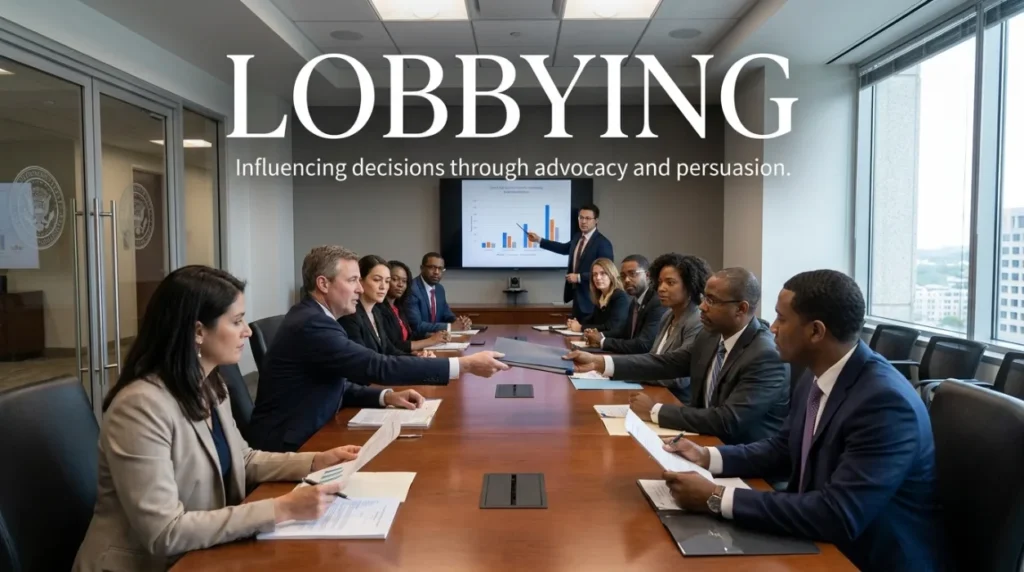
Synonyms for lobbying vary by context: use advocacy, campaigning, or petitioning for public causes; governmental relations, policy outreach, or legislative persuasion for official settings; grassroots mobilization for community movements; and pressure tactics, special-interest influence, or behind-the-scenes leverage for critical or political discussions.
A synonym for lobbying helps you describe political influence, advocacy, and persuasion more precisely. For example, residents may campaign for a new green park by asking city leaders to support their community.
Learning the right synonym for lobbying can strengthen your vocabulary and make your writing more engaging. Instead of repeating the same word, you can choose alternatives that match the exact meaning and tone of your message.
The word “lobbying” commonly appears in government news, corporate communication, environmental debates, and political discussions. It can describe organized advocacy as well as efforts to influence decisions.
Understanding these alternatives helps students, bloggers, journalists, and everyday speakers communicate ideas clearly while expressing different forms of influence and persuasion.
What Does “Lobbying” Really Mean?
“Lobbying” refers to the act of attempting to influence actions, policies, or decisions made by government officials, legislators, or regulatory agencies.
Native English speakers use it to describe organized efforts by groups, corporations, or individuals to shape public policy. It can happen in official legislative halls or through grassroots public campaigns.
Part of Speech: Noun (Gerund / Verbal Noun)
Definition: The practice of trying to persuade politicians or officials to support specific laws, causes, or policy decisions.
Connotative Meaning
(Connotation is the emotional tone, cultural association, or implied feeling a word carries beyond its literal dictionary definition.)
- Positive tone: Positive when associated with grassroots activism, civil rights defense, environmental protection, or public welfare advocacy.
- Negative tone: Often carries negative associations when linked to backroom deals, special interest money, corporate pressure, or political corruption.
- Neutral tone: Objective when used in political science, legislative tracking, legal reporting, or policy analysis.
Etymology
The term originated from the physical lobbies or hallways of legislative buildings where people met lawmakers.
- Old English (450–1100): Derived indirectly from Medieval Latin laubia (covered walkway or porch).
- Middle English (1100–1500): Adapted as lobbe or lobby, referring to a large entrance hall or corridor.
- Modern English (1500–Present): By the mid-1800s, “lobbying” specifically described gathering in legislative corridors to influence voting representatives.
Pronunciation
- US: /ˈlɑː.bi.ɪŋ/
- UK: /ˈlɒb.i.ɪŋ/
Syllables
lob-by-ing
Affixation Pattern
- Root: Lobby (verb meaning to seek influence)
- Prefix: None
- Suffix: -ing (forms the gerund or present participle noun)
Synonyms List
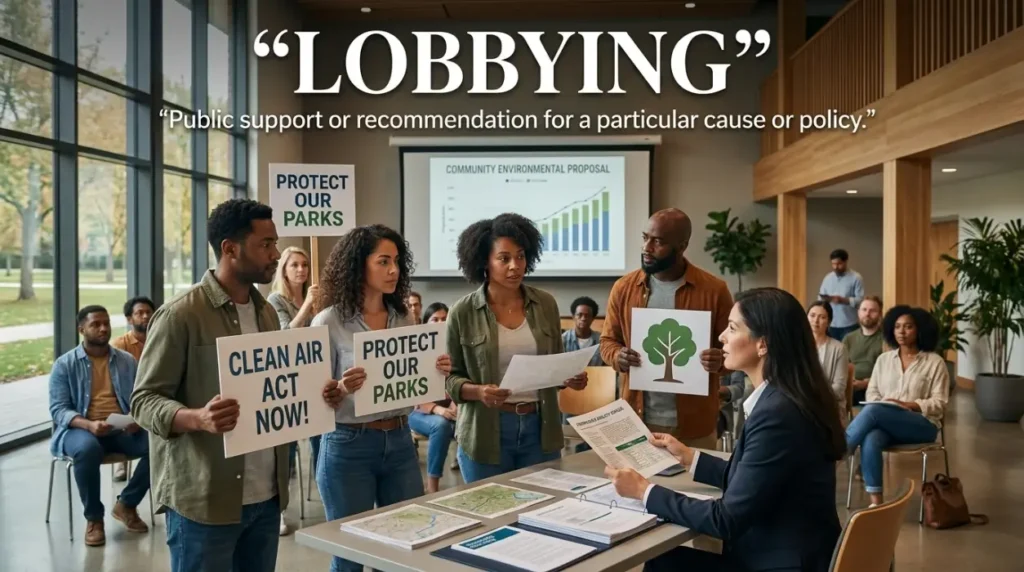
Advocacy (Noun) — US: /ˈæd.və.kə.si/ | UK: /ˈæd.və.kə.si/
Meaning: Public support for or recommendation of a particular cause or policy.
Tone/Register: Formal / Positive
Example 1: Patient advocacy groups pushed hard for lower prescription medicine costs.
Example 2: Environmental advocacy plays a key role in passing clean energy laws.
Persuasion (Noun) — US: /pɚˈsweɪ.ʒən/ | UK: /pəˈsweɪ.ʒən/
Meaning: The act of convincing someone to do or believe something through reasoning or argument.
Tone/Register: General / Neutral
Example 1: Gentle persuasion convinced the board to reconsider the budget cuts.
Example 2: Political persuasion requires clear evidence and strong communication skills.
Campaigning (Noun) — US: /kæmˈpeɪ.nɪŋ/ | UK: /kæmˈpeɪ.nɪŋ/
Meaning: Organized work toward a specific political, social, or commercial goal.
Tone/Register: General / Public
Example 1: Active campaigning helped raise public awareness about local school funding.
Example 2: Years of campaigning led directly to new workplace safety standards.
Pressuring (Noun) — US: /ˈpreʃ.ɚ.ɪŋ/ | UK: /ˈpreʃ.ər.ɪŋ/
Meaning: The act of exerting strong influence or force on someone to yield to demands.
Tone/Register: Informal / Negative
Example 1: Constant pressuring from voters forced the council to hold a public hearing.
Example 2: Media pressure compelled the official to release the full finance report.
Petitioning (Noun) — US: /pəˈtɪʃ.ən.ɪŋ/ | UK: /pəˈtɪʃ.ən.ɪŋ/
Meaning: Making a formal written request to an authority signed by many citizens.
Tone/Register: Civic / Formal
Example 1: Neighborhood petitioning secured a new crosswalk near the primary school.
Example 2: Public petitioning remains a fundamental right in democratic societies.
Soliciting (Noun) — US: /səˈlɪs.ə.t̬ɪŋ/ | UK: /səˈlɪs.ɪ.tɪŋ/
Meaning: Asking for or trying to obtain support, votes, or financial contributions.
Tone/Register: Formal / Business
Example 1: The campaign manager spent weeks soliciting endorsements from local union leaders.
Example 2: Strict laws regulate soliciting donations near government offices.
Promoting (Noun) — US: /prəˈmoʊ.t̬ɪŋ/ | UK: /prəˈməʊ.tɪŋ/
Meaning: Supporting or encouraging the progress, growth, or acceptance of something.
Tone/Register: Positive / Business
Example 1: Promoting public health initiatives requires clear messaging from community leaders.
Example 2: The association focuses on promoting fair trade policies across the region.
Exerting influence (Noun Phrase) — US: /ɪɡˈzɝː.t̬ɪŋ ˈɪn.flu.əns/ | UK: /ɪɡˈzɜː.tɪŋ ˈɪn.flu.əns/
Meaning: Using authority, power, or persuasion to affect outcomes or decisions.
Tone/Register: Academic / Analytical
Example 1: Exerting influence behind closed doors often draws public criticism.
Example 2: Tech firms are exerting influence on international digital privacy laws.
Championing (Noun) — US: /ˈtʃæm.pi.ən.ɪŋ/ | UK: /ˈtʃæm.pi.ən.ɪŋ/
Meaning: Vigorously supporting or defending a cause, project, or policy.
Tone/Register: Inspiring / Formal
Example 1: Her championing of women’s rights earned national recognition and respect.
Example 2: The senator’s championing of rural broadband expanded internet access.
Promoting a cause (Noun Phrase) — US: /prəˈmoʊ.t̬ɪŋ ə kɑːz/ | UK: /prəˈməʊ.tɪŋ ə kɔːz/
Meaning: Working actively to build support for a social, political, or moral principle.
Tone/Register: Positive / Civic
Example 1: Dedicated volunteers spend their weekends promoting a cause they believe in.
Example 2: Promoting a cause effectively requires both passion and strategic planning.
Canvassing (Noun) — US: /ˈkæn.vəs.ɪŋ/ | UK: /ˈkæn.vəs.ɪŋ/
Meaning: Systematically contacting people in an area to seek votes or gather support.
Tone/Register: Political / Practical
Example 1: Door-to-door canvassing helped the candidate connect directly with voters.
Example 2: Weekend canvassing yields higher response rates in suburban neighborhoods.
Pushing (Noun) — US: /ˈpʊʃ.ɪŋ/ | UK: /ˈpʊʃ.ɪŋ/
Meaning: Persistently urging or promoting a particular plan, idea, or policy.
Tone/Register: Informal / Conversational
Example 1: Their continuous pushing for lower taxes gained strong backing from small business owners.
Example 2: The editor’s pushing for honest reporting improved the newspaper’s reputation.
Urging (Noun) — US: /ˈɝː.dʒɪŋ/ | UK: /ˈɜː.dʒɪŋ/
Meaning: Persistently encouraging or recommending a specific course of action.
Tone/Register: Direct / Persuasive
Example 1: Despite repeated urging from advisers, the mayor refused to delay the vote.
Example 2: Public urging led the committee to review safety measures at the harbor.
Special interest influence (Noun Phrase) — US: /ˈspeʃ.əl ˈɪn.trɪst ˈɪn.flu.əns/ | UK: /ˈspeʃ.əl ˈɪn.trəst ˈɪn.flu.əns/
Meaning: Pressure exerted by organized groups seeking advantages for their specific sector.
Tone/Register: Critical / Political Science
Example 1: Critics argue that special interest influence distorts democratic decision-making.
Example 2: New transparency laws aim to curb special interest influence in Congress.
Pressure tactics (Noun Phrase) — US: /ˈpreʃ.ɚ ˈtæk.tɪks/ | UK: /ˈpreʃ.ər ˈtæk.tɪks/
Meaning: Strategic methods used to force someone into taking a desired action.
Tone/Register: Negative / Strategic
Example 1: Activists used subtle pressure tactics to make corporate leaders adopt green policies.
Example 2: High-handed pressure tactics often backfire and alienate undecided voters.
Backroom influence (Noun Phrase) — US: /ˈbæk.ruːm ˈɪn.flu.əns/ | UK: /ˈbæk.ruːm ˈɪn.flu.əns/
Meaning: Unofficial, non-public persuasion conducted out of sight of the public eye.
Tone/Register: Highly Critical / Informal
Example 1: Voters grew tired of backroom influence dictating major city infrastructure deals.
Example 2: Investigations exposed backroom influence surrounding the zoning law changes.
Grassroots mobilization (Noun Phrase) — US: /ˈɡræs.ruːts ˌmoʊ.bəl.əˈzeɪ.ʃən/ | UK: /ˈɡrɑːs.ruːts ˌməʊ.bəl.aɪˈzeɪ.ʃən/
Meaning: Organizing ordinary citizens to drive political change from the community level.
Tone/Register: Formal / Positive
Example 1: Successful grassroots mobilization forced state leaders to preserve the local forest.
Example 2: Digital tools have made grassroots mobilization faster and more widespread.
Political pressure (Noun Phrase) — US: /pəˈlɪt̬.ə.kəl ˈpreʃ.ɚ/ | UK: /pəˈlɪt.ɪ.kəl ˈpreʃ.ər/
Meaning: Exertion of force or influence on leaders to achieve political objectives.
Tone/Register: News / Analytical
Example 1: Mounting political pressure compelled the governor to resign ahead of schedule.
Example 2: International political pressure helped secure the release of trade delegates.
Arm-twisting (Noun) — US: /ˈɑːrm.twɪs.tɪŋ/ | UK: /ˈɑːm.twɪs.tɪŋ/
Meaning: The use of direct pressure or strong persuasion to make someone comply.
Tone/Register: Informal / Idiomatic
Example 1: It took serious political arm-twisting to get the compromise bill passed.
Example 2: Party leaders resorted to arm-twisting to keep voting ranks unified.
Soft persuasion (Noun Phrase) — US: /sɑːft pɚˈsweɪ.ʒən/ | UK: /sɒft pəˈsweɪ.ʒən/
Meaning: Gentle, indirect methods of convincing others without aggressive force.
Tone/Register: Business / Diplomatic
Example 1: She relied on soft persuasion and detailed facts to win over skeptical clients.
Example 2: Soft persuasion often works far better than open confrontation in negotiations.
Policy promotion (Noun Phrase) — US: /ˈpɑː.lə.si prəˈmoʊ.ʃən/ | UK: /ˈpɒl.ə.si prəˈməʊ.ʃən/
Meaning: The active work of publicizing and advocating for specific legislative proposals.
Tone/Register: Professional / Governmental
Example 1: Think tanks spend millions each year on research and policy promotion.
Example 2: Effective policy promotion requires clear public relations strategies.
Interest group activity (Noun Phrase) — US: /ˈɪn.trɪst ɡruːp ækˈtɪv.ə.t̬i/ | UK: /ˈɪn.trəst ɡruːp ækˈtɪv.ə.ti/
Meaning: Actions taken by organized associations to shape public policy outcomes.
Tone/Register: Academic / Policy
Example 1: Political scientists track interest group activity during major election cycles.
Example 2: Increased interest group activity was observed surrounding the healthcare debate.
Governmental relations (Noun Phrase) — US: /ˌɡʌv.ɚnˈmen.t̬əl rɪˈleɪ.ʃənz/ | UK: /ˌɡʌv.ənˈmen.təl rɪˈleɪ.ʃənz/
Meaning: Professional efforts by organizations to communicate and liaise with public officials.
Tone/Register: Corporate / Executive
Example 1: The corporation established a new office dedicated entirely to governmental relations.
Example 2: A career in governmental relations requires a deep understanding of legislation.
Legislative outreach (Noun Phrase) — US: /ˈledʒ.ə.slə.t̬ɪv ˈaʊt.riːtʃ/ | UK: /ˈledʒ.ɪ.slə.tɪv ˈaʊt.riːtʃ/
Meaning: Connecting directly with lawmakers to inform them about key policy positions.
Tone/Register: Formal / Business
Example 1: The charity expanded its legislative outreach to advocate for homeless youth.
Example 2: Strategic legislative outreach ensures that community concerns reach decision-makers.
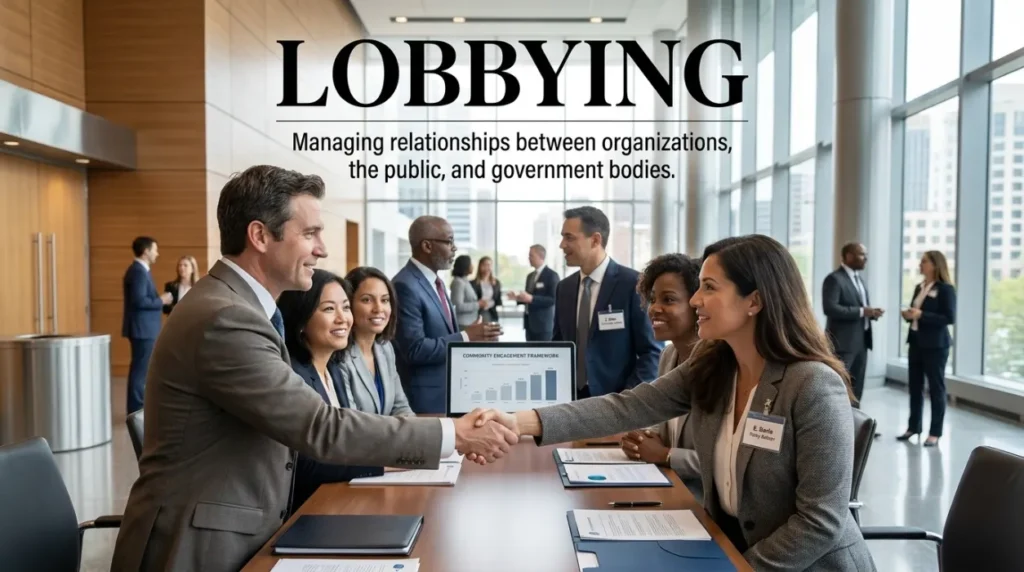
Public affairs work (Noun Phrase) — US: /ˈpʌb.lɪk əˈferz wɝːk/ | UK: /ˈpʌb.lɪk əˈfeəz wɜːk/
Meaning: Managing relationships between organizations, the public, and government bodies.
Tone/Register: Professional / Administrative
Example 1: Public affairs work involves writing press releases and organizing policy forums.
Example 2: He transitioned from journalism into high-level public affairs work.
Wheeling and dealing (Noun Phrase) — US: /ˈhwiː.lɪŋ ænd ˈdiː.lɪŋ/ | UK: /ˈwiː.lɪŋ ænd ˈdiː.lɪŋ/
Meaning: Complex and often crafty political or financial bargaining behind the scenes.
Tone/Register: Playful / Critical
Example 1: The political summit was full of late-night wheeling and dealing between leaders.
Example 2: She succeeded in politics without resorting to shady wheeling and dealing.
Influence peddling (Noun Phrase) — US: /ˈɪn.flu.əns ˈped.lɪŋ/ | UK: /ˈɪn.flu.əns ˈped.lɪŋ/
Meaning: Using personal connections or power in government to gain illegal or unethical favors.
Tone/Register: Highly Critical / Legal
Example 1: The state prosecutor charged the official with systemic influence peddling.
Example 2: Strict ethics guidelines help prevent influence peddling among retired politicians.
Persuasive communication (Noun Phrase) — US: /pɚˈsweɪ.sɪv kəˌmjuː.nəˈkeɪ.ʃən/ | UK: /pəˈsweɪ.sɪv kəˌmjuː.nɪˈkeɪ.ʃən/
Meaning: Clear messaging aimed at changing people’s attitudes, beliefs, or behaviors.
Tone/Register: Educational / Professional
Example 1: Persuasive communication is a vital skill for advocates and political leaders alike.
Example 2: The workshop taught effective methods of persuasive communication for non-profits.
Ear-bending (Noun) — US: /ˈɪr.ben.dɪŋ/ | UK: /ˈɪə.ben.dɪŋ/
Meaning: Talking continuously or persistently to someone in an effort to persuade them.
Tone/Register: Informal / Casual
Example 1: The mayor got a thorough ear-bending from angry taxpayers at the town hall.
Example 2: He gave the senator an ear-bending regarding local environmental regulations.
Wire-pulling (Noun) — US: /ˈwaɪ.ɚ.pʊl.ɪŋ/ | UK: /ˈwaɪ.ə.pʊl.ɪŋ/
Meaning: Using secret influence or background connections to control events or decisions.
Tone/Register: Old-fashioned / Critical
Example 1: Behind-the-scenes wire-pulling determined who received the coveted contract.
Example 2: The news exposed years of political wire-pulling inside the regional planning board.
Community organizing (Noun Phrase) — US: /kəˈmjuː.nə.t̬i ˈoʊr.ɡə.naɪ.zɪŋ/ | UK: /kəˈmjuː.nɪ.ti ˈɔː.ɡən.aɪ.zɪŋ/
Meaning: Mobilizing residents to act collectively for social and political improvement.
Tone/Register: Positive / Civic
Example 1: Community organizing empowered residents to demand cleaner city parks.
Example 2: Her background in community organizing made her an effective campaign leader.
Policy advocacy (Noun Phrase) — US: /ˈpɑː.lə.si ˈæd.və.kə.si/ | UK: /ˈpɒl.ə.si ˈæd.və.kə.si/
Meaning: Intentionally striving to influence institutional policy decisions through research and rhetoric.
Tone/Register: Academic / Professional
Example 1: Effective policy advocacy relies on rigorous scientific research and facts.
Example 2: Think tanks engage in policy advocacy to shape economic strategies.
Cause marketing (Noun Phrase) — US: /kɑːz ˈmɑːr.kɪ.t̬ɪŋ/ | UK: /kɔːz ˈmɑː.kɪ.tɪŋ/
Meaning: Promoting a cause or issue alongside commercial business operations to raise awareness.
Tone/Register: Business / Promotional
Example 1: The brand used cause marketing to highlight marine conservation efforts.
Example 2: Cause marketing helps companies align with consumer social values.
Issue advertising (Noun Phrase) — US: /ˈɪʃ.uː ˈæd.vɚ.taɪ.zɪŋ/ | UK: /ˈɪs.juː ˈæd.və.taɪ.zɪŋ/
Meaning: Paid media messages designed to sway public opinion on social or political topics.
Tone/Register: Media / Political
Example 1: Massive issue advertising flooded television screens right before the election.
Example 2: Regulations require transparency regarding who funds issue advertising campaigns.
Political maneuver (Noun Phrase) — US: /pəˈlɪt̬.ə.kəl məˈnuː.vɚ/ | UK: /pəˈlɪt.ɪ.kəl məˈnuː.vər/
Meaning: A calculated action intended to gain a political advantage over opponents.
Tone/Register: Strategic / Critical
Example 1: The sudden call for a vote was seen as a shrewd political maneuver.
Example 2: Analysts analyzed every political maneuver during the budget deadlock.
Civic engagement (Noun Phrase) — US: /ˈsɪv.ɪk ɪnˈɡeɪdʒ.mənt/ | UK: /ˈsɪv.ɪk ɪnˈɡeɪdʒ.mənt/
Meaning: Individual and collective actions designed to address public concerns in a community.
Tone/Register: Academic / Positive
Example 1: High levels of civic engagement lead to more accountable local governments.
Example 2: Schools foster civic engagement by organizing student mock trials.
Public pressure (Noun Phrase) — US: /ˈpʌb.lɪk ˈpreʃ.ɚ/ | UK: /ˈpʌb.lɪk ˈpreʃ.ər/
Meaning: The collective force of public opinion urging leaders to take specific action.
Tone/Register: General / News
Example 1: Intense public pressure led to the immediate cancellation of the tariff hike.
Example 2: Leaders rarely ignore strong public pressure during election years.
Strategic influence (Noun Phrase) — US: /strəˈtiː.dʒɪk ˈɪn.flu.əns/ | UK: /strəˈtiː.dʒɪk ˈɪn.flu.əns/
Meaning: Purposeful and planned efforts to guide long-term policy or institutional directions.
Tone/Register: Corporate / Executive
Example 1: The coalition exercised strategic influence over trade agreement terms.
Example 2: Building strategic influence takes years of consistent relationship management.
Coalition building (Noun Phrase) — US: /koʊ.əˈlɪʃ.ən ˈbɪl.dɪŋ/ | UK: /kəʊ.əˈlɪʃ.ən ˈbɪl.dɪŋ/
Meaning: Uniting diverse groups or organizations to work together for a common objective.
Tone/Register: Political / Strategic
Example 1: Successful coalition building was vital in securing votes for healthcare reforms.
Example 2: Coalition building brings together environmentalists and business leaders.
Legislative maneuvering (Noun Phrase) — US: /ˈledʒ.ə.slə.t̬ɪv məˈnuː.vɚ.ɪŋ/ | UK: /ˈledʒ.ɪ.slə.tɪv məˈnuː.vər.ɪŋ/
Meaning: Using parliamentary rules and procedural tactics to push or block laws.
Tone/Register: Formal / Technical
Example 1: Clever legislative maneuvering allowed the committee to bypass the filibuster.
Example 2: Observers watched the legislative maneuvering surrounding the tax bill.
Favor currying (Noun Phrase) — US: /ˈfeɪ.vɚ ˈkɝː.i.ɪŋ/ | UK: /ˈfeɪ.vər ˈkʌr.i.ɪŋ/
Meaning: Flattering or pleasing powerful people to secure personal advantages or support.
Tone/Register: Critical / Informal
Example 1: Critics dismissed his speech as plain favor-currying with party elites.
Example 2: Avoid obvious favor-currying if you want genuine professional respect.
Backchannel communication (Noun Phrase) — US: /ˈbæk.tʃæn.əl kəˌmjuː.nəˈkeɪ.ʃən/ | UK: /ˈbæk.tʃæn.əl kəˌmjuː.nɪˈkeɪ.ʃən/
Meaning: Unofficial, secret, or informal dialogue used to negotiate outside official channels.
Tone/Register: Diplomatic / Executive
Example 1: Backchannel communication helped resolve the trade dispute quietly.
Example 2: Diplomatic envoys kept backchannel communication open during the crisis.
Perception management (Noun Phrase) — US: /pɚˈsep.ʃən ˈmæn.ədʒ.mənt/ | UK: /pəˈsep.ʃən ˈmæn.ɪdʒ.mənt/
Meaning: Actions designed to shape how the public or authorities view an issue or organization.
Tone/Register: Corporate / Strategic
Example 1: The firm engaged in perception management following the product recall.
Example 2: Effective perception management rebuilds public trust after a scandal.
Social advocacy (Noun Phrase) — US: /ˈsoʊ.ʃəl ˈæd.və.kə.si/ | UK: /ˈsəʊ.ʃəl ˈæd.və.kə.si/
Meaning: Active effort aimed at promoting justice, equality, and well-being in society.
Tone/Register: Inspiring / Civic
Example 1: Her career was defined by passionate social advocacy for affordable housing.
Example 2: Non-profit groups lead social advocacy initiatives in underserved areas.
Institutional pressure (Noun Phrase) — US: /ˌɪn.stəˈtuː.ʃən.əl ˈpreʃ.ɚ/ | UK: /ˌɪn.stɪˈtjuː.ʃən.əl ˈpreʃ.ər/
Meaning: Force exerted by established organizations or systems to enforce compliance or change.
Tone/Register: Academic / Analytical
Example 1: Institutional pressure forced universities to update their research privacy policies.
Example 2: Banking firms faced institutional pressure to reduce carbon funding.
Corporate lobbying (Noun Phrase) — US: /ˈkɔːr.pɚ.ət ˈlɑː.bi.ɪŋ/ | UK: /ˈkɔː.pər.ət ˈlɒb.i.ɪŋ/
Meaning: Direct efforts by commercial companies to influence public regulations and laws.
Tone/Register: Business / Critical
Example 1: Corporate lobbying heavily influenced the drafting of new energy subsidies.
Example 2: Citizens demanded stricter limits on corporate lobbying during elections.
Citizen lobbying (Noun Phrase) — US: /ˈsɪt̬.ə.zən ˈlɑː.bi.ɪŋ/ | UK: /ˈsɪt.ɪ.zən ˈlɒb.i.ɪŋ/
Meaning: Direct attempts by ordinary voters to convince lawmakers to support key public issues.
Tone/Register: Positive / Civic
Example 1: Citizen lobbying brought immediate attention to clean water access in the county.
Example 2: Workshops teach effective citizen lobbying techniques to local residents.
Persuasive advocacy (Noun Phrase) — US: /pɚˈsweɪ.sɪv ˈæd.və.kə.si/ | UK: /pəˈsweɪ.sɪv ˈæd.və.kə.si/
Meaning: The art of using compelling arguments and facts to champion a specific cause.
Tone/Register: Professional / Formal
Example 1: Persuasive advocacy turned a rejected proposal into a unanimous vote.
Example 2: Lawyers use persuasive advocacy to argue complex cases before the court.
Influence campaign (Noun Phrase) — US: /ˈɪn.flu.əns kæmˈpeɪn/ | UK: /ˈɪn.flu.əns kæmˈpeɪn/
Meaning: An organized, large-scale attempt to shape public opinion or official policy decisions.
Tone/Register: Analytical / Media
Example 1: The foundation launched a nationwide influence campaign for clean oceans.
Example 2: Analysts uncovered a covert digital influence campaign aimed at voters.
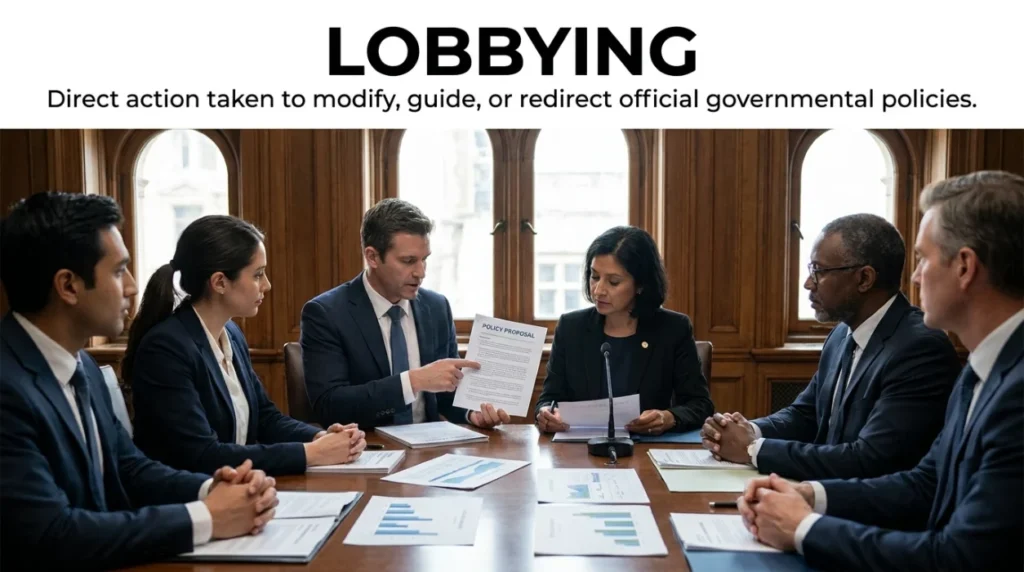
Policy intervention (Noun Phrase) — US: /ˈpɑː.lə.si ˌɪn.t̬ɚˈven.ʃən/ | UK: /ˈpɒl.ə.si ˌɪn.təˈven.ʃən/
Meaning: Direct action taken to modify, guide, or redirect official governmental policies.
Tone/Register: Academic / Policy
Example 1: Timely policy intervention prevented a severe drop in agricultural exports.
Example 2: Economists recommended targeted policy intervention to curb inflation.
Synonyms by Tone
| Tone Category | Synonyms for Lobbying |
| Positive | Advocacy, Championing, Grassroots mobilization, Citizen lobbying, Civic engagement |
| Neutral | Persuasion, Campaigning, Petitioning, Public affairs work, Legislative outreach |
| Negative | Pressure tactics, Backroom influence, Arm-twisting, Influence peddling |
| Informal | Pushing, Ear-bending, Wheeling and dealing, Favor currying |
Choosing the appropriate tone ensures that your writing matches your audience and professional setting accurately.
Positive Tone
- Advocacy
- Championing
- Grassroots mobilization
- Citizen lobbying
- Civic engagement
Neutral Tone
- Persuasion
- Campaigning
- Petitioning
- Public affairs work
- Legislative outreach
Negative Tone
(Note: These terms emphasize manipulation, coercion, secrecy, or unfair political advantages).
- Pressure tactics
- Backroom influence
- Arm-twisting
- Influence peddling
- Wire-pulling
Playful / Informal Tone
- Pushing
- Ear-bending
- Wheeling and dealing
- Favor currying
Mini Comparison: “Lobbying” vs Close Alternatives
| Term | Core Meaning | Tone | Best Context To Use |
| Lobbying | Direct attempts to influence public officials or lawmakers on specific laws. | Neutral / Political | Government news, corporate policy affairs, legislative reports. |
| Advocacy | Public support and active promotion for a broader cause, issue, or group. | Positive / Inspiring | Non-profit work, social justice, public health, community causes. |
| Campaigning | Organized, structured public work aimed at winning an election or goal. | Public / Dynamic | Political elections, marketing drives, public awareness movements. |
Context-Based Usage
Daily Conversation
In casual chats, use relatable terms like pushing, persuasion, or ear-bending.
Example: “After some gentle persuasion, my team agreed to change our meeting schedule.”
Writing or Blogging
Bloggers prefer engaging options like grassroots mobilization, championing, or campaigning.
Example: “Digital tools make grassroots mobilization easier for young social activists.”
Professional or Academic Tone
Formal papers require precise terms like policy advocacy, governmental relations, or legislative outreach.
Example: “The university established a department for governmental relations to secure research grants.”
Creative or Informal Use
Storytellers use evocative phrases like backroom influence, arm-twisting, or wheeling and dealing.
Example: “The novel vividly exposes political wheeling and dealing inside city hall.”
Common Mistakes & Native Usage
Misuse Scenarios
- Confusing “Lobbying” with “Bribery”: Lobbying is a legal, regulated attempt to persuade officials using arguments, facts, or public pressure. Bribery involves illegal payments or kickbacks.
- Overusing “Lobbying” for Everyday Persuasion: Avoid calling everyday personal advice “lobbying.” Use “persuading” or “encouraging” when talking about friends or family.
Register Notes
- Formal Written English: Use phrases like policy advocacy, governmental relations, institutional pressure, and legislative outreach.
- Spoken Informal English: Use casual words like pushing, arm-twisting, ear-bending, and wheeling and dealing.
Real-Life Mini Scenarios
Workplace Scenario
An executive presents data to city council members as part of corporate legislative outreach for green zoning permits.
Social Situations
A neighborhood association organizes a petitioning drive to demand speed bumps near the public park.
Media & Pop Culture
Investigative documentaries highlight how special-interest influence sways national environmental laws.
Writing & Storytelling
A fiction writer describes how a character relied on soft persuasion to unite rival families against a common threat.
Conclusion
Expanding your English vocabulary gives you precise tools to describe political persuasion, social causes, and public debate effortlessly. Choosing an accurate synonym for lobbying sharpens your writing style across every platform.
Understanding distinct tone nuances allows you to tailor your message precisely for academic, corporate, media, or everyday social settings. Mastered vocabulary choices build genuine writing authority and keep readers engaged.
Practice incorporating these dynamic alternatives into your daily emails, essays, articles, and discussions. Consistent application builds long-term confidence and transforms quick learning into lasting language skills.
Practice Exercise
1. Which synonym carries the most positive tone for supporting a social cause?
A) Arm-twisting
B) Advocacy
C) Influence peddling
D) Backroom influence
2. What phrase best fits an official corporate department communicating with lawmakers?
A) Governmental relations
B) Ear-bending
C) Wheeling and dealing
D) Pressure tactics
3. Which choice describes illegal or corrupt political influence?
A) Civic engagement
B) Grassroots mobilization
C) Influence peddling
D) Policy promotion
4. What term describes ordinary citizens uniting locally to demand political action?
A) Corporate lobbying
B) Grassroots mobilization
C) Backroom influence
D) Legislative maneuvering
5. Which informal phrase means using direct force or leverage to compel agreement?
A) Soft persuasion
B) Policy advocacy
C) Arm-twisting
D) Public affairs work
6. What term suits an academic paper analyzing political group efforts?
A) Interest group activity
B) Ear-bending
C) Favor currying
D) Wheeling and dealing
7. Which phrase describes paid public advertisements meant to shape opinion on key issues?
A) Issue advertising
B) Backchannel communication
C) Soft persuasion
D) Wire-pulling
8. What term fits a casual conversation about urging someone repeatedly?
A) Institutional pressure
B) Ear-bending
C) Policy intervention
D) Legislative outreach
9. Which choice highlights gentle, non-aggressive methods of convincing others?
A) Pressure tactics
B) Soft persuasion
C) Arm-twisting
D) Influence peddling
10. What phrase best describes formal requests signed by citizens and sent to leaders?
A) Petitioning
B) Wire-pulling
C) Favor currying
D) Perception management
Answer Key:
1: B | 2: A | 3: C | 4: B | 5: C | 6: A | 7: A | 8: B | 9: B | 10: A
Application Task:
Write one original sentence about community politics using the synonym grassroots mobilization or policy advocacy.
FAQs
What is the main difference between lobbying and advocacy?
Lobbying specifically focuses on influencing lawmakers and government officials regarding targeted legislation or regulations. Advocacy is a broader term that includes raising public awareness and championing social causes without necessarily targeting specific laws.
Is lobbying illegal or unethical?
No, lobbying is legal in most democratic countries and protected as a form of petitioning government authorities. However, it requires transparent registration and strict ethical compliance to prevent unlawful influence peddling or political corruption.
What are grassroots lobbying tactics?
Grassroots lobbying involves organizing the general public to contact their elected officials regarding specific issues. Tactics include writing letter-writing campaigns, gathering petition signatures, making phone calls, and coordinating community rallies.
What is corporate lobbying?
Corporate lobbying occurs when private companies or industry associations hire professionals to communicate with government officials. Their goal is to influence laws, regulations, tariffs, or tax policies that impact their commercial business operations.
How do you use “advocacy” instead of “lobbying” in an essay?
Replace “lobbying” with “advocacy” when focusing on public support, moral education, or social awareness rather than direct legislative vote-seeking. For example: “The organization engages in passionate environmental advocacy across rural communities.”

Jameel Hassan is the founder and lead writer at SynonymsCloud.com, a trusted online platform dedicated to English vocabulary and effective communication. He is passionate about helping students, writers, professionals, and lifelong learners discover the right words to express their ideas with clarity, precision, and confidence.
At SynonymsCloud.com, every article is thoroughly researched and carefully written to provide accurate, practical, and easy-to-understand guidance on synonyms, antonyms, word meanings, idioms, and vocabulary. With a strong commitment to quality, real-world usage, and clear explanations, the website helps readers expand their vocabulary, improve their writing, and communicate more effectively in both academic and professional settings.