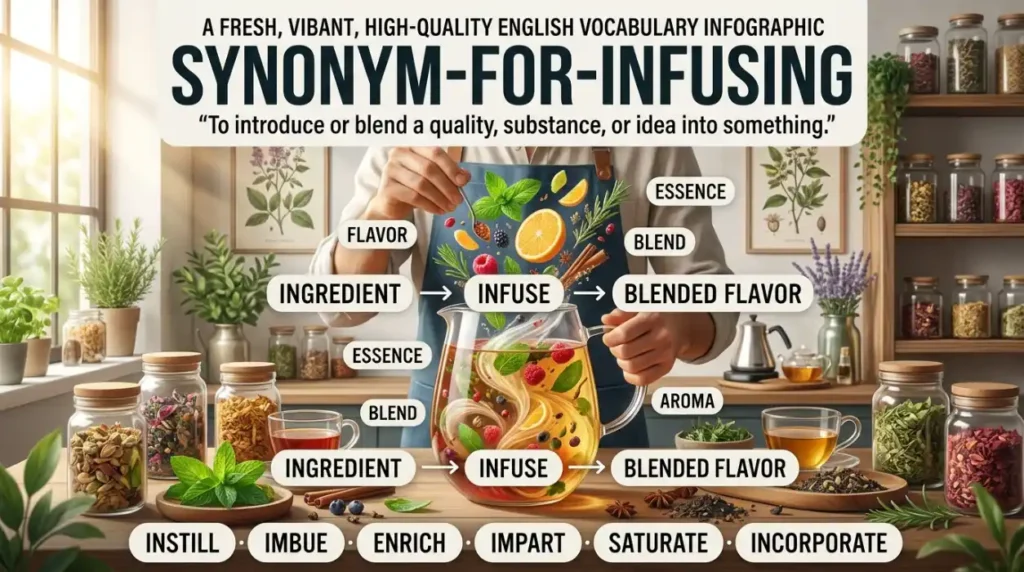
A direct synonym for infusing depends on context: use steeping, soaking, or marinating for cooking and tea; instilling, imbuing, or inspiring for emotions and values; and permeating, saturating, or pervading when describing qualities, scents, or atmosphere spreading throughout a space.
A synonym for infusing helps you describe adding flavor, quality, emotion, or energy to something. Think of fresh mint steeping in hot tea, giving the drink a refreshing taste. The word can describe both physical and abstract actions.
For example, a chef may infuse garlic into olive oil to create a rich flavor. Choosing the right synonym for infusing can help you describe steeping, enriching, inspiring, or filling something with greater precision and variety.
Expanding your vocabulary makes writing more engaging and natural. Using alternatives can prevent repetition while helping you communicate ideas clearly and creatively in different contexts.
This guide introduces useful alternatives for students, bloggers, writers, and speakers. Learning each synonym for infusing can strengthen your vocabulary and make everyday communication more expressive in 2026.
What Does “Infusing” Really Mean?
Infusing means soaking a substance to extract its flavor, or filling a person, space, or idea with a specific quality, feeling, or energy.
- Part of Speech: Verb (Present Participle / Gerund)
- Simple English Definition: Filling, soaking, or introducing a quality, feeling, or element into something else.
- Emotional Tone: Inspiring, enriching, comforting, or transformative.
Connotative Meaning
(Connotation is the emotional, cultural, or social association attached to a word beyond its literal dictionary definition.)
- Positive Tone: Highly positive when associated with inspiring hope, adding rich flavors, or spreading vitality.
- Negative Tone: Rarely negative, though it can describe instilling negative feelings like fear or doubt.
- Neutral Tone: Objective scientific or medical descriptions, such as soaking herbs or delivering intravenous fluids.
Etymology and History
- Source Language: Latin (infundere, meaning “to pour in or pour upon”).
- Old English (450–1100): Not present in Old English; Old English used terms like geotan (to pour).
- Middle English (1100–1500): Borrowed from Old French (infuser) during the 14th century, initially used in alchemy and medicine.
- Modern English (1500–Present): Expanded to describe culinary steeping, artistic inspiration, and spiritual enrichment.
Pronunciation (US & UK)
- US: /ɪnˈfjuː.zɪŋ/
- UK: /ɪnˈfjuː.zɪŋ/
Syllables & Structure
- Syllables: in-fus-ing
- Root: fuse (from Latin fundere, to pour)
- Prefix: in- (in, into)
- Suffix: -ing (present participle/gerund suffix)
Synonyms List
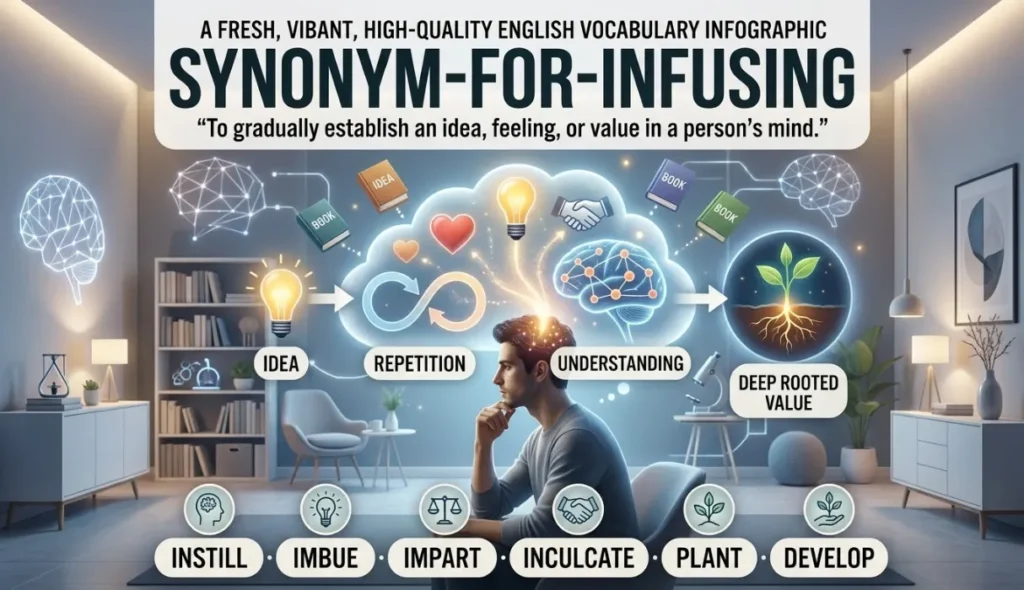
Instilling (Verb) — US: /ɪnˈstɪl.ɪŋ/ | UK: /ɪnˈstɪl.ɪŋ/
- Meaning: Gradually establishing an idea, feeling, or value in a person’s mind.
- Tone/Register: Educational / Formal
- Example 1: Good teachers focus on instilling confidence in young students.
- Example 2: She spent years instilling strong moral values in her children.
Imbuing (Verb) — US: /ɪmˈbjuː.ɪŋ/ | UK: /ɪmˈbjuː.ɪŋ/
- Meaning: Inspiring or permeating someone or something with a feeling or quality.
- Tone/Register: Literary / Formal
- Example 1: The artist was imbuing his canvas with vibrant energy.
- Example 2: Her speech succeeded in imbuing the crowd with hope.
Steeping (Verb) — US: /ˈstiː.pɪŋ/ | UK: /ˈstiː.pɪŋ/
- Meaning: Soaking a solid in liquid to extract flavor, or immersing deeply in a subject.
- Tone/Register: General / Culinary
- Example 1: The chef spent ten minutes steeping tea leaves in boiling water.
- Example 2: He spent the summer steeping himself in local history.
Permeating (Verb) — US: /ˈpɝː.mi.eɪ.t̬ɪŋ/ | UK: /ˈpɜː.mi.eɪ.tɪŋ/
- Meaning: Spreading widely throughout every part of a space or object.
- Tone/Register: Academic / General
- Example 1: The aroma of roasted coffee was permeating the morning air.
- Example 2: Optimism was permeating the entire office after the big sale.
Pervading (Verb) — US: /pɚˈveɪ.dɪŋ/ | UK: /pəˈveɪ.dɪŋ/
- Meaning: Spreading throughout all parts of a place, atmosphere, or group.
- Tone/Register: Formal / Literary
- Example 1: A calm feeling was pervading the room during the quiet meditation.
- Example 2: Joy was pervading the village during the annual festival.
Saturating (Verb) — US: /ˈsætʃ.ə.reɪ.t̬ɪŋ/ | UK: /ˈsætʃ.ər.eɪ.tɪŋ/
- Meaning: Soaking completely or filling with something.
- Tone/Register: General / Technical
- Example 1: Rain fell all morning, saturating the garden soil completely.
- Example 2: Marketing teams were saturating the local radio waves with ads.
Soaking (Verb) — US: /ˈsoʊ.kɪŋ/ | UK: /ˈsəʊ.kɪŋ/
- Meaning: Leaving something in liquid to become thoroughly wet or flavored.
- Tone/Register: Informal / Conversational
- Example 1: She left the wooden beans soaking in warm water overnight.
- Example 2: He stood in the rain, soaking his new leather boots.
Inculcating (Verb) — US: /ɪnˈkʌl.keɪ.t̬ɪŋ/ | UK: /ˈɪn.kʌl.keɪ.tɪŋ/
- Meaning: Instilling an attitude or habit by persistent instruction and repetition.
- Tone/Register: Formal / Academic
- Example 1: The school aims at inculcating discipline in every student.
- Example 2: Parents work on inculcating healthy habits early in life.
Injecting (Verb) — US: /ɪnˈdʒek.t̬ɪŋ/ | UK: /ɪnˈdʒek.tɪŋ/
- Meaning: Introducing a new element, energy, or fluid suddenly into something.
- Tone/Register: General / Dynamic
- Example 1: The coach was injecting enthusiasm into the tired team.
- Example 2: Adding bright colors is great for injecting life into a dark room.
Impregnating (Verb) — US: /ɪmˈpreɡ.neɪ.t̬ɪŋ/ | UK: /ɪmˈpreɡ.neɪ.tɪŋ/
- Meaning: Saturating or filling a substance thoroughly with another element.
- Tone/Register: Technical / Formal
- Example 1: Workers were impregnating the timber with protective oil.
- Example 2: The cloth was effective at impregnating the room with scent.
Insinuating (Verb) — US: /ɪnˈsɪn.ju.eɪ.t̬ɪŋ/ | UK: /ɪnˈsɪn.ju.eɪ.tɪŋ/
- Meaning: Introducing an idea or feeling subtly, gradually, or indirectly.
- Tone/Register: Formal / Expressive
- Example 1: He kept insinuating subtle doubts into our project plans.
- Example 2: Soft music was insinuating peace into the noisy hall.
Inspiring (Verb) — US: /ɪnˈspaɪr.ɪŋ/ | UK: /ɪnˈspaɪə.rɪŋ/
- Meaning: Filling someone with the urge, emotion, or ability to do something creative.
- Tone/Register: General / Positive
- Example 1: Her story was inspiring young writers across the country.
- Example 2: The ocean view was inspiring his next musical piece.
Breathing Life Into (Verb Phrase) — US: /briːð.ɪŋ laɪf ˈɪn.tuː/ | UK: /briːð.ɪŋ laɪf ˈɪn.tuː/
- Meaning: Revitalizing or bringing fresh energy and purpose to something.
- Tone/Register: Expressive / Informal
- Example 1: The designer was breathing life into the old historic building.
- Example 2: Her fresh ideas were breathing life into the boring campaign.
Implanting (Verb) — US: /ɪmˈplæn.t̬ɪŋ/ | UK: /ɪmˈplɑːn.tɪŋ/
- Meaning: Establishing an idea or quality in a person’s mind.
- Tone/Register: Formal / Medical
- Example 1: The mentor was implanting key leadership principles in his staff.
- Example 2: Science fiction movies love implanting false memories in characters.
Indoctrinating (Verb) — US: /ɪnˈdɑːk.trə.neɪ.t̬ɪŋ/ | UK: /ɪnˈdɒk.trɪ.neɪ.tɪŋ/
- Meaning: Teaching a group to accept a set of beliefs uncritically.
- Tone/Register: Formal / Critical
- Example 1: The organization was accused of indoctrinating young recruits.
- Example 2: They warned against indoctrinating students with biased views.
Transfusing (Verb) — US: /trænsˈfjuː.zɪŋ/ | UK: /trænsˈfjuː.zɪŋ/
- Meaning: Transferring fluid, vitality, or energy from one source into another.
- Tone/Register: Medical / Formal
- Example 1: The medical team was transfusing blood to save the patient.
- Example 2: The manager succeeded in transfusing fresh energy into the group.
Diffusing (Verb) — US: /dɪˈfjuː.zɪŋ/ | UK: /dɪˈfjuː.zɪŋ/
- Meaning: Spreading out or scattering a quality, light, or fluid widely.
- Tone/Register: Technical / Formal
- Example 1: The essential oil burner was diffusing lavender aroma.
- Example 2: Soft curtains were diffusing harsh sunlight into gentle illumination.
Flavoring (Verb) — US: /ˈfleɪ.vɚ.ɪŋ/ | UK: /ˈfleɪ.vər.ɪŋ/
- Meaning: Adding a specific taste or ingredient to food or drink.
- Tone/Register: Culinary / Informal
- Example 1: She was flavoring the soup with fresh rosemary leaves.
- Example 2: Vanilla bean is ideal for flavoring cold milk drinks.
Seasoning (Verb) — US: /ˈsiː.zən.ɪŋ/ | UK: /ˈsiː.zən.ɪŋ/
- Meaning: Enhancing the taste of food by adding herbs, spices, or salt.
- Tone/Register: Culinary / General
- Example 1: The cook was seasoning the meat before placing it on the grill.
- Example 2: He spent time seasoning the cast-iron skillet properly.
Marinating (Verb) — US: /ˈmær.ə.neɪ.t̬ɪŋ/ | UK: /ˈmær.ɪ.neɪ.tɪŋ/
- Meaning: Soaking food in a seasoned liquid to flavor and tenderize it.
- Tone/Register: Culinary / Conversational
- Example 1: They spent hours marinating chicken in lemon and garlic.
- Example 2: Leaving the mixture marinating overnight improves the taste.
Macerating (Verb) — US: /ˈmæs.ə.reɪ.t̬ɪŋ/ | UK: /ˈmæs.ər.eɪ.tɪŋ/
- Meaning: Softening or breaking down fruit by soaking it in liquid or sugar.
- Tone/Register: Culinary / Technical
- Example 1: The baker was macerating berries in sugar for the cake.
- Example 2: Macerating cherries in juice yields a rich dessert sauce.
Soaking up (Verb Phrase) — US: /ˈsoʊ.kɪŋ ʌp/ | UK: /ˈsəʊ.kɪŋ ʌp/
- Meaning: Absorbing liquid, knowledge, or atmosphere completely.
- Tone/Register: Informal / Conversational
- Example 1: The tourists enjoyed soaking up the afternoon sunshine.
- Example 2: The young apprentice was soaking up skills from the master artist.
Filling (Verb) — US: /ˈfɪl.ɪŋ/ | UK: /ˈfɪl.ɪŋ/
- Meaning: Making a space or container full of a liquid, gas, or emotion.
- Tone/Register: General / Standard
- Example 1: Loud laughter was filling the cozy dining room.
- Example 2: She began filling the bucket with clean tap water.
Charging (Verb) — US: /ˈtʃɑːr.dʒɪŋ/ | UK: /ˈtʃɑː.dʒɪŋ/
- Meaning: Filling a space or situation with intense feeling or energy.
- Tone/Register: Expressive / Dynamic
- Example 1: The sudden announcement was charging the crowd with excitement.
- Example 2: The electric atmosphere was charging the stadium before kickoff.
Enlivening (Verb) — US: /ɪnˈlaɪ.vən.ɪŋ/ | UK: /ɪnˈlaɪ.vən.ɪŋ/
- Meaning: Making something more entertaining, active, or bright.
- Tone/Register: Formal / Expressive
- Example 1: Upbeat music was enlivening the dull corporate party.
- Example 2: Colorful paintings were enlivening the plain gray hallway.
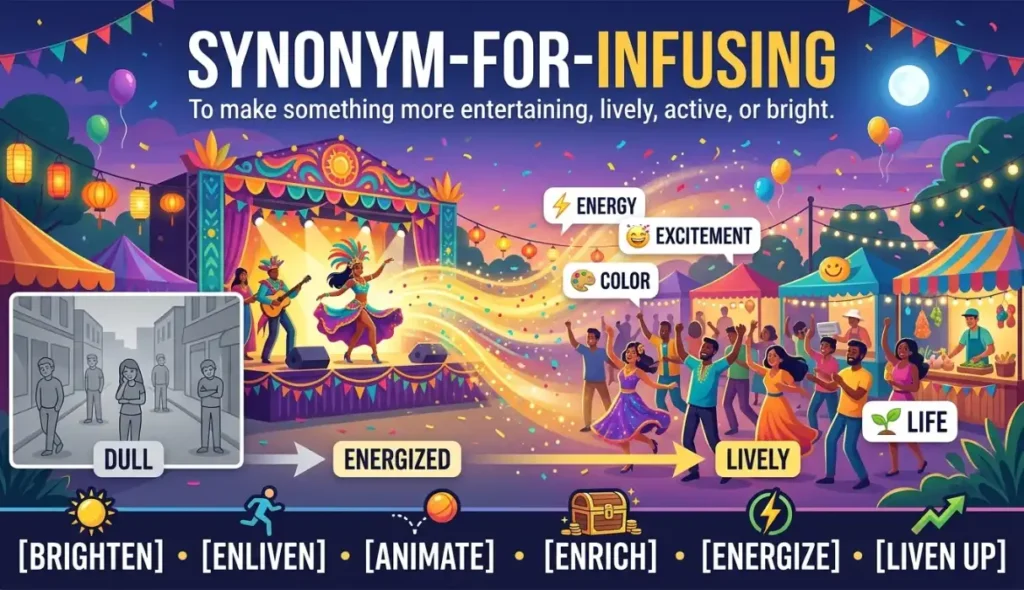
Animating (Verb) — US: /ˈæn.ə.meɪ.t̬ɪŋ/ | UK: /ˈæn.ɪ.meɪ.tɪŋ/
- Meaning: Giving life, movement, or spirit to something static.
- Tone/Register: General / Creative
- Example 1: A passion for justice was animating her public speech.
- Example 2: Bright lights were animating the sleepy city streets.
Vitalizing (Verb) — US: /ˈvaɪ.t̬ə.laɪ.zɪŋ/ | UK: /ˈvaɪ.tə.laɪ.zɪŋ/
- Meaning: Giving strength, energy, or vitality to a system or group.
- Tone/Register: Professional / Formal
- Example 1: Fresh investment was vitalizing the local economy.
- Example 2: Exercise routine proved effective at vitalizing his mornings.
Invigorating (Verb) — US: /ɪnˈvɪɡ.ɚ.eɪ.t̬ɪŋ/ | UK: /ɪnˈvɪɡ.ər.eɪ.tɪŋ/
- Meaning: Giving strength, freshness, or renewed energy to a person.
- Tone/Register: General / Positive
- Example 1: Cold mountain air was invigorating the morning hikers.
- Example 2: Swimming in cool water was invigorating after a long run.
Refreshing (Verb) — US: /rɪˈfreʃ.ɪŋ/ | UK: /rɪˈfreʃ.ɪŋ/
- Meaning: Giving new strength or energy to someone; making cool or clean.
- Tone/Register: General / Everyday
- Example 1: Cold lemon juice was refreshing the tired outdoor workers.
- Example 2: A brief nap was refreshing her focus for the evening shift.
Enriching (Verb) — US: /ɪnˈrɪtʃ.ɪŋ/ | UK: /ɪnˈrɪtʃ.ɪŋ/
- Meaning: Improving or enhancing the quality or value of something.
- Tone/Register: Academic / Positive
- Example 1: Reading classic books was enriching her daily vocabulary.
- Example 2: Adding organic compost was enriching the garden soil.
Elevating (Verb) — US: /ˈel.ə.veɪ.t̬ɪŋ/ | UK: /ˈel.ɪ.veɪ.tɪŋ/
- Meaning: Raising something to a higher intellectual, moral, or emotional level.
- Tone/Register: Formal / Inspiring
- Example 1: The soloist’s voice was elevating the quality of the concert.
- Example 2: Gentle kindness was elevating the tone of the meeting.
Fusing (Verb) — US: /ˈfjuː.zɪŋ/ | UK: /ˈfjuː.zɪŋ/
- Meaning: Joining different things together to form a single entity.
- Tone/Register: Technical / Creative
- Example 1: The chef was fusing Asian and European culinary techniques.
- Example 2: Heat was fusing the glass pieces into a single sculpture.
Blending (Verb) — US: /ˈblend.ɪŋ/ | UK: /ˈblend.ɪŋ/
- Meaning: Mixing different ingredients or qualities harmoniously together.
- Tone/Register: General / Everyday
- Example 1: The painter was blending shades of blue and gold smoothly.
- Example 2: The drink maker was blending fresh fruits into a smoothie.
Combining (Verb) — US: /kəmˈbaɪ.nɪŋ/ | UK: /kəmˈbaɪ.nɪŋ/
- Meaning: Joining two or more substances, ideas, or efforts together.
- Tone/Register: Standard / General
- Example 1: Combining hard work with good strategy yields great results.
- Example 2: She tried combining flour and water to make simple dough.
Interfusing (Verb) — US: /ˌɪn.t̬ɚˈfjuː.zɪŋ/ | UK: /ˌɪn.təˈfjuː.zɪŋ/
- Meaning: Blending or mixing mutually throughout two or more things.
- Tone/Register: Rare / Literary
- Example 1: The poet described mist interfusing with evening mountain shadows.
- Example 2: Cultures were intermingling in the historic harbor city.
Intertwining (Verb) — US: /ˌɪn.t̬ɚˈtwaɪ.nɪŋ/ | UK: /ˌɪn.təˈtwaɪ.nɪŋ/
- Meaning: Twisting or connecting two or more things closely together.
- Tone/Register: Literary / Expressive
- Example 1: The author was intertwining two love stories in one novel.
- Example 2: Vines were intertwining around the porch pillars.
Weaving (Verb) — US: /ˈwiː.vɪŋ/ | UK: /ˈwiː.vɪŋ/
- Meaning: Interlacing threads, ideas, or details into a complex whole.
- Tone/Register: Creative / General
- Example 1: She was weaving traditional folklore into her modern story.
- Example 2: Artisans were weaving colorful yarns into a thick blanket.
Infiltrating (Verb) — US: /ˈɪn.fɪl.treɪ.t̬ɪŋ/ | UK: /ˈɪn.fɪl.treɪ.tɪŋ/
- Meaning: Entering or gaining access to a place or group gradually.
- Tone/Register: Formal / Strategic
- Example 1: Cold water was infiltrating the foundation through tiny cracks.
- Example 2: Secret agents were infiltrating the rogue network quietly.
Filtering (Verb) — US: /ˈfɪl.tɚ.ɪŋ/ | UK: /ˈfɪl.tər.ɪŋ/
- Meaning: Passing a liquid or gas through a device to remove impurities.
- Tone/Register: Technical / General
- Example 1: Sunlight was filtering gently through dense pine tree branches.
- Example 2: The charcoal system was filtering impurities out of water.
Distilling (Verb) — US: /dɪˈstɪl.ɪŋ/ | UK: /dɪˈstɪl.ɪŋ/
- Meaning: Extracting the essential meaning, quality, or spirit of something.
- Tone/Register: Academic / Formal
- Example 1: The researcher was distilling years of complex data into facts.
- Example 2: The herbalist was distilling essential oils from mint leaves.
Instigating (Verb) — US: /ˈɪn.stə.ɡeɪ.t̬ɪŋ/ | UK: /ˈɪn.stɪ.ɡeɪ.tɪŋ/
- Meaning: Initiating or provoking an action, feeling, or event intentionally.
- Tone/Register: Formal / Critical
- Example 1: Gossip was instigating unnecessary panic among residents.
- Example 2: Community leaders were instigating positive economic reforms.
Prompting (Verb) — US: /ˈprɑːmp.tɪŋ/ | UK: /ˈprɒmp.tɪŋ/
- Meaning: Encouraging or causing an action, thought, or feeling to happen.
- Tone/Register: General / Standard
- Example 1: Her thoughtful remark was prompting deep reflection among listeners.
- Example 2: Cold weather was prompting families to turn on heaters.
Awakening (Verb) — US: /əˈweɪ.kə.nɪŋ/ | UK: /əˈweɪ.kən.ɪŋ/
- Meaning: Rousing a feeling, memory, or interest into active existence.
- Tone/Register: Literary / Expressive
- Example 1: Spring flowers were awakening joy in neighborhood gardens.
- Example 2: The speech was awakening interest in local environmental protection.
Kindling (Verb) — US: /ˈkɪn.dl̩.ɪŋ/ | UK: /ˈkɪn.dl̩.ɪŋ/
- Meaning: Arousing, inspiring, or lighting up an emotion, interest, or flame.
- Tone/Register: Literary / Warm
- Example 1: Her encouraging words were kindling hope in struggling students.
- Example 2: Storytelling by campfire was kindling warm childhood memories.
Igniting (Verb) — US: /ɪɡˈnaɪ.t̬ɪŋ/ | UK: /ɪɡˈnaɪ.tɪŋ/
- Meaning: Catching fire or triggering an intense emotion or action instantly.
- Tone/Register: Dynamic / Expressive
- Example 1: The speaker’s words were igniting passion across the crowd.
- Example 2: Sparks were igniting dry autumn leaves in the yard.
Prompting energy into (Phrase) — US: /ˈprɑːmp.tɪŋ ˈen.ɚ.dʒi ˈɪn.tuː/ | UK: /ˈprɒmp.tɪŋ ˈen.ə.dʒi ˈɪn.tuː/
- Meaning: Actively directing or introducing vigor into a system or group.
- Tone/Register: Business / Informal
- Example 1: The coach was prompting energy into the team before kickoff.
- Example 2: New managers were prompting energy into sales operations.
Channeling (Verb) — US: /ˈtʃæn.əl.ɪŋ/ | UK: /ˈtʃæn.əl.ɪŋ/
- Meaning: Directing energy, thoughts, or feelings toward a specific goal.
- Tone/Register: General / Focus
- Example 1: She was channeling her frustration into productive gym workouts.
- Example 2: Artists were channeling local culture into modern murals.
Imprinting (Verb) — US: /ɪmˈprɪn.t̬ɪŋ/ | UK: /ɪmˈprɪn.tɪŋ/
- Meaning: Impressing a mark, memory, or quality firmly on a surface or mind.
- Tone/Register: Academic / Formal
- Example 1: The experience was imprinting lasting memories on the children.
- Example 2: Machines were imprinting serial numbers onto metal sheets.
Inscribing (Verb) — US: /ɪnˈskraɪ.bɪŋ/ | UK: /ɪnˈskraɪ.bɪŋ/
- Meaning: Writing, carving, or engraving words or values permanently.
- Tone/Register: Formal / Historical
- Example 1: The stonemason was inscribing words onto the marble base.
- Example 2: She was inscribing personal notes inside gift books.
Ingraining (Verb) — US: /ɪnˈɡreɪ.nɪŋ/ | UK: /ɪnˈɡreɪ.nɪŋ/
- Meaning: Establishing a habit, idea, or belief so deeply that it is permanent.
- Tone/Register: Academic / Formal
- Example 1: Daily practice was ingraining proper posture in young dancers.
- Example 2: Training programs focus on ingraining workplace safety rules.
Diffusing into (Verb Phrase) — US: /dɪˈfjuː.zɪŋ ˈɪn.tuː/ | UK: /dɪˈfjuː.zɪŋ ˈɪn.tuː/
- Meaning: Slowly penetrating and blending into surrounding elements.
- Tone/Register: Scientific / General
- Example 1: Ink was diffusing into the cup of clear tap water.
- Example 2: New cultural habits were diffusing into daily city routines.
Enshrouding (Verb) — US: /ɪnˈʃraʊ.dɪŋ/ | UK: /ɪnˈʃraʊ.dɪŋ/
- Meaning: Covering or enveloping completely, often with mystery or atmosphere.
- Tone/Register: Literary / Formal
- Example 1: Fog was enshrouding the harbor as night fell quiet.
- Example 2: Mystery was enshrouding the old abandoned estate house.
Enveloping (Verb) — US: /ɪnˈvel.ə.pɪŋ/ | UK: /ɪnˈvel.ə.pɪŋ/
- Meaning: Wrapping up, covering, or surrounding.
- Tone/Register: General / Expressive
- Example 1: Warm blankets were enveloping the winter campers comfortably.
- Example 2: Smoke was enveloping the kitchen after the pan burned.
Transmuting (Verb) — US: /trænzˈmjuː.t̬ɪŋ/ | UK: /trænzˈmjuː.tɪŋ/
- Meaning: Changing or transforming one quality or state into a higher one.
- Tone/Register: Academic / Formal
- Example 1: Alchemy focused on transmuting base metals into pure gold.
- Example 2: She was transmuting personal grief into powerful poetry and art.
Permeating with (Verb Phrase) — US: /ˈpɝː.mi.eɪ.t̬ɪŋ wɪð/ | UK: /ˈpɜː.mi.eɪ.tɪŋ wɪð/
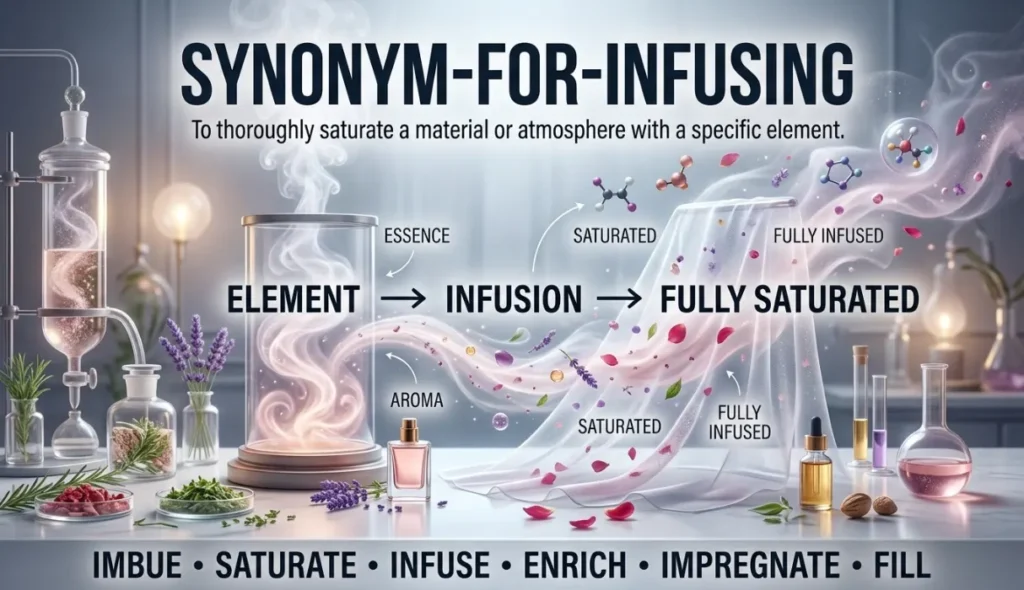
- Meaning: Thoroughly saturating a material or atmosphere with a specific element.
- Tone/Register: Formal / Descriptive
- Example 1: Chefs were permeating oil with fresh herb extracts.
- Example 2: Speakers were permeating the hall with inspiring stories.
Synonyms by Tone
Choosing the right tone ensures your writing connects effectively with your readers.
- Positive Tone: Inspiring, Enlivening, Invigorating, Enriching, Vitalizing, Kindling. These convey energy, inspiration, and positive transformation.
- Neutral Tone: Steeping, Permeating, Saturating, Soaking, Blending, Filtering. These offer clear descriptions of physical or chemical processes without emotional bias.
- Negative Tone: Indoctrinating, Infiltrating, Inculcating, Ingraining (in negative contexts). These suggest unwanted control, slow intrusion, or rigid repetition.
- Playful / Informal Tone: Breathing life into, Soaking up, Injecting, Charging. These add lively energy to everyday conversations and blog posts.
Mini Comparison: Infusing vs. Close Alternatives
| Word | Key Shade of Meaning | Tone | Best Context |
| Infusing | Soaking herbs/flavors, or filling people with inspiring feelings | Positive / Rich | Cooking teas/oils, inspiring teams, creative art |
| Instilling | Gradually teaching habits, values, or mental ideas over time | Educational / Formal | Parenting, classroom teaching, corporate values |
| Steeping | Physically soaking solids in liquid, or deep immersion in studies | Culinary / Descriptive | Brewing tea/coffee, historical research |
How “Infusing” Changes by Context
Daily Conversation
In casual talk, speakers rarely use heavy formal terms. They prefer soaking, breathing life into, mixing, or filling.
Writing & Blogging
Writers use infusing or imbuing to add emotional color. Describing a story as infusing passion into readers creates instant connection.
Professional & Academic Tone
In business or academic papers, select precise alternatives such as instilling, inculcating, diffusing, or vitalizing.
Common Mistakes & Native Usage
Misuse Scenarios
- Confusing “Infusing” with “Instilling”: Use infusing when introducing flavor, mood, or energy overall. Use instilling when teaching habits or values to a person step-by-step.
- Using “Infusing” for Solid Physical Assembly: Do not say “He was infusing bricks into the wall.” Use building, assembling, or laying.
Register Notes
Native speakers reserve infusing for liquid steeping or spreading abstract qualities like hope, joy, or enthusiasm.
Real-Life Mini Scenarios
- Workplace: A corporate manager organizes outdoor team events, injecting fresh energy into tired employees.
- Social Situations: Friends sit on a porch on a cold evening, soaking up warm tea while catching up.
- Media & Pop Culture: Film directors use dramatic lighting, imbuing superhero movie scenes with dark suspense.
Conclusion
Mastering a useful synonym for infusing gives you greater control over descriptive language. The right word can help you express flavor, emotion, energy, or qualities more clearly and naturally. Using varied vocabulary also makes your writing more interesting and engaging.
Strong vocabulary benefits students, bloggers, content writers, and speakers. Students can create better essays, bloggers can write vivid content, and speakers can communicate ideas with confidence. Learning alternatives also reduces repetition and makes your writing sound polished and professional.
Choose three synonyms from this list and create original sentences with them. Practice using each word in different contexts to understand its meaning and usage. Regular practice strengthens vocabulary, improves communication, and builds confidence in everyday writing.
Practice Exercise
Questions
- Which synonym best fits soaking tea leaves in hot water?
A) Indoctrinating
B) Steeping
C) Infiltrating
D) Inscribing - Teaching children moral values gradually over time is best called:
A) Steeping
B) Instilling
C) Filtering
D) Macerating - What tone does the word indoctrinating carry?
A) Highly positive
B) Neutral scientific
C) Critical / Negative
D) Playful - Which word fits a chef softening berries in sugar?
A) Macerating
B) Inculcating
C) Transfusing
D) Infiltrating - Adding quick energy to a tired team is called:
A) Soaking
B) Injecting
C) Inscribing
D) Filtering - Which term works best for light passing gently through curtains?
A) Distilling
B) Diffusing
C) Impregnating
D) Indoctrinating - What is the key difference between infusing and instilling?
A) Infusing relates to flavor/energy; instilling relates to values/habits.
B) Infusing is negative; instilling is positive.
C) Infusing applies only to math; instilling applies to art.
D) There is no difference. - Identify the correct usage sentence:
A) “She was infusing bricks into the concrete floor.”
B) “The chef was infusing fresh herbs into warm olive oil.”
C) “He was infusing his shoes onto his feet.”
D) “They were infusing window glass into the wall.” - Which term means bringing renewed vitality to an old building or plan?
A) Breathing life into
B) Macerating
C) Filtering
D) Indoctrinating - Spreading an aroma completely throughout a building is best described as:
A) Inscribing
B) Permeating
C) Macerating
D) Implanting
Reflection Task:
Write a 2-sentence paragraph describing a culinary or creative process using at least two synonyms from this article.
Answer Key:
1: B | 2: B | 3: C | 4: A | 5: B | 6: B | 7: A | 8: B | 9: A | 10: B
FAQs
1. What is the most common synonym for infusing in cooking?
The most common culinary synonyms are steeping, marinating, soaking, and seasoning. Steeping is used for teas, while marinating applies to meats.
2. Can infusing be used for abstract ideas?
Yes. Writers frequently use infusing to describe introducing emotions, enthusiasm, or creativity into speeches, stories, or workplace environments.
3. What is the difference between infusing and imbuing?
Infusing often refers to soaking physical elements or filling spaces with energy. Imbuing is more literary, usually describing filling a person or artwork with feelings or spirit.
4. Is instilling a direct synonym for infusing?
Instilling is a close semantic variant, but it specifically refers to teaching values, ideas, or habits to people over time through repetition.
5. What Latin root gives us the word infusing?
The word comes from Latin infundere, formed from in- (into) and fundere (to pour), literally meaning “to pour into.”

Jameel Hassan is the founder and lead writer at SynonymsCloud.com, a trusted online platform dedicated to English vocabulary and effective communication. He is passionate about helping students, writers, professionals, and lifelong learners discover the right words to express their ideas with clarity, precision, and confidence.
At SynonymsCloud.com, every article is thoroughly researched and carefully written to provide accurate, practical, and easy-to-understand guidance on synonyms, antonyms, word meanings, idioms, and vocabulary. With a strong commitment to quality, real-world usage, and clear explanations, the website helps readers expand their vocabulary, improve their writing, and communicate more effectively in both academic and professional settings.