
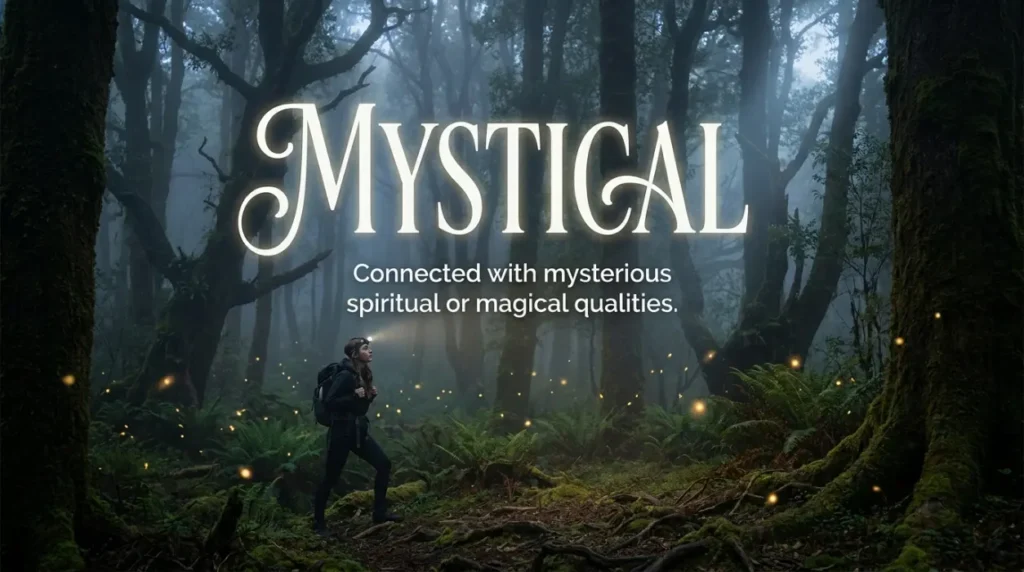
A synonym for mystical is an adjective describing things related to spiritual mystery, hidden meaning, or otherworldly wonder. Common alternatives include mysterious, magical, esoteric, arcane, and otherworldly, which help writers describe secret traditions, imaginative fantasy settings, and deep spiritual concepts with absolute precision.
A synonym for mystical helps you describe hidden wonders, spiritual experiences, ancient traditions, and mysterious encounters in a vivid way. The right word can make your descriptions more atmospheric and memorable.
Imagine walking through a fog-covered forest where ancient trees seem to hold forgotten stories. While “mystical” captures the mysterious feeling of the scene, words such as “magical,” “enchanted,” or “spiritual” can create a different mood.
Finding a synonym for mystical gives you fresh ways to describe unexplained events, magical settings, spiritual ideas, and imaginative experiences without repeating the same expression. These alternatives can suit both creative and informative writing.
Learning a synonym for mystical benefits students, content writers, fiction bloggers, storytellers, and ESL learners. Varied vocabulary helps you express mysterious ideas naturally, clearly, and confidently.
What Does “Synonym for Mystical” Really Mean?
A “synonym for mystical” refers to any adjective describing things relating to spiritual mystery, hidden meaning, occult practices, or an inspiring sense of otherworldly wonder. Native speakers use these terms in fantasy literature, philosophical essays, spiritual discussions, and atmospheric descriptions.
Part of Speech: Adjective
Simple Definition: Involving spiritual mystery, secret knowledge, or an inspiring aura of sacred wonder.
Connotative Meaning
Connotation is the emotional tone, cultural association, or implied feeling a word carries beyond its literal dictionary definition.
- Positive tone: Highly positive when describing inspiring spiritual experiences, beautiful natural wonders, or creative fantasy world-building.
- Negative tone: Occasionally negative if implying deceptive obscurity, cultish secrecy, or superstition lacking rational grounding.
- Neutral tone: Neutral when used in literary analysis, historical accounts of religious traditions, or academic folklore studies.
Etymology
- Origin: Derived from Greek mystikos (secret or initiated), tracing back to mystery cults in ancient Greece.
- Old English (450–1100): Early spiritual concepts entered through Christian religious texts translated into Anglo-Saxon, focusing on hidden holy truths.
- Middle English (1100–1500): The term evolved via Old French and Latin to describe spiritual contemplation and hidden scriptural meanings.
- Modern English (1500–Present): Expanded into general literary, psychological, and imaginative usage to denote anything obscurely magical or deeply spiritual.
Syllables
syn-o-nym for mys-ti-cal
Affixation Pattern
- Root: Mystic
- Prefix: None
- Suffix: -al (adjective-forming marker)
Synonyms List
Mysterious (Adjective)
Meaning: Difficult or impossible to understand, explain, or identify.
Tone/Register: Standard / General
Example 1: A mysterious noise echoed down the empty hallway.
Example 2: Detectives investigated the mysterious disappearance of the artifact.
Magical (Adjective)
Meaning: Beautiful, charming, or seeming to use supernatural powers.
Tone/Register: Warm / Imaginative
Example 1: Sunset cast a magical glow over the quiet lake.
Example 2: The children believed a magical fairy lived in the garden.
Occult (Adjective)
Meaning: Relating to supernatural, mystical, or magical beliefs and practices.
Tone/Register: Formal / Academic
Example 1: The library holds rare manuscripts on occult philosophy.
Example 2: Scholars study historical occult rituals in medieval Europe.
Esoteric (Adjective)
Meaning: Intended for or likely to be understood by only a small number of people.
Tone/Register: Academic / Formal
Example 1: Monks guarded esoteric texts inside the stone monastery.
Example 2: The lecture explored esoteric aspects of ancient astronomy.
Arcane (Adjective)
Meaning: Understood by few; mysterious or secret.
Tone/Register: Formal / Literary
Example 1: The scholar deciphered arcane symbols carved into the stone.
Example 2: Old legal documents often contain arcane terminology.
Otherworldly (Adjective)
Meaning: Relating to an imaginary or spiritual world; strikingly unconventional.
Tone/Register: Literary / Descriptive
Example 1: Glowing mushrooms gave the cave an otherworldly atmosphere.
Example 2: Her quiet voice carried an otherworldly calmness.
Spiritual (Adjective)
Meaning: Relating to or affecting the human spirit or soul.
Tone/Register: General / Respectful
Example 1: Meditation offers deep spiritual clarity during stressful weeks.
Example 2: Pilgrims visited the temple for spiritual reflection.
Secretive (Adjective)
Meaning: Given to hiding feelings or intentions.
Tone/Register: General / Conversational
Example 1: The old keeper remained secretive about the shrine’s origin.
Example 2: Cats have a secretive nature that intrigues owners.
Enigmatic (Adjective)
Meaning: Difficult to interpret or understand; mysterious.
Tone/Register: Formal / Literary
Example 1: The painting features a woman with an enigmatic smile.
Example 2: Historians debated the enigmatic leader’s final journal entry.
Cryptic (Adjective)
Meaning: Having a meaning that is mysterious or obscure.
Tone/Register: Standard / Professional
Example 1: The detective received a cryptic message in the mail.
Example 2: Software engineers left cryptic notes in the code.
Transcendent (Adjective)
Meaning: Going beyond ordinary limits; surpassing the material universe.
Tone/Register: Academic / Literary
Example 1: Classical music offers a transcendent emotional experience.
Example 2: Philosophers discussed transcendent truths in human existence.
Supernatural (Adjective)
Meaning: Attributed to some force beyond scientific understanding or the laws of nature.
Tone/Register: General / Narrative
Example 1: Ghost stories often feature supernatural phenomena.
Example 2: Villagers whispered about supernatural lights in the hills.
Uncanny (Adjective)
Meaning: Strange or mysterious, especially in an unsettling way.
Tone/Register: Descriptive / Engaging
Example 1: The portrait bore an uncanny resemblance to his grandfather.
Example 2: An uncanny silence fell across the deserted town.
Eerie (Adjective)
Meaning: Strange and frightening.
Tone/Register: Conversational / Descriptive
Example 1: An eerie wind howled through the broken windows.
Example 2: Glowing fog created an eerie scene on the marshes.
Phantom (Adjective)
Meaning: Seeming to be real, but actually existing only in the mind as a ghost.
Tone/Register: Literary / Narrative
Example 1: Sailors spotted a phantom ship drifting in the mist.
Example 2: A phantom shadow flickered across the bedroom wall.
Visionary (Adjective)
Meaning: Thinking about or planning the future with imagination or wisdom.
Tone/Register: Professional / Inspiring
Example 1: The architect presented visionary plans for the sustainable city.
Example 2: Founders need visionary insight to disrupt traditional industries.
Paranormal (Adjective)
Meaning: Denoting events or phenomena that are beyond scientific understanding.
Tone/Register: Informal / Pop Culture
Example 1: Investigators explored paranormal activity inside the abandoned hotel.
Example 2: Books on paranormal mysteries fill the local library shelves.
Mythic (Adjective)
Meaning: Occurring in or characteristic of myth or folklore.
Tone/Register: Literary / Epic
Example 1: The hero embarked on a mythic quest across the sea.
Example 2: Ancient ruins carried a powerful mythic resonance.
Legendary (Adjective)
Meaning: Remarkable enough to be famous; described in well-known stories.
Tone/Register: Popular / General
Example 1: Musicians praised the guitarist’s legendary live performances.
Example 2: The restaurant is legendary for its secret dessert recipe.
Fabled (Adjective)
Meaning: Celebrated in fable or legend; traditional.
Tone/Register: Literary / Narrative
Example 1: Explorers searched jungles for the fabled city of gold.
Example 2: The king ruled over a fabled kingdom of peace.
Dreamlike (Adjective)
Meaning: Having the whimsical, unreal quality of a dream.
Tone/Register: Descriptive / Artistic
Example 1: Pastel watercolors gave the canvas a dreamlike quality.
Example 2: Morning mist lent a dreamlike feel to the valley.
Surreal (Adjective)
Meaning: Having the disorienting, hallucinatory quality of a dream.
Tone/Register: Modern / Artistic
Example 1: Walking through the empty city felt completely surreal.
Example 2: The abstract art exhibit featured surreal floating clocks.
Inscrutable (Adjective)
Meaning: Impossible to understand or interpret.
Tone/Register: Formal / Literary
Example 1: The merchant maintained an inscrutable expression during negotiations.
Example 2: Human behavior remains an inscrutable puzzle to scientists.
Unfathomable (Adjective)
Meaning: Incapable of being fully explored or understood.
Tone/Register: Academic / Formal
Example 1: Divers explored the unfathomable depths of the ocean trench.
Example 2: The vastness of space holds unfathomable secrets.
Obscure (Adjective)
Meaning: Not discovered or known about; uncertain.
Tone/Register: Academic / Standard
Example 1: Researchers found an obscure reference in a medieval scroll.
Example 2: The artist spent years working in obscure isolation.
Ambiguous (Adjective)
Meaning: Open to more than one interpretation; having a double meaning.
Tone/Register: Formal / Professional
Example 1: The contract contained ambiguous clauses regarding delivery dates.
Example 2: Her ambiguous reply left everyone wondering what she meant.
Puzzling (Adjective)
Meaning: Making someone feel confused because they cannot understand something.
Tone/Register: Standard / Conversational
Example 1: Scientists found a puzzling anomaly in the telescope data.
Example 2: The sudden shift in weather patterns proved puzzling.
Baffling (Adjective)
Meaning: Impossible to understand; perplexing.
Tone/Register: Expressive / General
Example 1: The magician’s final trick left the audience completely baffled.
Example 2: Investigators faced a baffling array of missing clues.
Perplexing (Adjective)
Meaning: Causing a feeling of bewilderment; confusing.
Tone/Register: Formal / Professional
Example 1: Economists analyzed perplexing shifts in global markets.
Example 2: The complex math equation offered a perplexing challenge.
Recondite (Adjective)
Meaning: Little known; abstruse subject matter.
Tone/Register: Academic / Rare
Example 1: The professor specialized in recondite historical dialects.
Example 2: Students struggled with the recondite physics textbook.
Abstruse (Adjective)
Meaning: Difficult to understand; obscure.
Tone/Register: Formal / Academic
Example 1: Quantum mechanics involves abstruse mathematical models.
Example 2: The philosopher’s arguments remained deeply abstruse.
Imponderable (Adjective)
Meaning: Impossible to estimate or fathom.
Tone/Register: Literary / Philosophical
Example 1: Life after death remains an imponderable question.
Example 2: Economists weighed imponderable risks before launching the project.
Orphic (Adjective)
Meaning: Mysterious, entrancing, beyond ordinary understanding.
Tone/Register: Literary / Poetic
Example 1: The poet recited verses with an orphic cadence.
Example 2: Deep forest shadows held an orphic charm.
Sibylline (Adjective)
Meaning: Prophetic and mysterious.
Tone/Register: Literary / Formal
Example 1: The fortune teller spoke in sibylline riddles.
Example 2: Ancient prophets delivered sibylline warnings to kings.
Delphic (Adjective)
Meaning: Ambiguous and obscure, like the oracle of Delphi.
Tone/Register: Academic / Literary
Example 1: The CEO issued a delphic statement about future mergers.
Example 2: Critics disliked the author’s delphic narrative style.
Cabalistic (Adjective)
Meaning: Relating to secret mystical interpretations of scripture.
Tone/Register: Historical / Academic
Example 1: The manuscript contained cabalistic diagrams and symbols.
Example 2: Scholars examined cabalistic texts from the Renaissance.
Hermetic (Adjective)
Meaning: Insulated from external influence; occult.
Tone/Register: Technical / Formal
Example 1: Alchemists followed hermetic traditions of secret transformation.
Example 2: The laboratory maintained a hermetic seal against dust.
Theosophical (Adjective)
Meaning: Relating to systems of philosophy seeking divine truth.
Tone/Register: Academic / Philosophical
Example 1: Victorian intellectuals debated theosophical doctrines.
Example 2: The library featured theosophical journals from the 1920s.
Gnostic (Adjective)
Meaning: Relating to knowledge of spiritual mysteries.
Tone/Register: Academic / Historical
Example 1: Early Christian sects debated Gnostic scriptures.
Example 2: The museum displayed ancient Gnostic amulets.
Transcendental (Adjective)
Meaning: Relating to a spiritual realm above the physical world.
Tone/Register: Philosophical / Literary
Example 1: Emerson championed transcendental philosophies in nature writing.
Example 2: Hikers sought transcendental peace in mountain solitudes.
Charismatic (Adjective)
Meaning: Exercising a compelling charm that inspires devotion.
Tone/Register: Professional / Social
Example 1: The speaker held audiences with charismatic energy.
Example 2: Leaders need charismatic presence to unite teams.
Mesmeric (Adjective)
Meaning: Causing someone to become mesmerized; hypnotic.
Tone/Register: Literary / Descriptive
Example 1: The speaker used a mesmeric tone of voice.
Example 2: Waves crashing on rocks had a mesmeric effect.
Spellbinding (Adjective)
Meaning: Holding one’s attention completely as though by magic.
Tone/Register: Engaging / Narrative
Example 1: The storyteller delivered a spellbinding performance.
Example 2: Audiences watched the spellbinding acrobatics in awe.
Enthralling (Adjective)
Meaning: Capturing and holding one’s fascinated attention completely.
Tone/Register: Expressive / Engaging
Example 1: The historical documentary proved absolutely enthralling.
Example 2: Children listened to an enthralling tale of adventure.
Hypnotic (Adjective)
Meaning: Producing a state resembling sleep; mesmerizing.
Tone/Register: Descriptive / Literary
Example 1: The campfire flames had a hypnotic flicker.
Example 2: Rhythmic drumming created a hypnotic soundscape.
Captivating (Adjective)
Meaning: Capable of attracting and holding interest; charming.
Tone/Register: General / Warm
Example 1: The dancer delivered a captivating routine on stage.
Example 2: Visitors admired the captivating sunset over the ocean.
Fascinating (Adjective)
Meaning: Extremely interesting and attractive.
Tone/Register: Conversational / Standard
Example 1: Biologists shared fascinating insights into deep-sea creatures.
Example 2: The museum exhibition proved fascinating for history buffs.
Bewitching (Adjective)
Meaning: Enchanting; charming someone completely.
Tone/Register: Literary / Expressive
Example 1: She wore a bewitching dress to the evening gala.
Example 2: The violin solo had a bewitching emotional pull.
Rapturous (Adjective)
Meaning: Characterized by, feeling, or expressing great pleasure or enthusiasm.
Tone/Register: Literary / Emotional
Example 1: The choir received rapturous applause from the crowd.
Example 2: Fans shared rapturous reactions to the concert finale.
Stupefying (Adjective)
Meaning: Making someone unable to think properly; astonishing.
Tone/Register: Expressive / Dramatic
Example 1: The magician performed a stupefying card trick.
Example 2: Investors faced stupefying fluctuations in the market.
Astounding (Adjective)
Meaning: Surprisingly impressive or notable.
Tone/Register: General / Expressive
Example 1: Science made astounding progress in renewable energy.
Example 2: The athlete broke records with astounding speed.
Staggering (Adjective)
Meaning: Deeply shocking or astonishing.
Tone/Register: Professional / Dramatic
Example 1: The charity raised a staggering amount of donations.
Example 2: Engineers tackled staggering logistical challenges.
Prodigious (Adjective)
Meaning: Remarkably or impressively great in extent, size, or degree.
Tone/Register: Formal / Academic
Example 1: Mozart showed prodigious musical talent as a child.
Example 2: The project required a prodigious amount of research.
Marvelous (Adjective)
Meaning: Causing great wonder; extraordinary.
Tone/Register: Warm / Conversational
Example 1: They enjoyed a marvelous vacation in the mountains.
Example 2: The chef prepared a marvelous multi-course dinner.
Miraculous (Adjective)
Meaning: Occurring by divine or supernatural intervention; wonderful.
Tone/Register: Expressive / General
Example 1: The lost puppy made a miraculous return home.
Example 2: Medical staff witnessed a miraculous patient recovery.
Extraordinary (Adjective)
Meaning: Very unusual or remarkable.
Tone/Register: Formal / Standard
Example 1: Volunteers showed extraordinary dedication to the cause.
Example 2: The artifact possessed extraordinary historical value.
Remarkable (Adjective)
Meaning: Worthy of attention; striking.
Tone/Register: Professional / General
Example 1: The team achieved remarkable results this month.
Example 2: Architecture featured remarkable stone carvings.
Striking (Adjective)
Meaning: Attracting attention by reason of being unusual or extreme.
Tone/Register: Descriptive / Visual
Example 1: The painting featured striking contrasts of light and shadow.
Example 2: She wore a striking blue coat to the meeting.
Peculiar (Adjective)
Meaning: Strange or odd; unusual.
Tone/Register: Conversational / Descriptive
Example 1: A peculiar smell drifted from the old chemistry lab.
Example 2: The stray cat had a peculiar habit of jumping high.
Astonishing (Adjective)
Meaning: Extremely surprising or impressive.
Tone/Register: Expressive / General
Example 1: The acrobat performed astonishing flips in mid-air.
Example 2: Technicians achieved astonishing data transmission speeds.
Synonyms by Tone
| Tone Category | Synonyms for Mystical |
| Formal / Academic | Esoteric, Arcane, Recondite, Abstruse, Hermetic |
| Literary / Poetic | Otherworldly, Enigmatic, Orphic, Sibylline, Dreamlike |
| Everyday / Conversational | Mysterious, Magical, Eerie, Puzzling, Hidden |
| Spiritual / Philosophical | Transcendental, Occult, Theosophical, Gnostic, Visionary |
Choosing the correct tone ensures your vocabulary matches the context of fantasy storytelling, academic essays, or casual daily conversation.
Mini Comparison: “Mystical” vs Close Alternatives
| Term | Core Meaning | Tone | Best Context To Use |
| Mystical | Involving spiritual mystery or sacred wonder. | Literary / General | Fantasy writing, spiritual reflections, atmospheric descriptions. |
| Esoteric | Understood by only a small group of initiates. | Academic / Formal | Philosophy texts, specialized historical research, scholarly articles. |
| Enigmatic | Mysterious and difficult to interpret clearly. | Literary / Professional | Character descriptions, puzzling plot points, art reviews. |
Context-Based Usage
Daily Conversation
In everyday chats, speakers prefer simple terms like mysterious, magical, or creepy when describing strange occurrences.
Example: “There was a mysterious package left on the front porch.”
Writing or Blogging
Fiction writers and bloggers use engaging terms like otherworldly, spellbinding, or enchanting to captivate readers.
Example: “The author created an otherworldly kingdom filled with secrets.”
Professional or Academic Tone
Research papers and philosophical essays require formal terms like esoteric, arcane, or hermetic.
Example: “The historian examined esoteric manuscripts from the library archive.”
Creative or Informal Use
Storytellers and poets describe fantasy settings using words like dreamlike, orphic, or surreal.
Example: “The forest possessed a dreamlike beauty at midnight.”
Common Mistakes & Native Usage
Common Mistakes Learners Make
- Overusing Fantasy Terms: Avoid using heavy academic words like recondite in casual everyday storytelling where mysterious works better.
- Confusing Occult with Medical: Do not mix up spiritual occult with medical terms; ensure context clearly separates esoteric traditions from science.
Register Notes
- Formal Written English: Use esoteric, arcane, enigmatic, and hermetic.
- Spoken Informal English: Use mysterious, magical, creepy, and weird.
Real-Life Mini Scenarios
Workplace Scenario
Researchers reviewed an arcane software algorithm left by previous engineers.
Social Situations
Friends shared spooky stories about a mysterious light in the woods.
Media & Pop Culture
Film critics praised the movie’s surreal and dreamlike cinematography.
Writing & Storytelling
The novelist described an orphic ritual performed in stone ruins.
Conclusion
Building a stronger vocabulary gives you more expressive ways to describe mystery, wonder, spiritual experiences, and imaginative worlds. The right synonyms can add depth and atmosphere to your writing while keeping your ideas clear.
Choosing words that match your context helps you connect with readers across fantasy novels, creative stories, academic essays, and professional blogs. A synonym for mystical, a carefully selected alternative, can make descriptions feel more vivid, natural, and memorable.
Put these new vocabulary choices into practice through your essays, emails, stories, and everyday conversations. Regular use strengthens your word choice, improves English fluency, and gives you greater confidence when expressing mysterious or imaginative ideas.
Practice
1. Which term describes knowledge understood only by a small initiated group?
A) Esoteric
B) Public
C) Common
D) Simple
2. What literary adjective means having a dreamy, unreal quality?
A) Dreamlike
B) Industrial
C) Practical
D) Numerical
3. Which formal word means secret, hidden, or mysterious?
A) Arcane
B) Loud
C) Clear
D) Plain
4. What word describes a difficult puzzle or mysterious person?
A) Enigmatic
B) Open
C) Flat
D) Direct
5. Which term refers to spiritual or supernatural practices outside science?
A) Occult
B) Metric
C) Digital
D) Plastic
6. What descriptive word means striking and unsettlingly strange?
A) Uncanny
B) Normal
C) Boring
D) Stable
7. Which word describes writing or ideas beyond ordinary human limits?
A) Transcendent
B) Shallow
C) Brief
D) Tiny
8. What formal term describes secret alchemical or hidden traditions?
A) Hermetic
B) Loose
C) Open
D) Public
9. Which word means holding attention completely as if by magic?
A) Spellbinding
B) Tiresome
C) Dull
D) Weak
10. What term describes language that is obscure and hard to interpret?
A) Cryptic
B) Literal
C) Explicit
D) Exact
Answer Key:
1: A | 2: A | 3: A | 4: A | 5: A | 6: A | 7: A | 8: A | 9: A | 10: A
Application Task:
Write one original sentence describing a foggy, mysterious landscape using the term otherworldly or enigmatic.
FAQs
1. What is the difference between mystical and esoteric?
“Mystical” relates broadly to spiritual wonder, mystery, and magic, whereas “esoteric” specifically denotes specialized knowledge understood by only a small, select group of initiates.
2. Can mystical be used in professional business writing?
While “mystical” usually fits creative and spiritual contexts, professionals occasionally use terms like “enigmatic” or “obscure” when discussing complex, unexplained market trends.
3. What is a good academic alternative for mystical?
“Hermetic,” “esoteric,” and “arcane” serve as precise academic alternatives when discussing historical or philosophical texts.
4. How does expanding descriptive vocabulary improve storytelling?
Swapping repeated words for precise terms like otherworldly, orphic, or enigmatic adds atmospheric depth and emotional resonance to fiction writing.
5. When should I use uncanny instead of mysterious?
Use “uncanny” when something is mysterious in an unsettling, eerie way that feels slightly unnatural or strange.

Jameel Hassan is the founder and lead writer at SynonymsCloud.com, a trusted online platform dedicated to English vocabulary and effective communication. He is passionate about helping students, writers, professionals, and lifelong learners discover the right words to express their ideas with clarity, precision, and confidence.
At SynonymsCloud.com, every article is thoroughly researched and carefully written to provide accurate, practical, and easy-to-understand guidance on synonyms, antonyms, word meanings, idioms, and vocabulary. With a strong commitment to quality, real-world usage, and clear explanations, the website helps readers expand their vocabulary, improve their writing, and communicate more effectively in both academic and professional settings.