

The synonym for log signifies systemic tracking or physical timber, yet modern language frames this dual nature as chronological archiving—systematically stamping temporal data to construct verifiable histories—and structural biomass, representing raw timber whose physical grain or digital footprint serves as an immutable foundation for complex systems and construction.
Synonyms for log offer writers, students, and professionals a versatile set of vocabulary terms to describe recorded data, official accounts, or pieces of timber. Imagine a ship captain recording daily sea coordinates during a rough storm.
Using a synonym for log keeps your writing sharp and precise. A software engineer tracking system errors uses different terms than a forestry worker moving fallen trees in a quiet forest.
This flexible word appears frequently across software development, maritime history, aviation records, personal journaling, and timber production. It covers both active recording and physical wooden objects.
Finding a synonym for log builds vocabulary depth for writers, bloggers, students, and ESL learners. Replacing repetitive phrasing ensures clear communication across both formal reports and daily conversations.
What Does “Synonym for Log” Really Mean?
“Log” functions as both a noun and a verb. As a noun, it refers to a thick piece of cut wood or an official record of events. As a verb, it means to enter details into an official record or to cut down trees for timber.
Native speakers use the noun form in computing to mean system histories, in aviation for flight paths, and in forestry for cut timber. As a verb, it describes documenting work hours, tracking phone calls, or signing into digital applications.
Part of Speech: Noun / Verb
Definition: An official written or digital record of events; a heavy piece of cut tree trunk; or the act of systematically recording data.
Connotative Meaning
Connotation is the emotional tone, cultural association, or implied feeling a word carries beyond its literal dictionary definition.
- Positive tone: Positive when associated with cozy fireplaces, organized personal growth journals, or successful productivity tracking.
- Negative tone: Can carry a negative feel when connected to tedious administrative paperwork, invasive digital tracking, or environmental deforestation.
- Neutral tone: Objective when used in technical computing, legal record-keeping, maritime navigation, or industrial timber processing.
Etymology
The word originates from the wooden block used in historical maritime navigation.
- Old English (450–1100): Early Germanic roots linked to heavy wooden blocks and rough timber pieces.
- Middle English (1100–1500): Evolved into logge, referring specifically to a heavy cut piece of a tree trunk.
- Modern English (1500–Present): Mariners threw a wooden “log” tied to a knotted line into the water to measure speed, recording the results in a “logbook.” Modern technology later adopted the term for digital system records.
Pronunciation
- US: /lɑːɡ/ or /lɔːɡ/
- UK: /lɒɡ/
Syllables
log
Affixation Pattern
- Root: Log (monosyllabic root word)
- Prefix: None
- Suffix: None
Synonyms List
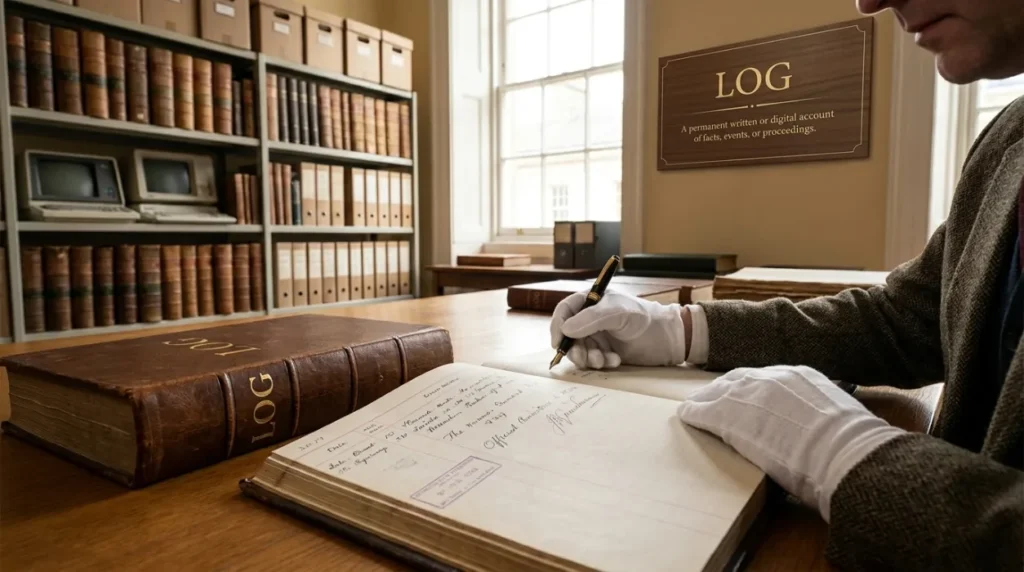
Record (Noun / Verb) — US: /ˈrek.ɚd/ | UK: /ˈrek.ɔːd/
Meaning: A permanent written or digital account of facts, events, or proceedings.
Tone/Register: Formal / Professional
Example 1: The clerk kept a precise record of every meeting held this year.
Example 2: Please record your daily work hours in the company portal.
Journal (Noun / Verb) — US: /ˈdʒɝː.nəl/ | UK: /ˈdʒɜː.nəl/
Meaning: A written book or file used to detail personal thoughts, daily activities, or research findings.
Tone/Register: Personal / Academic
Example 1: She writes in her personal journal every night before sleeping.
Example 2: Researchers journal their daily laboratory observations carefully.
Register (Noun / Verb) — US: /ˈredʒ.ə.stɚ/ | UK: /ˈredʒ.ɪ.stər/
Meaning: An official list or record of names, items, or commercial transactions.
Tone/Register: Official / Administrative
Example 1: The hotel clerk asked us to sign the guest register.
Example 2: You must register your vehicle before driving on public roads.
Ledger (Noun) — US: /ˈledʒ.ɚ/ | UK: /ˈledʒ.ər/
Meaning: A book or digital database used by businesses to record financial accounts.
Tone/Register: Business / Accounting
Example 1: The accountant examined the general ledger for transaction errors.
Example 2: All sales records are backed up in a digital ledger.
Diary (Noun) — US: /ˈdaɪ.ə.ri/ | UK: /ˈdaɪ.ə.ri/
Meaning: A book where a person records daily personal events and private thoughts.
Tone/Register: Informal / Personal
Example 1: He keeps a small diary in his pocket to track his thoughts.
Example 2: Reading her childhood diary brought back fond summer memories.
Chronicle (Noun / Verb) — US: /ˈkrɑː.nɪ.kəl/ | UK: /ˈkrɒn.ɪ.kəl/
Meaning: A detailed historical account of events arranged in order of time.
Tone/Register: Formal / Literary
Example 1: The library holds a rare chronicle of local history.
Example 2: The novel chronicles the struggles of an immigrant family.
Logbook (Noun) — US: /ˈlɑːɡ.bʊk/ | UK: /ˈlɒɡ.bʊk/
Meaning: A bound book or file used to record official measurements and daily activities.
Tone/Register: Nautical / Technical
Example 1: The pilot filled out the flight logbook after landing safely.
Example 2: Mechanics record every vehicle repair in a master logbook.
Document (Noun / Verb) — US: /ˈdɑː.kjə.ment/ | UK: /ˈdɒk.jə.ment/
Meaning: A written or digital representation of information intended for official reference.
Tone/Register: Professional / Legal
Example 1: Save your changes before closing the project document.
Example 2: Lawyers document every piece of evidence before going to trial.
File (Noun / Verb) — US: /faɪl/ | UK: /faɪl/
Meaning: A folder or digital object used to store organized information and records.
Tone/Register: General / Technical
Example 1: The secretary placed the contract inside the client’s paper file.
Example 2: Remember to file your tax return before the deadline.
Catalog (Noun / Verb) — US: /ˈkæt̬.ə.lɑːɡ/ | UK: /ˈkæt.ə.lɒɡ/
Meaning: A systematic list of items, books, or goods arranged in a specific order.
Tone/Register: Formal / Business
Example 1: The library catalog allows users to search for rare books easily.
Example 2: Curators catalog every ancient artifact brought into the museum.
Index (Noun / Verb) — US: /ˈɪn.deks/ | UK: /ˈɪn.deks/
Meaning: An alphabetical or organized list of items referencing detailed locations.
Tone/Register: Academic / Technical
Example 1: Check the index at the back of the textbook to find topics.
Example 2: Search engines index web pages to deliver fast search results.
Note (Noun / Verb) — US: /noʊt/ | UK: /nəʊt/
Meaning: A short record of facts, events, or thoughts written down for future reference.
Tone/Register: Casual / General
Example 1: She left a quick note on the kitchen counter for her brother.
Example 2: Please note down the main points during the morning presentation.
Minute (Noun / Verb) — US: /ˈmɪn.ɪt/ | UK: /ˈmɪn.ɪt/
Meaning: Official written notes taking account of business discussed during a meeting.
Tone/Register: Business / Formal
Example 1: The secretary distributed the board meeting minutes to all executives.
Example 2: She was assigned to minute the proceedings of the council meeting.
Timber (Noun) — US: /ˈtɪm.bɚ/ | UK: /ˈtɪm.bər/
Meaning: Wood prepared or suitable for building, carpentry, or industrial construction.
Tone/Register: Industrial / Forestry
Example 1: The truck transported fresh timber from the forest to the mill.
Example 2: High-quality timber was used to build the rustic mountain lodge.
Trunk (Noun) — US: /trʌŋk/ | UK: /trʌŋk/
Meaning: The main woody stem of a tree from which branches grow.
Tone/Register: Descriptive / Natural
Example 1: A thick oak trunk supported the sprawling tree branches above.
Example 2: Lightning struck the old trunk during yesterday’s thunderstorm.
Lumber (Noun) — US: /ˈlʌm.bɚ/ | UK: /ˈlʌm.bər/
Meaning: Timber processed into planks or boards for commercial construction work.
Tone/Register: Commercial / Industrial
Example 1: Carpenters ordered fresh lumber to frame the house walls.
Example 2: Lumber prices rose sharply due to supply chain shortages.
Block (Noun) — US: /blɑːk/ | UK: /blɒk/
Meaning: A solid, heavy piece of hard material such as wood, stone, or metal.
Tone/Register: General / Descriptive
Example 1: He chopped a block of wood to start a warm fire.
Example 2: Workers moved heavy stone blocks to construct the new wall.
Chump (Noun) — US: /tʃʌmp/ | UK: /tʃʌmp/
Meaning: A short, thick piece of cut wood or timber.
Tone/Register: Informal / Regional
Example 1: He gathered a few chumps of wood to fuel the campfire.
Example 2: The woodsman stacked cut chumps behind the outdoor shed.
Firewood (Noun) — US: /ˈfaɪr.wʊd/ | UK: /ˈfaɪə.wʊd/
Meaning: Wood cut down specifically to be burned for heating or cooking.
Tone/Register: General / Practical
Example 1: We stacked dried firewood beside the stone fireplace before winter.
Example 2: Collecting firewood was an essential task during campsite prep.
Billet (Noun) — US: /ˈbɪl.ɪt/ | UK: /ˈbɪl.ɪt/
Meaning: A short, thick piece of wood, especially one cut for fuel.
Tone/Register: Literary / Technical
Example 1: He tossed a birch billet into the wood stove.
Example 2: Billets of oak were stacked neatly in the woodshed.
Audit trail (Noun Phrase) — US: /ˈɑː.dɪt treɪl/ | UK: /ˈɔː.dɪt treɪl/
Meaning: A step-by-step record providing evidence of the sequence of transaction activities.
Tone/Register: Business / Technical
Example 1: Financial auditors reviewed the digital audit trail for discrepancies.
Example 2: Security systems maintain an automated audit trail of user access.
History (Noun) — US: /ˈhɪs.t̬ɚ.i/ | UK: /ˈhɪs.tər.i/
Meaning: A continuous, systematic record of past events, actions, or technological states.
Tone/Register: General / Technical
Example 1: Clear your web browser history to protect your digital privacy.
Example 2: The patient had no previous medical history of heart conditions.
Entry (Noun) — US: /ˈen.tri/ | UK: /ˈen.tri/
Meaning: An item or piece of information written down in a journal, list, or database.
Tone/Register: Administrative / General
Example 1: Her latest diary entry described her travels through Italy.
Example 2: Ensure every database entry includes a timestamp and user ID.
Detail (Noun / Verb) — US: /dɪˈteɪl/ | UK: /ˈdiː.teɪl/
Meaning: An individual fact, item, or feature recorded within a broader account.
Tone/Register: Formal / Precise
Example 1: The police report provided every detail of the accident.
Example 2: Please detail your exact steps in the troubleshooting report.
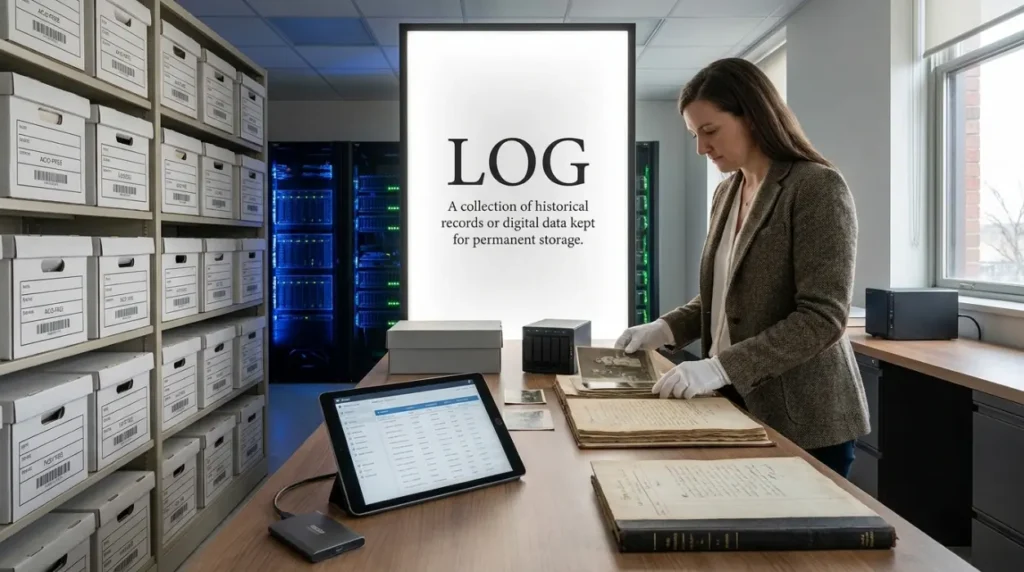
Archive (Noun / Verb) — US: /ˈɑːr.kaɪv/ | UK: /ˈɑː.kaɪv/
Meaning: A collection of historical records or digital data kept for permanent storage.
Tone/Register: Academic / Technical
Example 1: Historians searched the museum archive for ancient letters.
Example 2: You can archive old email messages to keep your inbox clean.
Account (Noun / Verb) — US: /əˈkaʊnt/ | UK: /əˈkaʊnt/
Meaning: A written or spoken report describing an event or series of events.
Tone/Register: Formal / Legal
Example 1: An eyewitness provided a clear account of the bank robbery.
Example 2: She had to account for every dollar spent during her business trip.
Inventory (Noun / Verb) — US: /ˈɪn.vən.tɔːr.i/ | UK: /ˈɪn.vən.tr i/
Meaning: A complete, itemized list of goods, stock, or property in possession.
Tone/Register: Business / Industrial
Example 1: The store manager conducted a monthly inventory of stock levels.
Example 2: Staff members inventory incoming warehouse shipments every morning.
Schedule (Noun / Verb) — US: /ˈskedʒ.uːl/ | UK: /ˈʃed.juːl/
Meaning: A plan or list showing intended events, tasks, or times for completion.
Tone/Register: Professional / General
Example 1: Check the train schedule to see when the next express leaves.
Example 2: Please schedule the team meeting for Thursday afternoon.
Tabulate (Verb) — US: /ˈtæb.jə.leɪt/ | UK: /ˈtæb.jə.leɪt/
Meaning: To arrange data, numbers, or facts systematically in a table or list.
Tone/Register: Academic / Statistical
Example 1: Computers quickly tabulate survey results from thousands of respondents.
Example 2: The committee will tabulate votes at the end of the election.
Track (Verb) — US: /træk/ | UK: /træk/
Meaning: To follow or record the continuous progress, movement, or growth of something.
Tone/Register: General / Technical
Example 1: Fitness apps track your daily steps and active heart rate.
Example 2: Delivery services let customers track packages online in real time.
Note down (Phrasal Verb) — US: /noʊt daʊn/ | UK: /nəʊt daʊn/
Meaning: To write information down quickly on paper or a digital device.
Tone/Register: Conversational / General
Example 1: Note down her phone number before you forget it.
Example 2: I always note down sudden ideas in my phone’s memo app.
Mark down (Phrasal Verb) — US: /mɑːrk daʊn/ | UK: /mɑːk daʊn/
Meaning: To make a written record of something for reference or evaluation.
Tone/Register: Practical / Educational
Example 1: Teachers mark down attendance at the start of every class.
Example 2: Mark down the important key points during the safety briefing.
Set down (Phrasal Verb) — US: /set daʊn/ | UK: /set daʊn/
Meaning: To state or record something formally in writing for rules or records.
Tone/Register: Formal / Legal
Example 1: Company policies set down strict guidelines for data protection.
Example 2: The contract set down exact payment terms for both parties.
Write down (Phrasal Verb) — US: /raɪt daʊn/ | UK: /raɪt daʊn/
Meaning: To record thoughts, spoken words, or data on paper or screen.
Tone/Register: Casual / Conversational
Example 1: Write down the recipe steps so you can cook it again later.
Example 2: She wrote down her thoughts to clear her mind before sleeping.
Put on record (Idiom / Verb Phrase) — US: /pʊt ɑːn ˈrek.ɚd/ | UK: /pʊt ɒn ˈrek.ɔːd/
Meaning: To state something officially so that it is formally noted in writing.
Tone/Register: Formal / Political
Example 1: The senator wanted to put his disagreement on record.
Example 2: We must put these safety concerns on record immediately.
Enter (Verb) — US: /ˈen.t̬ɚ/ | UK: /ˈen.tər/
Meaning: To input data or information into an official register, record, or system.
Tone/Register: Professional / Technical
Example 1: Enter your user login details to access the secure database.
Example 2: The clerk will enter your flight information into the system.
Post (Verb) — US: /poʊst/ | UK: /pəʊst/
Meaning: To record or publish entries into an official ledger, message board, or site.
Tone/Register: Business / Digital
Example 1: Accountants post daily financial transactions to the main ledger.
Example 2: The team leader posted project updates on the shared portal.
Sign in (Phrasal Verb) — US: /saɪn ɪn/ | UK: /saɪn ɪn/
Meaning: To record one’s arrival at a building or access a digital account.
Tone/Register: General / Technical
Example 1: All visitors must sign in at the front desk security station.
Example 2: Sign in to your cloud storage account to upload your files.
Log in (Phrasal Verb) — US: /lɑːɡ ɪn/ | UK: /lɒɡ ɪn/
Meaning: To gain access to a computer system or program by entering credentials.
Tone/Register: Technical / Digital
Example 1: Log in to your corporate portal to view your pay statements.
Example 2: You need a strong password to log in securely.
Clock in (Phrasal Verb) — US: /klɑːk ɪn/ | UK: /klɒk ɪn/
Meaning: To record the time of arrival at work using a time card or app.
Tone/Register: Business / Workplace
Example 1: Employees clock in at 8 AM using digital ID cards.
Example 2: Don’t forget to clock in before starting your morning shift.
Tally (Noun / Verb) — US: /ˈtæl.i/ | UK: /ˈtæl.i/
Meaning: A current score, count, or record of calculated amounts over time.
Tone/Register: Practical / Informational
Example 1: Keep a running tally of election votes as they arrive.
Example 2: The official will tally the final scores at the game’s end.
Summary (Noun) — US: /ˈsʌm.ɚ.i/ | UK: /ˈsʌm.ər.i/
Meaning: A brief statement or account giving the main points of a longer record.
Tone/Register: Academic / Business
Example 1: Read the executive summary before looking through detailed files.
Example 2: She presented a clear summary of weekly department progress.
Listing (Noun) — US: /ˈlɪs.tɪŋ/ | UK: /ˈlɪs.tɪŋ/
Meaning: An entry in a directory, register, or systematically organized catalog.
Tone/Register: Commercial / General
Example 1: Real estate agencies updated their housing listings this morning.
Example 2: Check the directory listing to locate the medical clinic.
Note-taking (Noun) — US: /ˈnoʊtˌteɪ.kɪŋ/ | UK: /ˈnəʊtˌteɪ.kɪŋ/
Meaning: The practice of recording information captured from another source or lecture.
Tone/Register: Educational / General
Example 1: Effective note-taking helps students perform better on final exams.
Example 2: She improved her note-taking skills during university seminars.
Plot (Verb) — US: /plɑːt/ | UK: /plɒt/
Meaning: To mark or record positions, progress, or points on a chart or map.
Tone/Register: Technical / Scientific
Example 1: Navigators plot the ship’s coordinates on nautical maps daily.
Example 2: Scientists plot temperature changes on a line graph.
Enrollment (Noun) — US: /ɪnˈroʊl.mənt/ | UK: /ɪnˈrəʊl.mənt/
Meaning: The act or process of systematically entering a person into an official register.
Tone/Register: Academic / Administrative
Example 1: Student enrollment increased significantly for the autumn semester.
Example 2: Complete your course enrollment before classes fill up.
Manifest (Noun) — US: /ˈmæn.ə.fest/ | UK: /ˈmæn.ɪ.fest/
Meaning: An official document listing cargo, passengers, and crew carried on a vessel or plane.
Tone/Register: Transportation / Legal
Example 1: Customs officers checked the ship’s shipping manifest carefully.
Example 2: The airline passenger manifest verified everyone on board.
Docket (Noun / Verb) — US: /ˈdɑː.kɪt/ | UK: /ˈdɒk.ɪt/
Meaning: An official calendar or agenda listing pending cases or items for attention.
Tone/Register: Legal / Official
Example 1: The court docket was full of pending trial cases.
Example 2: Clerks docket incoming legal appeals systematically.
System log (Noun Phrase) — US: /ˈsɪs.təm lɑːɡ/ | UK: /ˈsɪs.təm lɒɡ/
Meaning: An automatically generated digital record detailing operating software events.
Tone/Register: Technical / IT
Example 1: Engineers reviewed the server system log to identify network errors.
Example 2: System logs record every administrative access attempt automatically.
Wood (Noun) — US: /wʊd/ | UK: /wʊd/
Meaning: The hard fibrous material that forms the main substance of trees.
Tone/Register: General / Basic
Example 1: Dry wood burns much cleaner than wet green branches.
Example 2: Artisans carved beautiful kitchen bowls out of local olive wood.
Synonyms by Tone
| Tone Category | Synonyms for Log |
| Positive | Chronicle, Journal, Archive, Milestone record |
| Neutral | Record, Register, Document, Entry, File, Index |
| Negative | Deforestation, timber, Incident log, Audit trail (in dispute) |
| Informal | Note down, Write down, Clock in, Sign in, Firewood |
Selecting the proper tone ensures your vocabulary choices align with context.
Positive Tone
- Chronicle
- Journal
- Archive
- Milestone record
Neutral Tone
- Record
- Register
- Document
- Entry
- File
- Index
Negative Tone
Note: Associated with legal disputes, administrative burdens, or environmental issues.
- Deforestation timber
- Incident log
- Audit trail
Playful / Informal Tone
- Note down
- Write down
- Clock in
- Sign in
- Firewood
Mini Comparison: “Log” vs Close Alternatives
| Term | Core Meaning | Tone | Best Context To Use |
| Log | Systematic record of events or a heavy piece of wood. | Technical / Versatile | Computing, shipping, aviation, forestry. |
| Record | Any permanent account of facts, events, or transactions. | General / Official | Business, healthcare, legal documents. |
| Journal | Personal or reflective daily account of events or thoughts. | Personal / Academic | Personal growth, research, creative writing. |
Context-Based Usage
Daily Conversation
In everyday speech, people prefer simple phrasal verbs like note down, write down, or sign in.
Example: “Let me note down your address so I can send the birthday invitation.”
Writing or Blogging
Bloggers and writers use expressive terms like journal, chronicle, or document.
Example: “Travel bloggers love to chronicle their trips through vivid photo updates.”
Professional or Academic Tone
Formal reports require structured words like register, ledger, archive, or tabulate.
Example: “The financial auditor examined every entry inside the firm’s corporate ledger.”
Creative or Informal Use
Storytellers describing physical settings use words like timber, firewood, or billet.
Example: “The woodsman carried a fresh bundle of dry firewood inside the cabin.”
Common Mistakes & Native Usage

Misuse Scenarios
- Confusing Physical Wood with Digital Records: Do not use physical timber synonyms (like lumber) when describing digital data files.
- Overusing Technical Terms in Personal Writing: Avoid using computing terms like system log when describing a personal diary or travel story.
Register Notes
- Formal Written English: Use words like document, chronicle, ledger, and tabulate.
- Spoken Informal English: Use phrases like write down, clock in, keep track of, and note down.
Real-Life Mini Scenarios
Workplace Scenario
A project manager uses a digital task tracker to record project updates and review team entries.
Social Situations
Friends sitting around a campfire add another cut block of wood to keep the fire going through the cold night.
Media & Pop Culture
Tech news Outlets report on security experts reviewing server system logs to stop data breaches.
Writing & Storytelling
An author paints a vivid scene of an old sailor writing down sea coordinates in his weather-beaten ship logbook.
Conclusion
Expanding your English vocabulary gives you precise tools to describe digital data records, reflective writing, and physical timber clearly. Selecting the right synonym for log sharpens your writing style across every project.
Understanding distinct tone nuances ensures your words match your audience perfectly, whether you are writing technical software reports or creative stories. Varied phrasing keeps readers interested and engaged.
Practice using these dynamic vocabulary alternatives in your everyday emails, essays, and workplace reports. Regular application builds long-term language confidence and natural communication skills.
Practice Exercise
1. Which synonym best fits an official accounting book used for financial transactions?
A) Billet
B) Ledger
C) Firewood
D) Trunk
2. What word describes a personal book where someone writes down private daily thoughts?
A) Ledger
B) Journal
C) Manifest
D) Audit trail
3. Which term refers specifically to processed wood boards used for house construction?
A) Lumber
B) Minute
C) Index
D) Chronicle
4. What word fits best in computing when referring to user access histories?
A) System log
B) Firewood
C) Billet
D) Chump
5. Which phrasal verb means to write down information quickly on paper?
A) Mark down
B) Note down
C) Clock in
D) Sign in
6. What formal term describes official notes taken during a corporate meeting?
A) Minutes
B) Chumps
C) Firewood
D) Trunks
7. Which word describes an alphabetical list at the back of a textbook referencing page locations?
A) Index
B) Billet
C) Manifest
D) Ledger
8. What shipping document lists the cargo and crew on board a vessel?
A) Manifest
B) Journal
C) Diary
D) Note
9. Which word fits best when describing historical events recorded over centuries?
A) Firewood
B) Chronicle
C) Lumber
D) Billet
10. What action does an employee take when recording their morning arrival time at work?
A) Clock in
B) Mark down
C) Tabulate
D) Archive
Answer Key:
1: B | 2: B | 3: A | 4: A | 5: B | 6: A | 7: A | 8: A | 9: B | 10: A
Application Task:
Write one original sentence about your personal productivity routine or study habits using the synonym document or journal.
FAQs
1. What is the most common synonym for log when referring to data?
The most common synonym for log regarding data is “record.” Other popular choices include “entry,” “register,” and “document,” depending on whether you are working with computing files, legal documents, or general notes.
2. What is the difference between a log and a journal?
A log is typically a systematic, factual, and objective record of events, measurements, or data. A journal focuses more on personal thoughts, reflections, creative writing, or detailed qualitative observations recorded over time.
3. Which synonym for log should I use for physical wood?
When referring to physical wood, use “timber” for standing or uncut trees, “lumber” for cut boards prepared for construction, “firewood” for fuel, or “trunk” for the main wooden body of a tree.
4. Is “log in” different from “sign in”?
Both terms mean gaining access to a computer system or account. “Log in” is slightly more technical and common in software settings, whereas “sign in” is widely used for both digital accounts and physical visitor guestbooks.
5. What is a good synonym for log to use on a professional resume?
On a resume, replace “logged” with strong action verbs like “documented,” “recorded,” “cataloged,” “tracked,” or “tabulated.” These verbs highlight organization, technical skill, and attention to detail clearly to hiring managers.

Jameel Hassan is the founder and lead writer at SynonymsCloud.com, a trusted online platform dedicated to English vocabulary and effective communication. He is passionate about helping students, writers, professionals, and lifelong learners discover the right words to express their ideas with clarity, precision, and confidence.
At SynonymsCloud.com, every article is thoroughly researched and carefully written to provide accurate, practical, and easy-to-understand guidance on synonyms, antonyms, word meanings, idioms, and vocabulary. With a strong commitment to quality, real-world usage, and clear explanations, the website helps readers expand their vocabulary, improve their writing, and communicate more effectively in both academic and professional settings.