
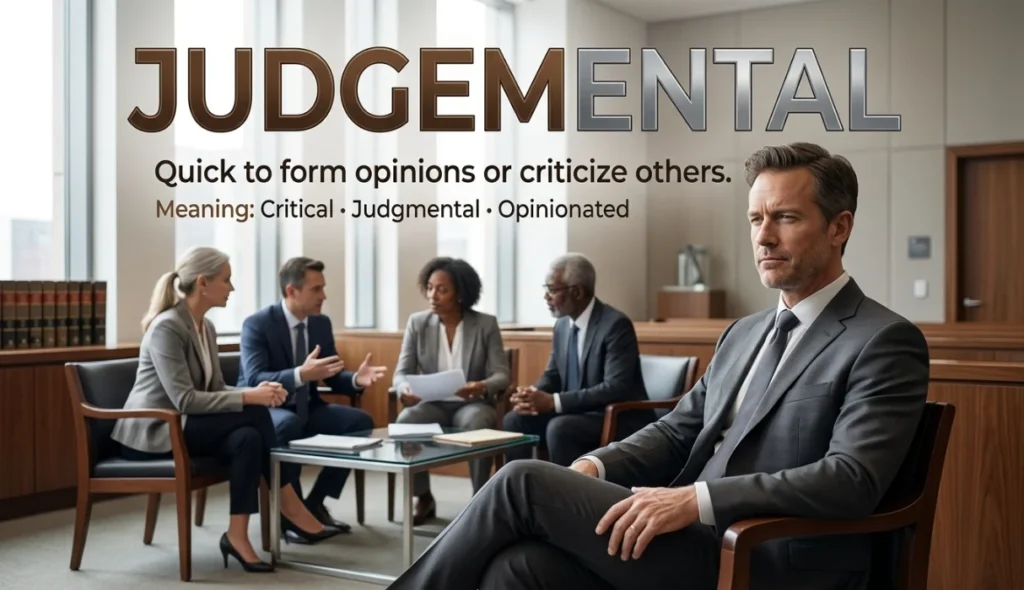
Judgemental describes someone who quickly forms harsh, critical, or unfair opinions about others. Depending on tone, common synonyms include critical (everyday), hypercritical or censorious (formal), self-righteous or sanctimonious (moral superiority), and discerning or perceptive (positive, insightful evaluation). The American English spelling is judgmental.
A synonym for judgemental (also spelled judgmental) is an essential vocabulary term when describing critical people or unfair attitudes. Imagine sitting in a coffee shop where someone loudly critiques another person’s outfit choice. You might instantly describe that overly critical observer as judgemental.
Learning a new synonym for judgemental helps you describe human behavior with accuracy and depth. Broadening your vocabulary ensures your writing stays vivid, precise, and expressive across any format.
People frequently use this descriptor because human social interactions involve constant observation and personal opinions. Finding the right synonym for judgemental lets you express approval, disapproval, or neutral assessment with precision.
This vocabulary guide is ideal for students writing essays, bloggers drafting posts, content writers crafting stories, and ESL learners improving everyday English. Master these expressive alternatives to elevate your communication skills.
What Does “Judgemental” Really Mean?
“Judgemental” is an adjective used to describe someone who tends to judge others quickly, harshly, or critically.
It carries a strong emotional tone of disapproval, implying that the person forms negative opinions without knowing the full story. Native speakers understand it as an unhelpful trait in social or professional relationships. It commonly appears in conversations about personal relationships, workplace culture, social media commentary, and book reviews.
- Part of Speech: Adjective
- Simple Definition: Having or showing a strong tendency to judge others critically or unfairly.
Connotative Meaning
(Connotation is the emotional feeling or cultural association attached to a word beyond its strict dictionary definition.)
- Positive tone: Discerning, perceptive, critical (when meaning analytical).
- Negative tone: Judgemental, hypercritical, censorious, condemnatory, opinionated, sanctimonious.
- Neutral tone: Evaluative, judgmental, critical (when meaning objective assessment).
Etymology
“Judgemental” comes from the noun judgement, which traces back to Old French jugement, derived from Latin iudicare (meaning “to judge”).
- Old English (450–1100): Early Germanic terms like dēman (to deem or judge) were used before French imports.
- Middle English (1100–1500): The French word jugement entered English after the Norman Conquest.
- Modern English (1500–Present): The suffix -al was added in modern times to form “judgemental” (or “judgmental”), describing a critical personality trait.
Pronunciation (US & UK)
- US: /dʒʌdʒˈmentl/
- UK: /dʒʌdʒˈmentl/
Syllables & Structure
- Syllables: judge-men-tal
- Root: judge
- Prefix: None
- Suffix: -mental
Synonyms List
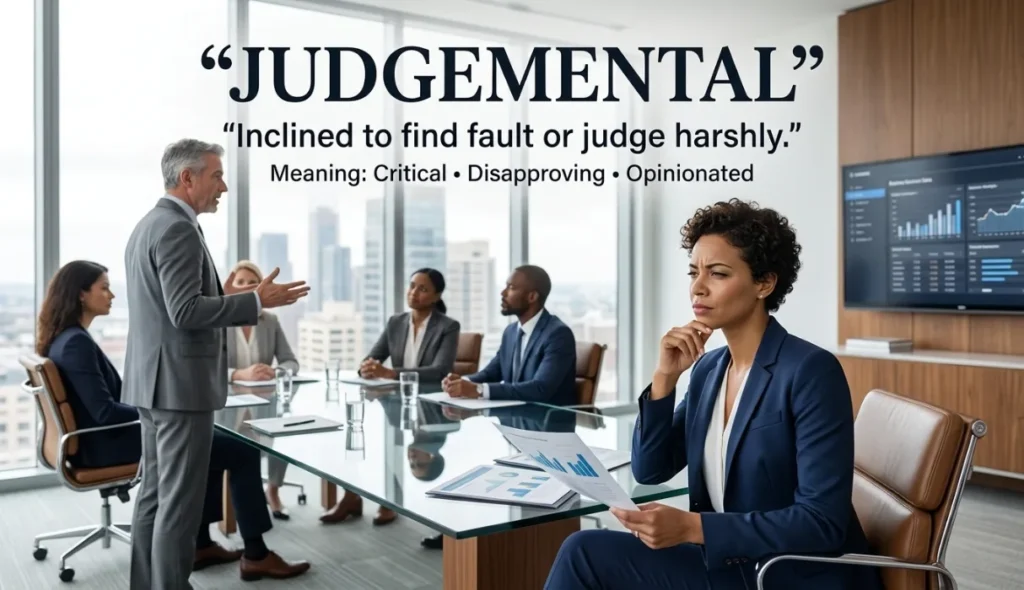
Critical (Adjective) — US: /ˈkrɪt̬.ɪ.kəl/ | UK: /ˈkrɪt.ɪ.kəl/
- Meaning: Inclined to find fault or judge harshly.
- Tone/Register: Neutral, Everyday
- Example 1: My boss became very critical during the morning staff meeting.
- Example 2: Try not to be so critical when reviewing your team’s first draft.
Hypercritical (Adjective) — US: /ˌhaɪ.pɚˈkrɪt̬.ɪ.kəl/ | UK: /ˌhaɪ.pəˈkrɪt.ɪ.kəl/
- Meaning: Excessively or unreasonably critical about small details.
- Tone/Register: Formal, Psychological
- Example 1: The hypercritical manager inspected every single document line by line.
- Example 2: She felt exhausted living with a hypercritical roommate.
Censorious (Adjective) — US: /senˈsɔːr.i.əs/ | UK: /senˈsɔː.ri.əs/
- Meaning: Severely critical and quick to express strong disapproval.
- Tone/Register: Formal, Academic
- Example 1: The committee issued a censorious report regarding the committee’s budget decisions.
- Example 2: His censorious remarks alienated most of his colleagues.
Condemnatory (Adjective) — US: /kənˈdem.nə.tɔːr.i/ | UK: /kənˈdem.nə.tr.i/
- Meaning: Expressing strong disapproval or official condemnation.
- Tone/Register: Formal, Legal
- Example 1: The judge spoke in a stern, condemnatory tone.
- Example 2: The newspaper published a condemnatory article about the local scandal.
Opinionated (Adjective) — US: /əˈpɪn.jə.neɪ.t̬ɪd/ | UK: /əˈpɪn.jə.neɪ.tɪd/
- Meaning: Holding strong opinions stubbornly without listening to others.
- Tone/Register: Informal, Everyday
- Example 1: Mark is so opinionated that discussions often end in arguments.
- Example 2: An opinionated podcast host shared his views on current events.
Disapproving (Adjective) — US: /ˌdɪs.əˈpruː.vɪŋ/ | UK: /ˌdɪs.əˈpruː.vɪŋ/
- Meaning: Showing a feeling that someone or something is bad or wrong.
- Tone/Register: General, Descriptive
- Example 1: She gave him a disapproving look when he arrived late.
- Example 2: His disapproving silence made everyone in the room uncomfortable.
Faultfinding (Adjective) — US: /ˈfɑːltˌfaɪn.dɪŋ/ | UK: /ˈfɒltˌfaɪn.dɪŋ/
- Meaning: Continually looking for mistakes or defects in others.
- Tone/Register: General, Descriptive
- Example 1: Nobody enjoys working with a faultfinding supervisor.
- Example 2: Her faultfinding attitude ruined the fun of the team project.
Sanctimonious (Adjective) — US: /ˌsæŋk.təˈmoʊ.ni.əs/ | UK: /ˌsæŋk.tɪˈməʊ.ni.əs/
- Meaning: Making a show of being morally superior to other people.
- Tone/Register: Formal, Literary
- Example 1: He gave a sanctimonious speech about honesty while hiding his mistakes.
- Example 2: Her sanctimonious attitude annoyed everyone at the dinner table.
Self-righteous (Adjective) — US: /ˌselfˈraɪ.tʃəs/ | UK: /ˌselfˈraɪ.tʃəs/
- Meaning: Convinced of one’s own moral superiority over others.
- Tone/Register: General, Expressive
- Example 1: The self-righteous activist refused to listen to alternative views.
- Example 2: His self-righteous posts on social media turned many friends away.
Judgmental (Adjective) — US: /dʒʌdʒˈmentl/ | UK: /dʒʌdʒˈmentl/
- Meaning: American spelling variant meaning quick to form harsh judgments.
- Tone/Register: General, Standard
- Example 1: Try to listen with an open mind rather than being judgmental.
- Example 2: American publications typically prefer the spelling judgmental.
Picky (Adjective) — US: /ˈpɪk.i/ | UK: /ˈpɪk.i/
- Meaning: Very selective and difficult to please regarding small details.
- Tone/Register: Informal, Casual
- Example 1: The restaurant client was extremely picky about how his food was cooked.
- Example 2: She is picky about the software tools she uses for design.
Fastidious (Adjective) — US: /fæˈstɪd.i.əs/ | UK: /fæˈstɪd.i.əs/
- Meaning: Very attentive to accuracy, detail, and cleanliness.
- Tone/Register: Formal, Professional
- Example 1: The fastidious editor checked every single reference in the book.
- Example 2: He kept his desk in fastidious order at all times.
Carping (Adjective) — US: /ˈkɑːr.pɪŋ/ | UK: /ˈkɑː.pɪŋ/
- Meaning: Difficult to please and constantly complaining about petty matters.
- Tone/Register: Literary, Formal
- Example 1: She grew tired of his carping criticism regarding her cooking.
- Example 2: The carping reviewer found fault with even the best scenes.
Caviling (Adjective) — US: /ˈkæv.əl.ɪŋ/ | UK: /ˈkæv.əl.ɪŋ/
- Meaning: Raising petty and unnecessary objections.
- Tone/Register: Academic, Rare
- Example 1: The caviling lawyer questioned every minor detail in the contract.
- Example 2: Ignore those caviling remarks and focus on your main goals.
Nitpicking (Adjective) — US: /ˈnɪtˌpɪk.ɪŋ/ | UK: /ˈnɪtˌpɪk.ɪŋ/
- Meaning: Giving too much attention to tiny, insignificant details or errors.
- Tone/Register: Informal, Everyday
- Example 1: Stop nitpicking and look at the overall progress we made.
- Example 2: A nitpicking reviewer gave the product four stars for minor reasons.
Dismissive (Adjective) — US: /dɪsˈmɪs.ɪv/ | UK: /dɪsˈmɪs.ɪv/
- Meaning: Showing that something is unworthy of serious consideration.
- Tone/Register: General, Professional
- Example 1: He made a dismissive gesture and walked out of the room.
- Example 2: Her dismissive response hurt the young designer’s confidence.
Scornful (Adjective) — US: /ˈskɔːrn.fəl/ | UK: /ˈskɔːn.fəl/
- Meaning: Feeling or showing open contempt or mockery toward someone.
- Tone/Register: Literary, Expressive
- Example 1: The villain gave a scornful laugh before walking away.
- Example 2: She shot him a scornful look when he suggested skipping work.
Disdainful (Adjective) — US: /dɪsˈdeɪn.fəl/ | UK: /dɪsˈdeɪn.fəl/
- Meaning: Showing contempt or a lack of respect for others.
- Tone/Register: Formal, Literary
- Example 1: The art critic held a disdainful attitude toward modern pop art.
- Example 2: He spoke about his competitors in a disdainful tone.
Contemptuous (Adjective) — US: /kənˈtemp.tʃu.əs/ | UK: /kənˈtemp.tʃu.əs/
- Meaning: Showing deep hatred or disrespect for a person or thing.
- Tone/Register: Formal, Expressive
- Example 1: The executive was contemptuous of the new company regulations.
- Example 2: Her contemptuous remark sparked an angry debate among committee members.
Supercilious (Adjective) — US: /ˌsuː.pɚˈsɪl.i.əs/ | UK: /ˌsuː.pəˈsɪl.i.əs/
- Meaning: Behaving as though one thinks one is superior to others.
- Tone/Register: Formal, Literary
- Example 1: The supercilious waiter looked down on customers who ordered cheap wine.
- Example 2: His supercilious attitude made him unpopular in the neighborhood.
Patronizing (Adjective) — US: /ˈpeɪ.trə.naɪ.zɪŋ/ | UK: /ˈpæt.rə.naɪ.zɪŋ/
- Meaning: Treating someone with apparent kindness that betrays a feeling of superiority.
- Tone/Register: General, Social
- Example 1: I dislike it when people use a patronizing tone with beginners.
- Example 2: Her patronizing explanation felt insulting to the experienced engineers.
Condescending (Adjective) — US: /ˌkɑːn.dəˈsen.dɪŋ/ | UK: /ˌkɒn.dɪˈsen.dɪŋ/
- Meaning: Showing a feeling of patronizing superiority over others.
- Tone/Register: General, Everyday
- Example 1: He spoke in a condescending manner during the entire interview.
- Example 2: Avoid being condescending when explaining complex topics to students.
Snobbish (Adjective) — US: /ˈsnɑː.bɪʃ/ | UK: /ˈsnɒb.ɪʃ/
- Meaning: Inclined to look down on social classes or tastes perceived as inferior.
- Tone/Register: Informal, Social
- Example 1: Their snobbish behavior alienated visitors at the art gallery opening.
- Example 2: She realized her snobbish attitude was holding her back from making new friends.
Haughty (Adjective) — US: /ˈhɑː.t̬i/ | UK: /ˈhɔː.ti/
- Meaning: Arrogantly superior and disdainful toward others.
- Tone/Register: Formal, Literary
- Example 1: The haughty nobleman refused to speak to the local villagers.
- Example 2: She walked into the room with a haughty expression on her face.
Overbearing (Adjective) — US: /ˌoʊ.vɚˈber.ɪŋ/ | UK: /ˌəʊ.vəˈbeə.rɪŋ/
- Meaning: Unpleasantly domineering and dictatorial.
- Tone/Register: General, Descriptive
- Example 1: An overbearing parent interfered with every aspect of the child’s life.
- Example 2: His overbearing personality dominated every team meeting.
Dogmatic (Adjective) — US: /dɑːɡˈmæt̬.ɪk/ | UK: /dɒɡˈmæt.ɪk/
- Meaning: Expressing personal opinions strongly as if they were unquestionable facts.
- Tone/Register: Academic, Formal
- Example 1: The professor was dogmatic about his research methodology.
- Example 2: Dogmatic statements leave little room for constructive debate.
Uncompromising (Adjective) — US: /ʌnˈkɑːm.prə.maɪ.zɪŋ/ | UK: /ʌnˈkɒm.prə.maɪ.zɪŋ/
- Meaning: Unwilling to grant concessions or adjust opinions.
- Tone/Register: Professional, Formal
- Example 1: Her uncompromising stance on quality earned her widespread respect.
- Example 2: Uncompromising directors can be challenging for actors to work with.
Inflexible (Adjective) — US: /ɪnˈflek.sə.bəl/ | UK: /ɪnˈflek.sə.bəl/
- Meaning: Rigid and unwilling to change one’s mind or approach.
- Tone/Register: General, Everyday
- Example 1: An inflexible mindset prevents people from learning new skills.
- Example 2: The company policy remained inflexible despite employee requests.
Narrow-minded (Adjective) — US: /ˌner.oʊˈmaɪn.dɪd/ | UK: /ˌnær.əʊˈmaɪn.dɪd/
- Meaning: Unwilling to accept or consider different ideas and perspectives.
- Tone/Register: General, Descriptive
- Example 1: Travel helps people become less narrow-minded about other cultures.
- Example 2: His narrow-minded views created tension in the diverse team.
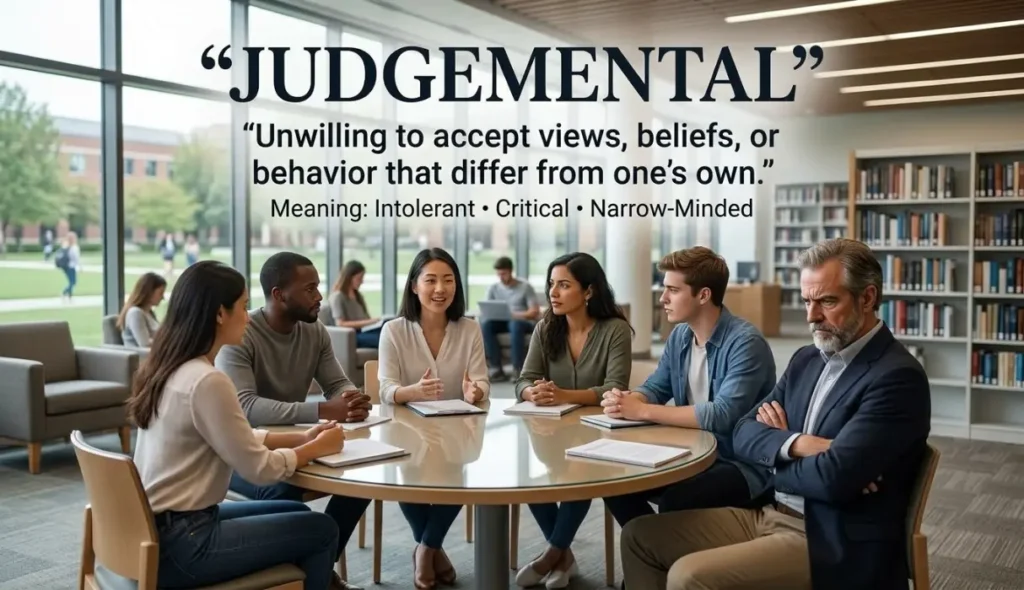
Intolerant (Adjective) — US: /ɪnˈtɑː.lɚ.ənt/ | UK: /ɪnˈtɒl.ər.ənt/
- Meaning: Unwilling to accept views, beliefs, or behavior that differ from one’s own.
- Tone/Register: Formal, Social
- Example 1: Society must remain vigilant against intolerant behavior.
- Example 2: She found him intolerant of anyone who disagreed with his politics.
Biased (Adjective) — US: /ˈbaɪ.əst/ | UK: /ˈbaɪ.əst/
- Meaning: Unfairly prejudiced for or against someone or something.
- Tone/Register: Academic, Media
- Example 1: The news coverage appeared biased toward one political candidate.
- Example 2: Analysts must avoid presenting biased data in their reports.
Prejudiced (Adjective) — US: /ˈpredʒ.ə.dɪst/ | UK: /ˈpredʒ.ə.dɪst/
- Meaning: Having or showing an unfair dislike based on preconceived ideas.
- Tone/Register: General, Social
- Example 1: Prejudiced assumptions can ruin community trust quickly.
- Example 2: He realized his prejudiced views were based on outdated information.
Sharp-tongued (Adjective) — US: /ʃɑːrpˈtʌŋd/ | UK: /ʃɑːpˈtʌŋd/
- Meaning: Given to speaking in a harsh, critical, or sarcastic way.
- Tone/Register: Descriptive, Literary
- Example 1: The sharp-tongued host made guests feel nervous on live television.
- Example 2: Her sharp-tongued comments caused hurt feelings among team members.
Acerbic (Adjective) — US: /əˈsɝː.bɪk/ | UK: /əˈsɜː.bɪk/
- Meaning: Sharp and forthright in expression, often with a sour tone.
- Tone/Register: Literary, Formal
- Example 1: The critic wrote an acerbic review of the new theater production.
- Example 2: His acerbic wit entertained readers but hurt his friends.
Caustic (Adjective) — US: /ˈkɑː.stɪk/ | UK: /ˈkɔː.stɪk/
- Meaning: Sarcastic, scathingly and bitterly.
- Tone/Register: Formal, Literary
- Example 1: Her caustic humor left a bitter taste in everyone’s mouth.
- Example 2: The politician received caustic criticism from the national press.
Vitriolic (Adjective) — US: /ˌvɪt.riˈɑː.lɪk/ | UK: /ˌvɪt.riˈɒl.ɪk/
- Meaning: Filled with bitter malice or severe hostility.
- Tone/Register: Formal, Media
- Example 1: Online comments turned vitriolic after the controversial announcement.
- Example 2: He delivered a vitriolic attack on his former business partners.
Severe (Adjective) — US: /səˈvɪr/ | UK: /sɪˈvɪər/
- Meaning: Very strict, harsh, or unforgiving in judgment.
- Tone/Register: General, Formal
- Example 1: The headmaster was known for his severe discipline style.
- Example 2: She faced severe criticism for missing the project deadline.
Stern (Adjective) — US: /stɝːn/ | UK: /stɜːn/
- Meaning: Serious and unrelenting in tone or discipline.
- Tone/Register: General, Descriptive
- Example 1: The teacher gave the noisy classroom a stern warning.
- Example 2: His stern demeanor hid a kind and generous heart.
Unforgiving (Adjective) — US: /ˌʌn.fɚˈɡɪv.ɪŋ/ | UK: /ˌʌn.fəˈɡɪv.ɪŋ/
- Meaning: Unwilling to pardon mistakes or show mercy in evaluation.
- Tone/Register: General, Expressive
- Example 1: The financial market can be unforgiving toward sloppy management.
- Example 2: He maintained an unforgiving attitude toward his former rival.
Harsh (Adjective) — US: /hɑːrʃ/ | UK: /hɑːʃ/
- Meaning: Unpleasantly rough, severe, or cruel in assessment.
- Tone/Register: General, Everyday
- Example 1: The judge handed down a harsh penalty for the offense.
- Example 2: Do not be too harsh on yourself after making a simple mistake.
Exacting (Adjective) — US: /ɪɡˈzæk.tɪŋ/ | UK: /ɪɡˈzæk.tɪŋ/
- Meaning: Making severe demands or requiring extreme care and effort.
- Tone/Register: Formal, Professional
- Example 1: The architect held exacting standards for every building project.
- Example 2: Working for such an exacting boss challenged her skills daily.
Demanding (Adjective) — US: /dɪˈmæn.dɪŋ/ | UK: /dɪˈmɑːn.dɪŋ/
- Meaning: Requiring much effort, attention, or high performance standards.
- Tone/Register: General, Workplace
- Example 1: Teaching is a demanding profession that requires immense patience.
- Example 2: Clients can be demanding when deadlines are tight.
Analytical (Adjective) — US: /ˌæn.əlˈɪt̬.ɪ.kəl/ | UK: /ˌæn.əlˈɪt.ɪ.kəl/
- Meaning: Using logical reasoning and detailed examination to evaluate things.
- Tone/Register: Academic, Professional
- Example 1: Her analytical approach helped identify the root cause of the error.
- Example 2: An analytical thinker evaluates facts before forming an opinion.
Evaluative (Adjective) — US: /ɪˈvæl.ju.ə.t̬ɪv/ | UK: /ɪˈvæl.ju.ə.tɪv/
- Meaning: Expressing or involving a careful assessment of value or quality.
- Tone/Register: Academic, Formal
- Example 1: The professor provided evaluative feedback on each essay submission.
- Example 2: Evaluative skills are crucial for modern data analysts.
Discerning (Adjective) — US: /dɪˈsɝː.nɪŋ/ | UK: /dɪˈsɜː.nɪŋ/
- Meaning: Showing good judgment and taste in evaluating quality.
- Tone/Register: Formal, Positive
- Example 1: Discerning shoppers prefer hand-crafted leather goods over cheap items.
- Example 2: She has a discerning eye for art and antique furniture.
Perceptive (Adjective) — US: /pɚˈsep.tɪv/ | UK: /pəˈsep.tɪv/
- Meaning: Having or showing keen insight and quick understanding.
- Tone/Register: Formal, Positive
- Example 1: His perceptive remarks highlighted issues others had completely missed.
- Example 2: Perceptive readers notice subtle themes throughout the novel.
Shrewd (Adjective) — US: /ʃruːd/ | UK: /ʃruːd/
- Meaning: Having or showing sharp powers of judgment in practical matters.
- Tone/Register: General, Business
- Example 1: The shrewd businessman invested wisely during the economic downturn.
- Example 2: Her shrewd observations saved the startup from costly errors.
Astute (Adjective) — US: /əˈstuːt/ | UK: /əˈstjuːt/
- Meaning: Having or showing an ability to accurately assess situations.
- Tone/Register: Formal, Professional
- Example 1: An astute journalist asked probing questions during the interview.
- Example 2: His astute strategy led the team to a major victory.
Discriminatory (Adjective) — US: /dɪˈskrɪm.ə.nə.tɔːr.i/ | UK: /dɪˈskrɪm.ɪ.nə.tr.i/
- Meaning: Making an unfair or prejudicial distinction between people.
- Tone/Register: Formal, Legal
- Example 1: Laws exist to prevent discriminatory hiring practices.
- Example 2: The club faced backlash over its discriminatory membership policies.
Censorious-minded (Adjective) — US: /senˈsɔːr.i.əs ˈmaɪn.dɪd/ | UK: /senˈsɔː.ri.əs ˈmaɪn.dɪd/
- Meaning: Having a mental habit of judging others severely and constantly.
- Tone/Register: Academic, Descriptive
- Example 1: Censorious-minded critics rarely appreciate creative experimentation.
- Example 2: His censorious-minded attitude drove away potential collaborators.
Over-critical (Adjective) — US: /ˌoʊ.vɚˈkrɪt̬.ɪ.kəl/ | UK: /ˌəʊ.vəˈkrɪt.ɪ.kəl/
- Meaning: Being far too critical when evaluating people or tasks.
- Tone/Register: General, Everyday
- Example 1: Try not to be over-critical of your initial creative attempts.
- Example 2: Her over-critical nature made team members hesitate to share ideas.
Judgment-prone (Adjective) — US: /ˈdʒʌdʒ.mənt proʊn/ | UK: /ˈdʒʌdʒ.mənt prəʊn/
- Meaning: Tendency or inclination toward making rapid personal assessments.
- Tone/Register: Modern, Informative
- Example 1: Humans are naturally judgment-prone in unfamiliar social settings.
- Example 2: Social media platforms can make users more judgment-prone daily.
Fault-finding-oriented (Adjective) — US: /fɑːlt ˈfaɪn.dɪŋ ˈɔːr.i.en.t̬ɪd/ | UK: /fɒlt ˈfaɪn.dɪŋ ˈɔː.ri.en.tɪd/
- Meaning: Focused primarily on searching for flaws rather than merits.
- Tone/Register: Formal, Corporate
- Example 1: A fault-finding-oriented review damages employee morale over time.
- Example 2: Shift your approach from fault-finding-oriented to constructive coaching.
Over-evaluative (Adjective) — US: /ˌoʊ.vɚ.ɪˈvæl.ju.eɪ.t̬ɪv/ | UK: /ˌəʊ.vər.ɪˈvæl.ju.eɪ.tɪv/
- Meaning: Analyzing every single detail to an unnecessary degree.
- Tone/Register: Academic, Psychological
- Example 1: Over-evaluative thinking often leads to hesitation and anxiety.
- Example 2: Writers should avoid being over-evaluative during their first draft.
Ultra-critical (Adjective) — US: /ˌʌl.trəˈkrɪt̬.ɪ.kəl/ | UK: /ˌʌl.trəˈkrɪt.ɪ.kəl/
- Meaning: Extremely critical to an intense or maximum degree.
- Tone/Register: Informal, Modern
- Example 1: Ultra-critical audiences picked apart every scene of the movie.
- Example 2: She faced an ultra-critical panel during her thesis defense.
Synonyms by Tone
| Tone Group | Synonyms Included | Why Tone Matters |
| Positive | Discerning, Perceptive, Astute, Analytical, Shrewd, Evaluative | Positive options frame sharp observation as a thoughtful, helpful skill rather than a flaw. |
| Neutral | Critical, Evaluative, Exacting, Demanding, Judgmental | Neutral terms describe high standards or analytical tendencies without implied malice. |
| Negative | Judgemental, Hypercritical, Censorious, Condemnatory, Sanctimonious, Self-righteous, Vitriolic, Caustic | Negative options highlight unfair criticism, moral arrogance, or harsh hostility. |
| Playful / Informal | Picky, Nitpicking, Opinionated, Sharp-tongued, Snobbish | Informal choices work well in casual conversations, blogging, or lighthearted stories. |
Selecting the correct tone prevents misunderstandings. Calling a colleague “discerning” praises their attention to quality, whereas calling them “judgemental” insults their personal character.
Mini Comparison: “Judgemental” vs Close Alternatives
Judgemental vs. Critical
- Meaning Difference: “Judgemental” implies making personal or moral assessments about others unfairly. “Critical” focuses on finding faults in work, ideas, or performance, which can be either constructive or negative.
- Tone Difference: “Judgemental” is almost always negative. “Critical” can be neutral, academic, or professional.
- When to Use Each: Use “judgemental” when describing personal attitudes or gossip. Use “critical” when discussing peer reviews, editing, or analytical thinking.
Judgemental vs. Fastidious
- Meaning Difference: “Judgemental” focuses on criticizing people. “Fastidious” describes someone meticulous about cleanliness, order, or artistic details.
- Tone Difference: “Judgemental” attacks character. “Fastidious” is a neutral to formal description of personal habits.
- When to Use Each: Use “judgemental” for harsh social attitudes. Use “fastidious” when describing a careful editor, accountant, or organizer.
How “Judgemental” Changes by Context
- Daily Conversation: People choose informal, relatable words like “picky,” “nitpicking,” or “opinionated” during casual chats.
- Writing & Blogging: Content creators use engaging options like “hypercritical,” “condescending,” or “censorious” to build strong narrative depth.
- Professional or Academic Tone: Scholars and managers prefer objective terms like “analytical,” “evaluative,” or “exacting.”
- Creative or Informal Use: Novelists use expressive, vivid vocabulary like “sanctimonious,” “supercilious,” or “sharp-tongued” for rich characterization.
More Answers to Common Judgemental Synonym Queries
If you are looking for a synonym for judgemental, the best choice depends on whether you are describing a person, behavior, attitude, expression, or type of judgment. Here are direct answers to some common variations.
What Is a Synonym for Quick to Judge?
Common synonyms for quick to judge include hasty in judgment, judgment-prone, rash in judgment, snap-judging, and quick to form opinions.
- Hasty in judgment forms opinions too quickly without enough information.
- Judgment-prone tends to judge people or situations readily.
- Rash in judgment makes conclusions without careful thought.
- Quick to form opinions develops opinions before considering all the facts.
For everyday English, hasty in judgment is one of the most natural alternatives.
What Is Another Word for a Judgemental Person?
A person who is judgemental can be called a critical person, faultfinder, censorious person, hypercritical person, disapproving person, self-righteous person, or narrow-minded person.
The best word depends on the behavior:
- Critical person frequently points out faults or weaknesses.
- Faultfinder focuses strongly on other people’s mistakes.
- Censorious person expresses severe disapproval of others.
- Hypercritical person finds fault excessively.
- Self-righteous person believes their own behavior or opinions are morally superior.
- Narrow-minded person is unwilling to accept different ideas or lifestyles.
What Are Some Words for “Judgy”?
Judgy is an informal word meaning overly quick or willing to judge others. Suitable alternatives include critical, picky, disapproving, faultfinding, opinionated, condescending, self-righteous, and narrow-minded.
For casual conversation, critical or disapproving usually works well. For a stronger meaning, self-righteous or condescending may be more precise.
What Is “Judgemental” in Other Words?
In other words, judgemental can mean quick to judge, overly critical, disapproving, faultfinding, censorious, self-righteous, narrow-minded, or harshly critical.
For example:
She is judgemental about other people’s choices.
You could also say:
She is overly critical of other people’s choices.
What Is a Synonym for Human Judgment?
Depending on the context, human judgment can be replaced by human assessment, human evaluation, personal judgment, individual assessment, or human discernment.
- Human assessment an evaluation made by a person.
- Human evaluation judgment or review performed by people rather than an automated system.
- Personal judgment an individual’s own evaluation or decision.
- Human discernment the ability to recognize and evaluate differences carefully.
In technology, research, and AI contexts, human evaluation is often the clearest choice.
What Is a Synonym for Social Judgment?
Common alternatives for social judgment include social evaluation, social assessment, interpersonal judgment, social appraisal, and, in some contexts, public opinion.
Social evaluation is useful when discussing how society assesses a person’s behavior, status, or actions. Interpersonal judgment works better when the focus is on how individuals evaluate other people.
What Is a Synonym for a Judgemental Look?
A judgemental look can be described as a disapproving look, critical look, judgmental glance, scornful look, disdainful look, or censorious look.
The most natural everyday alternative is disapproving look.
For example:
He gave me a disapproving look when I arrived late.
What Is a Synonym for Severe Judgment?
Useful alternatives for severe judgment include harsh judgment, harsh assessment, condemnatory judgment, unforgiving evaluation, and severe criticism.
Harsh judgment is the most natural general expression when someone evaluates another person or situation very negatively.
What Is Another Word for a Moral Judge?
Depending on the meaning, a moral judge can be described as a moral critic, moralizing person, self-righteous person, or sanctimonious person.
Sanctimonious is especially useful when someone acts as though they are morally superior to others, often in a way that seems insincere.
What Does “Judgeful” Mean, and What Is Its Synonym?
Judgeful is uncommon and is not a standard choice in modern English. If you mean someone who is quick to judge others, use judgemental, judgmental, judging, critical, or disapproving instead.
For natural everyday English, judgemental or judging is usually the better choice.
What Is a Synonym for Negative Judgment?
Depending on the context, negative judgment can be expressed as harsh assessment, disapproval, criticism, condemnation, or unfavorable evaluation.
If you are describing a person who frequently makes negative judgments about others, judgemental or critical is usually more appropriate.
What Is a Synonym for Someone Who Is Judgemental?
A person who is judgemental may be described as critical, censorious, hypercritical, faultfinding, disapproving, self-righteous, narrow-minded, or opinionated.
The most general everyday choice is critical, while censorious and hypercritical suggest stronger or more persistent criticism.
What Is the Antonym of Judgemental?
The closest direct antonym of judgemental is nonjudgmental. Other useful opposites include open-minded, accepting, tolerant, understanding, impartial, unbiased, and fair-minded.
- Nonjudgmental does not unfairly judge or criticize others.
- Open-minded willing to consider different ideas and perspectives.
- Accepting willing to respect people despite their differences.
- Tolerant willing to accept opinions, behaviors, or lifestyles that differ from one’s own.
- Impartial judges fairly without personal bias.
- Unbiased not influenced by prejudice or favoritism.
- Fair-minded considers different sides fairly.
For most situations, nonjudgmental is the strongest direct antonym of judgemental.
Common Mistakes & Native Usage

Mistakes Learners Make
- Spelling Confusion: “Judgemental” (UK standard) and “judgmental” (US standard) are both correct. Choose one variant consistently across your document.
- Misusing “Critical”: Learners often assume “critical” is always an insult, but in academic contexts, “critical thinking” is positive.
- Confusing “Sanctimonious” with “Religious”: Sanctimonious specifically refers to fake or hypocritical righteousness, not genuine faith.
Register Notes
- Spoken English: Words like “picky,” “condescending,” and “nitpicking” dominate daily speech.
- Written English: Terms like “censorious,” “vitriolic,” and “disdainful” suit formal writing and journalism. (Explore our main English resource hub for additional vocabulary strategies).
Real-Life Mini Scenarios
- Workplace: “The manager tried to offer constructive guidance without sounding judgmental.” (Judgmental highlights workplace communication dynamics.)
- Social Situations: “She felt hurt by the censorious looks from the other parents at the park.” (Censorious conveys silent disapproval.)
- Media / Pop Culture: “Online commentators were vitriolic after the celebrity made a mistake.” (Vitriolic describes harsh internet culture.)
- Writing or Storytelling: “The haughty king dismissed the messenger with a disdainful wave of his hand.” (Disdainful adds historical drama.)
Conclusion
Expanding your list of options for a synonym for judgemental improves how you describe personalities, social situations, and literary characters. Precise word choices ensure your message strikes the exact intended tone.
Practicing these varied descriptors in essays, professional emails, and creative writing will strengthen your overall vocabulary. Choosing words thoughtfully makes your writing clearer, richer, and far more engaging.
Try incorporating a few of these expressive synonyms into your next writing piece to sharpen your English skills!
Practice Exercise
Select the best synonym for each context below.
- Which word best describes someone who is overly meticulous about small errors in a document?
a) Nitpicking
b) Sanctimonious
c) Haughty
d) Intolerant - Choose the most formal synonym for a harsh, disapproval-filled speech:
a) Picky
b) Censorious
c) Snobbish
d) Opinionated - “An __________ thinker carefully analyzes facts before drawing conclusions.”
a) Analytical
b) Hypercritical
c) Vitriolic
d) Overbearing - Which word implies fake moral superiority over others?
a) Fastidious
b) Sanctimonious
c) Astute
d) Stern - What is the preferred US spelling for this target word?
a) Judgemantel
b) Judgmental
c) Judgemintal
d) Judgmetal - Which term best describes a waiter who acts superior toward customers?
a) Supercilious
b) Discerning
c) Evaluative
d) Stern - Choose the word that best fits an official court ruling tone:
a) Nitpicking
b) Condemnatory
c) Picky
d) Sharp-tongued - What is a positive word for having sharp, good judgment?
a) Hypercritical
b) Discerning
c) Censorious
d) Caustic - Which adjective describes someone who refuses to accept other viewpoints?
a) Narrow-minded
b) Fastidious
c) Exacting
d) Perceptive - Select the best informal word for someone hard to please regarding food:
a) Vitriolic
b) Picky
c) Dogmatic
d) Censorious
Application Task:
Write a 2-sentence story about a character using one formal synonym (e.g., supercilious, fastidious, or sanctimonious) correctly in context.
Answer Key:
1-a, 2-b, 3-a, 4-b, 5-b, 6-a, 7-b, 8-b, 9-a, 10-b
FAQs
1. What is the most common synonym for judgemental in daily speech?
The most common daily synonyms for judgemental are critical, picky, condescending, and disapproving. These words express disapproval without sounding overly academic.
2. Is there a difference between judgemental and judgmental?
The only difference is regional spelling. Judgmental (without the “e”) is preferred in American English, while judgemental (with the “e”) is common in British English. Both forms are accepted worldwide.
3. What is a positive synonym for judgemental?
While judgemental is negative, positive alternatives that describe sharp observation include discerning, perceptive, analytical, and astute. These focus on keen insight rather than unfair criticism.
4. How can I avoid sounding judgemental in professional emails?
Use neutral, constructive language instead of accusatory terms. Replace harsh statements with phrases like “analytical review,” “constructive feedback,” or “detailed evaluation” to keep communication professional.
5. What is the strongest, most intense synonym for judgemental?
Strong, intense synonyms include vitriolic, censorious, hypercritical, and scathing. These terms describe severe, hostile, or unforgiving criticism.

Jameel Hassan is the founder and lead writer at SynonymsCloud.com, a trusted online platform dedicated to English vocabulary and effective communication. He is passionate about helping students, writers, professionals, and lifelong learners discover the right words to express their ideas with clarity, precision, and confidence.
At SynonymsCloud.com, every article is thoroughly researched and carefully written to provide accurate, practical, and easy-to-understand guidance on synonyms, antonyms, word meanings, idioms, and vocabulary. With a strong commitment to quality, real-world usage, and clear explanations, the website helps readers expand their vocabulary, improve their writing, and communicate more effectively in both academic and professional settings.