
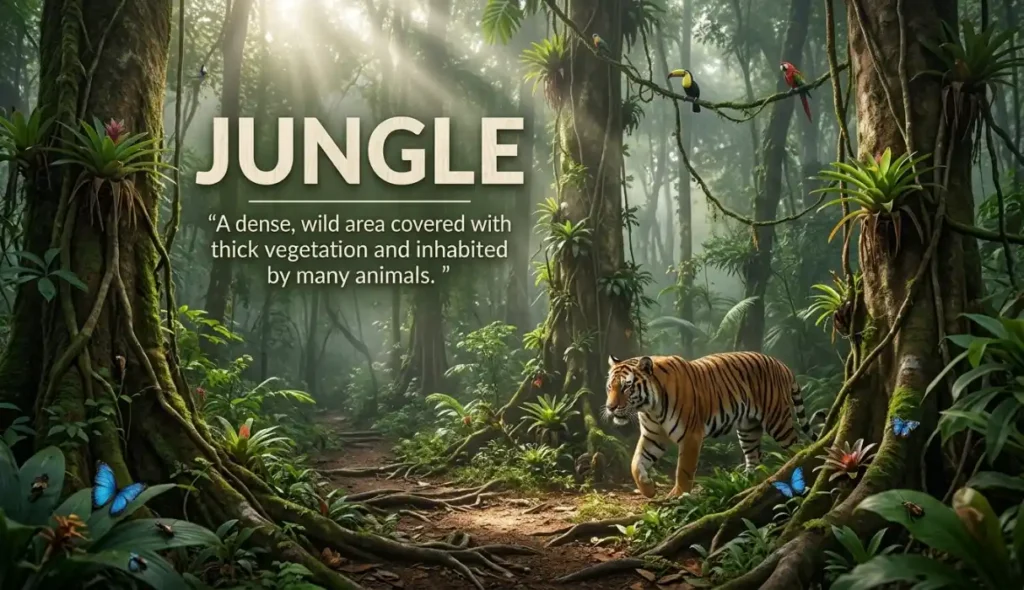
A synonym for jungle depends on the context. For dense natural environments, common synonyms include rainforest, forest, wilderness, thicket, and undergrowth. For chaotic or complex human environments, common figurative synonyms include concrete jungle, labyrinth, maze, zoo, and madhouse. The exact term depends on your intended tone.
A synonym for jungle is a crucial vocabulary term when describing dense rainforests or chaotic urban environments. Imagine walking into a bustling, noisy street market where vendor stalls block every path. You might instantly describe that chaotic place as a total jungle.
Learning a new synonym for jungle helps you describe nature and human environments with vivid depth. Expanding your word choices ensures your writing stays engaging, sharp, and expressive across any medium.
People frequently use this word because both natural ecosystems and busy human spaces can feel completely overwhelming. Finding the right synonym for jungle lets you describe overgrown wilderness or complex systems with exact detail.
This guide is ideal for students, bloggers, content writers, and daily English learners wanting to improve communication. Master these rich alternatives today to elevate your speaking and writing skills.
What Does “Jungle” Really Mean?
“Jungle” is a noun used to describe land covered with dense vegetation, tangled trees, and wild undergrowth.
Beyond its literal ecological meaning, it carries a strong figurative tone of chaos, complexity, or fierce competition. Native speakers frequently use it to describe dense tropical forests, cluttered rooms, complicated laws, or aggressive corporate workplaces.
- Part of Speech: Noun (sometimes used attributively as an adjective)
- Simple Definition: A dense, tropical forest with tangled vegetation, or any confusingly complex environment.
Connotative Meaning
(Connotation is the emotional feeling or cultural association attached to a word beyond its strict dictionary definition.)
- Positive tone: Paradise, ecosystem, sanctuary, wonderland.
- Negative tone: Wilderness, abyss, morass, labyrinth, dog-eat-dog environment.
- Neutral tone: Forest, rainforest, woods, woodland, biome.
Etymology
The word “jungle” entered English from the Hindi word jaṅgal, which came from the Sanskrit jaṅgala (meaning “arid land” or “uncultivated land”).
- Old English (450–1100): Early Germanic terms like weald (forest or wild land) were used before Indian trade influences.
- Middle English (1100–1500): General words like forest or wode were used for all wild, wooded terrains.
- Modern English (1500–Present): British interactions in India brought jungle into English during the late 18th century to describe dense tropical thickets.
Pronunciation (US & UK)
- US: /ˈdʒʌŋ.ɡəl/
- UK: /ˈdʒʌŋ.ɡəl/
Syllables & Structure
- Syllables: jun-gle
- Root: jungle
- Prefix: None
- Suffix: None
Synonyms List
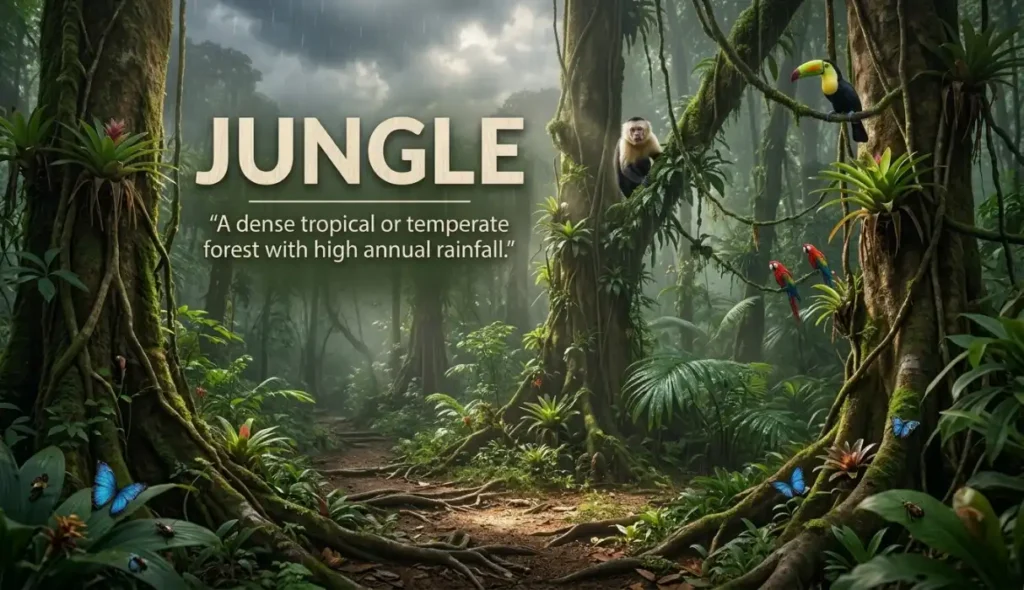
Rainforest (Noun) — US: /ˈreɪn.fɔːr.ɪst/ | UK: /ˈreɪn.fɒr.ɪst/
- Meaning: A dense tropical or temperate forest with high annual rainfall.
- Tone/Register: Scientific, Neutral
- Example 1: The Amazon rainforest produces a large percentage of the world’s oxygen.
- Example 2: Scientists discovered several new frog species deep inside the tropical rainforest.
Forest (Noun) — US: /ˈfɔːr.ɪst/ | UK: /ˈfɒr.ɪst/
- Meaning: A large area covered chiefly with trees and undergrowth.
- Tone/Register: General, Everyday
- Example 1: They decided to take a peaceful walk through the pine forest.
- Example 2: High winds knocked down several old trees across the local forest.
Woods (Noun) — US: /wʊdz/ | UK: /wʊdz/
- Meaning: An area of trees smaller than a full forest.
- Tone/Register: Informal, Everyday
- Example 1: Children love building wooden forts out in the neighborhood woods.
- Example 2: The cabin sits quietly at the edge of the deep woods.
Woodland (Noun) — US: /ˈwʊd.lənd/ | UK: /ˈwʊd.lənd/
- Meaning: Land covered with growing trees, typically less dense than a jungle.
- Tone/Register: Neutral, Descriptive
- Example 1: Local authorities protected the ancient woodland from real estate development.
- Example 2: Many bird species nest across this coastal woodland region every spring.
Thicket (Noun) — US: /ˈθɪk.ɪt/ | UK: /ˈθɪk.ɪt/
- Meaning: A dense group of bushes, shrubs, or small trees.
- Tone/Register: Descriptive, Literary
- Example 1: The frightened rabbit quickly hid inside a thorny thicket.
- Example 2: We had to cut through a thicket of vines to clear the path.
Bush (Noun) — US: /bʊʃ/ | UK: /bʊʃ/
- Meaning: Wild, uncultivated land covered with shrubs or low trees.
- Tone/Register: Casual, Regional (Australian/African English)
- Example 1: The hikers spent three days trekking through the remote Australian bush.
- Example 2: Wild animals vanished quickly into the thick green bush.
Wilderness (Noun) — US: /ˈwɪl.dɚ.nəs/ | UK: /ˈwɪl.də.nəs/
- Meaning: An uncultivated, uninhabited, and wild natural region.
- Tone/Register: Literary, General
- Example 1: Camping deep in the wilderness requires proper safety equipment and planning.
- Example 2: The national park preserves millions of acres of pristine wilderness.
Wilds (Noun) — US: /waɪldz/ | UK: /waɪldz/
- Meaning: Uncultivated or desolate regions of nature far from cities.
- Tone/Register: Expressive, Literary
- Example 1: Explorers ventured deep into the northern wilds searching for minerals.
- Example 2: He left city life behind to live out in the remote wilds.
Undergrowth (Noun) — US: /ˈʌn.dɚ.ɡroʊθ/ | UK: /ˈʌn.də.ɡrəʊθ/
- Meaning: A dense growth of shrubs and small trees growing under tall forest trees.
- Tone/Register: Scientific, Descriptive
- Example 1: Firefighters struggled to hike through the thick burning undergrowth.
- Example 2: The tracker found clear animal footprints pressed into the damp undergrowth.
Backwoods (Noun) — US: /ˈbæk.wʊdz/ | UK: /ˈbæk.wʊdz/
- Meaning: Remote, sparsely populated, and uncleared forest areas.
- Tone/Register: Informal, Regional
- Example 1: They bought a small wooden cabin deep in the backwoods.
- Example 2: Life in the backwoods offers solitude far from traffic noise.
Backcountry (Noun) — US: /ˈbækˌkʌn.tri/ | UK: /ˈbækˌkʌn.tri/
- Meaning: Isolated, undeveloped, and sparsely inhabited rural or wilderness land.
- Tone/Register: Outdoor, Neutral
- Example 1: Only experienced skiers should venture into the steep backcountry.
- Example 2: The rangers patrol the backcountry using off-road horses and vehicles.
Timberland (Noun) — US: /ˈtɪm.bɚ.lænd/ | UK: /ˈtɪm.bə.lænd/
- Meaning: Wooded land that contains trees valuable for timber production.
- Tone/Register: Industrial, Environmental
- Example 1: The paper company bought vast tracts of pine timberland in the state.
- Example 2: Sustainable timberland management prevents massive soil erosion.
Copse (Noun) — US: /kɑːps/ | UK: /kɒps/
- Meaning: A small, dense group of trees or bushes.
- Tone/Register: Literary, British English
- Example 1: A flock of birds took flight from the small copse near the farm.
- Example 2: The stream flows gently past a copse of birch trees.
Grove (Noun) — US: /ɡroʊv/ | UK: /ɡrəʊv/
- Meaning: A small group of trees without underbrush, often planted intentionally.
- Tone/Register: Pleasant, Neutral
- Example 1: Farmers harvested fresh oranges in the sunny citrus grove.
- Example 2: They sat down for a picnic under the cool shade of the olive grove.
Taiga (Noun) — US: /ˈtaɪ.ɡə/ | UK: /ˈtaɪ.ɡə/
- Meaning: The swampy, evergreen coniferous forest of high northern latitudes.
- Tone/Register: Academic, Geographic
- Example 1: The Siberian taiga experiences extremely cold winters and short summers.
- Example 2: Wolves and brown bears roam freely across the northern taiga biome.
Swamp (Noun) — US: /swɑːmp/ | UK: /swɒmp/
- Meaning: An area of low-lying, uncultivated ground where water collects; a boggy marsh forest.
- Tone/Register: General, Descriptive
- Example 1: Alligators moved silently through the murky coastal swamp.
- Example 2: High humidity makes working in the cypress swamp exhausting.
Marsh (Noun) — US: /mɑːrʃ/ | UK: /mɑːʃ/
- Meaning: An area of low, wet land characterized by herbaceous plants rather than woody trees.
- Tone/Register: Environmental, Neutral
- Example 1: Migratory ducks nest near the salt marsh every autumn.
- Example 2: The trail follows a boardwalk built over the marshy ground.
Bog (Noun) — US: /bɑːɡ/ | UK: /bɒɡ/
- Meaning: Wet, muddy ground too soft to support a heavy body, often acidic.
- Tone/Register: Descriptive, General
- Example 1: Ancient artifacts remained preserved for centuries inside the peat bog.
- Example 2: Be careful walking near the edge because the ground turns into a bog.
Fen (Noun) — US: /fen/ | UK: /fen/
- Meaning: Low, flat, marshy land drained by watercourses.
- Tone/Register: Geographic, Literary
- Example 1: Rare dragonflies thrive in the nutrient-rich waters of the fenland.
- Example 2: Fog settled heavily over the quiet fen at dawn.
Mire (Noun) — US: /maɪər/ | UK: /maɪər/
- Meaning: A stretch of swampy, boggy, or muddy ground that traps movement.
- Tone/Register: Literary, Expressive
- Example 1: The heavy supply wagon got stuck deep in the muddy mire.
- Example 2: Explorers struggled for hours to pull their gear out of the mire.
Mangrove (Noun) — US: /ˈmæŋ.ɡroʊv/ | UK: /ˈmæŋ.ɡrəʊv/
- Meaning: A tropical tree or dense coastal forest growing in tidal muddy water.
- Tone/Register: Ecological, Technical
- Example 1: Mangrove swamps protect coastlines against hurricane storm surges.
- Example 2: Small fish find safe nursery habitats among tangled mangrove roots.
Chaparral (Noun) — US: /ˌʃæp.əˈræl/ | UK: /ˌʃæp.əˈræl/
- Meaning: Dense, impenetrable vegetation consisting of spiny shrubs and small trees.
- Tone/Register: Geographic, Regional
- Example 1: Wildfires spread quickly through the dry California chaparral.
- Example 2: Deer navigated the dense brush of the coastal chaparral.
Scrubland (Noun) — US: /ˈskrʌb.lænd/ | UK: /ˈskrʌb/.lænd/
- Meaning: Land covered with small, stunted trees and low bushes.
- Tone/Register: Environmental, Neutral
- Example 1: The desert gives way to dry scrubland as elevation increases.
- Example 2: Cattle grazed on the sparse vegetation of the open scrubland.
Brush (Noun) — US: /brʌʃ/ | UK: /brʌʃ/
- Meaning: Wild vegetation, small trees, and bushes growing densely together.
- Tone/Register: Everyday, Informal
- Example 1: The hunter cleared a path through the heavy brush.
- Example 2: Dry brush near residential homes creates a serious fire hazard.
Heath (Noun) — US: /hiːθ/ | UK: /hiːθ/
- Meaning: An area of wild, uncultivated land covered with low shrubby vegetation.
- Tone/Register: Literary, British English
- Example 1: Cold wind blew across the open, heather-covered heath.
- Example 2: The old manor stood alone on the edge of the dark heath.
Moor (Noun) — US: /mʊr/ | UK: /mɔːr/
- Meaning: A tract of open, uncultivated upland overgrown with heath.
- Tone/Register: Literary, Geographic
- Example 1: Thick mist rolled across the Scottish moor in late afternoon.
- Example 2: Characters wandered across the lonely moor in the classic novel.
Labyrinth (Noun) — US: /ˈlæb.ə.rɪnθ/ | UK: /ˈlæb.ə.rɪnθ/
- Meaning: A complicated, irregular network of passages; a confusing maze.
- Tone/Register: Figurative, Literary
- Example 1: Navigating the labyrinth of corporate tax laws takes years of study.
- Example 2: The old city streets formed an endless, winding labyrinth.
Maze (Noun) — US: /meɪz/ | UK: /meɪz/
- Meaning: A network of paths through which it is difficult to find one’s way.
- Tone/Register: General, Figurative
- Example 1: The bustling night market was a maze of brightly lit food stalls.
- Example 2: New students often get lost in the maze of university hallways.
Morass (Noun) — US: /məˈræs/ | UK: /məˈræs/
- Meaning: An area of muddy ground, or a complicated, confusing situation.
- Tone/Register: Formal, Figurative
- Example 1: The project stalled due to a bureaucratic morass of paperwork.
- Example 2: Soldiers struggled across the muddy morass during the heavy rain.
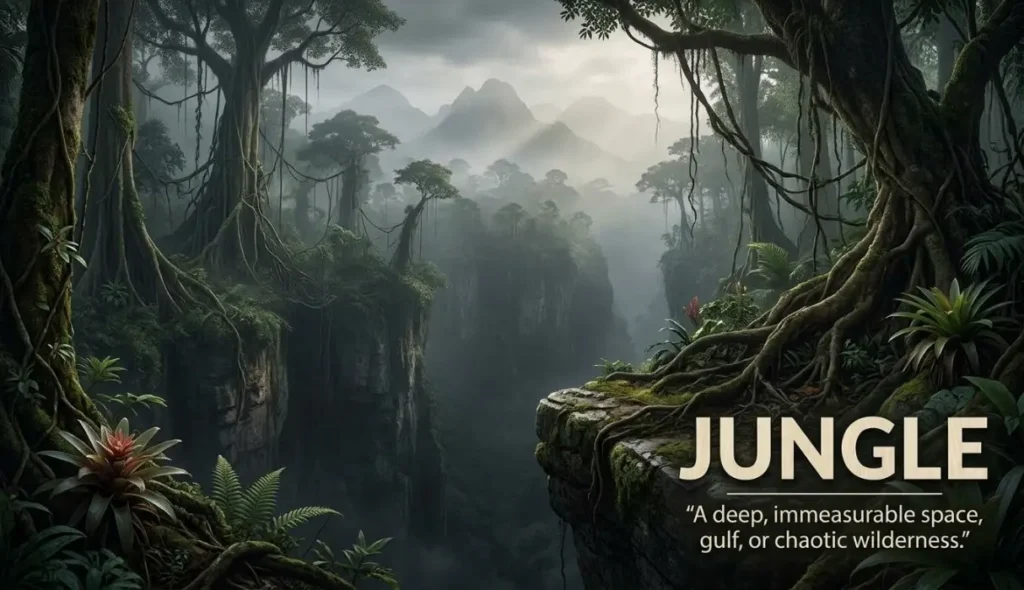
Abyss (Noun) — US: /əˈbɪs/ | UK: /əˈbɪs/
- Meaning: A deep, immeasurable space, gulf, or chaotic wilderness.
- Tone/Register: Dramatic, Expressive
- Example 1: Looking down from the cliff, he saw a dark abyss of green canopy.
- Example 2: The failed company sank into a financial abyss.
Web (Noun) — US: /web/ | UK: /web/
- Meaning: A complex, tangled network or interwoven structure.
- Tone/Register: Figurative, Common
- Example 1: The investigator uncovered a web of deception during the audit.
- Example 2: Electric wires formed a chaotic web across city power poles.
Tangle (Noun) — US: /ˈtæŋ.ɡəl/ | UK: /ˈtæŋ.ɡəl/
- Meaning: A confused mass of intertwined threads, vines, or obstacles.
- Tone/Register: Informal, Descriptive
- Example 1: A dense tangle of thorns blocked the entry to the hidden cave.
- Example 2: Her headphones ended up in a frustrating tangle inside her purse.
Snarl (Noun) — US: /snɑːrl/ | UK: /snɑːl/
- Meaning: A knot or complicated, tangled mass of things.
- Tone/Register: Expressive, Informal
- Example 1: Commuters faced a major traffic snarl downtown after the accident.
- Example 2: The fisherman spent twenty minutes untangling a snarl in his line.
Chaos (Noun) — US: /ˈkeɪ.ɑːs/ | UK: /ˈkeɪ.ɒs/
- Meaning: Complete disorder and confusion without structure.
- Tone/Register: General, Figurative
- Example 1: Rush hour at the central train station was absolute chaos.
- Example 2: The new software update restored order after days of system chaos.
Turmoil (Noun) — US: /ˈtɝː.mɔɪl/ | UK: /ˈtɜː.mɔɪl/
- Meaning: A state of great disturbance, confusion, or uncertainty.
- Tone/Register: Formal, Media
- Example 1: Political turmoil caused stock prices to drop sharply overnight.
- Example 2: Her mind was in turmoil as she weighed her career options.
Disorder (Noun) — US: /dɪsˈɔːr.dɚ/ | UK: /dɪsˈɔː.də/
- Meaning: A lack of order or regular arrangement; confusion.
- Tone/Register: Neutral, Professional
- Example 1: Papers and empty coffee cups lay in complete disorder on his desk.
- Example 2: The sudden announcement caused brief disorder in the stock market.
Hive (Noun) — US: /haɪv/ | UK: /haɪv/
- Meaning: A place swarming with activity and complex motion like a beehive.
- Tone/Register: Figurative, Metaphorical
- Example 1: The newsroom became a hive of intense activity as deadlines approached.
- Example 2: Tokyo at night feels like a glowing hive of energy.
Anthill (Noun) — US: /ˈænt.hɪl/ | UK: /ˈænt.hɪl/
- Meaning: A crowded, fast-moving place filled with small, busy individuals.
- Tone/Register: Descriptive, Informal
- Example 1: Looking down from the skyscraper, pedestrians looked like ants on an anthill.
- Example 2: The tech conference venue was a busy anthill of networking professionals.
Concrete Jungle (Noun Phrase) — US: /ˈkɑːn.kriːt ˈdʒʌŋ.ɡəl/ | UK: /ˈkɒŋ.kriːt ˈdʒʌŋ.ɡəl/
- Meaning: A modern city filled with large, crowded concrete buildings.
- Tone/Register: Metaphorical, Popular
- Example 1: New York City is often referred to as a massive concrete jungle.
- Example 2: She escaped the concrete jungle every weekend to go mountain hiking.
Dog-eat-dog Environment (Noun Phrase) — US: /dɑːɡ iːt dɑːɡ/ | UK: /dɒɡ iːt dɒɡ/
- Meaning: A situation of fierce, ruthless competition where people harm others to succeed.
- Tone/Register: Idiomatic, Business
- Example 1: Wall Street trading floors are notorious for being a dog-eat-dog environment.
- Example 2: In this dog-eat-dog industry, companies must innovate constantly to survive.
War Zone (Noun Phrase) — US: /ˈwɔːr ˌzoʊn/ | UK: /ˈwɔː ˌzəʊn/
- Meaning: A place of extreme conflict, disorder, or destruction.
- Tone/Register: Dramatic, Informal
- Example 1: The living room looked like a war zone after the children’s party.
- Example 2: Negotiators entered a corporate war zone during the hostile takeover bid.
Madhouse (Noun) — US: /ˈmæd.haʊs/ | UK: /ˈmæd.haʊs/
- Meaning: A scene of wild confusion, noise, or chaos.
- Tone/Register: Informal, Hyperbolic
- Example 1: Shopping malls turn into a complete madhouse on Black Friday.
- Example 2: The airport terminal was a madhouse during the holiday flight delays.
Zoo (Noun) — US: /zuː/ | UK: /zuː/
- Meaning: A place or situation full of noisy, wild, or uncontrolled behavior.
- Tone/Register: Informal, Casual
- Example 1: The classroom turned into a total zoo once the teacher stepped out.
- Example 2: Managing the trading floor during market panics feels like running a zoo.
Bedlam (Noun) — US: /ˈbed.ləm/ | UK: /ˈbed.ləm/
- Meaning: A scene of uproar and noisy confusion.
- Tone/Register: Formal, Expressive
- Example 1: Bedlam erupted in the stadium as the winning goal hit the net.
- Example 2: It was complete bedlam backstage right before the fashion show started.
Pandemonium (Noun) — US: /ˌpæn.dəˈmoʊ.ni.əm/ | UK: /ˌpæn.dəˈməʊ.ni.əm/
- Meaning: Wild and noisy disorder or confusion; chaos on a grand scale.
- Tone/Register: Formal, Literary
- Example 1: Pandemonium broke out when the pop star walked through the mall.
- Example 2: Sirens wailed outside, adding to the general pandemonium of the storm.
Shrubbery (Noun) — US: /ˈʃrʌb.ɚ.i/ | UK: /ˈʃrʌb.ər.i/
- Meaning: An area planted with shrubs or low bushes.
- Tone/Register: Descriptive, Gardening
- Example 1: The groundskeeper trimmed the dense shrubbery along the garden path.
- Example 2: Thieves hid stolen goods behind the thick park shrubbery.
Greenery (Noun) — US: /ˈɡriː.nɚ.i/ | UK: /ˈɡriː.nər.i/
- Meaning: Green foliage, plants, or lush vegetation.
- Tone/Register: Pleasant, Descriptive
- Example 1: Adding indoor plants brings vibrant greenery into a modern apartment.
- Example 2: Rain turned the dry hills into a paradise of lush greenery.
Flora (Noun) — US: /ˈflɔːr.ə/ | UK: /ˈflɔː.rə/
- Meaning: The plant life characteristic of a particular region, period, or environment.
- Tone/Register: Scientific, Academic
- Example 1: The island boasts rare flora that exists nowhere else on Earth.
- Example 2: Botanists documented native flora along the mountain slope.
Canopy (Noun) — US: /ˈkæn.ə.pi/ | UK: /ˈkæn.ə.pi/
- Meaning: The high, continuous layer of branches formed by forest tree crowns.
- Tone/Register: Ecological, Descriptive
- Example 1: Bright sunlight struggled to break through the thick forest canopy.
- Example 2: Monkeys move effortlessly across the high rainforest canopy.
Sylvan Realm (Noun Phrase) — US: /ˈsɪl.vən relm/ | UK: /ˈsɪl.vən relm/
- Meaning: A poetic term describing a pleasant, wooded, or forested region.
- Tone/Register: Literary, Poetic
- Example 1: The novel’s heroes traveled deep into an enchanted sylvan realm.
- Example 2: Sunlight filtered softly through the quiet sylvan realm.
Evergreen Forest (Noun Phrase) — US: /ˈev.ɚ.ɡriːn ˈfɔːr.ɪst/ | UK: /ˈev.ə.ɡriːn ˈfɒr.ɪst/
- Meaning: A forest consisting of trees that retain green leaves throughout the year.
- Tone/Register: Geographical, Neutral
- Example 1: The coastal mountain range is covered in dense evergreen forest.
- Example 2: Snow draped beautifully over branches across the evergreen forest.
Dense Vegetation (Noun Phrase) — US: /dens ˌvedʒ.əˈteɪ.ʃən/ | UK: /dens ˌvedʒ.ɪˈteɪ.ʃən/
- Meaning: An abundance of plants growing tightly together in one area.
- Tone/Register: Technical, Descriptive
- Example 1: Explorers needed machetes to slice through the dense vegetation.
- Example 2: Satellite images showed miles of dense vegetation covering the valley.
Primeval Forest (Noun Phrase) — US: /praɪˈmiː.vəl ˈfɔːr.ɪst/ | UK: /praɪˈmiː.vəl ˈfɒr.ɪst/
- Meaning: Ancient, untouched forest that has existed from the earliest ages.
- Tone/Register: Formal, Historical
- Example 1: Remnants of European primeval forest are strictly protected today.
- Example 2: Walking through the primeval forest felt like stepping back in time.
Tropical Thicket (Noun Phrase) — US: /ˈtrɑː.pɪ.kəl ˈθɪk.ɪt/ | UK: /ˈtrɒp.ɪ.kəl ˈθɪk.ɪt/
- Meaning: A dense, tangled growth of small trees or bushes in warm climates.
- Tone/Register: Descriptive, Geographical
- Example 1: Bright butterflies fluttered above the humid tropical thicket.
- Example 2: The trail vanished into an impenetrable tropical thicket.
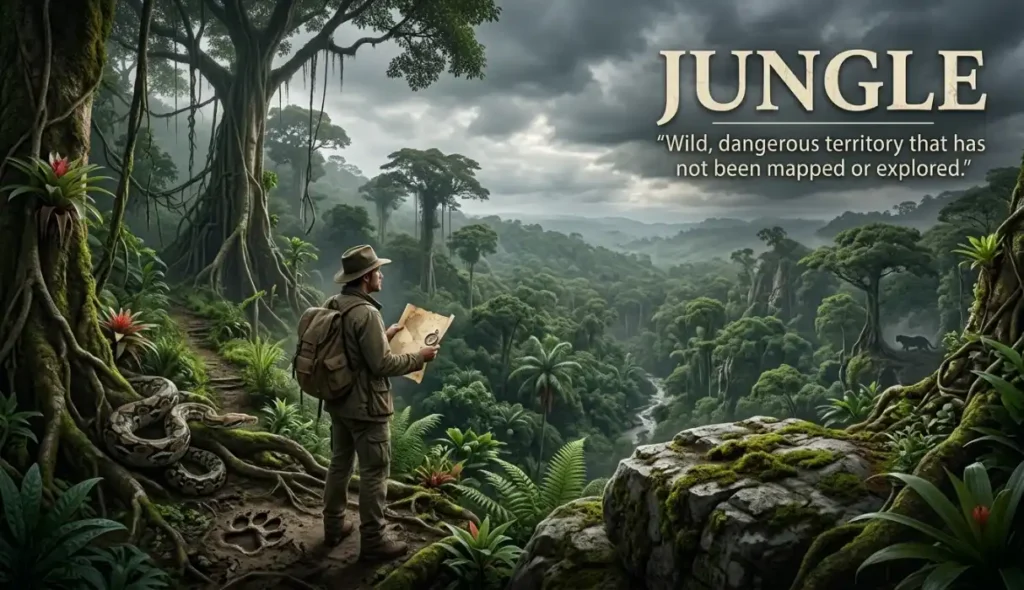
Uncharted Wilderness (Noun Phrase) — US: /ʌnˈtʃɑːr.t̬ɪd ˈwɪl.dɚ.nəs/ | UK: /ʌnˈtʃɑː.tɪd ˈwɪl.də.nəs/
- Meaning: Wild, dangerous territory that has not been mapped or explored.
- Tone/Register: Expressive, Storytelling
- Example 1: Early navigators risked their lives entering the uncharted wilderness.
- Example 2: Space exploration represents the ultimate uncharted wilderness.
Synonyms by Tone
| Tone Group | Synonyms Included | Why Tone Matters |
| Positive | Sanctuary, Grove, Sylvan realm, Flora, Paradise, Greenery | Positive choices frame nature as peaceful, beautiful, and refreshing rather than dangerous or wild. |
| Neutral | Rainforest, Forest, Woodland, Canopy, Taiga, Evergreen forest | Neutral options provide clear geographical descriptions without emotional bias or exaggerated drama. |
| Negative | Morass, Abyss, Chaos, Madhouse, War zone, Bedlam | Negative terms emphasize physical danger, extreme noise, mental overwhelm, or frustrating confusion. |
| Playful / Informal | Zoo, Anthill, Tangle, Snarl, Concrete jungle, Backwoods | Informal terms use vivid metaphors to describe busy human environments lightheartedly. |
Choosing the proper tone ensures accurate communication. Referring to a corporate office as a “lush forest” sounds absurd, but calling it a “concrete jungle” or “zoo” paints a vivid, understandable picture.
Mini Comparison: “Jungle” vs Close Alternatives
Jungle vs. Rainforest
- Meaning Difference: A “jungle” refers to dense, tangled land with thick undergrowth, often at forest edges. A “rainforest” is a specific ecological biome defined by high annual rainfall and tall tree canopy cover.
- Tone Difference: “Jungle” carries wild, chaotic, or negative connotations. “Rainforest” is scientific, neutral, and environmentally focused.
- When to Use Each: Use “jungle” when describing tangled vegetation or chaotic human situations. Use “rainforest” for environmental reports, geography, or scientific discussions.
Jungle vs. Wilderness
- Meaning Difference: “Jungle” describes dense, tangled tropical growth. “Wilderness” refers to any broad, uninhabited, uncultivated natural region, including deserts, mountains, and tundra.
- Tone Difference: “Jungle” feels hot, crowded, and humid. “Wilderness” feels vast, open, quiet, and expansive.
- When to Use Each: Use “jungle” for overgrown thickets or chaotic scenes. Use “wilderness” when talking about open outdoor preservation or remote survival trips.
How “Jungle” Changes by Context
- Daily Conversation: People choose casual, metaphorical words like “zoo,” “madhouse,” or “tangle” to describe messy rooms, heavy traffic, or noisy family gatherings.
- Writing & Blogging: Content creators use engaging options like “concrete jungle,” “labyrinth,” or “backcountry” to build memorable visual imagery for readers.
- Professional or Academic Tone: Researchers prefer exact terms like “rainforest,” “taiga,” “canopy,” or “flora” when documenting environmental data.
- Creative or Informal Use: Fiction writers reach for evocative terms like “primeval forest,” “sylvan realm,” or “impenetrable thicket” to craft rich settings.
Related Jungle Vocabulary and Common Search Questions
What Is Another Word for Jungle?
Another word for jungle depends on the type of environment you want to describe. Common alternatives include rainforest, forest, wilderness, thicket, undergrowth, woods, woodland, wilds, and tropical thicket. For a figurative or chaotic environment, concrete jungle, labyrinth, maze, tangle, zoo, madhouse, and bedlam can work well.
What Are Synonyms for Thick Jungle?
For a thick jungle, useful alternatives include dense vegetation, heavy undergrowth, tropical thicket, tangled vegetation, dense foliage, thick brush, lush greenery, impenetrable thicket, and primeval forest. These choices emphasize the difficulty of moving through an area because of closely packed plants, trees, vines, and shrubs.
What Are Synonyms for Dense Vegetation?
Common synonyms and related expressions for dense vegetation include thick vegetation, dense foliage, heavy undergrowth, thick greenery, tangled growth, lush plant life, heavy brush, dense plant growth, and tropical thicket. The best choice depends on whether you are describing trees, shrubs, vines, or general plant growth.
What Adjectives Describe a Jungle?
Many adjectives can describe a jungle’s appearance, atmosphere, climate, or difficulty. Useful choices include dense, thick, tropical, lush, green, humid, tangled, overgrown, wild, untamed, remote, mysterious, verdant, impenetrable, primeval, and leafy.
For example, dense jungle emphasizes closely packed vegetation, while lush jungle creates a greener and more beautiful image. Untamed jungle suggests a wild natural environment, whereas impenetrable jungle highlights vegetation that is extremely difficult to pass through.
What Is the Opposite of Jungle?
There is no single exact opposite of jungle because the word describes a particular type of dense natural environment. Depending on the context, possible contrasting terms include open land, cleared land, cultivated land, open space, barren land, and developed land.
For example, if you contrast a dense jungle with an area where vegetation has been removed, cleared land is a suitable opposite. If you contrast dense vegetation with a wide, unobstructed landscape, open land or open space may be more appropriate.
What Is the Opposite of Forest?
Forest also has no single universal opposite. Depending on the intended meaning, useful contrasts include open land, cleared land, grassland, barren land, farmland, and open country.
For example, forest and open grassland can describe contrasting natural landscapes, while wooded land and cleared land represent opposite conditions in terms of tree cover.
Jungle in Hindi
The English word jungle is commonly translated into Hindi as जंगल (jangal). Related Hindi words can vary according to context, including वन (van) for a forest or wooded area and अरण्य (aranya) for a wilderness or forest region.
In English vocabulary writing, forest, wilderness, woodland, and rainforest may correspond to different meanings depending on what type of जंगल is being described.
Jungle in Urdu
The common Urdu word for jungle is جنگل (jangal). Depending on context, related words and expressions may include بن (ban) for a forest or wilderness and جنگلات (janglaat) for forests or woodland areas.
For English learners, forest, woods, woodland, wilderness, and rainforest are useful English alternatives, but they do not always have exactly the same meaning as the Urdu word جنگل.
Jungle in Chinese
The common Chinese translation for jungle is 丛林 (cónglín), meaning a dense forest or jungle. Another related word is 森林 (sēnlín), which generally means forest.
The distinction is useful because 丛林 often suggests dense, wild vegetation, while 森林 is a broader and more neutral term for a forest.
Jungle in Spanish
The common Spanish translation of jungle is selva. Therefore, a synonym or equivalent for jungle in Spanish can be selva, especially when referring to a dense tropical forest.
For example, selva tropical means tropical rainforest/jungle. English alternatives such as rainforest, forest, wilderness, and thicket can express related ideas, although their meanings are not always identical.
Jungle in German
The common German word for jungle is Dschungel. Depending on context, related German vocabulary may include Wald for forest and Regenwald for rainforest.
In English, jungle, rainforest, and forest should not always be treated as exact equivalents because each term describes a different type or characteristic of natural environment.
Words That Rhyme With Jungle
Finding exact rhymes for jungle is difficult because jungle has a distinctive ending. In standard English, it has very few common perfect rhymes. Words such as bungle and mungle can appear in rhyme lists, although bungle is by far the most familiar everyday word.
Jungle and bungle form a clear rhyme:
- He wandered through the jungle.
- He did not want to bungle the expedition.
For poetry and creative writing, writers may also use near-rhymes or imperfect rhymes when an exact rhyme is unavailable.
Is Jungle a Noun or an Adjective?
Jungle is primarily a noun. It refers to a dense, wild area of vegetation, especially in tropical regions.
It can also appear before another noun in expressions such as jungle environment, jungle trail, jungle expedition, and jungle vegetation. In these combinations, it functions attributively, meaning it modifies the following noun, but its basic dictionary part of speech remains a noun.
What Are Other Terms for Jungle?
Other terms for jungle include rainforest, tropical forest, wilderness, thicket, undergrowth, woodland, woods, wilds, tropical thicket, dense vegetation, and primeval forest.
When describing a chaotic human environment rather than a natural landscape, alternatives such as concrete jungle, labyrinth, maze, tangle, zoo, madhouse, bedlam, and chaos may be more appropriate.
What Is the Best Synonym for Jungle?
There is no single best synonym for jungle in every sentence. Rainforest is often the closest choice when referring to a tropical ecosystem, while thicket emphasizes dense shrubs and vegetation. Wilderness focuses on wild, undeveloped land, and concrete jungle works when describing a crowded modern city.
The most accurate alternative depends on whether you are describing nature, vegetation, a remote landscape, or a figuratively chaotic environment.
Common Mistakes & Native Usage
Mistakes Learners Make
- Using “Jungle” for All Forests: Learners often call pine forests in cold climates “jungles.” Jungles are specifically dense, tropical vegetation areas.
- Confusing “Jungle” with “Desert”: Despite early Sanskrit origins meaning dry land, modern English strictly uses “jungle” for lush, overgrown green growth.
- Literal Overuse: Using “jungle” purely for nature ignores its valuable metaphorical uses in business and urban writing.
Register Notes
- Spoken English: Words like “zoo,” “brush,” and “madhouse” dominate everyday conversations.
- Written English: Terms like “impenetrable thicket,” “morass,” and “primeval forest” elevate formal literature and journalism.
Real-Life Mini Scenarios
- Workplace: “Managing corporate compliance felt like hacking through a jungle of regulations.” (Jungle highlights complex bureaucratic challenges.)
- Social Situations: “The music festival grounds turned into a total zoo once the headliner took the stage.” (Zoo captures wild crowd energy.)
- Media / Pop Culture: “City planners are building green rooftops to combat the heat of the concrete jungle.” (Concrete jungle contrasts urban growth with nature.)
- Writing or Storytelling: “The knight entered the dark primeval forest, unsure of what creatures lurked inside.” (Primeval forest creates mystery.)
Conclusion
Expanding your list of options for a synonym for jungle improves how you describe wild nature, complex systems, and crowded cities. Choosing precise terms ensures your message conveys the exact right tone and picture.
Practicing these varied descriptors in essays, articles, and everyday conversations will sharpen your vocabulary. Thoughtful word choices make your communication clearer, richer, and far more engaging.
Try using a few of these expressive synonyms in your next writing project to strengthen your English skills!
Practice Exercise
Select the best synonym for each context below.
- Which term best describes a cold northern forest filled with pine and spruce trees?
a) Taiga
b) Mangrove
c) Chaparral
d) Heath - Choose the best informal synonym for a loud, chaotic airport terminal:
a) Grove
b) Zoo
c) Woodland
d) Flora - “Environmentalists work tirelessly to protect the Amazon __________ from deforestation.”
a) Bedlam
b) Rainforest
c) Madhouse
d) Snarl - Which word implies an ancient, untouched natural forest?
a) Primeval forest
b) Concrete jungle
c) Scrubland
d) Marsh - What is a poetic term for a quiet, wooded realm?
a) Sylvan realm
b) War zone
c) Morass
d) Mire - Which phrase describes a modern city filled with skyscrapers?
a) Backwoods
b) Concrete jungle
c) Cypress swamp
d) Salt marsh - Choose the term that best fits a scientific report on plant species:
a) Bedlam
b) Flora
c) Zoo
d) Madhouse - What is a negative figurative word for a complex bureaucratic situation?
a) Grove
b) Morass
c) Greenery
d) Sanctuary - Which adjective/noun describes low, dense coastal bushes in dry climates?
a) Chaparral
b) Taiga
c) Canopy
d) Rainforest - Select the best casual word for tangled bushes in a backyard:
a) Pandemonium
b) Brush
c) Bedlam
d) Abyss
Application Task:
Write a 2-sentence story about a character navigating a crowded city or natural environment using one synonym (e.g., labyrinth, concrete jungle, or thicket) correctly.
Answer Key:
1-a, 2-b, 3-b, 4-a, 5-a, 6-b, 7-b, 8-b, 9-a, 10-b
FAQs
1. What is the most accurate scientific synonym for jungle?
The most accurate scientific equivalent is tropical rainforest or tropical seasonal forest. Scientists prefer these terms because they specify weather patterns, rainfall levels, and canopy structures rather than general tangled growth.
2. Can “jungle” be used to describe a city?
Yes, native speakers frequently use the metaphor concrete jungle to describe large cities. It highlights tall buildings, dense populations, traffic congestion, and competitive urban living styles.
3. What is the difference between a jungle and a forest?
A forest has tall trees with a high canopy that blocks sunlight, keeping the forest floor relatively open. A jungle has dense, tangled undergrowth on the ground level where light penetrates, making travel difficult.
4. What are good informal synonyms for a chaotic jungle-like situation?
Popular informal choices include zoo, madhouse, bedlam, tangle, and war zone. These words effectively convey noise, confusion, and lack of control in everyday speech.
5. What is a positive word for a jungle environment?
Positive choices include sanctuary, greenery, Eden, biodiverse haven, and sylvan realm. These frame dense natural growth as beautiful, peaceful, and ecologically valuable.

Jameel Hassan is the founder and lead writer at SynonymsCloud.com, a trusted online platform dedicated to English vocabulary and effective communication. He is passionate about helping students, writers, professionals, and lifelong learners discover the right words to express their ideas with clarity, precision, and confidence.
At SynonymsCloud.com, every article is thoroughly researched and carefully written to provide accurate, practical, and easy-to-understand guidance on synonyms, antonyms, word meanings, idioms, and vocabulary. With a strong commitment to quality, real-world usage, and clear explanations, the website helps readers expand their vocabulary, improve their writing, and communicate more effectively in both academic and professional settings.