
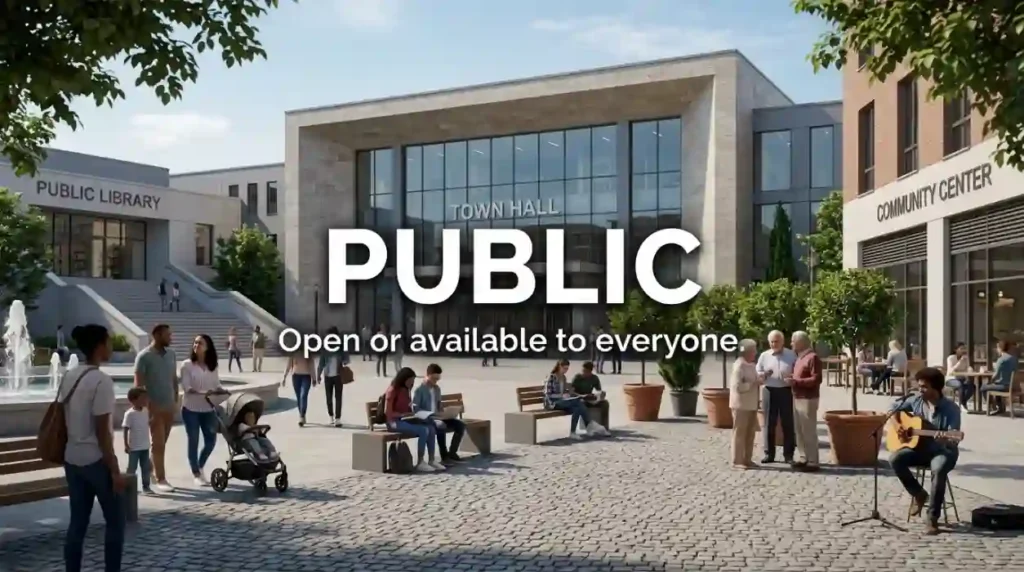
A synonym for public can be open, accessible, shared, communal, civic, common, general, or widespread, depending on the context. Use open for something available to everyone, civic for community matters, communal for shared use, and accessible for something people can easily reach or use.
A synonym for public can be open, communal, common, civic, shared, or accessible, depending on context. The word public describes something available to people generally, connected with society, or known by many people.
Synonyms for public become useful when you want to avoid repeating the same word. Imagine writing, “The public library is open to the public.” Replacing one use with “community” or “general” can make the sentence smoother.
Students often need alternatives for essays, while bloggers and content writers use them to create varied, natural sentences. Daily English speakers also benefit from choosing the right word for each situation.
Learning a synonym for public helps you express ideas more precisely. Some alternatives sound formal, while others work better in casual speech, business writing, or academic English.
What Does “Public” Really Mean?
Public generally describes something open, available, visible, known, or connected to ordinary people or society as a whole.
For example:
- A public park is available for people to use.
- A public meeting is open to members of the community.
- A public figure is widely known.
- Public opinion means the views held by many people.
- Public services are provided for the community.
Part of Speech
Public can function mainly as an adjective and noun.
As an adjective, it describes something connected with people generally:
The museum is a public institution.
As a noun, the public refers to people as a group:
The public deserves clear information.
Native speakers commonly use public when discussing society, government, information, spaces, institutions, events, or people who are widely known.
Connotative Meaning of “Public”
Connotation (the emotional or cultural feeling associated with a word beyond its basic dictionary meaning) can change depending on context.
Positive Tone
Public can suggest openness, inclusion, accessibility, and community participation.
The new garden is a beautiful public space.
Neutral Tone
In many situations, public simply means available to people generally.
The library has public computers.
Negative Tone
Public can sometimes suggest unwanted exposure or loss of privacy.
Their disagreement became a public argument.
The tone depends heavily on the noun or situation that follows the word.
Etymology of “Public”
The word public comes from the Latin publicus, meaning “of the people” or “belonging to the people.” It entered English through Old French and became established in Middle English.
Old English: 450–1100
The exact modern form, public, was not a regular Old English word. English speakers used native terms related to people, communities, and common ownership.
Middle English: 1100–1500
After the Norman Conquest, French and Latin vocabulary strongly influenced English. Forms related to public entered English through Anglo-French and Latin usage.
Modern English: 1500–Present
Public became a central English word for things associated with society, government, communities, shared access, and general awareness.
Today, it appears in phrases such as public opinion, public transport, public education, public space, public information, and public figure.
Pronunciation of “Public”
- US: /ˈpʌb.lɪk/
- UK: /ˈpʌb.lɪk/
Syllables
pub-lic
Affixation Pattern of “Public”
Root: Latin publicus
Prefix: None in modern English
Suffix: -ic, forming an adjective
Synonyms List
Because public has several meanings, there is no single replacement that works in every sentence. The list below includes direct synonyms, close alternatives, and context-specific expressions that native speakers naturally use.
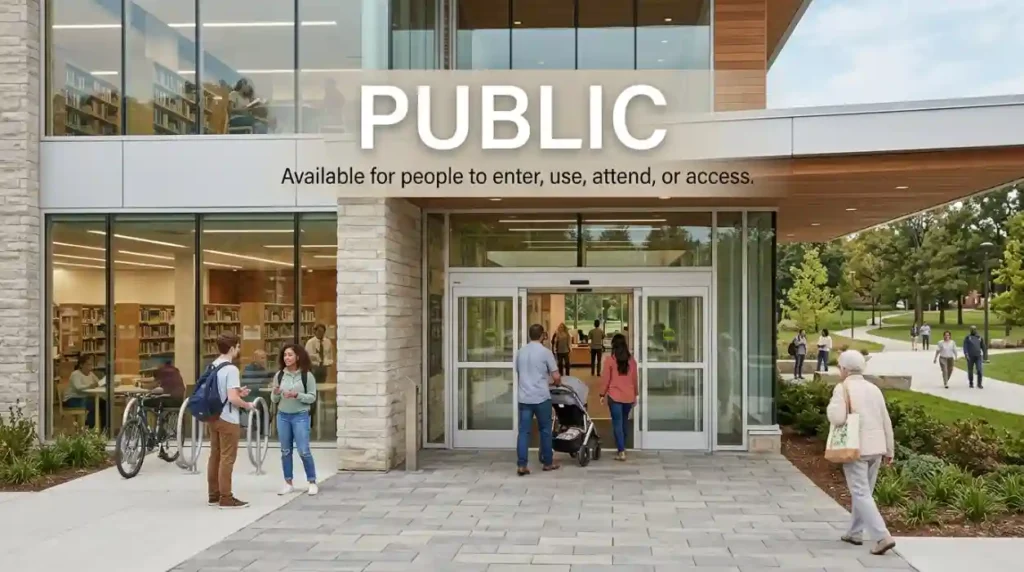
1. Open (Adjective) — US /ˈoʊpən/ — UK /ˈəʊpən/
Meaning: Available for people to enter, use, attend, or access.
Tone/Register: Neutral; very common.
Examples:
The meeting is open to everyone.
The gallery is open to visitors every weekend.
2. Shared (Adjective) — US /ʃerd/ — UK /ʃeəd/
Meaning: Used or experienced by more than one person or group.
Tone/Register: Neutral; everyday.
Examples:
The apartment has a shared garden.
They created a shared workspace for residents.
3. Common (Adjective) — US /ˈkɑːmən/ — UK /ˈkɒmən/
Meaning: Belonging to or available to many people rather than one individual.
Tone/Register: Neutral.
Examples:
The village has a common meeting area.
Clean water should be a common resource.
4. Communal (Adjective) — US /kəˈmjuːnəl/ — UK /kəˈmjuːnəl/
Meaning: Shared by members of a community.
Tone/Register: Formal/academic.
Examples:
Residents use the communal kitchen.
The building includes a communal garden.
5. Civic (Adjective) — US /ˈsɪvɪk/ — UK /ˈsɪvɪk/
Meaning: Connected with a city, community, or responsibilities of citizens.
Tone/Register: Formal; academic.
Examples:
She joined a civic organization.
The project encourages civic participation.
6. Collective (Adjective) — US /kəˈlektɪv/ — UK /kəˈlektɪv/
Meaning: Shared by or involving a group of people.
Tone/Register: Formal/academic.
Examples:
The decision reflected collective concerns.
They made a collective effort to improve the neighborhood.
7. General (Adjective) — US /ˈdʒenərəl/ — UK /ˈdʒenərəl/
Meaning: Relating to people or things as a whole rather than a limited group.
Tone/Register: Neutral/formal.
Examples:
The announcement was made for general information.
The course is designed for the general audience.
8. Accessible (Adjective) — US /əkˈsesəbəl/ — UK /əkˈsesəbəl/
Meaning: Available or easy for people to reach, use, or obtain.
Tone/Register: Neutral/formal.
Examples:
The website makes research accessible to everyone.
The building has accessible public entrances.
9. Available (Adjective) — US /əˈveɪləbəl/ — UK /əˈveɪləbəl/
Meaning: Ready for people to use, obtain, or access.
Tone/Register: Neutral.
Examples:
Free information is available online.
The service is available to residents.
10. Universal (Adjective) — US /ˌjuːnəˈvɜːrsəl/ — UK /ˌjuːnɪˈvɜːsəl/
Meaning: Applying to or involving everyone without a limited group.
Tone/Register: Formal/academic.
Examples:
The campaign promotes universal access to education.
The principle has universal importance.
11. Widespread (Adjective) — US /ˈwaɪdspred/ — UK /ˈwaɪdspred/
Meaning: Existing or happening among many people or places.
Tone/Register: Neutral/formal.
Examples:
The announcement received widespread attention.
The issue has become widespread across the region.
12. Popular (Adjective) — US /ˈpɑːpjələr/ — UK /ˈpɒpjʊlə/
Meaning: Liked, followed, or supported by many people.
Tone/Register: Neutral.
Examples:
The singer is popular with young audiences.
The restaurant became popular after the review.
13. Societal (Adjective) — US /səˈsaɪətəl/ — UK /səˈsaɪətəl/
Meaning: Related to society as a whole.
Tone/Register: Academic/formal.
Examples:
The study examines societal changes.
The issue has important societal effects.
14. Social (Adjective) — US /ˈsoʊʃəl/ — UK /ˈsəʊʃəl/
Meaning: Relating to society or interactions among people.
Tone/Register: Neutral/academic.
Examples:
The campaign addresses social problems.
They discussed social responsibility at the event.
15. Governmental (Adjective) — US /ˌɡʌvərnˈmentəl/ — UK /ˌɡʌvənˈmentəl/
Meaning: Connected with a government or its activities.
Tone/Register: Formal.
Examples:
The agency released a governmental report.
The project received governmental support.
16. State (Adjective) — US /steɪt/ — UK /steɪt/
Meaning: Connected with a government or government-controlled institution.
Tone/Register: Formal; often political or administrative.
Examples:
She attends a state university.
The state agency published new guidance.
17. National (Adjective) — US /ˈnæʃənəl/ — UK /ˈnæʃənəl/
Meaning: Relating to an entire country rather than a local area.
Tone/Register: Neutral/formal.
Examples:
The story received national attention.
The government launched a national campaign.
18. Official (Adjective) — US /əˈfɪʃəl/ — UK /əˈfɪʃəl/
Meaning: Approved, authorized, or connected with an organization or authority.
Tone/Register: Formal/neutral.
Examples:
The official statement was released Monday.
Please check the official announcement.
19. Civic-Minded (Adjective) — US /ˈsɪvɪk ˌmaɪndɪd/ — UK /ˈsɪvɪk ˌmaɪndɪd/
Meaning: Concerned with improving the community and fulfilling civic responsibilities.
Tone/Register: Formal/positive.
Examples:
She is known as a civic-minded leader.
The program encourages civic-minded behavior.
20. Community (Noun) — US /kəˈmjuːnəti/ — UK /kəˈmjuːnəti/
Meaning: A group of people living together or sharing a common identity or interest.
Tone/Register: Neutral.
Examples:
The community supported the new library.
The center provides services for the community.
21. Neighborhood (Noun) — US /ˈneɪbərhʊd/ — UK /ˈneɪbəhʊd/
Meaning: A local area and the people who live there.
Tone/Register: Everyday.
Examples:
The neighborhood organized a clean-up day.
Everyone in the neighborhood was invited.
22. Population (Noun) — US /ˌpɑːpjəˈleɪʃən/ — UK /ˌpɒpjʊˈleɪʃən/
Meaning: The people living in a particular place or belonging to a particular group.
Tone/Register: Academic/formal.
Examples:
The population welcomed the new service.
The survey included a large urban population.
23. Citizens (Noun) — US /ˈsɪtəzənz/ — UK /ˈsɪtɪzənz/
Meaning: People who legally belong to a particular country or community.
Tone/Register: Formal/civic.
Examples:
Citizens attended the town meeting.
The policy affects millions of citizens.
24. People (Noun) — US /ˈpiːpəl/ — UK /ˈpiːpəl/
Meaning: Human beings considered generally or collectively.
Tone/Register: Everyday.
Examples:
The event attracted many people.
The message was designed for ordinary people.
25. Mass (Adjective) — US /mæs/ — UK /mæs/
Meaning: Involving or intended for very large numbers of people.
Tone/Register: Formal/media.
Examples:
The campaign reached a mass audience.
The product became a form of mass entertainment.
26. Broad (Adjective) — US /brɔːd/ — UK /brɔːd/
Meaning: Including a large range or group of people.
Tone/Register: Neutral/formal.
Examples:
The article has broad appeal.
The proposal received broad public support.
27. Inclusive (Adjective) — US /ɪnˈkluːsɪv/ — UK /ɪnˈkluːsɪv/
Meaning: Designed to include people from different groups.
Tone/Register: Formal/positive.
Examples:
The organization promotes inclusive education.
They created an inclusive community space.
28. Nonprivate (Adjective) — US /ˌnɑːnˈpraɪvət/ — UK /ˌnɒnˈpraɪvət/
Meaning: Not restricted to a private person or limited group.
Tone/Register: Formal/technical.
Examples:
The information is considered nonprivate.
The records contain both private and nonprivate material.
29. Unrestricted (Adjective) — US /ˌʌnrɪˈstrɪktɪd/ — UK /ˌʌnrɪˈstrɪktɪd/
Meaning: Not limited by rules controlling who can enter, use, or access something.
Tone/Register: Formal.
Examples:
The archive offers unrestricted access.
Visitors have unrestricted use of the reading room.
30. Free (Adjective) — US /friː/ — UK /friː/
Meaning: Available for people to use or enter without restriction or payment, depending on context.
Tone/Register: Everyday.
Examples:
The park offers free access during the day.
The lecture is free and open to everyone.
31. Exposed (Adjective) — US /ɪkˈspoʊzd/ — UK /ɪkˈspəʊzd/
Meaning: Visible or known rather than hidden or protected.
Tone/Register: Neutral; often negative in privacy contexts.
Examples:
The mistake became exposed after the report.
His private disagreement was suddenly exposed.
32. Visible (Adjective) — US /ˈvɪzəbəl/ — UK /ˈvɪzəbəl/
Meaning: Able to be seen, noticed, or recognized by people.
Tone/Register: Neutral.
Examples:
The logo is clearly visible from the street.
Her work became more visible after the exhibition.
33. Known (Adjective) — US /noʊn/ — UK /nəʊn/
Meaning: Recognized or familiar to many people.
Tone/Register: Neutral.
Examples:
The author is known around the world.
His views became widely known after the interview.
34. Noted (Adjective) — US /ˈnoʊtɪd/ — UK /ˈnəʊtɪd/
Meaning: Well known or respected because of achievement or importance.
Tone/Register: Formal.
Examples:
She is a noted environmental researcher.
The event featured several noted writers.
35. Prominent (Adjective) — US /ˈprɑːmɪnənt/ — UK /ˈprɒmɪnənt/
Meaning: Important, famous, or easily noticed within a group or society.
Tone/Register: Formal.
Examples:
A prominent journalist attended the event.
The issue became prominent in national discussions.
36. Renowned (Adjective) — US /rɪˈnaʊnd/ — UK /rɪˈnaʊnd/
Meaning: Widely known and admired for an achievement or quality.
Tone/Register: Formal/positive.
Examples:
The museum houses works by renowned artists.
She is a renowned expert in language education.
37. Famed (Adjective) — US /feɪmd/ — UK /feɪmd/
Meaning: Very well known, especially for a notable quality or achievement.
Tone/Register: Literary/media.
Examples:
The city is famed for its historic architecture.
The restaurant is famed for its traditional dishes.
38. Celebrated (Adjective) — US /ˈseləbreɪtɪd/ — UK /ˈseləbreɪtɪd/
Meaning: Widely admired or recognized.
Tone/Register: Formal/literary.
Examples:
The festival honored a celebrated poet.
She became a celebrated voice in modern literature.
39. Well-Known (Adjective) — US /ˌwel ˈnoʊn/ — UK /ˌwel ˈnəʊn/
Meaning: Familiar to many people.
Tone/Register: Neutral.
Examples:
He is a well-known television host.
The town is well-known for its food.
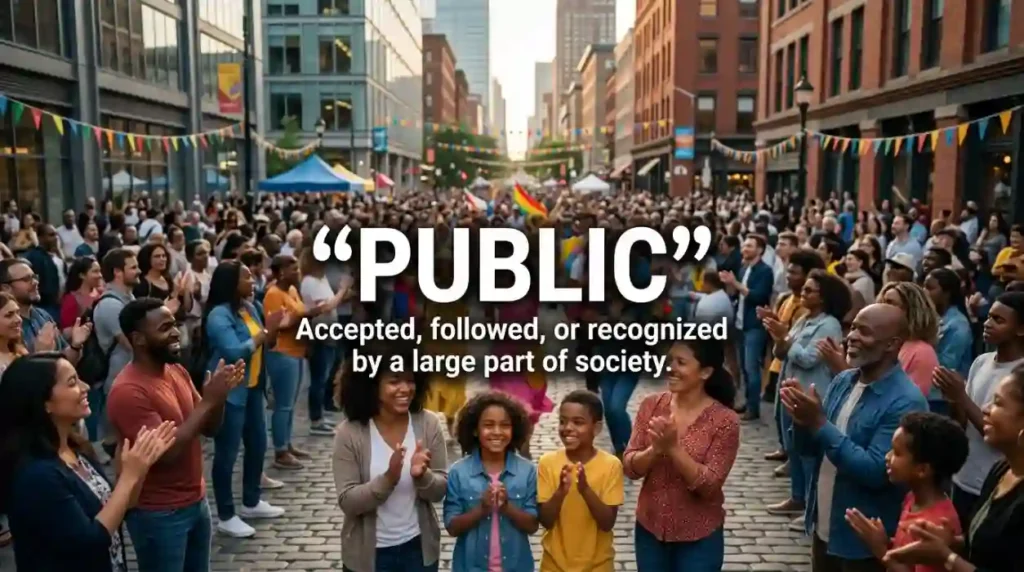
40. Mainstream (Adjective) — US /ˈmeɪnstriːm/ — UK /ˈmeɪnstriːm/
Meaning: Accepted, followed, or recognized by a large part of society.
Tone/Register: Neutral/media.
Examples:
The idea eventually entered mainstream culture.
Her music has a mainstream audience.
41. Popularized (Adjective/Participle) — US /ˈpɑːpjələrˌaɪzd/ — UK /ˈpɒpjʊləraɪzd/
Meaning: Made widely known or accepted among ordinary people.
Tone/Register: Academic/media.
Examples:
The phrase was popularized by social media.
The author popularized the concept for general readers.
42. Shared-Use (Adjective) — US /ˌʃerd ˈjuːs/ — UK /ˌʃeəd ˈjuːs/
Meaning: Intended to be used by several people or groups.
Tone/Register: Formal/administrative.
Examples:
The building has a shared-use conference room.
The city created a shared-use community facility.
43. Commonly Available (Phrase) — US /ˈkɑːmənli əˈveɪləbəl/ — UK /ˈkɒmənli əˈveɪləbəl/
Meaning: Easy for many people to obtain or access.
Tone/Register: Neutral/formal.
Examples:
The information is commonly available online.
These materials are commonly available in libraries.
44. Open to All (Phrase) — US /ˈoʊpən tə ɔːl/ — UK /ˈəʊpən tə ɔːl/
Meaning: Available without limiting participation to a particular group.
Tone/Register: Neutral; highly natural.
Examples:
The workshop is open to all.
The competition is open to all students.
45. For Everyone (Phrase) — US /fər ˈevriwʌn/ — UK /fə ˈevriwʌn/
Meaning: Intended or available for people generally.
Tone/Register: Everyday.
Examples:
The park is a safe place for everyone.
The guide was written for everyone, not just experts.
46. In the Public Domain (Phrase) — US /ɪn ðə ˈpʌblɪk dəˈmeɪn/ — UK /ɪn ðə ˈpʌblɪk dəˈmeɪn/
Meaning: Available for public use rather than being protected by private ownership or copyright, depending on context.
Tone/Register: Legal/technical.
Examples:
The old photograph is now in the public domain.
The text can be reused because it is in the public domain.
47. Community-Based (Adjective) — US /kəˈmjuːnəti beɪst/ — UK /kəˈmjuːnəti beɪst/
Meaning: Organized around the needs or participation of a local community.
Tone/Register: Formal/academic.
Examples:
The city supports community-based programs.
They created a community-based education project.
48. Society-Wide (Adjective) — US /səˈsaɪəti waɪd/ — UK /səˈsaɪəti waɪd/
Meaning: Affecting or involving society as a whole.
Tone/Register: Academic/formal.
Examples:
The change could have society-wide effects.
The report examines society-wide attitudes toward education.
49. General-Purpose (Adjective) — US /ˌdʒenərəl ˈpɜːrpəs/ — UK /ˌdʒenərəl ˈpɜːpəs/
Meaning: Designed for ordinary or broad use rather than a specialized group.
Tone/Register: Neutral/technical.
Examples:
The room serves as a general-purpose space.
It is a general-purpose facility for local activities.
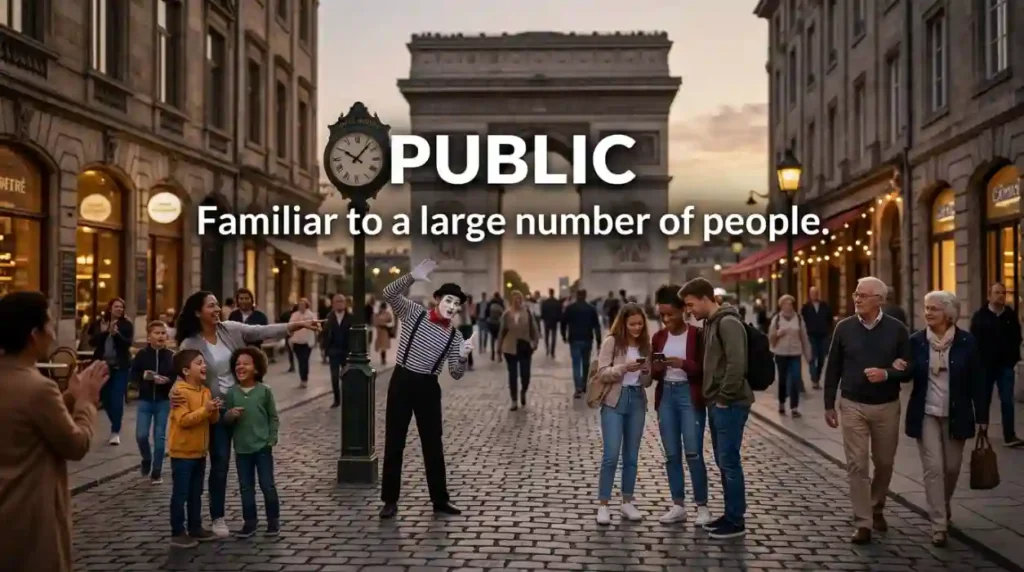
50. Commonly Known (Phrase) — US /ˈkɑːmənli noʊn/ — UK /ˈkɒmənli nəʊn/
Meaning: Familiar to a large number of people.
Tone/Register: Neutral.
Examples:
The fact is commonly known among researchers.
Her work is commonly known outside the country.
Synonyms by Tone
Positive
These choices can emphasize inclusion, accessibility, community, or broad participation:
- Inclusive
- Accessible
- Community-based
- Civic-minded
- Shared
- Open
- Universal
Neutral
These words work well when you simply need a natural alternative:
- General
- Common
- Available
- Social
- People
- Known
- Open to all
- Well-known
Formal or Academic
These are useful in essays, reports, research, and professional writing:
- Civic
- Communal
- Collective
- Societal
- Governmental
- Unrestricted
- Society-wide
- National
Negative or Exposure-Related
Some alternatives highlight visibility rather than accessibility:
- Exposed
- Visible
- Known
- Prominent
This distinction matters. For example, public information and exposed information are not always interchangeable. The first suggests legitimate availability. The second can suggest unwanted disclosure.
Playful or Informal
There are fewer true informal synonyms for public. In everyday speech, phrases such as everyone, for everyone, or out in the open can sound more natural than forcing a formal synonym.
“Public” vs. Close Alternatives
| Word | Main Difference | Best Use |
|---|---|---|
| Public | Available to or connected with people generally | General writing and speech |
| Open | Emphasizes access or participation | Events, spaces, opportunities |
| Communal | Emphasizes shared community use | Facilities and living spaces |
| Civic | Connects with citizenship or community responsibilities | Government and community topics |
| General | Refers to people or things broadly | Information and audiences |
For example, a public meeting is a meeting people can attend. An open meeting emphasizes that attendance is not restricted. A civic meeting suggests a connection with community or government matters.
How “Public” Changes by Context
Daily Conversation
In everyday English, public commonly describes places and services.
Is this a public park?
The bus is public transportation.
For casual speech, open, shared, common, and available can sometimes sound more natural.
Writing and Blogging
Writers often use public when discussing audiences, information, opinion, or visibility.
The article explains how public opinion can influence policy.
You can vary the wording with general audience, widespread, community, or society-wide when the meaning fits.
Professional and Academic Writing
Formal writing often needs greater precision.
Civic for citizenship and community duties.
Societal for broad effects on society.
Governmental for government-related matters.
Accessible when the key idea is availability.
This precision makes academic and professional writing clearer.
Creative and Informal Use
Creative writing may use open, visible, known, or out in the open to create a stronger image.
Their secret was suddenly out in the open.
That expression has a stronger emotional effect than simply saying the information became public.
Common Mistakes Learners Make
Mistake 1: Treating Every Synonym as Identical
The words in this list do not all replace public in every sentence.
For example:
Public transport
does not always become:
Civic transport.
Public is the natural choice in the first expression.
Mistake 2: Confusing “Public” With “Popular”
A public figure is someone known to many people.
A popular figure is someone liked or supported by many people.
A person can be famous without being popular.
Mistake 3: Confusing “Public” With “Open”
Public can describe who something belongs to or serves.
Open usually emphasizes access or participation.
The public library is open today.
Here, the two words have different jobs.
Mistake 4: Using Formal Words in Casual Speech
Words such as societal, governmental, and communal can sound too formal in ordinary conversation.
Choose simple words when simple English communicates the idea clearly.
Register Notes
Public is highly flexible. It works in casual conversation, journalism, business writing, education, government documents, and academic texts.
Open, shared, common, and available are generally accessible to everyday speakers.
Civic, societal, governmental, and society-wide are more formal.
Famed, celebrated, and renowned are especially useful when writing about well-known people, places, or achievements.
For internal linking, this article can naturally connect to related vocabulary pages about community, social, popular, or accessible.
Real-Life Mini Scenarios Using “Public”
Workplace
A company publishes a public announcement about an important organizational change.
Here, official may work when emphasizing authorization, while public emphasizes that everyone can know about it.
Social Situation
A couple discusses whether they should make their disagreement public.
Here, public contrasts with private and focuses on outside awareness.
Media and Pop Culture
A musician becomes a public figure after gaining widespread attention.
In this context, well-known, prominent, or renowned may describe different shades of fame.
Writing and Storytelling
A novelist describes a secret becoming public after a character reveals it.
Words such as known, visible, or exposed can change the emotional effect.
Why Choosing the Right Synonym Matters
The best synonym depends on what you want to emphasize.
When something is available for everyone to use or access, open, accessible, or available may be the most suitable choices.
For resources or spaces used by members of a community, consider communal or shared.
In contexts involving citizenship, public duties, or community participation, civic is a more precise term.
When describing matters connected to society and its members, social or societal may fit better.
For a person or thing recognized by a large number of people, well-known, prominent, or noted can express the meaning more clearly.
This is why memorizing a long list is less useful than understanding the difference between the words.
Practice Exercise
Choose the best answer for each situation. Do not look at the answer key until you finish.
1. Which word best describes a park that everyone can use?
A. Open
B. Renowned
C. Governmental
D. Noted
2. Which word best fits a discussion about responsibilities of citizens?
A. Popular
B. Civic
C. Famed
D. Visible
3. Which alternative means “shared by members of a community”?
A. Prominent
B. National
C. Communal
D. Popular
4. Which word best describes a person who is widely known?
A. Shared
B. Accessible
C. Civic
D. Well-known
5. Which word is most suitable for an academic discussion about effects on society?
A. Societal
B. Free
C. Open
D. Famed
6. A website can be described as one where people can easily use its information.
A. Celebrated
B. Accessible
C. Noted
D. National
7. Which word best describes something connected with an entire country?
A. National
B. Communal
C. Shared
D. Open
8. Which word suggests that a famous person is respected for their achievements?
A. Common
B. Available
C. Renowned
D. Shared
9. Which phrase means that an event welcomes everyone?
A. In the public domain
B. Open to all
C. Society-wide
D. State
10. Which word is most suitable for something connected with government?
A. Governmental
B. Popular
C. Famed
D. Broad
Answer Key:
1-A | 2-B | 3-C | 4-D | 5-A | 6-B | 7-A | 8-C | 9-B | 10-A
Reflection Task:
Choose one synonym from this article and write a sentence about your school, workplace, neighborhood, favorite website, or daily routine.
Frequently Asked Questions
1. What is the best synonym for public in English?
The best synonym depends on the sentence. Open works well for access, communal emphasizes shared community use, civic relates to citizenship, and societal refers to society as a whole. If you mean something known by many people, well-known or prominent may be better choices.
2. What is a synonym for public that means open to everyone?
Open and open to all are natural choices when you mean that everyone can participate, enter, or use something. Accessible can also work when the main idea is easy access. For example, “The event is open to all” clearly tells readers that participation is not restricted to a particular group.
3. What is another word for public in formal writing?
Formal alternatives include civic, communal, societal, governmental, collective, national, and society-wide. The correct choice depends on the meaning. For example, use civic for citizenship, societal for society-wide issues, and governmental for matters connected with government.
4. What is a synonym for public when talking about a famous person?
When public means widely known, useful alternatives include well-known, prominent, noted, renowned, celebrated, and famed. However, these words have different levels of formality. Well-known is simple and neutral, while renowned usually suggests respect or admiration for achievements.
5. Is “popular” a synonym for public?
Popular can overlap with public when discussing people, media, or ideas, but they do not have the same meaning. Public can mean known or available to many people, while popular specifically suggests that many people like, support, or follow something. A public figure is not necessarily a popular figure.
6. What is the difference between public and communal?
Public usually means available to people generally or connected with society. Communal focuses more specifically on something shared by members of a particular community or group. A public park may serve an entire city, while a communal garden may primarily serve residents of one neighborhood or housing community.
7. What is a synonym for public information?
Depending on the exact meaning, alternatives include accessible information, openly available information, general information, and nonprivate information. If the emphasis is that people can legally access the information, accessible or openly available may be clearer than simply replacing public with another adjective.
8. How can I avoid repeating the word public in an essay?
First, identify what public means in each sentence. Replace it with a precise alternative rather than a random synonym. Use civic for citizenship, societal for society, accessible for availability, popular for widespread approval, and well-known for broad recognition. This creates variety without changing your meaning.
Suggested External Learning Source
For pronunciation, definitions, usage examples, and additional meanings, Cambridge Dictionary is a useful external reference.
Conclusion
Knowing a synonym for public helps you express ideas with greater accuracy. Words such as open, civic, communal, and accessible each add a useful shade of meaning.
Strong vocabulary makes essays, blogs, and everyday conversations more natural. The right alternative can also make your writing clearer and easier for readers to understand.
You do not need to replace public every time. Instead, choose a synonym when it adds precision, improves flow, or better matches your intended tone.
Keep practicing these alternatives in emails, essays, blog posts, and daily conversations. Small vocabulary choices can make your English more confident and expressive.

Jameel Hassan is the founder and lead writer at SynonymsCloud.com, a trusted online platform dedicated to English vocabulary and effective communication. He is passionate about helping students, writers, professionals, and lifelong learners discover the right words to express their ideas with clarity, precision, and confidence.
At SynonymsCloud.com, every article is thoroughly researched and carefully written to provide accurate, practical, and easy-to-understand guidance on synonyms, antonyms, word meanings, idioms, and vocabulary. With a strong commitment to quality, real-world usage, and clear explanations, the website helps readers expand their vocabulary, improve their writing, and communicate more effectively in both academic and professional settings.