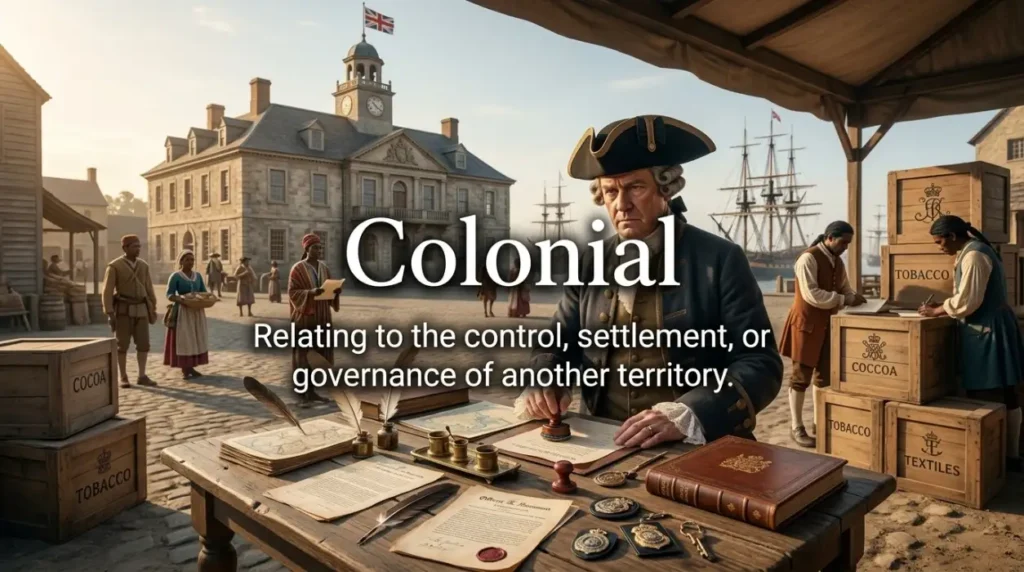
Key synonyms for colonial vary by context. For architecture and decor, use Georgian, provincial, or Early American. For governance and history, choices include imperial, territorial, dependent, and foreign. To express critical or negative historical tones, precise alternatives include exploitative, subjugated, and hegemonic. Choose based on your specific tone and subject.
Synonyms for Colonial provide precise vocabulary for describing history, architecture, government, settlement, and cultural influence. Choosing the right alternative helps you communicate specific ideas without depending on one general term repeatedly.
For example, words such as imperial, settler, and provincial can emphasize different aspects of historical or social contexts. Understanding these distinctions makes your descriptions clearer and gives readers a more accurate sense of your intended meaning.
Learning Synonyms for Colonial can benefit students, bloggers, content writers, researchers, and English learners. These words are useful when discussing historical events, architectural styles, literature, and cultural topics in both formal and everyday writing.
Practicing Synonyms for Colonial in original sentences can strengthen your vocabulary and improve word choice. Compare meanings, consider the context, and select alternatives that express your ideas naturally, accurately, and confidently.
What Does “Colonial” Really Mean?
The word colonial describes anything related to a colony, settlements established by a foreign power, or the era when one nation controlled other territories. In everyday English, native speakers use it to describe physical styles (like furniture or houses) or historical relationships between nations.
As an adjective, its core definition is simple: relating to or characteristic of a colony or colonies.
Connotative Meaning
Words carry emotional weight beyond their dictionary definitions.
Connotation refers to the cultural or emotional feeling associated with a word rather than its explicit literal meaning.
- Positive tone: When applied to architecture, furniture, or design, it often implies classic craftsmanship, elegance, and historic charm.
- Negative tone: When used in historical or political contexts, it carries strong negative feelings of exploitation, dominance, and oppression.
- Neutral tone: In scientific or geographical contexts (like “colonial organisms”), it simply describes living groups without any emotional bias.
Etymology
The word originates from the Latin term colonialis, derived from colonia, which means “settled land,” “farm,” or “estate.”
- Old English (450–1100): The word did not exist in Old English.
- Middle English (1100–1500): Early forms entered English through Old French via Latin legal texts.
- Modern English (1500–Present): The exact word “colonial” emerged in the 17th century as European nations expanded their global territories.
Pronunciation (US & UK)
- US: /kəˈloʊ.ni.əl/
- UK: /kəˈləʊ.ni.əl/
Syllables & Structure
- Syllable Breakdown: co-lo-ni-al (4 syllables)
- Root: Colony (from Latin colonia)
- Prefix: None
- Suffix:– ial (forms an adjective meaning “relating to”)
Synonyms List
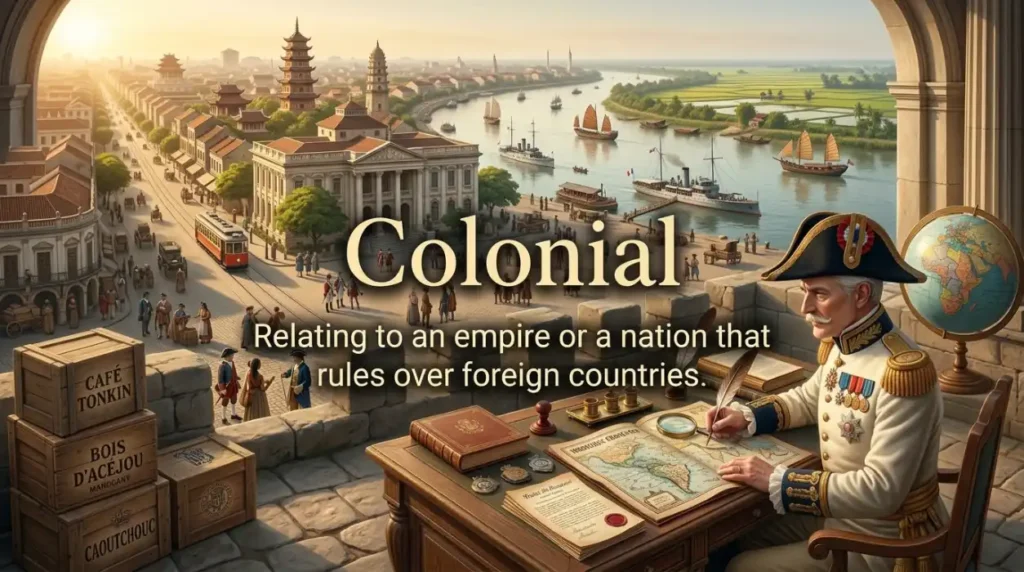
1. Imperial (Adjective)
Meaning: Relating to an empire or a nation that rules over foreign countries.
Tone/Register: Formal / Academic
Examples:
- The city features striking imperial architecture from the nineteenth century.
- Many historians analyze the impact of imperial policies on local trade.
2. Provincial (Adjective)
Meaning: Related to an outer province or region controlled by a central authority.
Tone/Register: Neutral / Formal
Examples:
- They renovated a beautiful provincial cottage in the countryside.
- Her research focuses on provincial government structures.
3. Dependent (Adjective)
Meaning: Controlled or supported by another country or central power.
Tone/Register: Neutral / Technical
Examples:
- The island remained a dependent territory for several decades.
- Economic growth was slow during the dependent era.
4. Territorial (Adjective)
Meaning: Relating to the ownership or control of a specific land area.
Tone/Register: Formal / Legal
Examples:
- The nations signed a new territorial agreement last week.
- She studies territorial expansion in North America.
5. Settler (Adjective)
Meaning: Characteristic of people who establish a new community in a foreign land.
Tone/Register: Historical / Neutral
Examples:
- The museum displays authentic settler tools and clothing.
- They preserved the original settler log cabins near the river.
6. Subordinate (Adjective)
Meaning: Placed in a lower rank or under the control of an authority.
Tone/Register: Formal / Business
Examples:
- The local council played a subordinate role to foreign governors.
- Small trading hubs remained subordinate to the main port.
7. Hegemonic (Adjective)
Meaning: Involving dominant political or social influence over other groups.
Tone/Register: Academic / Advanced
Examples:
- The essay criticizes hegemonic power structures in global history.
- They discussed how hegemonic rule affected regional culture.
8. Outlying (Adjective)
Meaning: Situated far from the main center or ruling capital.
Tone/Register: Neutral / Everyday
Examples:
- Supplies took weeks to reach the outlying settlements.
- A small patrol guarded the outlying border posts.
9. Pioneer (Adjective)
Meaning: Relating to early exploration, settlement, and development of new regions.
Tone/Register: Positive / Historical
Examples:
- We visited a restored pioneer village during our summer trip.
- Her family documented their pioneer lifestyle in old journals.
10. Tributary (Adjective)
Meaning: Paying tribute or subject to a dominant ruling state.
Tone/Register: Historical / Formal
Examples:
- The emperor collected taxes from several tributary states.
- This region operated as a tributary kingdom for centuries.
11. Frontier (Adjective)
Meaning: Relating to a border area or newly settled territory.
Tone/Register: Neutral / Storytelling
Examples:
- Life in frontier towns required great resilience and teamwork.
- They built strong wooden forts along the frontier line.
12. Dominion (Adjective)
Meaning: Under the rule or sovereignty of a governing nation.
Tone/Register: Formal / Legal
Examples:
- The region held dominion status before achieving full independence.
- Royal officers managed trade across the vast dominion lands.
13. Annexed (Adjective)
Meaning: Taken over and added to an existing nation’s territory.
Tone/Register: Formal / News
Examples:
- Old maps highlight the annexed zones across the continent.
- Legal disputes arose over the annexed agricultural areas.
14. Subject (Adjective)
Meaning: Under the political rule and law of a monarch or foreign nation.
Tone/Register: Historical / Formal
Examples:
- The subject population petitioned the local governor for lower taxes.
- They lived as subject citizens without full voting rights.
15. Foreign-ruled (Adjective)
Meaning: Governed directly by authorities from another nation.
Tone/Register: Clear / Informational
Examples:
- The region transitioned smoothly from a foreign-ruled era to self-governance.
- Living in a foreign-ruled territory shaped local traditions deeply.
16. Expatriate (Adjective)
Meaning: Related to people living outside their native country under external authority.
Tone/Register: Neutral / Modern
Examples:
- The coast features several charming expatriate neighborhoods.
- She writes novels about expatriate communities in Asia.
17. Expansionist (Adjective)
Meaning: Driven by a policy of expanding national territory and influence.
Tone/Register: Academic / Political
Examples:
- The country adopted aggressive expansionist goals during the 1800s.
- Historians debate the causes of early expansionist movements.
18. Non-sovereign (Adjective)
Meaning: Lacking independent supreme political authority.
Tone/Register: Formal / Political Science
Examples:
- The island remains a non-sovereign region with its own local council.
- International trade rules apply differently to non-sovereign areas.
19. Peripheral (Adjective)
Meaning: Located on the outer edge away from the central power.
Tone/Register: Academic / Descriptive
Examples:
- Development moved slowly across the peripheral districts.
- The capital ignored the needs of peripheral communities.
20. Non-autonomous (Adjective)
Meaning: Not self-governing; controlled by an external body.
Tone/Register: Official / Legal
Examples:
- The United Nations monitors several non-autonomous territories.
- Local officials requested more self-rule for the non-autonomous island.
21. Occupied (Adjective)
Meaning: Held and controlled by military or foreign forces.
Tone/Register: Serious / News
Examples:
- Conditions were harsh throughout the occupied regions.
- Citizens protested against foreign troops in the occupied capital.
22. Extraterritorial (Adjective)
Meaning: Situated or operating outside local jurisdiction due to external control.
Tone/Register: Legal / Formal
Examples:
- Foreign merchants enjoyed extraterritorial rights along the port.
- The treaty established special extraterritorial zones for trade.
23. Colonialist (Adjective)
Meaning: Directly supporting or practice-related to establishing foreign control.
Tone/Register: Critical / Academic
Examples:
- The book analyzes colonialist attitudes in nineteenth century literature.
- Critics debated the long term impact of colonialist policies.
24. Early American (Adjective)
Meaning: Relating to the historical period before or around the American Revolution.
Tone/Register: Descriptive / Design
Examples:
- Her dining set features beautiful Early American woodworking.
- We took a guided tour of Early American historic homes.
25. Overseas (Adjective)
Meaning: Located across the sea; relating to foreign possessions.
Tone/Register: Neutral / General
Examples:
- The nation managed dozens of overseas ports during its peak.
- They imported foreign spices directly from overseas territories.
26. Governed (Adjective)
Meaning: Under administrative direction and control of an external rule.
Tone/Register: Formal / Neutral
Examples:
- The newly governed territories adopted standard currency rules.
- Officials published reports on all governed districts.
27. Administered (Adjective)
Meaning: Managed under specific administrative authority.
Tone/Register: Formal / Official
Examples:
- The league created an administered region to maintain peace.
- Civic leaders improved roads across the administered lands.
28. Protectorate (Adjective)
Meaning: Controlled and protected politically by a stronger nation.
Tone/Register: Historical / Legal
Examples:
- The harbor operated under protectorate status for fifty years.
- Local leaders maintained internal power within the protectorate.
29. Satellite (Adjective)
Meaning: Politically or economically dependent on a dominant power.
Tone/Register: Political / News
Examples:
- Several satellite states aligned their foreign policies with the empire.
- Trade flowed heavily between the central capital and satellite towns.
30. Client (Adjective)
Meaning: Dependent on an external power for protection or economic aid.
Tone/Register: Academic / Formal
Examples:
- The empire supported a network of client kingdoms along the border.
- Local rulers remained loyal as client leaders.
31. Mandated (Adjective)
Meaning: Governed by a nation under an official international mandate.
Tone/Register: Historical / Legal
Examples:
- The Allied forces established mandated territories after the war.
- Officials reported yearly progress in the mandated zones.
32. Colonized (Adjective)
Meaning: Brought under foreign settlement and rule.
Tone/Register: Direct / Descriptive
Examples:
- The museum preserves artifacts from colonized coastal villages.
- Scholars study cultural shifts in colonized regions.
33. Subjugated (Adjective)
Meaning: Brought under complete control by force.
Tone/Register: Serious / Critical
Examples:
- The subjugated populations fought bravely for their rights.
- Severe laws restricted movement across subjugated lands.
34. Mercantilist (Adjective)
Meaning: Relating to trade policies designed to enrich a ruling power.
Tone/Register: Academic / Economic
Examples:
- The port enforced strict mercantilist trade regulations.
- Colonies exported raw materials under a mercantilist system.
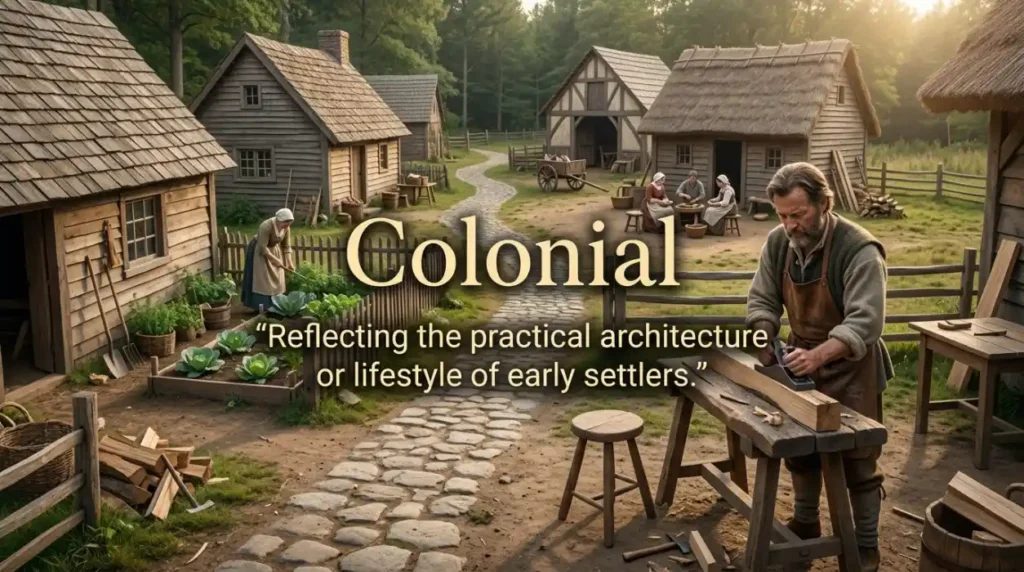
35. Settlement-style (Adjective)
Meaning: Reflecting the practical architecture or lifestyle of early settlers.
Tone/Register: Informal / Design
Examples:
- The cabin features simple settlement-style furniture.
- They built a cozy house with settlement-style wooden beams.
36. Pre-independence (Adjective)
Meaning: Occurring in the era before a nation won its independence.
Tone/Register: Historical / Neutral
Examples:
- The archive holds thousands of pre-independence documents.
- Pre-independence architecture still stands downtown.
37. Neo-colonial (Adjective)
Meaning: Involving modern economic or political dominance over former colonies.
Tone/Register: Academic / Critical
Examples:
- Economists often analyze neo-colonial trade practices today.
- The article discusses corporate influence in a neo-colonial context.
38. Superimposed (Adjective)
Meaning: Applied or forced over an existing native culture or system.
Tone/Register: Formal / Analytical
Examples:
- Foreign laws were superimposed onto traditional judicial systems.
- The modern grid plan was superimposed over ancient streets.
39. Dominion era (Adjective)
Meaning: Relating specifically to the era when a territory was a dominion.
Tone/Register: Historical / Specific
Examples:
- The library preserves rare Dominion-era postal stamps.
- This museum showcases Dominion-era military uniforms.
40. Traditionalist (Adjective)
Meaning: Adhering to historical design styles from earlier periods.
Tone/Register: General / Design
Examples:
- The architect chose a traditionalist design for the new library.
- Their living room combines modern art with traditionalist furniture.
41. Georgian (Adjective)
Meaning: Relating to the British architectural style popular during colonial eras.
Tone/Register: Specialized / Architecture
Examples:
- They bought a stunning Georgian brick home near the square.
- Symmetrical windows define classic Georgian-style buildings.
42. Native displacing (Adjective)
Meaning: Resulting in the removal or replacement of indigenous inhabitants.
Tone/Register: Serious / Academic
Examples:
- Historians document the severe native displacing policies of the era.
- Rapid expansion led to native displacing frontier movements.
43. Exploitative (Adjective)
Meaning: Unfairly taking advantage of resources or people for profit.
Tone/Register: Critical / Strong
Examples:
- Reformers spoke out against exploitative labor conditions.
- The report criticized exploitative mining operations overseas.
44. Paternalistic (Adjective)
Meaning: Managing people in a fatherly manner that restricts freedom.
Tone/Register: Analytical / Critical
Examples:
- The government faced backlash for its paternalistic laws.
- Local leaders rejected paternalistic guidance from external authorities.
45. Assimilative (Adjective)
Meaning: Intent on forcing minority or native cultures into a dominant one.
Tone/Register: Academic / Social Science
Examples:
- Schools enforced assimilative language policies across the territory.
- The exhibit highlights the impact of assimilative practices.
46. Controlled (Adjective)
Meaning: Managed and directed under external force or authority.
Tone/Register: General / Direct
Examples:
- Foreign troops maintained order across controlled borders.
- The central council oversaw all controlled trade routes.
47. Encroaching (Adjective)
Meaning: Gradually intruding upon or taking over land and rights.
Tone/Register: Descriptive / Cautious
Examples:
- Farming communities pushed back against encroaching frontier settlements.
- The map shows encroaching territorial borders over time.
48. Outpost-based (Adjective)
Meaning: Centered around remote military or trading stations.
Tone/Register: Descriptive / Historical
Examples:
- Early trade relied heavily on an outpost-based network.
- Outpost-based communities faced tough weather and isolation.
49. Vassal (Adjective)
Meaning: Held in a state of political subordination to a lord or nation.
Tone/Register: Historical / Formal
Examples:
- The king ruled over several vassal territories along the border.
- Vassal states contributed troops during military campaigns.
50. Plantation era (Adjective)
Meaning: Belonging to the historic period dominated by large agricultural estates.
Tone/Register: Historical / Specific
Examples:
- We toured a preserved plantation era manor in the South.
- The historian explained plantation era economic dynamics.
51. Borderland (Adjective)
Meaning: Located in the transition zone near territorial frontiers.
Tone/Register: Storytelling / Historical
Examples:
- Unique cultures often emerge in borderland regions.
- Traders exchanged goods across borderland settlements safely.
52. Tributary state (Adjective)
Meaning: A state that pays money or goods to a stronger nation for protection.
Tone/Register: Formal / History
Examples:
- The empire maintained peace across tributary state networks.
- Envoys visited the capital from every tributary state annually.
53. Monopolized (Adjective)
Meaning: Completely controlled by a single ruling entity or company.
Tone/Register: Business / Economic
Examples:
- Foreign companies ran monopolized spice trade routes.
- The market remained monopolized for nearly a century.
54. Dependent state (Adjective)
Meaning: A nation whose government relies fully on an external authority.
Tone/Register: Political / Formal
Examples:
- The island operated as a dependent state until political reforms occurred.
- Diplomats met to discuss dependent state governance.
55. Remote-governed (Adjective)
Meaning: Administered by leaders stationed far away across oceans or borders.
Tone/Register: Descriptive / Modern
Examples:
- Communication delays made remote-governed islands hard to manage.
- Local citizens felt ignored by remote-governed authorities.
56. Seized (Adjective)
Meaning: Taken by sudden force or official authority.
Tone/Register: Direct / Dramatic
Examples:
- Military forces established forts across seized lands.
- The company took over seized coastal shipping ports.
57. Outdistrict (Adjective)
Meaning: Located outside central civic boundaries.
Tone/Register: Informational / Regional
Examples:
- Mail delivery was slow throughout the outdistrict zones.
- Inspectors visited outdistrict farms once a month.
58. Imposed (Adjective)
Meaning: Forced upon a population without their consent.
Tone/Register: Critical / Formal
Examples:
- Citizens resisted imposed tax laws enacted from overseas.
- The region struggled under an imposed legal structure.
59. Foreign-controlled (Adjective)
Meaning: Managed completely by foreign governments or organizations.
Tone/Register: News / Clear
Examples:
- The port remained a foreign-controlled trade center for decades.
- Activists campaigned for an end to foreign-controlled banking.
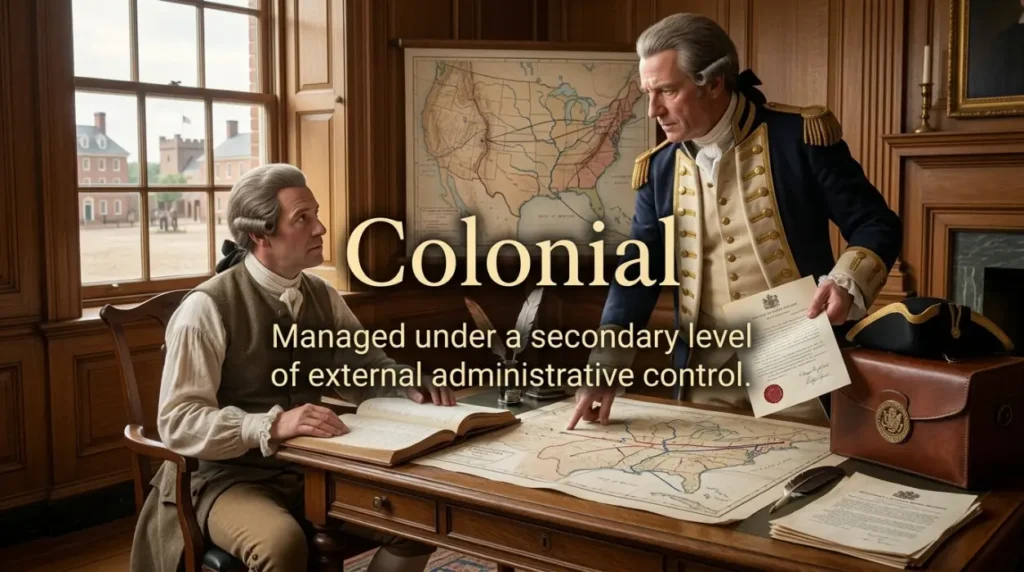
60. Sub-governed (Adjective)
Meaning: Managed under a secondary level of external administrative control.
Tone/Register: Technical / Administrative
Examples:
- The province was sub-governed by regional officers.
- Sub-governed regions followed strict central guidelines.
Synonyms by Tone
Choosing the right word depends heavily on your intended emotional tone and audience.
Positive
- Pioneer
- Early American
- Settlement style
- Frontier
Neutral
- Provincial
- Territorial
- Dominion era
- Overseas
- Georgian
Negative
- Subjugated
- Exploitative
- Hegemonic
- Occupied
- Native displacing
Playful / Informal
- Outpost style
- Old-school settlement
Word choice matters because describing a building as “Georgian” sounds polished and appreciative, whereas calling a policy “exploitative” highlights historical injustice. Matching tone to context prevents misunderstandings in your writing.
“Colonial” vs. Close Alternatives
| Term | Core Meaning Focus | Emotional Tone | Best Used For |
| Colonial | Foreign territorial settlement & administration | Neutral to Negative | Architecture, history, government systems |
| Imperial | Grand power extended over nations by an empire | Majestic / Authoritative | Ruling empires, monarchies, foreign conquest |
| Provincial | Belonging to outer regions away from capitals | Neutral to Mildly Critical | Regional design, rustic decor, rural life |
How “Colonial” Changes by Context
Daily Conversation
In casual talk, people mostly use this word to describe physical items like houses, dining tables, or decor. For instance: “I love those high-ceiling colonial houses downtown.”
Writing & Blogging
Bloggers and authors use synonyms like Early American or settlement-style to add rich visual details without repeating the focus keyword constantly.
Professional & Academic Tone
In academic essays or history papers, terms like hegemonic, non-autonomous, or territorial offer greater precision when discussing power dynamics.
Creative & Informal Use
Novelists often use visual words like frontier or borderland to establish historical settings quickly.
Common Mistakes Learners Make
- Confusing political and design contexts: Do not use heavy political words like exploitative when you simply mean a style of wooden furniture.
- Overusing the focus word: Repeating “colonial” five times in one paragraph makes writing feel robotic. Swap it out for provincial or historic.
- Assuming all settlements are colonial: Ancient villages or native settlements are not colonial unless ruled by an external foreign power.
When polishing your essays or articles, practicing natural phrase variations improves your overall vocabulary score on writing exams.
Real-Life Mini Scenarios
- Workplace: An architect presents a restoration plan using terms like Georgian symmetry instead of generic colonial labels.
- Social Situations: A friend describes their home decor as rustic provincial during a dinner party conversation.
- Media & Pop Culture: Film reviewers analyze historical dramas by discussing imperial themes in the script.
- Writing & Storytelling: A fantasy author describes a remote frontier outpost to build tension in chapter one.
Conclusion
Expanding your vocabulary with precise alternatives helps you describe historical, architectural, and cultural ideas with greater clarity. Synonyms for Colonial can give you more specific ways to express different contexts without repeating the same term.
Learning different words also helps you recognize subtle differences in meaning and tone. Whether you are discussing history, literature, design, or social topics, selecting specific vocabulary can make your descriptions more accurate and engaging.
Try choosing three new words from this list and using them in your next email, essay, article, or blog post. Regular practice will strengthen your vocabulary, improve your word choices, and help you communicate complex ideas with greater confidence.
Practice Exercise
1. Which synonym best describes an elegant 18th-century home with a symmetrical brick design?
A) Occupied
B) Georgian
C) Hegemonic
D) Subjugated
2. If a nation dominates its neighbors through economic force, its policies are best described as:
A) Hegemonic
B) Provincial
C) Pioneer
D) Settlement style
3. Which term carries a distinctly positive tone when describing early historical development?
A) Exploitative
B) Occupied
C) Pioneer
D) Subjugated
4. What is the best academic term for an island governed fully by another nation?
A) Outpost style
B) Non-autonomous
C) Old school
D) Traditionalist
5. Which word fits best when describing rustic countryside furniture?
A) Provincial
B) Annexed
C) Imperial
D) Extraterritorial
6. What is a territory called when it is required to pay annual taxes to a foreign emperor?
A) Settler village
B) Tributary state
C) Frontier cabin
D) Expatriate town
7. Which word carries a strong negative connotation when describing labor practices?
A) Pioneer
B) Exploitative
C) Georgian
D) Territorial
8. Which term describes land added to a country through military action or treaty?
A) Annexed
B) Settlement style
C) Traditionalist
D) Provincial
9. Which term works best in everyday conversation about interior décor?
A) Non-sovereign
B) Early American
C) Hegemonic
D) Subjugated
10. What is a remote border town far from central civil authorities often called?
A) Capital city
B) Frontier outpost
C) Monopolized port
D) Vassal kingdom
Answer Key:
1B | 2A | 3C | 4B | 5A | 6B | 7B | 8A | 9B | 10B
Reflection Task:
Write a two-sentence scene describing an old town using at least two synonyms from this article.
FAQs
1. What is the most accurate synonym for colonial in architecture?
The most accurate architectural terms are Georgian, Early American, or provincial. These words specify design aesthetics, symmetry, and historical eras without carrying political connotations.
2. Is imperial the same as colonial?
No, while related, imperial refers to the grand central empire exercising power over foreign regions, whereas colonial focuses specifically on local settlements, territories, and governance structures established overseas.
3. Which synonyms for colonial carry a negative meaning?
Words like exploitative, subjugated, native displacing, and hegemonic carry strong negative connotations, highlighting forced rule, resource extraction, and loss of local independence.
4. How can I choose between provincial and colonial in writing?
Use provincial when focusing on rural, regional, or countryside characteristics away from a main capital. Use colonial when specifically referencing foreign rule or historic settlement eras.
5. Why are there so many synonyms for colonial in English?
English absorbed terms from Latin, French, legal texts, and global history. Different contexts like architecture, politics, biology, and history require distinct shades of meaning.
6. What is a good neutral alternative for academic essays?
In academic contexts, terms like territorial, non-autonomous, or foreign-administered offer objective, precise descriptions suitable for research papers and formal analysis.

Jameel Hassan is the founder and lead writer at SynonymsCloud.com, a trusted online platform dedicated to English vocabulary and effective communication. He is passionate about helping students, writers, professionals, and lifelong learners discover the right words to express their ideas with clarity, precision, and confidence.
At SynonymsCloud.com, every article is thoroughly researched and carefully written to provide accurate, practical, and easy-to-understand guidance on synonyms, antonyms, word meanings, idioms, and vocabulary. With a strong commitment to quality, real-world usage, and clear explanations, the website helps readers expand their vocabulary, improve their writing, and communicate more effectively in both academic and professional settings.