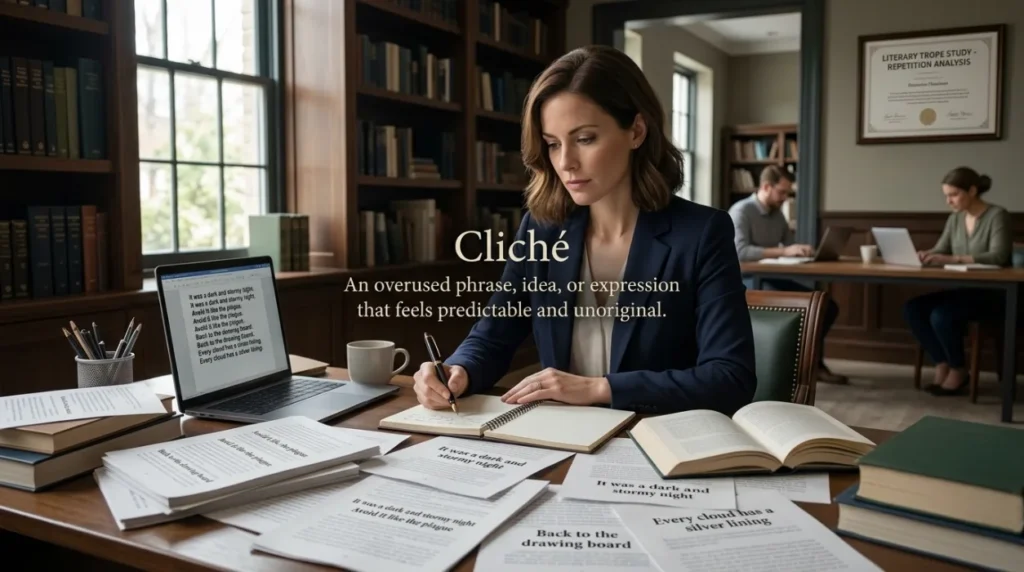
The best modern alternatives to “cliché” are “overused expression,” “trite phrase,” and “platitude.” Writers avoid clichés by replacing them with fresh, specific descriptions — explore 60 alternatives below.
The top synonyms for cliché include platitude, hackneyed phrase, trope, banality, truism, boilerplate, and old hat. A cliché is an overused expression or unoriginal idea that has lost its impact. Using these targeted alternatives enhances your vocabulary while keeping your writing fresh, clear, engaging, and professional.
Synonyms for Cliché can help you replace repetitive expressions with fresher, more precise language. When familiar phrases appear too often, they may make your writing feel predictable. Choosing a suitable alternative gives your sentences more personality and keeps readers interested.
For example, describing a familiar movie storyline as a “tired trope” can communicate the idea more specifically than simply calling it a cliché. Different alternatives can highlight repetition, outdated ideas, common patterns, or predictable expressions depending on your intended meaning.
Learning Synonyms for Cliché also improves your ability to recognize subtle differences in tone. This skill can make essays, reviews, articles, and conversations more engaging while helping you avoid unnecessary repetition.
Whether you are a student, blogger, writer, or English learner, practicing Synonyms for Cliché can expand your vocabulary and help you choose words that fit each situation naturally.
What Does “Cliché” Really Mean?
A cliché is an expression, idea, or element of an artistic work that has been overused to the point of losing its original meaning, impact, or freshness.
Native speakers view a cliché as a sign of lazy thinking or predictable storytelling. When someone uses a cliché, it suggests they relied on a default option rather than crafting an original thought. You will frequently encounter this word in film critiques, literary reviews, business presentations, and everyday social discussions.
- Part of Speech: Noun (also used as an adjective)
- Simple Definition: A phrase or idea that is used so often that it is no longer interesting or effective.
Connotative Meaning
Connotation is the emotional feeling, mental association, or social attitude that a word carries beyond its literal dictionary definition.
- Positive tone: Rarely positive, but occasionally used affectionately to describe comforting, classic storytelling patterns.
- Negative tone: Implies laziness, unoriginality, predictability, or a complete lack of creative effort.
- Neutral tone: Identifies an overused cultural phrase or standard template without passing heavy, harsh judgment.
Etymology
The word originates directly from French printing terminology in the nineteenth century.
- Old English (450–1100): The word did not exist in Old English; early speakers used Germanic terms like aldcwide (old saying) to describe familiar phrases.
- Middle English (1100–1500): Absent from Middle English, as writers relied on Latin rhetorical terms for overused expressions.
- Modern English (1500–Present): Borrowed from a French cliché in the late 1800s. It was an onomatopoeic word representing the sound of a matrix striking molten metal to cast a stereotyped printing plate.
Pronunciation (US & UK)
- US: /kliːˈʃeɪ/
- UK: /ˈkliː.ʃeɪ/
Syllables & Structure
- Syllables: cli-ché
- Root: clicher (French verb meaning “to click” or “to print dynamically”)
- Prefix: None
- Suffix: None (retains the French past participle accent)
Synonyms List
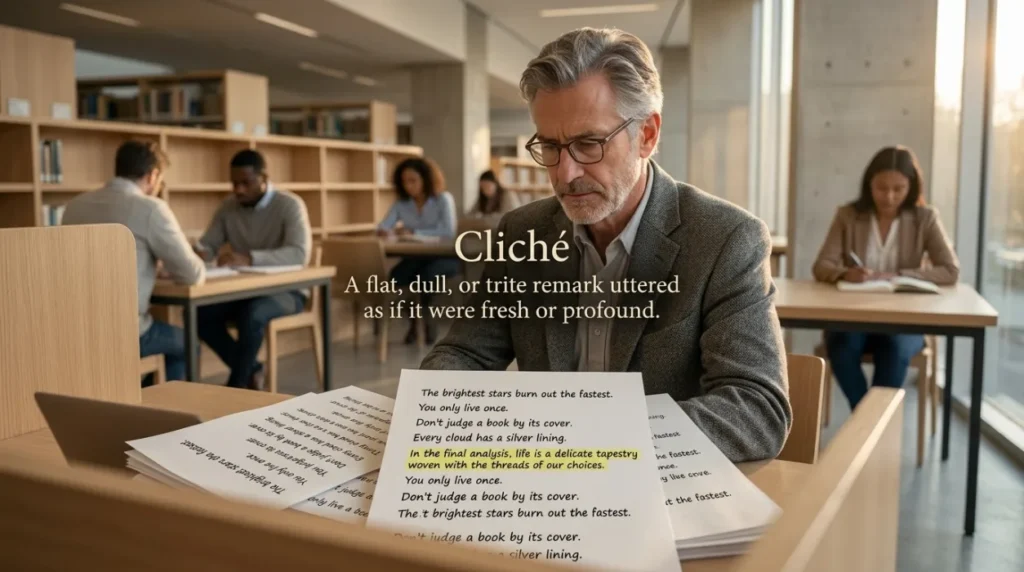
1. Platitude (Noun)
Meaning: A flat, dull, or trite remark uttered as if it were fresh or profound.
Tone/Register: Formal, Critical, Academic
Examples:
The manager offered a meaningless platitude instead of answering our concerns.
Telling a grieving friend that everything happens for a reason is a common platitude.
2. Bromide (Noun)
Meaning: A tiresome or soothing remark intended to calm someone without offering real substance.
Tone/Register: Literary, Intellectual
Examples:
His speech was filled with old bromides about hard work and success.
She grew tired of hearing the same comfort bromides after her team lost.
3. Chestnut (Noun)
Meaning: An old joke, story, or phrase that has been repeated so many times it has lost its humor.
Tone/Register: Conversational, Informal
Examples:
Grandpa told that old chestnut about walking to school in the snow again.
The speaker opened his presentation with an ancient comedy chestnut.
4. Trope (Noun)
Meaning: A recurring theme, motif, or device in literature and visual media that can easily become overused.
Tone/Register: Media Studies, Critical, Academic
Examples:
The lone hero saving the world is a familiar trope in action cinema.
Writers often subvert the traditional romantic trope to surprise their readers.
5. Truism (Noun)
Meaning: A statement that is obviously true and says nothing new or interesting.
Tone/Register: Philosophical, General, Formal
Examples:
Stating that time flies when you are having fun is an obvious truism.
His article relied on basic truisms rather than offering original research.
6. Banality (Noun)
Meaning: A completely unoriginal observation or feature that lacks novelty.
Tone/Register: Formal, Critical
Examples:
The dialogue in the movie suffered from extreme banality.
She escaped the daily banality of her routine by writing short stories.
7. Stereotype (Noun)
Meaning: An oversimplified and generalized belief or image associated with a group or thing.
Tone/Register: Sociological, General
Examples:
The novel avoids the common stereotype of the clumsy assistant.
Media representations often reinforce a narrow cultural stereotype.
8. Commonplace (Noun)
Meaning: A trite remark or an ordinary, completely predictable idea.
Tone/Register: Formal, Academic
Examples:
Complaining about the weather is a standard conversational commonplace.
Her essay was filled with academic commonplaces that lacked personal insight.
9. Old hat (Adjective)
Meaning: Outdated, overly familiar, or no longer interesting due to constant repetition.
Tone/Register: Casual, Conversational
Examples:
Using basic slide transitions in video editing is considered old hat now.
Her fashion advice felt like old hat to the design students.
10. Adage (Noun)
Meaning: A traditional saying that has gained acceptance over time, which can feel overused.
Tone/Register: Literary, Neutral
Examples:
Remember the adage that actions speak louder than words.
He quoted a familiar adage to settle the argument quickly.
11. Saw (Noun)
Meaning: An ancient proverb or wise saying that has been repeated for generations.
Tone/Register: Archaic, Literary
Examples:
The old saw about penny wisdom often holds.
She dismissed his advice as nothing more than a tired saw.
12. Maxim (Noun)
Meaning: A short, pithy statement expressing a general truth or rule of conduct.
Tone/Register: Formal, Philosophical
Examples:
He lives his life according to the famous maxim to do no harm.
The corporate handbook opened with a simple moral maxim.
13. Buzzword (Noun)
Meaning: A fashionable jargon word or phrase that loses real meaning through heavy repetition.
Tone/Register: Corporate, Technical, Business
Examples:
Synergy became an annoying buzzword in modern office meetings.
The marketing team packed the press release with trendy buzzwords.
14. Rehash (Noun)
Meaning: Old material or ideas presented again without any significant changes or improvements.
Tone/Register: Informal, Critical
Examples:
The new sequel felt like a weak rehash of the original movie.
His proposal was just a rehash of last year’s failed strategy.
15. Formula (Noun)
Meaning: A fixed, mechanical method or plot structure used repeatedly without creativity.
Tone/Register: Business, Creative Writing
Examples:
The pop song followed a proven commercial formula for radio success.
Hollywood studios often rely on a safe narrative formula.
16. Boilerplate (Noun)
Meaning: Standard, unoriginal text or language used repeatedly in documents or speeches.
Tone/Register: Legal, Business, Technical
Examples:
The contract was mostly filled with legal boilerplate language.
Avoid using boilerplate responses when answering customer complaints.
17. Catchphrase (Noun)
Meaning: A well-known sentence or phrase associated with a specific person or character.
Tone/Register: Popular Culture, Casual
Examples:
The comedian relied on his famous catchphrase to get a quick laugh.
Her catchphrase spread across social media platforms overnight.
18. Retread (Noun)
Meaning: An old idea, film, or concept brought back without fresh imagination.
Tone/Register: Informal, Critical
Examples:
Critics dismissed the television reboot as an unnecessary retread.
The company released a retread of its older product model.
19. Stock phrase (Noun)
Meaning: A standard phrase used habitually in specific situations without deep thought.
Tone/Register: Conversational, Neutral
Examples:
At the end of the day is a stock phrase used by many commentators.
She avoided stock phrases to keep her writing distinctive.
20. Hackneyed phrase (Noun)
Meaning: An expression that has grown stale and ineffective through excessive repetition.
Tone/Register: Literary, Academic
Examples:
Avoid hackneyed phrases like white as a sheet in your novel.
The speech was weighed down by hackneyed phrases and predictable metaphors.
21. Tired phrase (Noun)
Meaning: A wording that feels worn out and lacking in energy due to constant use.
Tone/Register: General, Casual
Examples:
The editor cut several tired phrases from the article draft.
He kept using tired phrases that bored his listeners.
22. Threadbare phrase (Noun)
Meaning: An expression so overused that its meaning is thin and transparent.
Tone/Register: Literary, Critical
Examples:
His defense relied on a threadbare phrase about noble intentions.
The writer discarded threadbare phrases in favor of fresh imagery.
23. Well-worn phrase (Noun)
Meaning: A familiar saying that is comfortable but lacks original spark.
Tone/Register: Neutral, Descriptive
Examples:
She used a well-worn phrase to describe her excitement.
The author included a few well-worn phrases in the opening chapter.
24. Standard line (Noun)
Meaning: A prepared or predictable response given habitually to avoid detailed explanation.
Tone/Register: Business, Political
Examples:
The official gave the standard line about ongoing investigations.
Do not just repeat the standard line when customers ask for help.
25. Default response (Noun)
Meaning: An automatic answer used without conscious thought or creative effort.
Tone/Register: Technical, Psychological
Examples:
Saying I am fine has become a default response for most people.
His default response to criticism was to change the subject.
26. Carbon copy (Noun)
Meaning: A person, idea, or thing that is an exact duplicate of another without original features.
Tone/Register: Informal, Descriptive
Examples:
The new restaurant is a carbon copy of the one downtown.
Her presentation was a carbon copy of her colleague’s work.
27. Echo (Noun)
Meaning: A repetition or imitation of a previously expressed idea or style.
Tone/Register: Literary, Poetic
Examples:
His poetry is a faint echo of classic nineteenth-century writers.
The movie feels like an echo of earlier science fiction films.
28. Copycat (Noun)
Meaning: Something designed to mimic a successful original idea closely.
Tone/Register: Casual, Slightly Critical
Examples:
The market is full of copycat apps trying to replicate that success.
Avoid producing a copycat design when launching a new brand.
29. Stale idea (Noun)
Meaning: A concept that has lost its novelty, relevance, or interest.
Tone/Register: General, Everyday
Examples:
The marketing team needed fresh concepts instead of another stale idea.
Her essay was rejected for presenting a stale idea about technology.
30. Unoriginal thought (Noun)
Meaning: An opinion or idea that merely repeats what others have already said.
Tone/Register: Educational, Critical
Examples:
The student was encouraged to replace unoriginal thoughts with analysis.
Relying on unoriginal thoughts will not win a debate competition.
31. Conventional wisdom (Noun)
Meaning: Ideas or beliefs that are generally accepted as true by the public but may be overused.
Tone/Register: Intellectual, Media
Examples:
The research paper challenged the conventional wisdom on sleep.
Conventional wisdom says to save money early in your career.
32. Routine (Noun)
Meaning: A sequence of actions or words that has become predictable through habit.
Tone/Register: General, Casual
Examples:
The comedian’s opening routine was filled with familiar jokes.
Her daily routine felt like a predictable script.
33. Mold (Noun)
Meaning: A fixed pattern or standard framework that shapes similar creations repeatedly.
Tone/Register: Artistic, Descriptive
Examples:
The movie breaks the traditional mold of superhero storytelling.
His writing style fits right into the classic thriller mold.
34. Stencil (Noun)
Meaning: A rigid template used to create identical copies effortlessly.
Tone/Register: Figurative, Critical
Examples:
The author used a generic character stencil for the villain.
Avoid applying a rigid stencil to complex social issues.
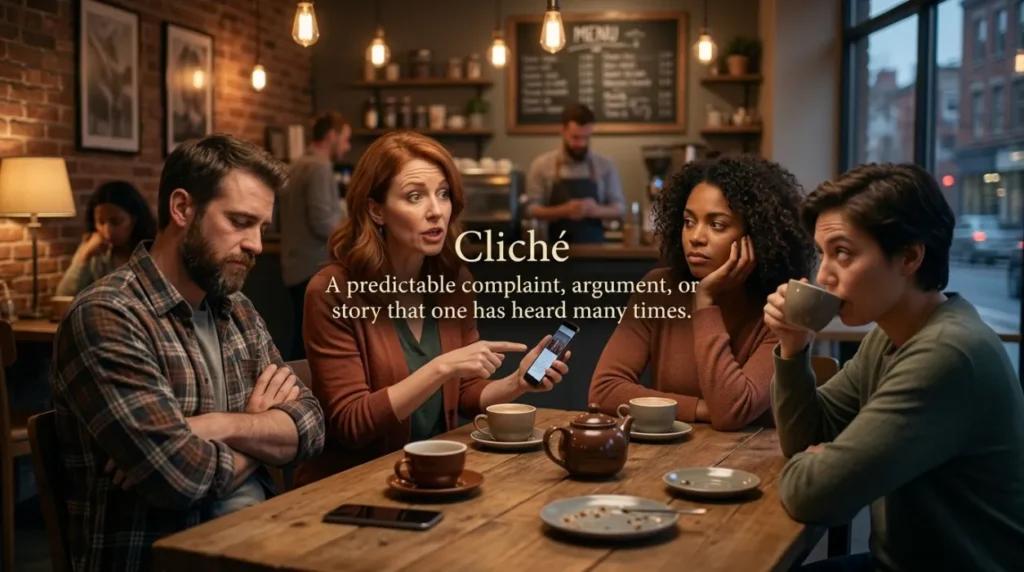
35. Same old song (Noun)
Meaning: A predictable complaint, argument, or story that one has heard many times.
Tone/Register: Idiomatic, Informal
Examples:
The politician sang the same old song about lower taxes during the campaign.
We do not want to hear the same old song about budget limits.
36. Old story (Noun)
Meaning: An event or explanation that is familiar and no longer surprises anyone.
Tone/Register: Informal, Narrative
Examples:
Traffic delays on Friday afternoon are an old story in this city.
The rising cost of living is an old story for young workers.
37. Derivative element (Noun)
Meaning: A component of a creative work that is visibly borrowed from another source.
Tone/Register: Academic, Artistic
Examples:
The album contains several derivative elements from eighties pop music.
Critics called the novel’s main plot a derivative element.
38. Slogan (Noun)
Meaning: A memorable motto used repeatedly in advertising or political campaigns.
Tone/Register: Business, Political
Examples:
The company adopted a catchy slogan for its new product line.
Her political slogan was repeated in every television advertisement.
39. Byword (Noun)
Meaning: A person or thing that becomes a perfect or proverbial embodiment of a quality.
Tone/Register: Literary, Formal
Examples:
His name became a national byword for extreme efficiency.
The brand is a byword for reliable craftsmanship across the globe.
40. Gimmick (Noun)
Meaning: A trick or novel device used to attract attention, which quickly feels overused.
Tone/Register: Commercial, Casual
Examples:
The 3D effect in the film felt like a cheap gimmick.
Focus on quality products rather than relying on a sales gimmick.
41. Pattern (Noun)
Meaning: A predictable sequence or repeated arrangement of thoughts or events.
Tone/Register: Analytical, Neutral
Examples:
Researchers noticed a repeating pattern in consumer behavior.
The story follows a familiar pattern of conflict and resolution.
42. Motif (Noun)
Meaning: A dominant or recurring image or idea in an artistic work.
Tone/Register: Academic, Artistic
Examples:
Light and darkness serve as a central motif in the play.
The author uses the sea as a recurring thematic motif.
43. Standard trope (Noun)
Meaning: An overused narrative element that audiences immediately recognize.
Tone/Register: Critical, Media
Examples:
The secret identity is a standard trope in superhero comics.
Her screenplay subverts every standard trope of the horror genre.
44. Copy-paste line (Noun)
Meaning: A statement that appears identical to previous ones as if digitally duplicated.
Tone/Register: Informal, Technical
Examples:
The customer service reply felt like a copy-paste line.
Avoid using copy-paste lines in your college entrance essay.
45. Prepackaged phrase (Noun)
Meaning: A phrase prepared in advance that lacks genuine personal sentiment.
Tone/Register: Critical, Workplace
Examples:
His apology sounded like a prepackaged phrase written by public relations.
She avoided prepackaged phrases when comforting her colleague.
46. Cookie-cutter phrase (Noun)
Meaning: A standardized expression that lacks unique character or originality.
Tone/Register: Informal, Descriptive
Examples:
The job description was full of cookie-cutter phrases.
Write fresh descriptions instead of relying on cookie-cutter phrases.
47. Second-hand phrase (Noun)
Meaning: Wording borrowed from someone else rather than created independently.
Tone/Register: Literary, Personal
Examples:
Her speech was full of second-hand phrases she heard on television.
Express your true feelings without using second-hand phrases.
48. Overused expression (Noun)
Meaning: A combination of words that has been used so frequently it lacks impact.
Tone/Register: Educational, Clear
Examples:
At the end of the day is an overused expression in business talk.
Try to replace every overused expression with a descriptive word.
49. Predictable line (Noun)
Meaning: Dialogue or statement that anyone can guess before it is spoken.
Tone/Register: Entertainment, Casual
Examples:
The villain delivered a predictable line before escaping.
I knew what he would say because it was such a predictable line.
50. Monotonous phrase (Noun)
Meaning: Dull wording that lacks variety or interest.
Tone/Register: Formal, Critical
Examples:
The report was filled with a monotonous phrase after another.
Vary your sentence structure to avoid a monotonous phrase.
51. Rerun (Noun)
Meaning: An event, statement, or creative work that repeats previous experiences exactly.
Tone/Register: Informal, Casual
Examples:
Their argument was just a rerun of yesterday’s debate.
The second season felt like an uninspired rerun.
52. Habitual line (Noun)
Meaning: A phrase someone repeats out of habit without thinking about its relevance.
Tone/Register: Behavioral, Conversational
Examples:
It is what it is was his habitual line during tough projects.
She noticed his habitual line whenever he felt nervous.
53. Formulaic idea (Noun)
Meaning: A concept constructed according to a rigid, pre-made plan rather than creative thought.
Tone/Register: Academic, Critical
Examples:
The judge rejected the thesis for presenting a formulaic idea.
Great inventions rarely come from a formulaic idea.
54. Dull remark (Noun)
Meaning: A comment that lacks brightness, intelligence, or interest.
Tone/Register: General, Casual
Examples:
His dull remark brought the lively conversation to a halt.
She ignored the dull remark and continued her speech.
55. Worn-out saying (Noun)
Meaning: An old proverb or saying that has lost its vigor or meaning.
Tone/Register: Everyday, Descriptive
Examples:
Don’t cry over spilled milk is a worn-out saying everyone knows.
He quoted a worn-out saying that made everyone roll their eyes.
56. Overworked term (Noun)
Meaning: A specific word that is used far too often in a short period.
Tone/Register: Professional, Linguistic
Examples:
Unprecedented became an overworked term during recent years.
Clean up your text by removing every overworked term.
57. Trite expression (Noun)
Meaning: A phrase that is lacking in freshness or effectiveness because of constant use.
Tone/Register: Formal, Academic
Examples:
The student’s essay was penalized for including trite expressions.
A good writer replaces trite expressions with original imagery.
58. Pedestrian remark (Noun)
Meaning: A commonplace or unimaginative comment.
Tone/Register: Literary, Formal
Examples:
His speech was ruined by pedestrian remarks about the weather.
She refused to offer pedestrian remarks on such an important topic.
59. Standardized line (Noun)
Meaning: A uniform response created for mass communication or formal consistency.
Tone/Register: Corporate, Formal
Examples:
The company issued a standardized line regarding the contract delay.
Every customer service agent was trained to repeat the standardized line.
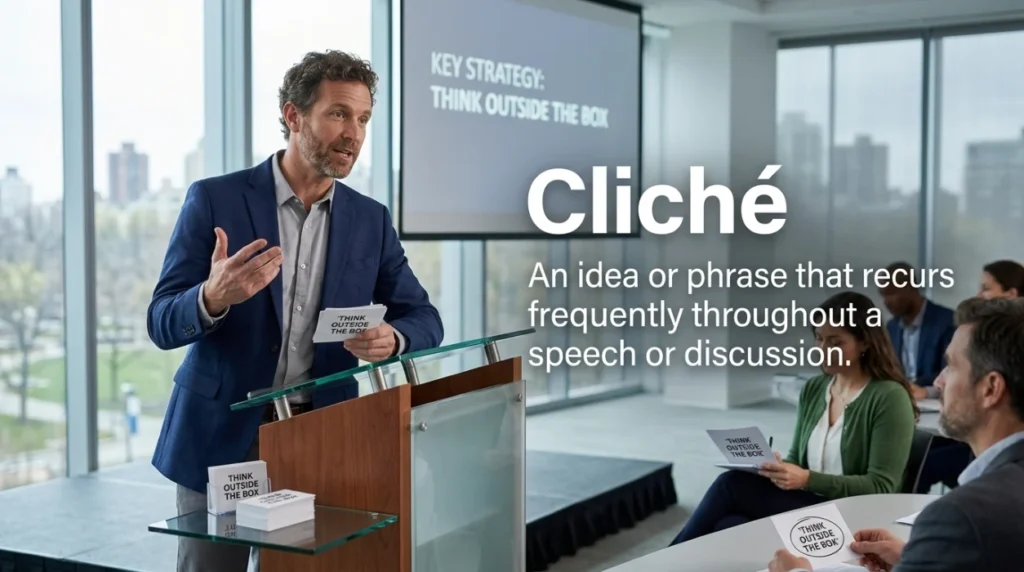
60. Repeated refrain (Noun)
Meaning: An idea or phrase that recurs frequently throughout a speech or discussion.
Tone/Register: Literary, Political
Examples:
Lowering operational costs was the repeated refrain of the conference.
The speaker made unity the repeated refrain of her campaign.
Synonyms by Tone
Categorizing synonyms by emotional register helps you pick the right alternative for your audience:
- Positive / Analytical (Constructive or Neutral): Trope, Motif, Maxim, Adage, Conventional wisdom, Pattern.
- Neutral (Structural / Direct): Commonplace, Formula, Boilerplate, Stock phrase, Standard line, Slogan, Byword.
- Negative (Critical / Unfavorable): Platitude, Bromide, Banality, Hackneyed phrase, Rehash, Trite expression, Cookie-cutter phrase.
- Playful / Informal (Casual speech): Old hat, Chestnut, Same old song, Copycat, Gimmick, Retread.
Tone matters greatly when replacing the word cliché. Calling a writer’s theme a “trope” analyzes their storytelling structure objectively, whereas labeling it a “platitude” or “banality” criticizes their lack of intellectual depth.
Mini Comparison: Cliche vs. Close Alternatives
| Word | Core Meaning | Primary Tone | Best Used When… |
| Cliche | An overused phrase or idea that has lost its impact | Neutral to Negative | Describing unoriginal creative works or tired expressions. |
| Platitude | A dull remark spoken as if it were wise | Critical / Negative | Calling out fake or empty comforting statements. |
| Trope | A recurring theme or device in storytelling | Neutral / Analytical | Discussing media, film, or literary conventions objectively. |
Context-Based Usage
Daily Conversation
In casual talk, choose simple terms like old hat, chestnut, tired phrase, or same old song.
Example: “That joke about airline food is total old hat.”
Writing & Blogging
Bloggers and essay writers use terms like platitude, hackneyed phrase, buzzword, or cookie-cutter phrase to criticize unoriginal ideas cleanly.
Example: “Avoid filling your landing page with meaningless corporate buzzwords.”
Professional & Academic Settings
Formal writing demands precise vocabulary like banality, truism, boilerplate, or conventional wisdom.
Example: “The legal team reviewed the contract’s standard boilerplate section.”
Creative Writing & Storytelling
Fiction authors analyze narrative structure using tropes, motifs, stereotypes, or derivative elements.
Example: “The author subverted the classic mentor trope by making him the true antagonist.”
Common Mistakes & Native Usage
- Confusing Trope with Cliché: A trope is simply a storytelling convention (e.g., the “chosen one”). It only becomes a cliché when overused lazily.
- Using Platitude for Physical Actions: Platitudes are spoken statements. Do not call an overused action scene a platitude; call it a cliché or formulaic scene.
- Overusing Focus Keywords: Avoid repeating “cliché” in every paragraph. Alternate naturally with hackneyed expression, trite remark, or platitude.
Register Notes
- Formal Written English: Use platitude, banality, truism, and trite expression.
- Spoken Casual English: Use old hat, chestnut, same old song, and rehash.
To build a stronger overall vocabulary, explore our comprehensive guide on descriptive writing techniques.
Real-Life Mini Scenarios
- Workplace: A team lead rejects a marketing slogan because it sounds like a cookie-cutter phrase.
- Social Situations: A friend avoids giving an empty platitude when listening to a neighbor’s struggles.
- Media & Pop Culture: A film critic notes that the movie relied heavily on the superhero trope.
- Writing & Storytelling: A novelist edits out every hackneyed phrase to make the dialogue sound realistic.
Conclusion
Strengthening your vocabulary gives you more freedom to communicate ideas in a clear and memorable way. Instead of relying on the same familiar expressions, exploring related words helps you create writing that feels fresh, natural, and purposeful. This approach can benefit students, writers, professionals, and anyone who wants to communicate with greater confidence.
Understanding why an expression feels predictable can also improve your word choices. Synonyms for cliché may describe language that has been repeated so often that it loses some of its originality. Learning alternatives allows you to select expressions that better match your meaning, tone, and audience without making your writing sound forced.
Keep improving by choosing a few new words each day and using them in your own sentences. Practice them in emails, essays, conversations, or journal entries. With regular use, new vocabulary becomes easier to remember and apply.
Practice Exercise
1. Which synonym best describes an overused, dull moral statement presented as deep wisdom?
A) Trope
B) Platitude
C) Slogan
D) Motif
2. Which term describes a familiar storytelling device, such as a haunted mansion in a horror movie?
A) Trope
B) Bromide
C) Boilerplate
D) Saw
3. What word describes standardized legal text repeated across many contracts?
A) Rehash
B) Boilerplate
C) Old hat
D) Catchphrase
4. What does the phrase “old hat” mean when describing an idea or expression?
A) Brand new
B) Outdated and overused
C) Offensively rude
D) Highly scientific
5. Which term refers to an ancient saying or proverb repeated for generations?
A) Adage
B) Echo
C) Gimmick
D) Copycat
6. Which word strongly criticizes empty or predictable statements meant to offer comfort?
A) Bromide
B) Motif
C) Pattern
D) Slogan
7. What term describes a movie sequel that repeats the original story without adding fresh ideas?
A) Truism
B) Rehash
C) Maxim
D) Byword
8. Which term describes a trendy corporate expression that has lost meaning through overuse?
A) Buzzword
B) Saw
C) Mold
D) Stencil
9. Which phrase refers to commonly accepted opinions or beliefs held by the general public?
A) Conventional wisdom
B) Habitual line
C) Carbon copy
D) Second-hand phrase
10. What term best describes an overused phrase that has lost its originality or impact?
A) Hackneyed phrase
B) Maxim
C) Motif
D) Slogan
Application Task:
Write one original sentence about a movie or book using either trope or platitude.
Answer Key:
1B, 2A, 3B, 4B, 5A, 6A, 7B, 8A, 9A, 10 A
FAQs
1. What is the most common synonym for cliché in everyday English?
The most common casual synonyms for cliché in daily speech are overused phrase, old hat, and platitude. Native speakers use these alternatives to describe tired sayings, predictable movie plots, or unoriginal ideas without sounding overly academic.
2. What is the main difference between a cliché and a trope?
A trope is a standard storytelling motif or theme, such as “the hero’s journey.” A trope is neutral and useful, but it becomes a cliché when creators execute it lazily or repeat it without any original creativity.
3. How can I avoid using clichés in my professional writing?
You can avoid clichés by identifying overused stock phrases during editing and replacing them with specific, literal descriptions. Instead of writing “at the speed of light,” state the exact time frame or use fresh, precise verbs to convey speed.
4. Is the word platitude always negative when replacing cliché?
Yes, platitude carries a critical tone. It specifically describes a flat or trite remark made to sound profound or comforting, making it ideal when you want to criticize insincere or superficial advice in speeches and essays.
5. Why do writers use synonyms for cliché in content creation?
Using synonyms for cliché improves search engine optimization, prevents repetitive phrasing, and keeps readers engaged. Selecting specific shades of meaning, like buzzword for business or trope for literature, makes your overall writing far more precise.
6. Can a cliché ever be used effectively in creative writing?
Yes, authors sometimes use clichés deliberately in dialogue to show that a character is unoriginal, nervous, or overly formal. Subverting a well-known cliché by twisting its expected outcome also creates engaging plot twists for readers.
“Platitude,” “trite expression,” or “banality” all work as synonyms.
Replace overused phrases with fresh, specific descriptions — show details instead of relying on familiar sayings.
“Cliché” is standard in both formal and informal writing; it is the go-to term in literary criticism.

Jameel Hassan is the founder and lead writer at SynonymsCloud.com, a trusted online platform dedicated to English vocabulary and effective communication. He is passionate about helping students, writers, professionals, and lifelong learners discover the right words to express their ideas with clarity, precision, and confidence.
At SynonymsCloud.com, every article is thoroughly researched and carefully written to provide accurate, practical, and easy-to-understand guidance on synonyms, antonyms, word meanings, idioms, and vocabulary. With a strong commitment to quality, real-world usage, and clear explanations, the website helps readers expand their vocabulary, improve their writing, and communicate more effectively in both academic and professional settings.