
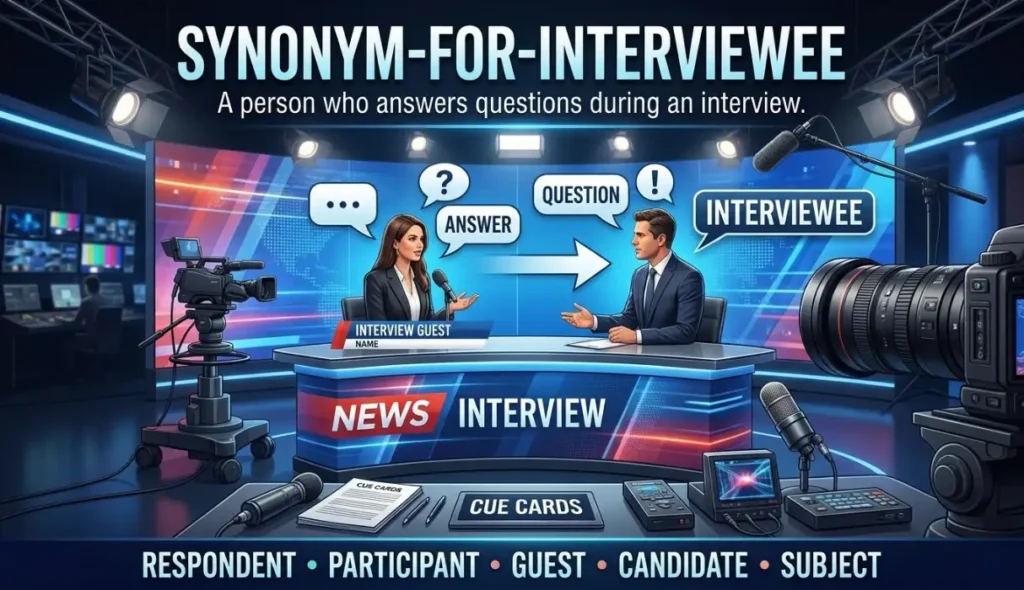
The noun interviewee refers to a person answering questions during an interview. Common synonyms depend on context: use candidate or applicant for job hiring, guest for podcasts or talk shows, respondent or subject for academic research, and source or witness for journalism and legal proceedings.
A synonym for interviewee is a useful search term for writers who want to describe a person answering questions without repeating the same word. It works well when writing HR reports, podcast summaries, articles, or interview-based content.
For example, calling a job seeker a “candidate” fits a hiring context, while “guest” works well for a celebrity appearing on a podcast or broadcast. Choosing the right synonym for interviewee depends on the specific situation and meaning.
Learning these vocabulary variations expands your word choices and prevents repetitive writing. You can find suitable alternatives in recruitment, journalism, legal proceedings, media, and professional communication.
Whether you are a student, blogger, journalist, or content writer, mastering a synonym for interviewee can improve clarity, flow, and confidence. Using the right alternative makes your writing sound natural, polished, and engaging.
What Does “Interviewee” Really Mean?
The word interviewee refers to a person who is interviewed by an interviewer. It functions as a noun to identify the individual responding to questions in a job meeting, journalistic inquiry, research study, or talk show.
Native English speakers view it as a neutral, direct descriptor of the person on the receiving end of a structured conversation. It is widely used across corporate recruitment, broadcast journalism, academic field research, and legal depositions.
Definition: In simple English, an interviewee is a person who answers questions during an official interview.
Connotative Meaning
(Connotation refers to the emotional association or implied feeling a word carries beyond its literal dictionary definition.)
- Positive tone: Highlights a willing participant, expert, or valued speaker sharing insights.
- Negative tone: Can sometimes suggest pressure, passivity, or feeling put on the spot by an examiner.
- Neutral tone: Factually identifies the person responding to questions in a conversation.
Etymology
The base word interview comes from the Middle French word s’entrevoir (meaning to see each other or meet briefly), combined from entre- (between) and voir (to see).
- Old English (450–1100): No direct equivalent existed; concepts centered around ġemēting (meeting) or āsciend (questioner/responder dynamics).
- Middle English (1100–1500): Adopted early French forms relating to formal meetings and face-to-face encounters.
- Modern English (1500–Present): The noun interview emerged in the 16th century, and adding the passive suffix -ee created interviewee in the 19th century to denote the recipient of questions.
Pronunciation (US & UK)
- US: /ˌɪn.t̬ɚ.vjuːˈiː/
- UK: /ˌɪn.tə.vjuːˈiː/
Syllables & Structure
Syllable Break: in-ter-view-ee (4 syllables)
Affixation Pattern:
- Root: View (from French voir, to see)
- Prefix: Inter- (meaning between or mutual)
- Suffix: -ee (passive noun suffix designating the person receiving the action)
Synonyms List
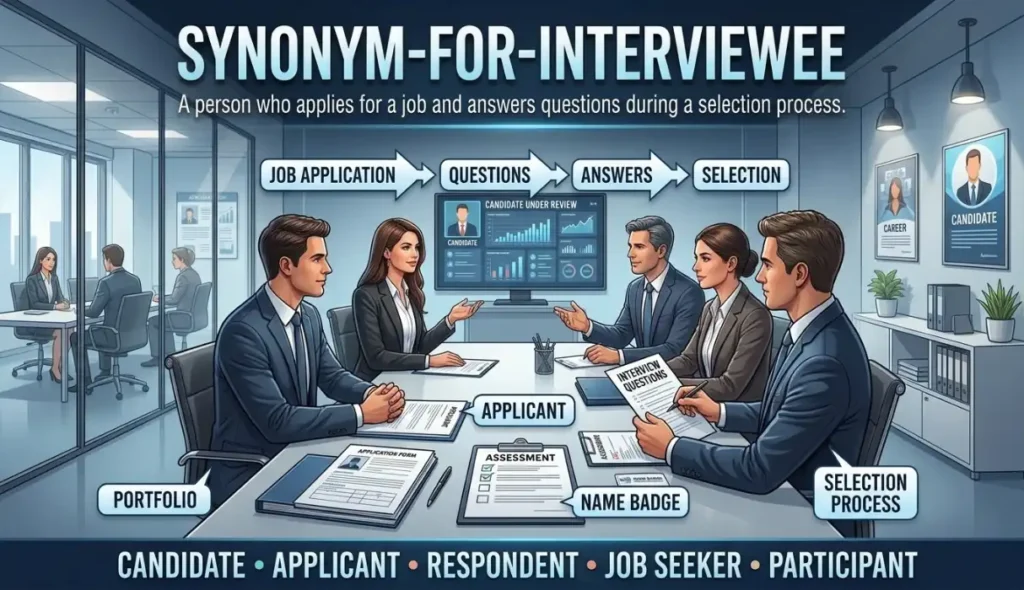
Candidate (Noun) — US: /ˈkæn.də.deɪt/ | UK: /ˈkæn.dɪ.dət/
Meaning: A person who applies for a job or position and answers questions during a selection process.
Tone/Register: Formal / Business / HR
Example 1: The hiring manager asked the candidate about her previous management experience.
Example 2: Each candidate received twenty minutes to present their portfolio to the board.
Applicant (Noun) — US: /ˈæp.lə.kənt/ | UK: /ˈæp.lɪ.kənt/
Meaning: A person who formally submits an application for a position or program and undergoes questioning.
Tone/Register: Formal / Business
Example 1: The recruiter selected five applicants for a second round of meetings.
Example 2: Every applicant must bring a printed resume to the office.
Respondent (Noun) — US: /rɪˈspɑːn.dənt/ | UK: /rɪˈspɒn.dənt/
Meaning: An individual who replies to questions in a research survey, interview, or legal proceeding.
Tone/Register: Academic / Legal / Formal
Example 1: Over eighty percent of survey respondents expressed satisfaction with the new policy.
Example 2: The primary respondent clarified his statements under oath during the deposition.
Subject (Noun) — US: /ˈsʌb.dʒekt/ | UK: /ˈsʌb.dʒɪkt/
Meaning: A person who is being discussed, interviewed, or studied in a specific project or story.
Tone/Register: Academic / Journalistic
Example 1: The documentary subject spoke candidly about his early career struggles.
Example 2: Researchers interviewed each human subject in a quiet, isolated room.
Guest (Noun) — US: /ɡest/ | UK: /ɡest/
Meaning: An invited speaker or personality featured on a podcast, radio show, or television interview.
Tone/Register: Informal / Media / Conversational
Example 1: Tonight’s special guest is an award-winning scientist and author.
Example 2: The podcast host introduced her guest to the studio audience.
Interlocutor (Noun) — US: /ˌɪn.t̬ɚˈlɑː.kjə.t̬ɚ/ | UK: /ˌɪn.təˈlɒk.jə.tər/
Meaning: A person who takes part in a formal conversation or dialogue.
Tone/Register: Formal / Academic / Literary
Example 1: She proved to be an engaging interlocutor during the diplomatic talks.
Example 2: The scholar debated key issues with his respected interlocutor.
Answerer (Noun) — US: /ˈæn.sɚ.ɚ/ | UK: /ˈɑːn.sər.ər/
Meaning: One who provides answers or replies to spoken or written questions.
Tone/Register: General / Descriptive
Example 1: The panel answerer addressed every inquiry from the curious audience.
Example 2: As the main answerer, he handled the media questions smoothly.
Speaker (Noun) — US: /ˈspiː.kɚ/ | UK: /ˈspiː.kər/
Meaning: A person who delivers spoken remarks or answers questions in an official capacity.
Tone/Register: Neutral / General
Example 1: The key speaker answered several questions from journalists after the speech.
Example 2: Our featured speaker shared practical tips on career advancement.
Contributor (Noun) — US: /kənˈtrɪb.jə.t̬ɚ/ | UK: /kənˈtrɪb.jə.tər/
Meaning: Someone who offers views, ideas, or testimony to a broadcast, article, or study.
Tone/Register: Professional / Media
Example 1: The news channel brought in a legal contributor to analyze the case.
Example 2: Several key contributors provided expert insights for the magazine article.
Talker (Noun) — US: /ˈtɑː.kɚ/ | UK: /ˈtɔː.kər/
Meaning: A person involved in a conversation or oral interview.
Tone/Register: Informal / Casual
Example 1: He is a fast talker who answered every question without hesitation.
Example 2: The radio host praised the guest for being a natural talker.
Interview Subject (Noun) — US: /ˈɪn.t̬ɚ.vjuː ˈsʌb.dʒekt/ | UK: /ˈɪn.tə.vjuː ˈsʌb.dʒɪkt/
Meaning: The specific individual chosen to be interviewed for a publication or study.
Tone/Register: Professional / Journalism
Example 1: The interview subject requested privacy before answering sensitive questions.
Example 2: Journalists spent weeks building trust with their interview subject.
Informant (Noun) — US: /ɪnˈfɔːr.mənt/ | UK: /ɪnˈfɔː.mənt/
Meaning: A person who provides specialized information or background data to an investigator or researcher.
Tone/Register: Formal / Academic / Legal
Example 1: The anthropologist relied on a local informant to understand regional customs.
Example 2: The investigator verified every claim made by the primary informant.
Deponent (Noun) — US: /dɪˈpoʊ.nənt/ | UK: /dɪˈpəʊ.nənt/
Meaning: A witness who gives written or oral testimony under oath during a legal deposition.
Tone/Register: Formal / Legal
Example 1: The deponent answered questions from defense lawyers for three hours.
Example 2: Transcripts of the deponent’s testimony were submitted to the judge.
Witness (Noun) — US: /ˈwɪt.nəs/ | UK: /ˈwɪt.nəs/
Meaning: A person who provides a firsthand account or answers questions regarding an event.
Tone/Register: Legal / Formal / General
Example 1: The key witness gave a detailed description of the incident to detectives.
Example 2: Attorneys took turns questioning the expert witness on the stand.
Examinee (Noun) — US: /ɪɡˌzæm.əˈniː/ | UK: /ɪɡˌzæm.ɪˈniː/
Meaning: A person who undergoes an examination, test, or formal questioning session.
Tone/Register: Academic / Formal
Example 1: The examinee remained calm while answering the oral test questions.
Example 2: Examiners monitored each examinee during the professional licensing review.
Job Candidate (Noun) — US: /dʒɑːb ˈkæn.də.deɪt/ | UK: /dʒɒb ˈkæn.dɪ.dət/
Meaning: A person actively being evaluated for employment through an interview.
Tone/Register: Business / Corporate
Example 1: Every job candidate must complete a technical assessment before the meeting.
Example 2: The company reimbursed travel costs for each out-of-town job candidate.
Job Applicant (Noun) — US: /dʒɑːb ˈæp.lə.kənt/ | UK: /dʒɒb ˈæp.lɪ.kənt/
Meaning: An individual seeking a specific job opening who attends an initial interview.
Tone/Register: Business / HR
Example 1: The job applicant submitted three glowing references along with her resume.
Example 2: HR contacted the qualified job applicant to arrange a phone screening.
Interviewee-to-be (Noun) — US: /ˌɪn.t̬ɚ.vjuːˈiː tuː biː/ | UK: /ˌɪn.tə.vjuːˈiː tuː biː/
Meaning: A person scheduled or about to undergo an upcoming interview.
Tone/Register: Informal / Conversational
Example 1: The nervous interviewee-to-be reviewed her notes in the waiting room.
Example 2: Advice articles help every interviewee-to-be feel confident before the big day.
Panelist (Noun) — US: /ˈpæn.əl.ɪst/ | UK: /ˈpæn.əl.ɪst/
Meaning: A member of a selected group who answers questions or discusses topics publicly.
Tone/Register: Professional / Media / Academic
Example 1: Each panelist shared insights on artificial intelligence during the Q&A session.
Example 2: The moderator directed questions to a panelist specializing in finance.
Interview Partner (Noun) — US: /ˈɪn.t̬ɚ.vjuː ˈpɑːrt.nɚ/ | UK: /ˈɪn.tə.vjuː ˈpɑːt.nər/
Meaning: A collaborative participant engaged in a two-way interview dynamic.
Tone/Register: Professional / Collaborative
Example 1: He treated his interview partner with immense respect throughout the broadcast.
Example 2: Finding a knowledgeable interview partner makes hosting a podcast enjoyable.
Interview Counterpart (Noun) — US: /ˈɪn.t̬ɚ.vjuː ˈkaʊn.t̬ɚ.pɑːrt/ | UK: /ˈɪn.tə.vjuː ˈkaʊn.tə.pɑːt/
Meaning: The corresponding person sitting across the table during an interview session.
Tone/Register: Formal / Professional
Example 1: The journalist nodded attentively as her interview counterpart explained the policy.
Example 2: Communication improved once the host relaxed his interview counterpart.
Source (Noun) — US: /sɔːrs/ | UK: /sɔːs/
Meaning: A person providing information or quotes to a reporter or investigator.
Tone/Register: Journalism / Media
Example 1: The reporter interviewed an anonymous source inside the government agency.
Example 2: Journalists double-check facts provided by any primary source.
Expert Source (Noun) — US: /ˈek.spɝːt sɔːrs/ | UK: /ˈek.spɜːt sɔːs/
Meaning: A specialist questioned by media or researchers to give authoritative opinions.
Tone/Register: Professional / Academic
Example 1: The news anchor questioned an expert source on economic trends.
Example 2: Citing an expert source adds credibility to investigative articles.
Story Subject (Noun) — US: /ˈstɔːr.i ˈsʌb.dʒekt/ | UK: /ˈstɔː.ri ˈsʌb.dʒɪkt/
Meaning: The individual whose personal experience or life is the central topic of an interview.
Tone/Register: Journalism / Publishing
Example 1: The magazine featured a profile on a remarkable story subject.
Example 2: The author spent months interviewing her story subject for the book.
Profile Subject (Noun) — US: /ˈproʊ.faɪl ˈsʌb.dʒekt/ | UK: /ˈprəʊ.faɪl ˈsʌb.dʒɪkt/
Meaning: A person being interviewed in detail for a biographical feature or profile article.
Tone/Register: Publishing / Media
Example 1: As a profile subject, the artist revealed his creative inspiration.
Example 2: The journalist captured the true personality of her profile subject.
Discussant (Noun) — US: /dɪˈskʌs.ənt/ | UK: /dɪˈskʌs.ənt/
Meaning: A person who takes part in a formal discussion or question-and-answer exchange.
Tone/Register: Academic / Formal
Example 1: The academic discussant answered audience questions after the presentation.
Example 2: Conference organizers assigned a discussant to respond to each paper.
Participant (Noun) — US: /pɑːrˈtɪs.ə.pənt/ | UK: /pɑːˈtɪs.ɪ.pənt/
Meaning: A person taking part in an organized interview session or focus group.
Tone/Register: General / Research
Example 1: Every participant received a brief orientation before the study began.
Example 2: Researchers recorded feedback from each study participant.
Focus Group Participant (Noun) — US: /ˈfoʊ.kəs ɡruːp pɑːrˈtɪs.ə.pənt/ | UK: /ˈfəʊ.kəs ɡruːp pɑːˈtɪs.ɪ.pənt/
Meaning: An individual interviewed as part of a small group to evaluate products or concepts.
Tone/Register: Marketing / Business
Example 1: Each focus group participant offered constructive feedback on the design.
Example 2: Marketers observed the focus group participant behind a one-way mirror.
Auditioner (Noun) — US: /ɑːˈdɪʃ.ən.ɚ/ | UK: /ɔːˈdɪʃ.ən.ər/
Meaning: A performer who undergoes a practical interview or trial performance for a role.
Tone/Register: Creative / Performing Arts
Example 1: The director questioned the talented auditioner after her monologue.
Example 2: Each prospective auditioner waited patiently backstage for their turn.
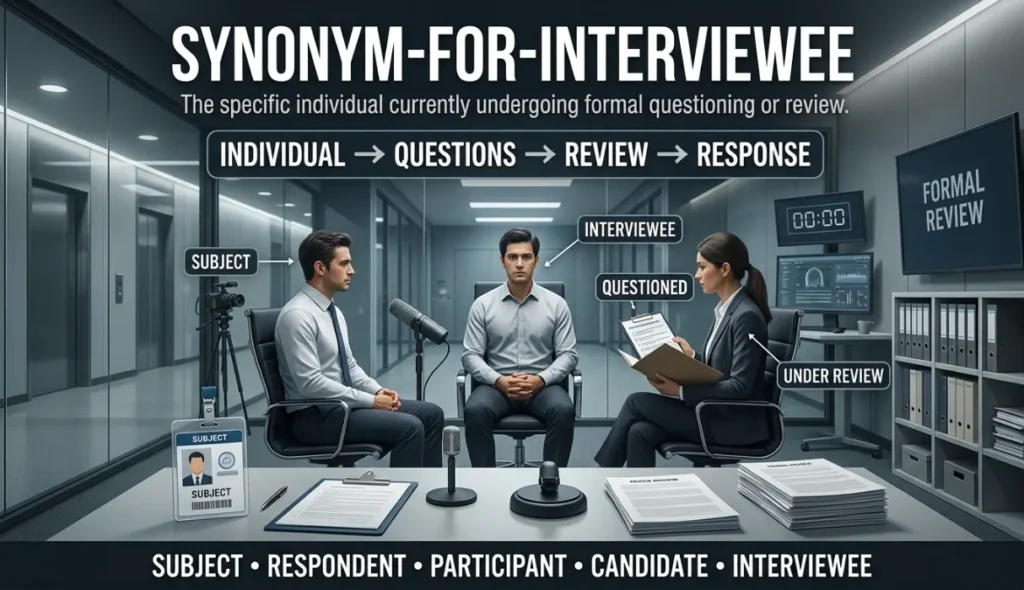
Examinee-in-question (Noun) — US: /ɪɡˌzæm.əˈniː ɪn ˈkwes.tʃən/ | UK: /ɪɡˌzæm.ɪˈniː ɪn ˈkwes.tʃən/
Meaning: The specific individual currently undergoing formal questioning or review.
Tone/Register: Legal / Formal
Example 1: The examinee-in-question answered all inquiries with clarity.
Example 2: Officers took detailed notes while speaking with the examinee-in-question.
Quizzed Party (Noun) — US: /kwɪzd ˈpɑːr.ti/ | UK: /kwɪzd ˈpɑː.ti/
Meaning: The person or side undergoing questioning in an official setting.
Tone/Register: Legal / Administrative
Example 1: The quizzed party maintained composure despite tough cross-examination.
Example 2: Investigators documented all statements from the quizzed party.
Testifier (Noun) — US: /ˈtes.tə.faɪ.ɚ/ | UK: /ˈtes.tɪ.faɪ.ər/
Meaning: A person who provides official evidence or answers questions in a hearing.
Tone/Register: Formal / Legal
Example 1: The testifier presented crucial facts during the Senate committee meeting.
Example 2: Media gathered outside to photograph the key testifier.
Information Provider (Noun) — US: /ˌɪn.fɚˈmeɪ.ʃən prəˈvaɪ.dɚ/ | UK: /ˌɪn.fəˈmeɪ.ʃən prəˈvaɪ.dər/
Meaning: A person who supplies facts or details during an informational interview.
Tone/Register: Corporate / Administrative
Example 1: The analyst served as the primary information provider for the audit.
Example 2: Clear communication from the information provider sped up the review.
Commentator (Noun) — US: /ˈkɑː.mən.teɪ.t̬ɚ/ | UK: /ˈkɒm.ən.teɪ.tər/
Meaning: An expert interviewed to offer commentary or opinion on ongoing events.
Tone/Register: Media / Broadcasting
Example 1: The news producer brought in a political commentator for live questioning.
Example 2: The commentator gave sharp analysis during the post-game interview.
Opinion Giver (Noun) — US: /əˈpɪn.jən ˌɡɪv.ɚ/ | UK: /əˈpɪn.jən ˌɡɪv.ər/
Meaning: Someone interviewed specifically to share personal views or judgments.
Tone/Register: Informal / General
Example 1: The survey highlighted perspectives from every key opinion giver.
Example 2: She stood out as an articulate opinion giver on public affairs.
Dialogue Partner (Noun) — US: /ˈdaɪ.ə.lɑːɡ ˈpɑːrt.nɚ/ | UK: /ˈdaɪ.ə.lɒɡ ˈpɑːt.nər/
Meaning: An individual participating in an interactive two-way conversational interview.
Tone/Register: Formal / Diplomatic
Example 1: The minister welcomed his foreign dialogue partner to the table.
Example 2: Constructive dialogue requires active listening from each dialogue partner.
Key Witness (Noun) — US: /kiː ˈwɪt.nəs/ | UK: /kiː ˈwɪt.nəs/
Meaning: An interviewed individual whose testimony or answers carry vital importance.
Tone/Register: Legal / Media
Example 1: Detectives spent hours questioning the key witness in private.
Example 2: The key witness provided a detailed timeline of events.
Featured Guest (Noun) — US: /ˈfiː.tʃɚd ɡest/ | UK: /ˈfiː.tʃəd ɡest/
Meaning: A prominent person invited for a spotlight interview segment on a show.
Tone/Register: Entertainment / Media
Example 1: Tonight’s featured guest discussed her latest bestselling novel.
Example 2: The show host thanked the featured guest for sharing her story.
Podcast Guest (Noun) — US: /ˈpɑːd.kæst ɡest/ | UK: /ˈpɒd.kɑːst ɡest/
Meaning: An individual interviewed on a recorded audio or video podcast.
Tone/Register: Modern Media / Casual
Example 1: The podcast guest explained how he built a successful business online.
Example 2: Listeners submitted questions for the upcoming podcast guest.
Studio Guest (Noun) — US: /ˈstuː.di.oʊ ɡest/ | UK: /ˈstjuː.di.əʊ ɡest/
Meaning: A person present in a television or radio studio for a live interview.
Tone/Register: Broadcasting / Formal
Example 1: The studio guest answered caller questions on live radio.
Example 2: Producers welcomed the studio guest into the broadcasting booth.
Main Subject (Noun) — US: /meɪn ˈsʌb.dʒekt/ | UK: /meɪn ˈsʌb.dʒɪkt/
Meaning: The primary individual being focused on and interviewed in a project.
Tone/Register: Journalistic / Academic
Example 1: The filmmaker spent years following the main subject of her documentary.
Example 2: The author interviewed the main subject multiple times.
Target Candidate (Noun) — US: /ˈtɑːr.ɡət ˈkæn.də.deɪt/ | UK: /ˈtɑː.ɡɪt ˈkæn.dɪ.dət/
Meaning: A specific job applicant prioritized for questioning in hiring.
Tone/Register: HR / Business
Example 1: The recruiter invited the target candidate for a final interview round.
Example 2: HR prepared custom questions for their primary target candidate.
Primary Respondent (Noun) — US: /ˈpraɪ.mer.i rɪˈspɑːn.dənt/ | UK: /ˈpraɪ.mər.i rɪˈspɒn.dənt/
Meaning: The chief individual supplying answers in an official inquiry or survey.
Tone/Register: Research / Legal
Example 1: The primary respondent submitted a detailed written statement.
Example 2: Researchers cross-checked answers given by the primary respondent.
Surveyed Individual (Noun) — US: /ˈsɝː.veɪd ˌɪn.dəˈvɪdʒ.u.əl/ | UK: /ˈsɜː.veɪd ˌɪn.dɪˈvɪdʒ.u.əl/
Meaning: A person interviewed to gather data for a statistical study or poll.
Tone/Register: Academic / Analytical
Example 1: Each surveyed individual completed a fifteen-minute questionnaire.
Example 2: Analysts categorized data by the age of each surveyed individual.
Consulted Party (Noun) — US: /kənˈsʌl.tɪd ˈpɑːr.ti/ | UK: /kənˈsʌl.tɪd ˈpɑː.ti/
Meaning: An expert or stakeholder interviewed for professional advice or input.
Tone/Register: Corporate / Legal
Example 1: The board interviewed every consulted party before voting on the deal.
Example 2: As a consulted party, she recommended changes to the project timeline.
Perspective Provider (Noun) — US: /pɚˈspek.tɪv prəˈvaɪ.dɚ/ | UK: /pəˈspek.tɪv prəˈvaɪ.dər/
Meaning: Someone interviewed specifically to share a unique viewpoint or angle.
Tone/Register: Professional / Creative
Example 1: The journalist sought out a fresh perspective provider for the article.
Example 2: Having a strong perspective provider enriched the panel discussion.
Interview Partner (Noun) — US: /ˈɪn.t̬ɚ.vjuː ˈpɑːrt.nɚ/ | UK: /ˈɪn.tə.vjuː ˈpɑːt.nər/
Meaning: A person paired with an interviewer to conduct a structured dialogue.
Tone/Register: Educational / General
Example 1: Students took turns acting as an interview partner in English class.
Example 2: She appreciated working with a supportive interview partner during practice.
Questioned Individual (Noun) — US: /ˈkwes.tʃənd ˌɪn.dəˈvɪdʒ.u.əl/ | UK: /ˈkwes.tʃənd ˌɪn.dɪˈvɪdʒ.u.əl/
Meaning: A person subject to questioning by authorities or researchers.
Tone/Register: Formal / Legal
Example 1: The questioned individual cooperated fully with investigators.
Example 2: Officers took notes as the questioned individual recounted the events.
Interviewee-in-question (Noun) — US: /ˌɪn.t̬ɚ.vjuːˈiː ɪn ˈkwes.tʃən/ | UK: /ˌɪn.tə.vjuːˈiː ɪn ˈkwes.tʃəd/
Meaning: The specific interviewee being discussed or highlighted at the moment.
Tone/Register: Formal / Professional
Example 1: The interviewee-in-question demonstrated outstanding problem-solving skills.
Example 2: HR reviewed background checks for the interviewee-in-question.
Interview Participant (Noun) — US: /ˈɪn.t̬ɚ.vjuː pɑːrˈtɪs.ə.pənt/ | UK: /ˈɪn.tə.vjuː pɑːˈtɪs.ɪ.pənt/
Meaning: Anyone taking part in an interview session as an answerer.
Tone/Register: Neutral / Academic
Example 1: Each interview participant gave consent before recording began.
Example 2: The study collected responses from every interview participant.
Information Source (Noun) — US: /ˌɪn.fɚˈmeɪ.ʃən sɔːrs/ | UK: /ˌɪn.fəˈmeɪ.ʃən sɔːs/
Meaning: A person interviewed to gather specific facts or insider knowledge.
Tone/Register: Journalism / Corporate
Example 1: She served as a reliable information source for local news reporters.
Example 2: The analyst interviewed a trusted information source in tech.
Media Guest (Noun) — US: /ˈmiː.di.ə ɡest/ | UK: /ˈmiː.di.ə ɡest/
Meaning: An individual invited for an interview on news or entertainment broadcasts.
Tone/Register: Media / Public Relations
Example 1: The PR team booked the author as a media guest on morning shows.
Example 2: The host welcomed the media guest to discuss global markets.
Primary Subject (Noun) — US: /ˈpraɪ.mer.i ˈsʌb.dʒekt/ | UK: /ˈpraɪ.mər.i ˈsʌb.dʒɪkt/
Meaning: The main person around whom an interview or biographical piece centers.
Tone/Register: Publishing / Academic
Example 1: The author spent two years studying her primary subject.
Example 2: As the primary subject, he shared rare photographs from his youth.
Question Respondent (Noun) — US: /ˈkwes.tʃən rɪˈspɑːn.dənt/ | UK: /ˈkwes.tʃən rɪˈspɒn.dənt/
Meaning: A person providing answers to specific structured queries during a session.
Tone/Register: Formal / Research
Example 1: The question respondent provided clear, concise answers to the panel.
Example 2: Analysts logged responses from each question respondent accurately.
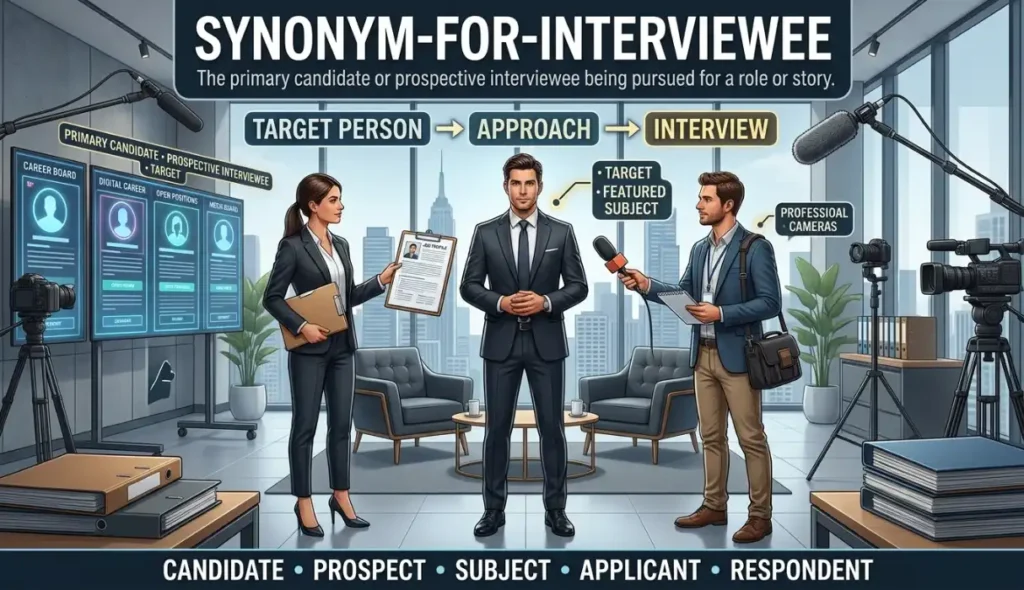
Interview Lead (Noun) — US: /ˈɪn.t̬ɚ.vjuː liːd/ | UK: /ˈɪn.tə.vjuː liːd/
Meaning: The primary candidate or prospective interviewee being pursued for a role or story.
Tone/Register: HR / Journalism
Example 1: Recruiters scheduled a call with their top interview lead this morning.
Example 2: The reporter reached out to a promising interview lead for comment.
Synonyms by Tone
Choosing a synonym for interviewee depends heavily on context and register.
Positive Tone
- Candidate / Job Candidate: Professional and optimistic, framing the individual as a strong contender.
- Guest / Featured Guest: Warm and welcoming, used in media contexts to honor the speaker.
- Expert Source: Respectful, highlighting the person’s authority and knowledge.
Neutral Tone
- Interviewee: Standard descriptive term with no inherent bias.
- Respondent / Participant: Objective, ideal for academic research, surveys, or formal studies.
- Subject / Interview Subject: Factual and analytical, standard in journalism and documentaries.
Negative / High-Pressure Tone
- Examinee / Quizzed Party: Can sound clinical or intense, carrying feelings of interrogation or rigid testing.
- Deponent / Questioned Individual: Legal or serious, suggesting formal investigations or court proceedings.
Mini Comparison: “Interviewee” vs Close Alternatives
| Word | Specific Meaning | Best Use Case | Tone |
| Interviewee | General term for any person being interviewed in any setting. | General writing, articles, and basic workplace discussions. | Neutral / Standard |
| Candidate | A person being interviewed specifically for employment or admission. | HR hiring processes, recruitment articles, and job reviews. | Professional / Business |
| Guest | An invited speaker participating in a broadcast or talk show interview. | Podcasts, television talk shows, radio, and public panels. | Warm / Media |
Context-Based Usage
Daily Conversation
In casual speech, native speakers rarely use formal words like interviewee. They prefer simple words like candidate or guest.
- “We have three candidates coming in for interviews today.”
- “Did you listen to the guest on that podcast episode?”
Writing or Blogging
Bloggers and content creators use varied terminology to keep readers interested and avoid repetitive prose.
- “Finding the right podcast guest takes research and outreach.”
- “Every story subject brings a unique narrative to the article.”
Professional or Academic Tone
Formal reports, academic papers, and legal documents require exact terminology to define roles clearly.
- “Survey respondents indicated a clear preference for digital tools.”
- “The deponent provided oral testimony during the pre-trial hearing.”
Interviewee, Interviewer, and Related Terms
The words interviewee and interviewer describe two different people in an interview. Understanding this distinction helps you choose the right term and avoid reversing their meanings.
What Is a Person Being Interviewed Called?
A person who is being interviewed is called an interviewee. The interviewee is the person who answers questions, shares information, gives opinions, or provides details during an interview.
For example:
- The interviewee answered questions about her previous experience.
- The journalist asked the interviewee about the event.
- Each interviewee completed a short questionnaire.
Depending on the setting, other terms may also be appropriate. A job interviewee can be called a candidate or applicant, while a podcast interviewee is often called a guest. In research, respondent or participant may be more suitable.
What Is the Person Who Interviews Someone Called?
A person who conducts an interview is called an interviewer. The interviewer asks the questions, guides the conversation, and listens to the interviewee’s answers.
For example:
- The interviewer asked five questions about her qualifications.
- The interviewer recorded the conversation for the documentary.
- The job interviewer explained the next stage of the hiring process.
The easiest way to remember the difference is:
Interviewer = asks the questions
Interviewee = answers the questions
The suffixes also provide a useful clue. In interviewer, the -er ending identifies the person acting. In interviewee, the -ee ending identifies the person receiving or experiencing the action.
Synonyms for Interviewer
If you need an interviewer synonym, the best alternative depends on the situation.
- Questioner: a person who asks questions.
- Interrogator someone who questions another person, often in a serious or official setting.
- Host a person interviewing on a podcast, television, or radio program.
- Recruiter a person interviewing candidates for employment.
- Hiring manager the person responsible for evaluating candidates during recruitment.
- Researcher a person conducting interviews as part of an academic or scientific study.
- Journalist a media professional interviewing for a news story or feature.
- Moderator a person guiding a structured discussion or panel.
- Examiner someone asking formal questions during an examination or assessment.
These words are related to interviewer, but they are not always exact synonyms. For example, a host usually interviews guests in media, while a recruiter conducts interviews for hiring.
Synonyms and Related Words for “Interviewed”
The word interviewed is the past tense and past participle of interview. It means that someone asked a person questions in a structured or purposeful conversation.
Depending on context, related words include:
- Questioned: asked someone a series of questions.
- Consulted asked someone for information, advice, or expertise.
- Surveyed asked someone questions to collect data or opinions.
- Examined questioned someone closely, often in a formal setting.
- Consulted– spoke with someone to obtain information or advice.
- Spoken to is a simpler, more conversational alternative.
- Asked is a general word for putting questions to someone.
For example:
Original: The journalist interviewed the scientist about climate research.
Alternative: The journalist questioned the scientist about climate research.
However, these words are not interchangeable in every situation. Interviewed usually suggests a structured conversation, while questioned can suggest a more direct or intensive series of questions.
Interviewee vs. Interviewer
| Term | Meaning | Role |
|---|---|---|
| Interviewee | Person answering questions | Responds |
| Interviewer | Person asking questions | Questions |
| Candidate | Person being evaluated for a position | Answers hiring questions |
| Guest | Invited person appearing on a show or podcast | Shares information |
| Respondent | Person providing answers in research or surveys | Provides data |
| Host | Person conducting a media interview | Leads the conversation |
This distinction is especially important in sentences such as “The interviewer introduced the interviewee.” The interviewer conducts the conversation, while the interviewee participates by answering questions.
Spanish Terms for “Interviewee”
Some searches use Spanish phrases such as sinónimo de entrevistado, sinónimos de entrevistado, or entrevistados sinónimos. The Spanish word entrevistado generally refers to a male person who is interviewed, while entrevistada refers to a female person who is interviewed.
Common Spanish alternatives or related terms include:
- entrevistado interviewed man / male interviewee
- entrevistada interviewed woman / female interviewee
- persona entrevistada interviewed person
- participante participant
- respondente respondent, especially in research contexts
- candidato candidate, particularly in a job interview
- invitado guest, especially in media or broadcasting
For the plural, entrevistados can refer to multiple male or mixed-gender interviewees, while entrevistadas refers to multiple female interviewees.
Spanish Terms for “Interviewer”
The Spanish word entrevistador generally refers to a male interviewer, while entrevistadora refers to a female interviewer.
Related terms include:
- entrevistador male interviewer
- entrevistadora female interviewer
- persona que entrevista person who conducts the interview
- periodista journalist, when the interviewer is a journalist
- presentador presenter or host, especially in broadcasting
- reclutador recruiter, in employment contexts
Therefore, entrevistado and entrevistador should not be confused. The entrevistado answers the questions, while the entrevistador asks them.
Quick Rule to Remember
If you are wondering “What do you call a person being interviewed?”, the standard English answer is interviewee.
Asking “What do you call a person who interviews someone?”, the answer is interviewer.
If you need a synonym, select one according to the context:
- Job interview: candidate, applicant, job candidate
- Podcast or TV: guest, featured guest, host
- Research: respondent, participant, subject
- Journalism: source, subject, guest, journalist
- Legal setting: witness, deponent, questioned individual
Using the context-specific term makes your writing more precise and prevents confusion between the person asking the questions and the person answering them.
Common Mistakes & Native Usage
Misuse Scenarios
- Confusing “Interviewee” with “Interviewer”: The interviewer asks the questions; the interviewee answers them. Mixing up these suffixes (-er vs -ee) alters the sentence meaning completely.
- Calling a Job Applicant a “Guest”: Using entertainment terms like guest during formal hiring sounds out of place. Stick to candidate or applicant in HR contexts.
Register Notes
- Spoken English: Use candidate, guest, or applicant.
- Written/Formal English: Prefer interviewee, respondent, subject, or deponent.
Real-Life Mini Scenarios
- Workplace: An HR manager reviews morning schedules: “Our first candidate arrives at nine o’clock for her interview.”
- Media & Broadcasting: A podcast producer checks equipment before recording: “Our featured guest is on the line and ready to speak.”
- Academic Research: A university researcher logs survey data: “Each respondent answered twenty questions about remote work habits.”
Conclusion
Mastering a synonym for interviewee allows you to communicate with clarity across recruitment, media, and academic contexts. Replacing repetitive terms sharpens your writing style and engages readers effectively.
Expanding your vocabulary builds professional confidence whether you write hiring reports, produce podcasts, or draft research essays. Selecting specific terms like candidate, guest, or respondent adds precision to your communication.
Try using two or three of these new synonyms in your next email, article, or practice essay to strengthen your writing habits naturally.
Practice Exercise
Test your understanding of synonyms for interviewee with these scenario-based questions:
- Which term is best suited for a person answering questions in a corporate job interview?
A) Guest
B) Candidate
C) Deponent
D) Story Subject - What is the most natural term for an invited speaker on a radio interview?
A) Examinee
B) Applicant
C) Guest
D) Respondent - In a scientific study or statistical survey, the person providing answers is called a:
A) Guest
B) Respondent
C) Auditioner
D) Talker - A witness answering questions under oath in a legal deposition is a:
A) Deponent
B) Podcast Guest
C) Candidate
D) Panelist - Which word suffix indicates the person RECEIVING or answering the questions?
A) -er (Interviewer)
B) -ee (Interviewee)
C) -or (Interlocutor)
D) -ist (Panelist) - What term best describes an actor undergoing a practical performance interview?
A) Respondent
B) Auditioner
C) Informant
D) Deponent - In journalism, a person being interviewed for a biographical feature is called the:
A) Profile Subject
B) Examinee
C) Quizzed Party
D) Applicant - Which choice is best for an expert invited to give opinions on news events?
A) Job Candidate
B) Commentator
C) Examinee
D) Deponent - What is the main error to avoid when using the word interviewee?
A) Using it as a verb
B) Confusing it with interviewer
C) Capitalizing it in prose
D) Pairing it with adjectives - Which term fits best when describing someone being questioned in an academic focus group?
A) Focus Group Participant
B) Auditioner
C) Deponent
D) Job Applicant
Application Task:
Write one short sentence describing a job interview experience using the word candidate or respondent.
Answer Key:
1-B, 2-C, 3-B, 4-A, 5-B, 6-B, 7-A, 8-B, 9-B, 10-A
FAQs
1. What is the most common synonym for interviewee in HR and hiring?
The most common synonym for interviewee in business and HR settings is candidate or job applicant. These words clearly communicate that the individual is being evaluated for potential employment.
2. What is the difference between an interviewer and an interviewee?
An interviewer is the person asking the questions during a conversation. An interviewee is the person answering the questions. The -er suffix denotes the actor, while -ee denotes the recipient.
3. What synonym for interviewee should I use in journalism or podcasting?
In journalism and broadcasting, writers typically use guest, source, or interview subject. “Guest” works best for live shows and podcasts, while “source” or “subject” fits written news articles.
4. Can I use respondent instead of interviewee in academic writing?
Yes, respondent or participant is preferred in academic writing and research studies. It describes individuals answering survey questions or participating in structured field interviews accurately.
5. What is a formal legal synonym for interviewee?
In legal contexts, formal synonyms for interviewee include deponent (for written/oral depositions under oath), witness, or questioned individual during investigations.
6. Is answerer an acceptable synonym for interviewee?
While “answerer” is grammatically correct and recognized in dictionaries, native speakers rarely use it in professional writing. Words like respondent, candidate, or guest sound much more natural.

Jameel Hassan is the founder and lead writer at SynonymsCloud.com, a trusted online platform dedicated to English vocabulary and effective communication. He is passionate about helping students, writers, professionals, and lifelong learners discover the right words to express their ideas with clarity, precision, and confidence.
At SynonymsCloud.com, every article is thoroughly researched and carefully written to provide accurate, practical, and easy-to-understand guidance on synonyms, antonyms, word meanings, idioms, and vocabulary. With a strong commitment to quality, real-world usage, and clear explanations, the website helps readers expand their vocabulary, improve their writing, and communicate more effectively in both academic and professional settings.