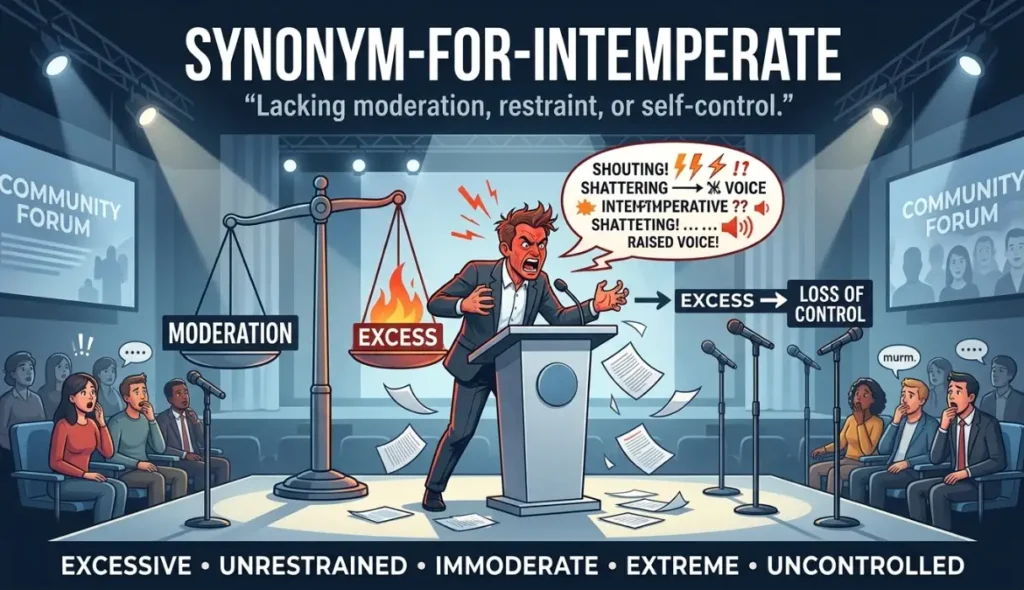
An intemperate synonym depends on the context. For uncontrolled anger or actions, use immoderate, unrestrained, or reckless. For excessive spending or eating, choose indulgent or profligate. When describing severe weather, use inclement or harsh. Formal writing favors immoderate or unrestrained, while casual speech uses uncontrolled or wild.
A synonym for intemperate helps you describe extreme behavior, uncontrolled emotions, severe weather, or excessive desires with greater clarity. The word often suggests a lack of restraint, moderation, or self-control in different situations.
Imagine a coworker losing his temper during a calm meeting or a sudden winter storm disrupting outdoor plans. Both examples demonstrate situations that lack control. Choosing the right synonym for intemperate can make such descriptions more precise and engaging.
Learning varied vocabulary improves your writing style and helps you avoid repetitive or dull phrasing. Strong alternatives can also make your descriptions sharper, more natural, and easier for readers to understand.
This guide provides useful word choices for students, bloggers, writers, and speakers. Exploring each synonym for intemperate can strengthen your vocabulary and improve communication skills throughout 2026.
What Does “Intemperate” Really Mean?
Intemperate describes behavior, speech, or climate that lacks self-control, moderation, or reasonable restraint. It applies to emotional outbursts, excessive drinking, or severe, unyielding weather patterns.
- Part of Speech: Adjective
- Simple English Definition: Lacking self-control, excessive, or severe.
- Emotional Tone: Disapproving, critical, dramatic, or formal.
Connotative Meaning
(Connotation is the emotional, cultural, or social association attached to a word beyond its literal dictionary definition.)
- Positive Tone: Rarely positive, though it can express passionate intensity in rare literary artistic contexts.
- Negative Tone: Strongly associated with anger, drunkenness, reckless spending, greed, or harsh environmental conditions.
- Neutral Tone: Used in historical or meteorological descriptions to denote extreme climates or uncalibrated biological systems.
Etymology and History
- Source Language: Latin (intemperatus, meaning “untamed,” “excessive,” or “unrestrained”).
- Old English (450–1100): Not present in Old English; native Germanic terms like ungemetfæst (unmoderate) were used.
- Middle English (1100–1500): Adapted from Old French intempérat during scholarly translations of classical texts.
- Modern English (1500–Present): Widely used in moral treatises, weather forecasts, legal arguments, and literature to denote excess.
Pronunciation (US & UK)
- US: /ɪnˈtem.pɚ.ət/
- UK: /ɪnˈtem.pər.ət/
Syllables & Structure
- Syllables: in-tem-per-ate
- Root: temper (from Latin temperare, meaning “to mix correctly” or “restrain”)
- Prefix: in- (not)
- Suffix: -ate (having the quality of)
Synonyms List
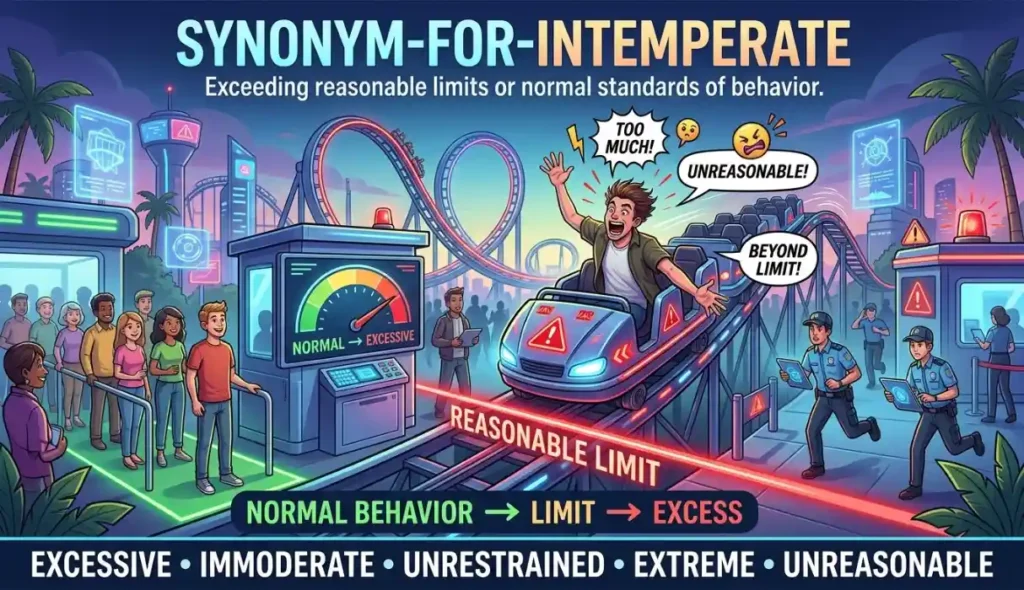
Immoderate (Adjective) — US: /ɪˈmɑː.dɚ.ət/ | UK: /ɪˈmɒd.ər.ət/
- Meaning: Exceeding reasonable limits or normal standards of behavior.
- Tone/Register: Formal / Academic
- Example 1: His immoderate consumption of coffee kept him awake all night.
- Example 2: She criticized his immoderate spending during the holiday trip.
Unrestrained (Adjective) — US: /ˌʌn.rɪˈstreɪnd/ | UK: /ˌʌn.rɪˈstreɪnd/
- Meaning: Not kept under control or restricted by rules or social boundaries.
- Tone/Register: General / Expressive
- Example 1: The children filled the backyard with unrestrained laughter.
- Example 2: Unrestrained emotion flooded his voice during the speech.
Excessive (Adjective) — US: /ɪkˈses.ɪv/ | UK: /ɪkˈses.ɪv/
- Meaning: Greater than what is necessary, desirable, or acceptable.
- Tone/Register: General / Standard
- Example 1: Excessive noise from the street interrupted our morning meeting.
- Example 2: The store charged excessive prices for basic grocery items.
Extreme (Adjective) — US: /ɪkˈstriːm/ | UK: /ɪkˈstriːm/
- Meaning: Reaching a very high degree or far beyond normal limits.
- Tone/Register: Everyday / General
- Example 1: They canceled the hike due to extreme heat in the canyon.
- Example 2: He holds extreme views on local economic policies.
Inordinate (Adjective) — US: /ɪnˈɔːr.də.nət/ | UK: /ɪnˈɔː.dɪ.nət/
- Meaning: Unusually or disproportionately large, excessive, or far beyond reason.
- Tone/Register: Formal / Business
- Example 1: She spends an inordinate amount of time organizing her files.
- Example 2: The project suffered inordinate delays due to bad weather.
Unbridled (Adjective) — US: /ʌnˈbraɪ.dəld/ | UK: /ʌnˈbraɪ.dəld/
- Meaning: Uncontrolled and lacking constraint, like a horse without a bridle.
- Tone/Register: Literary / Expressive
- Example 1: His unbridled ambition drove him to work seven days a week.
- Example 2: The city experienced unbridled growth over the past decade.
Uncontrolled (Adjective) — US: /ˌʌn.kənˈtroʊld/ | UK: /ˌʌn.kənˈtrəʊld/
- Meaning: Operating without any guidance, limits, or governing influence.
- Tone/Register: General / Neutral
- Example 1: The brush fire spread rapidly due to uncontrolled winds.
- Example 2: He faced trouble at school because of his uncontrolled temper.
Ungoverned (Adjective) — US: /ʌnˈɡʌv.ɚnd/ | UK: /ʌnˈɡʌv.ənd/
- Meaning: Lacking direction, rule, self-restraint, or proper supervision.
- Tone/Register: Formal / Scholarly
- Example 1: His ungoverned passions led to several poor life decisions.
- Example 2: Border areas remained ungoverned for many years.
Wild (Adjective) — US: /waɪld/ | UK: /waɪld/
- Meaning: Living or acting without human control, restraint, or discipline.
- Tone/Register: Casual / Everyday
- Example 1: Wild rumors spread through the town after the announcement.
- Example 2: They threw a wild party to celebrate their graduation.
Rash (Adjective) — US: /ræʃ/ | UK: /ræʃ/
- Meaning: Acting too quickly without thinking about possible risks or consequences.
- Tone/Register: General / Conversational
- Example 1: Making a rash choice now could cost you your job.
- Example 2: He apologized for his rash comments made during the argument.
Reckless (Adjective) — US: /ˈrek.ləs/ | UK: /ˈrek.ləs/
- Meaning: Showing a complete lack of care about danger or consequences.
- Tone/Register: General / Critical
- Example 1: Reckless driving causes many accidents on busy highways.
- Example 2: She regretted her reckless spending at the shopping mall.
Indulgent (Adjective) — US: /ɪnˈdʌl.dʒənt/ | UK: /ɪnˈdʌl.dʒənt/
- Meaning: Yielding readily to desires, whims, or the wishes of others.
- Tone/Register: General / Descriptive
- Example 1: Indulgent grandparents often buy too many toys for toddlers.
- Example 2: He treated himself to an indulgent dessert after dinner.
Self-indulgent (Adjective) — US: /ˌself.ɪnˈdʌl.dʒənt/ | UK: /ˌself.ɪnˈdʌl.dʒənt/
- Meaning: Allowing yourself to have or do whatever you want for pleasure.
- Tone/Register: Critical / Conversational
- Example 1: Spending working hours playing games is self-indulgent.
- Example 2: His self-indulgent lifestyle quickly drained his savings.
Uninhibited (Adjective) — US: /ˌʌn.ɪnˈhɪb.ɪ.t̬ɪd/ | UK: /ˌʌn.ɪnˈhɪb.ɪ.tɪd/
- Meaning: Free and natural in behavior without fear of social judgment.
- Tone/Register: Positive / General
- Example 1: Dancers expressed their uninhibited joy on the stage.
- Example 2: She gave an uninhibited answer to the reporter’s question.
Unchecked (Adjective) — US: /ʌnˈtʃekt/ | UK: /ʌnˈtʃekt/
- Meaning: Continuing or growing without being stopped, examined, or slowed down.
- Tone/Register: Formal / Critical
- Example 1: Unchecked inflation harms families living on low incomes.
- Example 2: Rumors will continue if left unchecked by management.
Uncurbed (Adjective) — US: /ʌnˈkɝːbd/ | UK: /ʌnˈkɜːbd/
- Meaning: Free from restraint, limitation, or governing control.
- Tone/Register: Formal / Literary
- Example 1: Uncurbed greed destroyed the once-successful company.
- Example 2: His uncurbed appetite surprised everyone at the buffet.
Ungovernable (Adjective) — US: /ʌnˈɡʌv.ɚ.nə.bəl/ | UK: /ʌnˈɡʌv.ən.ə.bəl/
- Meaning: Impossible to control, rule, direct, or restrain.
- Tone/Register: Formal / Serious
- Example 1: The crowds became ungovernable after the match was canceled.
- Example 2: Her anger felt ungovernable during the heated debate.
Violent (Adjective) — US: /ˈvaɪ.ə.lənt/ | UK: /ˈvaɪ.ə.lənt/
- Meaning: Using or involving strong physical force intended to hurt or destroy.
- Tone/Register: General / Serious
- Example 1: A violent storm knocked down electric power lines across town.
- Example 2: He has a violent temper when people disagree with him.
Severe (Adjective) — US: /səˈvɪr/ | UK: /səˈvɪər/
- Meaning: Extremely harsh, stern, intense, or painful in nature.
- Tone/Register: General / Official
- Example 1: Severe winter weather trapped motorists on the highway.
- Example 2: The judge handed down a severe penalty for the crime.
Harsh (Adjective) — US: /hɑːrʃ/ | UK: /hɑːʃ/
- Meaning: Unpleasantly rough, strict, severe, or cruel.
- Tone/Register: Everyday / Descriptive
- Example 1: Cold, harsh winds blew across the empty fields.
- Example 2: She spoke harsh words that hurt her friend’s feelings.
Inclement (Adjective) — US: /ɪnˈklem.ənt/ | UK: /ɪnˈklem.ənt/
- Meaning: Unpleasantly cold, wet, or stormy weather conditions.
- Tone/Register: Formal / Meteorological
- Example 1: School was closed today due to inclement weather.
- Example 2: Sailors stayed in the harbor to avoid inclement seas.
Unregulated (Adjective) — US: /ʌnˈreɡ.jə.leɪ.t̬ɪd/ | UK: /ʌnˈreɡ.jə.leɪ.tɪd/
- Meaning: Not controlled by official rules, laws, or guidelines.
- Tone/Register: Business / Technical
- Example 1: Unregulated markets can lead to sudden financial panics.
- Example 2: Dumping waste in unregulated areas is against the law.
Intemperate behavior (Noun Phrase) — US: /ɪnˈtem.pɚ.ət bɪˈheɪ.vjɚ/ | UK: /ɪnˈtem.pər.ət bɪˈheɪ.vjər/
- Meaning: Actions that lack self-control, moderation, or good judgment.
- Tone/Register: Formal / Legal
- Example 1: His intemperate behavior at work resulted in immediate suspension.
- Example 2: Board members complained about his intemperate behavior.
Extravagant (Adjective) — US: /ɪkˈstræv.ə.ɡənt/ | UK: /ɪkˈstræv.ə.ɡənt/
- Meaning: Spending much more money or using more resources than necessary.
- Tone/Register: General / Descriptive
- Example 1: They threw an extravagant party with expensive decorations.
- Example 2: Buying a third sports car seems purely extravagant.
Unfettered (Adjective) — US: /ʌnˈfet̬.ɚd/ | UK: /ʌnˈfet.əd/
- Meaning: Free from restraints, chains, or limiting conditions.
- Tone/Register: Academic / Literary
- Example 1: Artists need unfettered freedom to create original work.
- Example 2: The internet gives people unfettered access to global information.

Unmeasured (Adjective) — US: /ʌnˈmeʒ.ɚd/ | UK: /ʌnˈmeʒ.əd/
- Meaning: Not limited, restricted, or calculated; vast in scale.
- Tone/Register: Formal / Literary
- Example 1: He offered unmeasured praise to the brave rescue workers.
- Example 2: Unmeasured growth without a plan causes business failure.
Unbalanced (Adjective) — US: /ʌnˈbæl.ənst/ | UK: /ʌnˈbæl.ənst/
- Meaning: Lacking stability, emotional calm, or equal distribution.
- Tone/Register: General / Critical
- Example 1: His unbalanced reaction scared everyone sitting at the table.
- Example 2: An unbalanced diet lacks essential vitamins and minerals.
Heavy-handed (Adjective) — US: /ˌhev.iˈhæn.dɪd/ | UK: /ˌhev.iˈhæn.dɪd/
- Meaning: Using excessive force or authority without tact or skill.
- Tone/Register: Informal / Critical
- Example 1: The manager took a heavy-handed approach to fixing minor errors.
- Example 2: Heavy-handed discipline often backfires on parents.
Excessive-drinking (Noun / Adjective) — US: /ɪkˈses.ɪv ˈdrɪŋ.kɪŋ/ | UK: /ɪkˈses.ɪv ˈdrɪŋ.kɪŋ/
- Meaning: Consuming alcohol far beyond healthy or safe amounts.
- Tone/Register: Medical / Educational
- Example 1: Health warnings remind adults about the risks of excessive drinking.
- Example 2: Excessive drinking harms liver function over time.
Dissolute (Adjective) — US: /ˈdɪs.ə.luːt/ | UK: /ˈdɪs.ə.luːt/
- Meaning: Lacking moral restraint and devoted to personal pleasures.
- Tone/Register: Formal / Literary
- Example 1: Historical novels depict the prince living a dissolute life.
- Example 2: He wasted his inherited fortune through dissolute habits.
Licentious (Adjective) — US: /laɪˈsen.ʃəs/ | UK: /laɪˈsen.ʃəs/
- Meaning: Disregarding accepted rules, morality, or sexual standards.
- Tone/Register: Formal / Moralistic
- Example 1: Ancient moralists wrote essays condemning licentious behavior.
- Example 2: The court criticized the landlord for his licentious conduct.
Profligate (Adjective) — US: /ˈprɑː.flə.ɡət/ | UK: /ˈprɒf.lɪ.ɡət/
- Meaning: Recklessly wasteful of money, resources, or talent.
- Tone/Register: Formal / Academic
- Example 1: The government was accused of profligate spending on luxury projects.
- Example 2: Profligate habits lead straight to severe debt.
Overindulgent (Adjective) — US: /ˌoʊ.vɚ.ɪnˈdʌl.dʒənt/ | UK: /ˌəʊ.vər.ɪnˈdʌl.dʒənt/
- Meaning: Allowing too much freedom or giving excessive treats to oneself or others.
- Tone/Register: General / Conversational
- Example 1: Overindulgent parenting can make children feel entitled.
- Example 2: She felt sick after an overindulgent weekend of eating cake.
Unmanageable (Adjective) — US: /ʌnˈmæn.ə.dʒə.bəl/ | UK: /ʌnˈmæn.ɪ.dʒə.bəl/
- Meaning: Difficult or impossible to control, train, or organize.
- Tone/Register: General / Practical
- Example 1: Curly hair can become unmanageable during humid weather.
- Example 2: Company debt grew to an unmanageable level last quarter.
Furious (Adjective) — US: /ˈfjʊr.i.əs/ | UK: /ˈfjʊə.ri.əs/
- Meaning: Extremely angry, or characterized by intense speed and power.
- Tone/Register: Everyday / Descriptive
- Example 1: She was furious when she found her car window broken.
- Example 2: A furious storm rattled the wooden window frames.
Tempestuous (Adjective) — US: /temˈpes.tʃu.əs/ | UK: /temˈpes.tʃu.əs/
- Meaning: Characterized by strong, turbulent emotions or stormy weather.
- Tone/Register: Literary / Expressive
- Example 1: The actors shared a tempestuous relationship off screen.
- Example 2: Ships struggled to navigate the tempestuous ocean waters.
Turbulent (Adjective) — US: /ˈtɝː.bjə.lənt/ | UK: /ˈtɜː.bjə.lənt/
- Meaning: Involving strong agitation, unrest, disorder, or physical disturbance.
- Tone/Register: General / Academic
- Example 1: The plane bounced violently as it entered turbulent air.
- Example 2: The nation went through a turbulent era of political change.
Fiery (Adjective) — US: /ˈfaɪ.ɚ.i/ | UK: /ˈfaɪə.ri/
- Meaning: Easily angered, passionate, or burning with intense heat.
- Tone/Register: Everyday / Expressive
- Example 1: Her fiery speech inspired the crowd to demand lower taxes.
- Example 2: He has a fiery personality and argues with everyone.
Passionate (Adjective) — US: /ˈpæʃ.ən.ət/ | UK: /ˈpæʃ.ən.ət/
- Meaning: Showing or caused by strong feelings or intense belief.
- Tone/Register: Positive / General
- Example 1: She is passionate about teaching children to read.
- Example 2: They had a passionate discussion about art history.
Impulsive (Adjective) — US: /ɪmˈpʌl.sɪv/ | UK: /ɪmˈpʌl.sɪv/
- Meaning: Acting sudden without careful thought or advance planning.
- Tone/Register: Everyday / Conversational
- Example 1: Buying that expensive coat was an impulsive decision.
- Example 2: He is an impulsive traveler who books flights on a whim.
Hasty (Adjective) — US: /ˈheɪ.sti/ | UK: /ˈheɪ.sti/
- Meaning: Done or acting with excessive speed and lack of care.
- Tone/Register: Everyday / General
- Example 1: Do not make a hasty judgment before hearing both sides.
- Example 2: They made a hasty retreat when rain started pouring down.
Imprudent (Adjective) — US: /ɪmˈpruː.dənt/ | UK: /ɪmˈpruː.dənt/
- Meaning: Not sensible, wise, or cautious in managing practical affairs.
- Tone/Register: Formal / Business
- Example 1: Investing all your savings in one stock is highly imprudent.
- Example 2: The director warned against making imprudent public statements.
Headlong (Adjective) — US: /ˈhed.lɑːŋ/ | UK: /ˈhed.lɒŋ/
- Meaning: Moving with great speed and force, often recklessly.
- Tone/Register: Descriptive / Expressive
- Example 1: He made a headlong rush down the steep staircase.
- Example 2: The country plunged headlong into an unwanted conflict.
Uncalibrated (Adjective) — US: /ʌnˈkæl.ə.breɪ.t̬ɪd/ | UK: /ʌnˈkæl.ɪ.breɪ.tɪd/
- Meaning: Not adjusted or tested to meet standard measures or limits.
- Tone/Register: Technical / Formal
- Example 1: Uncalibrated equipment gave inaccurate temperature readings.
- Example 2: His uncalibrated emotional responses alienate team members.
Out of hand (Adjective Phrase) — US: /aʊt əv hænd/ | UK: /aʊt əv hænd/
- Meaning: Completely out of control and impossible to manage smoothly.
- Tone/Register: Informal / Conversational
- Example 1: The party got out of hand when uninvited guests arrived.
- Example 2: Inflation will get out of hand if interest rates stay low.
Over-the-top (Adjective) — US: /ˌoʊ.vɚ.ðəˈtɑːp/ | UK: /ˌəʊ.və.ðəˈtɒp/
- Meaning: So extreme or dramatic as to seem unreasonable or foolish.
- Tone/Register: Informal / Casual
- Example 1: Her over-the-top costume amazed everyone at the party.
- Example 2: The movie’s action scenes were completely over-the-top.
Drunken (Adjective) — US: /ˈdrʌŋ.kən/ | UK: /ˈdrʌŋ.kən/
- Meaning: Given to or caused by excessive alcohol consumption.
- Tone/Register: General / Descriptive
- Example 1: Police stopped a driver for dangerous, drunken behavior.
- Example 2: A drunken argument broke out in the alley late at night.
Uncontrolled anger (Noun Phrase) — US: /ˌʌn.kənˈtroʊld ˈæŋ.ɡɚ/ | UK: /ˌʌn.kənˈtrəʊld ˈæŋ.ɡər/
- Meaning: Rage that is expressed without restraint or calm reasoning.
- Tone/Register: General / Psychological
- Example 1: Uncontrolled anger can damage family relationships permanently.
- Example 2: Therapy helped him process his uncontrolled anger safely.
Extreme temperature (Noun Phrase) — US: /ɪkˈstriːm ˈtem.prə.tʃɚ/ | UK: /ɪkˈstriːm ˈtem.prə.tʃər/
- Meaning: Heat or cold levels that fall far outside comfortable human ranges.
- Tone/Register: Technical / Environmental
- Example 1: Workers faced extreme temperature shifts inside the glass factory.
- Example 2: Extreme temperature warnings were issued across the region.
Unrestrained emotion (Noun Phrase) — US: /ˌʌn.rɪˈstreɪnd ɪˈmoʊ.ʃən/ | UK: /ˌʌn.rɪˈstreɪnd ɪˈməʊ.ʃən/
- Meaning: Feelings expressed fully without holding anything back.
- Tone/Register: Expressive / Dramatic
- Example 1: Fans wept with unrestrained emotion as their team won the cup.
- Example 2: The actor delivered his lines with unrestrained emotion.
Unbounded (Adjective) — US: /ʌnˈbaʊn.dɪd/ | UK: /ʌnˈbaʊn.dɪd/
- Meaning: Having no limits, borders, or boundaries.
- Tone/Register: Literary / Academic
- Example 1: Children possess unbounded curiosity about nature.
- Example 2: She showed unbounded generosity toward local charities.
Ungoverned passion (Noun Phrase) — US: /ʌnˈɡʌv.ɚnd ˈpæʃ.ən/ | UK: /ʌnˈɡʌv.ənd ˈpæʃ.ən/
- Meaning: Intense feelings operating without moral restraint or common sense.
- Tone/Register: Literary / Formal
- Example 1: The hero was ruined by his ungoverned passion for revenge.
- Example 2: The novel explores stories of ungoverned passion and tragedy.
Excessive indulgence (Noun Phrase) — US: /ɪkˈses.ɪv ɪnˈdʌl.dʒəns/ | UK: /ɪkˈses.ɪv ɪnˈdʌl.dʒəns/
- Meaning: Overconsuming rich foods, drinks, or pleasures routinely.
- Tone/Register: Formal / Educational
- Example 1: Doctors warn that excessive indulgence causes health issues.
- Example 2: Holiday seasons often lead to excessive indulgence in sweets.
Severe climate (Noun Phrase) — US: /səˈvɪr ˈklaɪ.mət/ | UK: /səˈvɪər ˈklaɪ.mət/
- Meaning: An environmental climate featuring dangerous wind, cold, or heat.
- Tone/Register: Technical / Geography
- Example 1: Few plants can survive in such a severe climate.
- Example 2: Desert animals adapt uniquely to a severe climate.
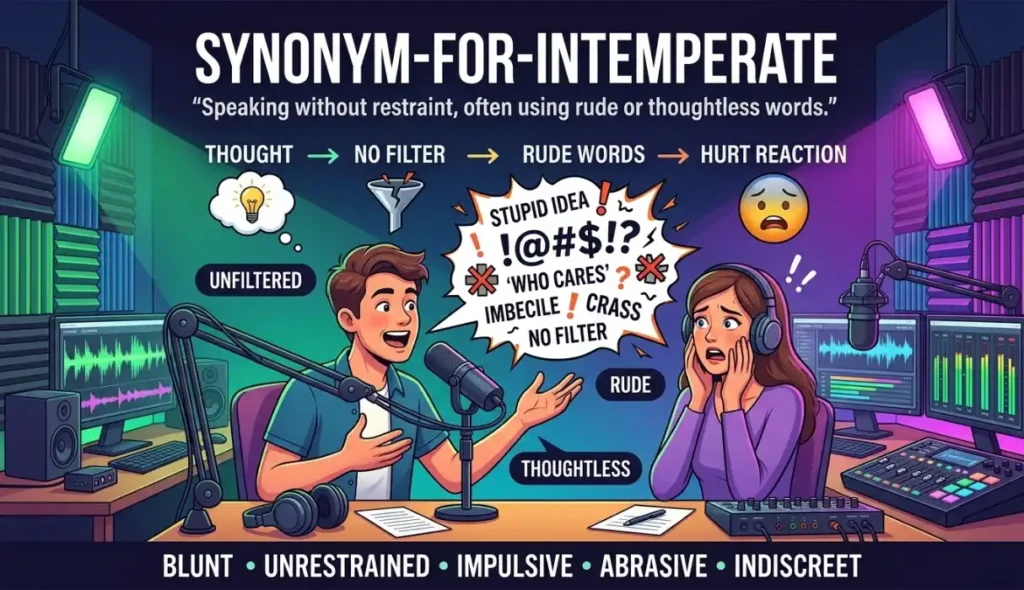
Unrestrained speech (Noun Phrase) — US: /ˌʌn.rɪˈstreɪnd spiːtʃ/ | UK: /ˌʌn.rɪˈstreɪnd spiːtʃ/
- Meaning: Talking without filtering rude words or thoughtless insults.
- Tone/Register: Formal / Critical
- Example 1: The politician was criticized for his unrestrained speech.
- Example 2: Unrestrained speech can offend colleagues during debates.
Synonyms by Tone
Matching word choice to tone guarantees clear, professional communication.
- Positive Tone: Uninhibited, Passionate, Unbounded, Unfettered. These terms highlight freedom, joy, energy, and creativity.
- Neutral Tone: Excessive, Extreme, Uncontrolled, Inclement, Unregulated. These words state facts clearly without passing moral judgment.
- Negative Tone: Immoderate, Reckless, Dissolute, Profligate, Licentious. These words criticize harmful waste, bad habits, or lack of discipline.
- Playful / Informal Tone: Wild, Over-the-top, Out of hand, Heavy-handed. These phrases suit casual conversations, storytelling, and friendly banter.
Mini Comparison: Intemperate vs. Close Alternatives
| Word | Key Shade of Meaning | Tone | Best Context |
|---|---|---|---|
| Intemperate | Lacking self-control, moderation, or climate mildness | Formal / Literary | Outbursts, drinking, harsh weather |
| Immoderate | Exceeding reasonable, customary limits | Formal / Academic | Spending, eating, habits |
| Reckless | Careless regarding physical danger or bad outcomes | Everyday / General | Driving, choices, actions |
How “Intemperate” Changes by Context
Daily Conversation
Speakers rarely use intemperate when chatting. They pick everyday words like wild, reckless, out of hand, or harsh.
Writing & Blogging
Writers use intemperate to describe dramatic arguments, sudden character flaws, or destructive environmental storms.
Professional & Academic Tone
In business, legal, or weather reports, professionals use intemperate, immoderate, inclement, or unregulated to maintain precision.
Common Mistakes & Native Usage
Misuse Scenarios
- Confusing Weather and Mood: Using intemperate only for anger ignores its historical weather meaning (inclement).
- Overusing in Casual Setting: Saying “You are being intemperate” while ordering extra fries sounds unnaturally formal. Say “overindulgent” or “excessive” instead.
Register Notes
Intemperate belongs in formal writing, essays, or literary works. In spoken English, use reckless or excessive.
Real-Life Mini Scenarios
- Workplace: A team leader warned an employee about making intemperate remarks during client meetings.
- Social Situations: Friends stopped a driver from making a reckless choice after leaving a late dinner.
- Media & Pop Culture: News commentators analyzed the candidate’s immoderate spending during the campaign.
Conclusion
Learning a strong synonym for intemperate expands your descriptive vocabulary and helps you express ideas with greater precision. Understanding suitable alternatives allows you to describe extreme behavior, emotions, or actions more clearly and naturally.
Choosing precise vocabulary can improve essays, enrich blog posts, and make professional communication more effective. Students can describe situations more accurately, while bloggers, writers, and speakers can create engaging content and avoid repetitive language.
Choose three new synonyms from this guide and use them in daily conversations or writing projects. Create original sentences with each word and explore different contexts. Regular practice strengthens vocabulary, improves communication skills, and builds lasting confidence in spoken and written English.
Practice Exercise
- Which synonym best describes cold, rainy, and stormy weather?
A) Inclement
B) Indulgent
C) Licentious
D) Uninhibited - In a legal report, what term fits uncontrolled workplace anger?
A) Over-the-top
B) Intemperate behavior
C) Wild
D) Rash - What tone does the word profligate carry?
A) Positive
B) Playful
C) Critical / Formal
D) Neutral - Which word describes spending money far beyond reasonable limits?
A) Immoderate
B) Inclement
C) Uncalibrated
D) Violent - Acting quickly without thinking of danger is called being:
A) Reckless
B) Unfettered
C) Moderate
D) Severe - Which word fits an artist given complete freedom without restrictions?
A) Unfettered
B) Dissolute
C) Inclement
D) Heavy-handed - What is the main difference between intemperate and reckless?
A) Intemperate means lack of moderation or control; reckless means ignoring danger.
B) Intemperate applies only to driving; reckless applies to weather.
C) Reckless is formal; intemperate is slang.
D) There is no difference. - Which phrase fits casual talk about a wild party getting chaotic?
A) Got out of hand
B) Was inclement
C) Was licentious
D) Was profligate - A person who gives in to every sweet craving is described as:
A) Self-indulgent
B) Inclement
C) Ungovernable
D) Severe - What prefix in intemperate signifies “not”?
A) -ate
B) temper
C) in-
D) un-
Reflection Task:
Write a 2-sentence paragraph describing a stormy day or an argument using at least two synonyms from this article.
Answer Key:
1: A | 2: B | 3: C | 4: A | 5: A | 6: A | 7: A | 8: A | 9: A | 10: C
FAQs
1. What is the most common synonym for intemperate in daily speech?
In daily speech, people rarely say intemperate. They use everyday synonyms like excessive, uncontrolled, harsh, or reckless.
2. Can intemperate describe weather conditions?
Yes. Intemperate historically describes severe, stormy, or extreme weather conditions, similar to inclement or harsh.
3. How does intemperate differ from immoderate?
Intemperate implies a personal lack of emotional self-control or extreme weather. Immoderate focuses simply on exceeding normal, reasonable limits.
4. What is the opposite of intemperate?
The direct opposites are temperate, moderate, restrained, self-controlled, or calm.
5. Is intemperate appropriate for business writing?
Yes. In formal business or legal writing, intemperate accurately describes inappropriate emotional outbursts, reckless financial behavior, or unmanaged risks.

Jameel Hassan is the founder and lead writer at SynonymsCloud.com, a trusted online platform dedicated to English vocabulary and effective communication. He is passionate about helping students, writers, professionals, and lifelong learners discover the right words to express their ideas with clarity, precision, and confidence.
At SynonymsCloud.com, every article is thoroughly researched and carefully written to provide accurate, practical, and easy-to-understand guidance on synonyms, antonyms, word meanings, idioms, and vocabulary. With a strong commitment to quality, real-world usage, and clear explanations, the website helps readers expand their vocabulary, improve their writing, and communicate more effectively in both academic and professional settings.