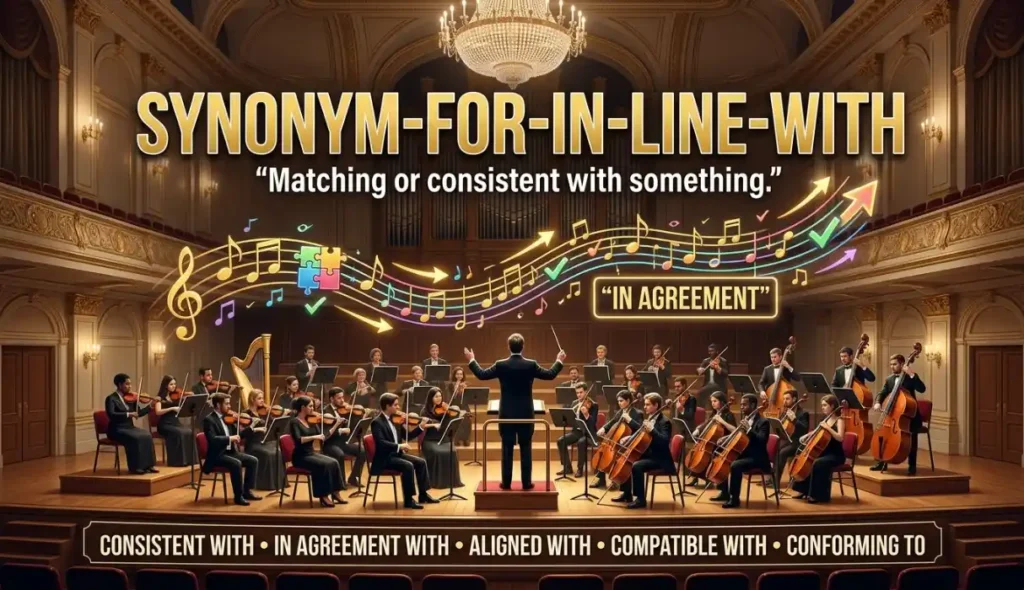
In business writing, “in line with” can be replaced with “consistent with,” “aligned with,” or “in accordance with.” For formal reports, “consistent with” is the safest choice — more alternatives with examples below.
The best synonyms for in line with are consistent with, aligned with, according to, congruent with, and compatible with. Use consistent with for steady adherence to rules, aligned with for cooperative goals, and according to when attributing statements or data to an external source.
Synonym for in line with is a top search term when you need to describe agreement or conformity without repeating phrases across your text. Imagine drafting a corporate compliance review and reusing the same matching phrase in every single paragraph. Finding alternative expressions keeps your narrative varied, fluid, and engaging for readers.
Writers look for a synonym for in line with to add descriptive nuance and precise alignment context to business essays, policy reports, and professional emails. Expanding your vocabulary helps you express agreement, consistency, or conformity with absolute clarity. This specific concept appears frequently in leadership blogs, corporate literature, and everyday project discussions.
Students, bloggers, content writers, and daily English users find this vocabulary study very useful. Precise word choices prevent text from feeling repetitive. Using a synonym for in line with ensures your professional articles truly stand out.
Developing a diverse vocabulary transforms your writing style completely. When you master alternative words for agreement and harmony, your professional reports and personal career stories become far more persuasive and engaging.
Core Meaning: What Does “In Line With” Really Mean?
In line with is a prepositional phrase that means consistent with, conforming to, or matching a standard, rule, or expectation. It denotes harmonious agreement or alignment between two or more elements.
Connotative Meaning
- Positive tone: Represents professional cooperation, accuracy, organizational harmony, and dependable compliance.
- Negative tone: Implies forced conformity, strict corporate obedience, or rigid standardization.
- Neutral tone: Used when objectively comparing data metrics, guidelines, or policy frameworks.
Etymology
- Source Language: Native English phrasal construction combining spatial alignment idioms (derived from military or physical rows) with regulatory standards.
- Old English (450–1100): Early Germanic terms expressed physical straightness and agreement before modern prepositional idioms emerged.
- Middle English (1100–1500): Evolved literal meanings of rows and lines into figurative expressions of social and rule-based conformity.
- Modern English (1500–Present): Standardized into the common phrasal idiom in line with for business, law, and everyday communication.
Pronunciation & Syllables
- US: /ɪn laɪn wɪð/
- UK: /ɪn lʌɪn wɪð/
- Syllables: in-line-with (3 words / phrasal unit)
- Affixation Pattern: Prepositional idiom composed of base words.
- Root: line (straight path/agreement standard)
- Prefix: in
- Suffix: with
Synonyms List
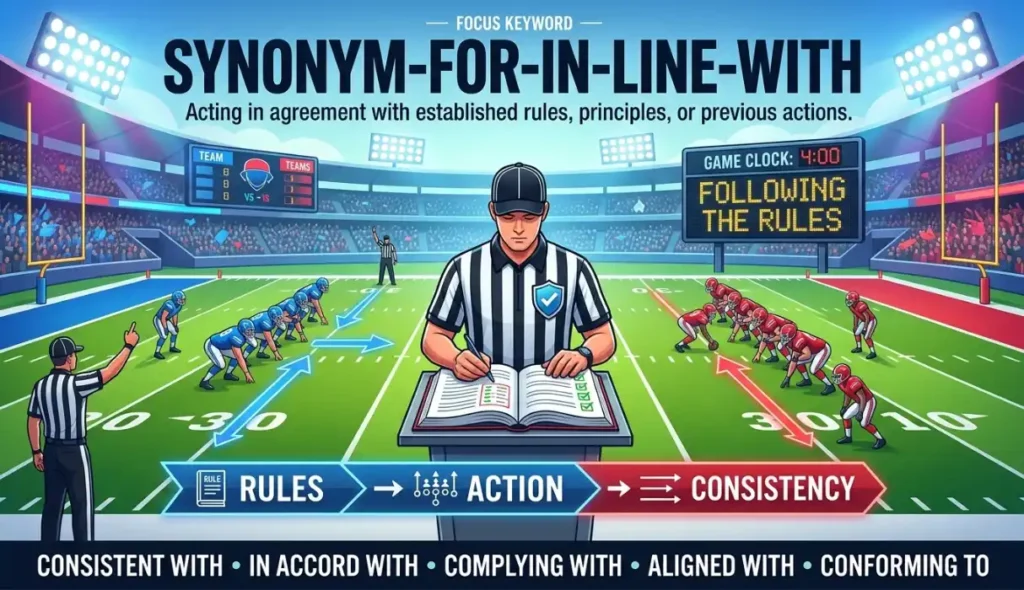
Consistent with (Adjective phrase) — US: /kənˈsɪs.tənt wɪð/ | UK: /kənˈsɪs.tənt wɪð/
- Meaning: Acting in agreement with a set of principles, rules, or previous actions.
- Tone/Register: Professional / Formal
- Example: The new policy remains consistent with federal labor laws.
- Example: Her modern design was consistent with company branding.
According to (Prepositional phrase) — US: /əˈkɔːr.dɪŋ tuː/ | UK: /əˈkɔː.dɪŋ tuː/
- Meaning: As stated or indicated by someone or a set of guidelines.
- Tone/Register: Standard / Common
- Example: According to the manager, the meeting starts at noon.
- Example: Weather forecasts predicted rain according to local radars.
Matching (Adjective) — US: /ˈmætʃ.ɪŋ/ | UK: /ˈmatʃ.ɪŋ/
- Meaning: Corresponding, equivalent, or structurally harmonious with another item.
- Tone/Register: Common / Standard
- Example: The team wore matching uniforms for the tournament.
- Example: He found matching curtains for the living room.
Corresponding to (Prepositional phrase) — US: /ˌkɔːr.əˈspɑːn.dɪŋ tuː/ | UK: /ˌkɒr.ɪˈspɒn.dɪŋ tuː/
- Meaning: Having a close similarity or matching connection to something else.
- Tone/Register: Academic / Formal
- Example: Expenses rose corresponding to increased production costs.
- Example: Data points showed results corresponding to expectations.
Agreeing with (Verb phrase) — US: /əˈɡriː.ɪŋ wɪð/ | UK: /əˈɡriː.ɪŋ wɪð/
- Meaning: Being of the same opinion or conforming to a standard.
- Tone/Register: Standard / Conversational
- Example: His proposal agreed with the board’s vision.
- Example: The witness statement agreed with the timeline.
Conforming to (Verb phrase) — US: /kənˈfɔːr.mɪŋ tuː/ | UK: /kənˈfɔː.mɪŋ tuː/
- Meaning: Complying with rules, standards, or laws.
- Tone/Register: Formal / Legal
- Example: Buildings must be conforming to local safety codes.
- Example: Software updates ensured systems were conforming to privacy laws.
Complying with (Verb phrase) — US: /kəmˈplaɪ.ɪŋ wɪð/ | UK: /kəmˈplʌɪ.ɪŋ wɪð/
- Meaning: Acting in accordance with a wish or command.
- Tone/Register: Professional / Legal
- Example: The factory operated while complying with environmental regulations.
- Example: Staff members worked while complying with safety protocols.
Parallel to (Adjective phrase) — US: /ˈpɛr.ə.lɛl tuː/ | UK: /ˈpar.ə.lɛl tuː/
- Meaning: Side by side and having the same distance continuously; analogous.
- Tone/Register: Technical / Formal
- Example: The new strategy ran parallel to corporate goals.
- Example: Roads ran parallel to the railway tracks.
Equivalent to (Adjective phrase) — US: /ɪˈkwɪv.ə.lənt tuː/ | UK: /ɪˈkwɪv.ə.lənt tuː/
- Meaning: Equal in value, amount, function, or meaning.
- Tone/Register: Academic / Formal
- Example: The bonus was equivalent to one month’s salary.
- Example: The fee was equivalent to local market rates.
Aligned with (Adjective phrase) — US: /əˈlaɪnd wɪð/ | UK: /əˈlʌɪnd wɪð/
- Meaning: Placed in proper position or cooperation with a goal.
- Tone/Register: Professional / Business
- Example: Our marketing strategy was aligned with consumer trends.
- Example: The department goals were aligned with corporate targets.
Harmonizing with (Verb phrase) — US: /ˈhɑːr.mə.naɪ.zɪŋ wɪð/ | UK: /ˈhɑː.mə.nʌɪ.zɪŋ wɪð/
- Meaning: Coexisting or cooperating in a pleasing, consistent manner.
- Tone/Register: Descriptive / Literary
- Example: The decor was harmonizing with the natural environment.
- Example: Melodies were harmonizing with the acoustic guitar.
Synchronized with (Adjective phrase) — US: /ˈsɪŋ.krə.naɪzd wɪð/ | UK: /ˈsɪŋ.krə.nʌɪzd wɪð/
- Meaning: Occurring at the same time or rate in harmonious coordination.
- Tone/Register: Technical / Professional
- Example: Clocks were synchronized with atomic time servers.
- Example: Team updates remained synchronized with project timelines.
Adapted to (Adjective phrase) — US: /əˈdæp.tɪd tuː/ | UK: /əˈdap.tɪd tuː/
- Meaning: Modified or suited for a particular purpose or environment.
- Tone/Register: Standard / Technical
- Example: The software was adapted to mobile operating systems.
- Example: Plants were adapted to desert climate conditions.
Fitted to (Adjective phrase) — US: /ˈfɪt.ɪd tuː/ | UK: /ˈfɪt.ɪd tuː/
- Meaning: Suited or appropriate for a specific role or purpose.
- Tone/Register: Standard / Common
- Example: The room was fitted to serve as a home office.
- Example: Candidates were fitted to lead the new division.
Suited to (Adjective phrase) — US: /ˈsuː.tɪd tuː/ | UK: /ˈsuː.tɪd tuː/
- Meaning: Right or appropriate for a particular person, purpose, or situation.
- Tone/Register: Professional / Standard
- Example: The climate was suited to growing citrus fruits.
- Example: Her skills were suited to project management.
Tailored to (Adjective phrase) — US: /ˈteɪ.lərd tuː/ | UK: /ˈteɪ.ləd tuː/
- Meaning: Customized or made specifically for a particular purpose.
- Tone/Register: Business / Professional
- Example: Training programs were tailored to new employee needs.
- Example: The software included options tailored to user preferences.
Concurrent with (Adjective phrase) — US: /kənˈkɜːr.ənt wɪð/ | UK: /kənˈkəː.rənt wɪð/
- Meaning: Existing, happening, or done at the same time.
- Tone/Register: Formal / Academic
- Example: Growth was concurrent with rising industry demand.
- Example: The festival ran concurrent with city celebrations.
Congruent with (Adjective phrase) — US: /ˈkɑːŋ.ɡru.ənt wɪð/ | UK: /ˈkɒŋ.ɡru.ənt wɪð/
- Meaning: In agreement or harmony; compatible.
- Tone/Register: Academic / Formal
- Example: The findings were congruent with previous research data.
- Example: Policy changes remained congruent with ethical standards.
Compatible with (Adjective phrase) — US: /kəmˈpæt.ə.bəl wɪð/ | UK: /kəmˈpat.ə.bəl wɪð/
- Meaning: Able to exist or occur together without conflict.
- Tone/Register: Technical / Standard
- Example: New apps were compatible with older mobile devices.
- Example: The materials were compatible with outdoor weather.
Accordant with (Adjective phrase) — US: /əˈkɔːr.dənt wɪð/ | UK: /əˈkɔː.dənt wɪð/
- Meaning: Matching or in harmony with; conforming.
- Tone/Register: Literary / Formal
- Example: Actions were accordant with traditional community values.
- Example: His statement was accordant with the reported facts.
Balanced with (Adjective phrase) — US: /ˈbæl.ənst wɪð/ | UK: /ˈbal.ənst wɪð/
- Meaning: Kept in a state of harmonious proportion or stability.
- Tone/Register: Professional / Standard
- Example: Costs were balanced with projected quarterly revenue.
- Example: Work schedules were balanced with personal time.
Attuned to (Adjective phrase) — US: /əˈtuːnd tuː/ | UK: /əˈtuːnd tuː/
- Meaning: Receptive, responsive, or sensitive to specific conditions.
- Tone/Register: Descriptive / Literary
- Example: Teachers remained attuned to student learning needs.
- Example: Investors were attuned to market fluctuation trends.
Reflecting (Verb phrase) — US: /rɪˈflɛk.ɪŋ/ | UK: /rɪˈflɛk.ɪŋ/
- Meaning: Showing or representing an attitude, condition, or standard.
- Tone/Register: Professional / Standard
- Example: Prices rose, reflecting higher fuel and shipping costs.
- Example: The report featured data reflecting consumer preferences.
Mirroring (Verb phrase) — US: /ˈmɪr.ər.ɪŋ/ | UK: /ˈmɪr.ər.ɪŋ/
- Meaning: Representing or duplicating something closely.
- Tone/Register: Descriptive / Professional
- Example: Market trends were mirroring patterns from last year.
- Example: Her artistic style was mirroring classical masters.
Echoing (Verb phrase) — US: /ˈɛk.oʊ.ɪŋ/ | UK: /ˈɛk.əʊ.ɪŋ/
- Meaning: Repeating or resembling an idea, style, or sentiment.
- Tone/Register: Literary / Descriptive
- Example: The speech was echoing themes of unity and peace.
- Example: Modern architecture was echoing historic design motifs.

Supporting (Verb phrase) — US: /səˈpɔːr.tɪŋ/ | UK: /səˈpɔː.tɪŋ/
- Meaning: Bearing weight or providing evidence for a claim.
- Tone/Register: Professional / Standard
- Example: Evidence came forward supporting the safety claim.
- Example: Financial graphs appeared supporting growth projections.
Backing (Verb phrase) — US: /ˈbæk.ɪŋ/ | UK: /ˈbak.ɪŋ/
- Meaning: Giving support or approval to an initiative.
- Tone/Register: Business / Common
- Example: Investors arrived backing the new technology startup.
- Example: Community leaders stayed backing the park project.
Validating (Verb phrase) — US: /ˈvæl.əˌdeɪ.tɪŋ/ | UK: /ˈval.ɪˌdeɪ.tɪŋ/
- Meaning: Proving or confirming the validity or accuracy of something.
- Tone/Register: Academic / Professional
- Example: Tests arrived validating the engineering safety model.
- Example: New research emerged validating previous theories.
Substantiating (Verb phrase) — US: /səbˈstæn.ʃi.eɪ.tɪŋ/ | UK: /səbˈstan.ʃi.eɪ.tɪŋ/
- Meaning: Providing evidence to support or prove the truth of.
- Tone/Register: Formal / Academic
- Example: Documents were produced substantiating the financial claims.
- Example: Witnesses arrived substantiating the accident report.
Corroborating (Verb phrase) — US: /kəˈrɑːb.əˌreɪ.tɪŋ/ | UK: /kəˈrɒb.əˌreɪ.tɪŋ/
- Meaning: Confirming or giving support to a statement or theory.
- Tone/Register: Legal / Formal
- Example: Forensic data came forward corroborating the alibi.
- Example: Records were found corroborating the historical timeline.
Affirming (Verb phrase) — US: /əˈfɜːr.mɪŋ/ | UK: /əˈfəː.mɪŋ/
- Meaning: State strongly and publicly as true; confirming.
- Tone/Register: Formal / Standard
- Example: Leaders issued statements affirming their mutual commitment.
- Example: Judges ruled, affirming the lower court decision.
Fulfilling (Verb phrase) — US: /fʊlˈfɪl.ɪŋ/ | UK: /fʊlˈfɪl.ɪŋ/
- Meaning: Achieving or realizing something desired or mandated.
- Tone/Register: Standard / Professional
- Example: Contracts were signed fulfilling all project requirements.
- Example: Students worked hard fulfilling graduation credits.
Meeting (Verb phrase) — US: /ˈmiː.tɪŋ/ | UK: /ˈmiː.tɪŋ/
- Meaning: Satisfying a requirement, expectation, or condition.
- Tone/Register: Business / Standard
- Example: Engineers built servers meeting rigorous industry standards.
- Example: The company succeeded in meeting sales targets.
Satisfying (Verb phrase) — US: /ˈsæt.ɪs.faɪ.ɪŋ/ | UK: /ˈsat.ɪs.fʌɪ.ɪŋ/
- Meaning: Meeting expectations, needs, or demands.
- Tone/Register: Standard / Common
- Example: The meal was satisfying hunger after long hikes.
- Example: Results proved satisfying criteria for the grant.
Answering (Verb phrase) — US: /ˈæn.sər.ɪŋ/ | UK: /ˈɑːn.sər.ɪŋ/
- Meaning: Acting in response to a call, need, or standard.
- Tone/Register: Standard / Literary
- Example: Protocols were built to answer safety guidelines.
- Example: Volunteers arrived answering community needs.
Responding to (Verb phrase) — US: /rɪˈspɑːn.dɪŋ tuː/ | UK: /rɪˈspɒn.dɪŋ tuː/
- Meaning: Acting in reaction to an external stimulus or rule.
- Tone/Register: Standard / Professional
- Example: Markets shifted, responding to global economic news.
- Example: Officials issued statements responding to inquiries.
Reconciling with (Verb phrase) — US: /ˈrɛk.ən.saɪ.lɪŋ wɪð/ | UK: /ˈrɛk.ən.sʌɪ.lɪŋ wɪð/
- Meaning: Restoring friendly relations or making consistent with.
- Tone/Register: Formal / Academic
- Example: Auditors worked reconciling accounts with bank records.
- Example: Diplomats focused on reconciling views with treaties.
Integrating with (Verb phrase) — US: /ˈɪn.təˌɡreɪ.tɪŋ wɪð/ | UK: /ˈɪn.tɪˌɡreɪ.tɪŋ wɪð/
- Meaning: Combining with another system to form a harmonious whole.
- Tone/Register: Technical / Professional
- Example: Software features were integrating with cloud databases.
- Example: New departments were integrating with corporate structures.
Blending with (Verb phrase) — US: /ˈblɛn.dɪŋ wɪð/ | UK: /ˈblɛn.dɪŋ wɪð/
- Meaning: Mixing smoothly together with surrounding elements.
- Tone/Register: Descriptive / Literary
- Example: Modern furniture was blending with historic room decor.
- Example: Colors were blending with natural sunset hues.
Fitting with (Verb phrase) — US: /ˈfɪt.ɪŋ wɪð/ | UK: /ˈfɪt.ɪŋ wɪð/
- Meaning: Being suitable or appropriate alongside something else.
- Tone/Register: Standard / Conversational
- Example: The plan was fitting with our summer timeline.
- Example: His shirt was fitting with his dark trousers.
Jibing with (Verb phrase) — US: /ˈdʒaɪ.bɪŋ wɪð/ | UK: /ˈdʒʌɪ.bɪŋ wɪð/
- Meaning: Being in accord or consistent with something.
- Tone/Register: Informal / Conversational
- Example: His story jibed with security camera footage.
- Example: The data was jibing with our initial estimates.
Tallying with (Verb phrase) — US: /ˈtæl.i.ɪŋ wɪð/ | UK: /ˈtal.i.ɪŋ wɪð/
- Meaning: Matching or agreeing accurately with figures or facts.
- Tone/Register: Professional / Standard
- Example: Receipts were tallying with monthly expense reports.
- Example: Inventory counts were tallying with warehouse logs.
Accords with (Verb phrase) — US: /əˈkɔːrdz wɪð/ | UK: /əˈkɔːdz wɪð/
- Meaning: Be consistent or harmonious with.
- Tone/Register: Formal / Literary
- Example: His testimony accords with the police report.
- Example: Modern policy accords with international treaties.
Squares with (Verb phrase) — US: /skwɛrz wɪð/ | UK: /skwɛəz wɪð/
- Meaning: Match or be consistent with facts or statements.
- Tone/Register: Informal / Standard
- Example: The witness account squares with physical evidence.
- Example: Expenses did not square with company budgets.
Analogous to (Adjective phrase) — US: /əˈنæl.ə.ɡəs tuː/ | UK: /əˈnal.ə.ɡəs tuː/
- Meaning: Comparable in certain respects, typically in clarity or function.
- Tone/Register: Academic / Formal
- Example: The situation was analogous to market crashes in past decades.
- Example: Biological models proved analogous to computer networks.
Akin to (Adjective phrase) — US: /əˈkɪn tuː/ | UK: /əˈkɪn tuː/
- Meaning: Of similar character; closely related in nature.
- Tone/Register: Literary / Expressive
- Example: Their corporate culture felt akin to a family business.
- Example: The sensation was akin to flying in open air.
Allied with (Adjective phrase) — US: /ˈæl.aɪd wɪð/ | UK: /ˈal.ʌɪnd wɪð/
- Meaning: Combined or associated in a cooperative relationship.
- Tone/Register: Formal / Historical
- Example: Research teams were allied with university laboratories.
- Example: Nations remained allied with global trade pacts.
Affiliated with (Adjective phrase) — US: /əˈfɪl.i.eɪ.tɪd wɪð/ | UK: /əˈfɪl.i.eɪ.tɪd wɪð/
- Meaning: Officially attached or connected to an organization.
- Tone/Register: Professional / Formal
- Example: Doctors were affiliated with regional medical centers.
- Example: The school remained affiliated with the university system.
Associated with (Adjective phrase) — US: /əˈsoʊ.ʃi.eɪ.tɪd wɪð/ | UK: /əˈsəʊ.ʃi.eɪ.tɪd wɪð/
- Meaning: Connected with something else in business or thought.
- Tone/Register: Standard / Professional
- Example: Risks were associated with high-yield financial investments.
- Example: Symptoms were associated with seasonal weather shifts.
Connected to (Adjective phrase) — US: /kəˈnɛk.tɪd tuː/ | UK: /kəˈnɛk.tɪd tuː/
- Meaning: Joined, linked, or related to another entity.
- Tone/Register: Common / Standard
- Example: Computers were connected to secure enterprise networks.
- Example: Issues were connected to power supply failures.
Synonyms by Tone
- Positive / Professional: Aligned with, Consistent with, Compatible with, Synchronized with, Tailored to.
- Neutral / Standard: According to, Matching, Equivalent to, Meeting, Tallying with.
- Negative / Rigid: Conforming to, Complying with (when implying strict external pressure).
Mini Comparison
In Line With vs. Consistent With vs. According To
- In Line With: Describes general harmony, expectation matching, or parallel goals in projects and plans.
- Consistent With: Focuses on steady adherence to rules, logic, or previous behavior over time.
- According To: Attributes statements or metrics directly to an external source, rule, or report.
Context-Based Usage
- Daily Conversation: Use everyday phrases like according to or matching when talking about casual plans and daily tasks.
- Writing or Blogging: Elevate career articles and business guides by replacing basic terms with aligned with or consistent with.
- Professional or Academic Tone: Opt for formal vocabulary such as congruent with, equivalent to, or corroborating in research reports.
- Creative or Informal Use: Lean into expressive terms like akin to or mirroring when describing artistic descriptions and storytelling.
Common Mistakes & Native Usage

- Confusing In Line With with According To: In line with measures compatibility or harmony, whereas according to cites a direct source of information.
- Overusing Formal Idioms: Avoid using archaic or rigid legal phrases like conforming to when writing casual team messages.
- Register Mismatch: Do not use casual slang like jibing with when drafting formal corporate governance policies.
Real-Life Mini Scenarios
- Workplace: The project manager ensured all deliverables remained aligned with quarterly corporate goals.
- Social Situations: Friends checked the weather forecast according to local mobile updates before hiking.
- Media / Pop Culture: Financial analysts reported earnings figures consistent with previous market projections.
- Writing or Storytelling: The historical novelist ensured dialogue felt akin to speech patterns of the era.
Conclusion
Expanding your vocabulary with precise alternatives transforms how you write business reports, professional emails, and educational essays. Exploring different phrases helps you convey exact nuances of agreement and alignment across various publishing formats.
Integrating these terms into your daily messages makes your communication engaging and memorable. Thoughtful word choices elevate your articles far above standard, repetitive phrasing. Take time to practice these dynamic words in your emails, essays, and everyday conversations today.
Embracing a richer vocabulary unlocks new levels of confidence and clarity in your writing journey, ensuring your synonym for in line with searches always lead to exceptional creative results.
Practice Exercise
- Which synonym best describes actions that remain steady and in agreement with rules over time?
- A) Consistent with
- B) Dirt
- C) Cloud
- D) Rock
- What is the best professional term for goals placed in proper cooperation and harmony?
- A) Aligned with
- B) Puddle
- C) Shadow
- D) Brick
- Which phrase is best used when attributing facts or statements to an external source?
- A) According to
- B) Branch
- C) Wall
- D) Leaf
- If you want a formal academic term to show data matches expectations, which option works best?
- A) Congruent with
- B) Hammer
- C) Nail
- D) Screw
- Which phrase is most appropriate for hardware or software existing together without conflict?
- A) Compatible with
- B) Famine
- C) Drought
- D) Storm
- What term describes figures matching expense reports accurately?
- A) Tallying with
- B) Silence
- C) Darkness
- D) Noise
- Which phrase captures actions customized specifically for user preferences?
- A) Tailored to
- B) Window
- C) Door
- D) Floor
- How would an engineer describe systems occurring at the same time in coordination?
- A) Synchronized with
- B) Penalty
- C) Fine
- D) Debt
- Which term describes data that confirms or supports an initial hypothesis?
- A) Corroborating
- B) Invoice
- C) Bill
- D) Receipt
- What is a suitable formal phrase for items equal in value or function?
- A) Equivalent to
- B) Gift
- C) Donation
- D) Prize
Reflection Task:
Write one original sentence using the synonym aligned with to describe a team’s strategy meeting company targets.
Answer Key:
1: A | 2: A | 3: A | 4: A | 5: A | 6: A | 7: A | 8: A | 9: A | 10: A
FAQs
Why do business writers search for alternatives to in line with?
Business writers search for alternatives because repeating phrases like in line with makes corporate strategy documents sound monotonous. Swapping basic terms for precise semantic variants improves overall professional style.
Is there a difference between in line with and consistent with in English?
Yes, in line with generally indicates general harmony or agreement with an expectation, whereas consistent with emphasizes steady adherence to established rules or past behavior over time.
How does understanding word register improve corporate writing?
Understanding register helps authors select phrases that reflect professional polish accurately, distinguishing between casual spoken phrases and formal legal compliance terms.
Can I use casual phrases like square with in formal executive summaries?
Informal expressions like square with sound too conversational for strict executive summaries. Professional writing prefers objective terms like consistent with, aligned with, or congruent with.
What is the quickest way to remember new phrases for writing?
The most effective retention strategy is writing original personal sentences mirroring real-life workplace or editorial scenarios, helping you master tone, context, and register with ease.

Jameel Hassan is the founder and lead writer at SynonymsCloud.com, a trusted online platform dedicated to English vocabulary and effective communication. He is passionate about helping students, writers, professionals, and lifelong learners discover the right words to express their ideas with clarity, precision, and confidence.
At SynonymsCloud.com, every article is thoroughly researched and carefully written to provide accurate, practical, and easy-to-understand guidance on synonyms, antonyms, word meanings, idioms, and vocabulary. With a strong commitment to quality, real-world usage, and clear explanations, the website helps readers expand their vocabulary, improve their writing, and communicate more effectively in both academic and professional settings.