Synonyms for nation include country, state, sovereign state, homeland, and realm. Choose country for general geographic references, state or sovereign state for formal political contexts, homeland for deep cultural or emotional identity, and realm for historical or literary writing. These precise alternatives elevate your vocabulary across any context.
A synonym for nation helps you describe countries, communities, cultures, and populations with greater precision. Whether you are discussing a country’s identity or watching athletes represent their homelands at the Olympics, the right word can make your message clearer.
Terms such as country, state, homeland, republic, and sovereign state can add variety to your vocabulary. Choosing the right alternative helps you discuss international affairs, geography, culture, and national identity without repeating the same word.
Learning a synonym for nation can expand your geography and civic vocabulary while giving you more options for different contexts. Searching for a synonym for nation can also help you find suitable words for essays, articles, presentations, and everyday conversations.
Students, bloggers, content writers, and everyday English speakers can use these alternatives when discussing global news, cultural traditions, social history, and international relationships. Practicing them can make your writing more precise, natural, and engaging.
What Does “Nation” Really Mean?
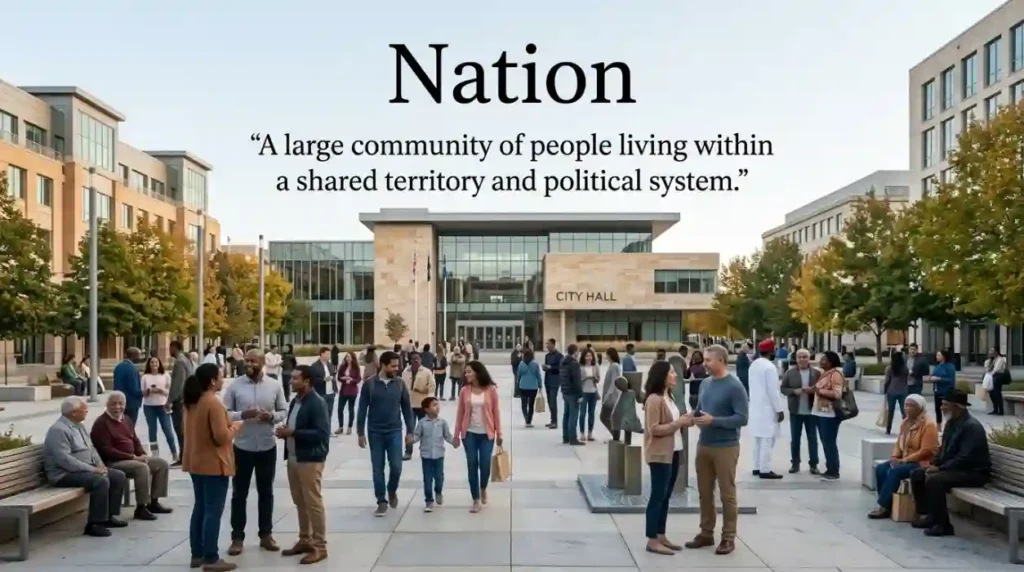
The word nation describes a large body of people united by common descent, history, culture, language, or government, inhabiting a particular territory.
Native English speakers understand “nation” as a word with strong cultural and human identity. It emphasizes shared heritage, social values, and political unity.
You will see this word often in international news reports, history textbooks, diplomatic speeches, political essays, and cultural documentaries.
Part of Speech: Noun
Simple Definition: A large group of people sharing a common culture, history, or government.
Connotative Meaning
Connotation is the emotional, cultural, or secondary meaning that a word carries beyond its literal dictionary definition.
- Positive tone: Connotes heritage, community pride, shared cultural identity, unity, and national solidarity (e.g., “homeland,” “commonwealth”).
- Negative tone: Implies aggressive nationalism, strict border division, regime control, or exclusionary politics (e.g., “regime,” “hegemon”).
- Neutral tone: Refers strictly to a defined geographic territory or political legal system (e.g., “state,” “country”).
Etymology
- Origin: Derived from the Latin word natio, which means “birth,” “origin,” “breed,” or “crew.”
- Old English (450–1100): Early English used native Germanic words like theod (people or crew) or land before Latin legal terms entered.
- Middle English (1100–1500): The word entered English through Old French nacion to describe communities of shared origin and language.
- Modern English (1500–Present): “Nation” evolved into a fundamental term in political science, law, and international diplomacy.
Pronunciation & Syllables
- US: /ˈneɪ.ʃən/
- UK: /ˈneɪ.ʃən/
- Syllables: na-tion (2 syllables)
- Affixation Pattern: Root nation
- Root: Nation (from Latin natio)
- Prefix: None
- Suffix: None
Synonyms List
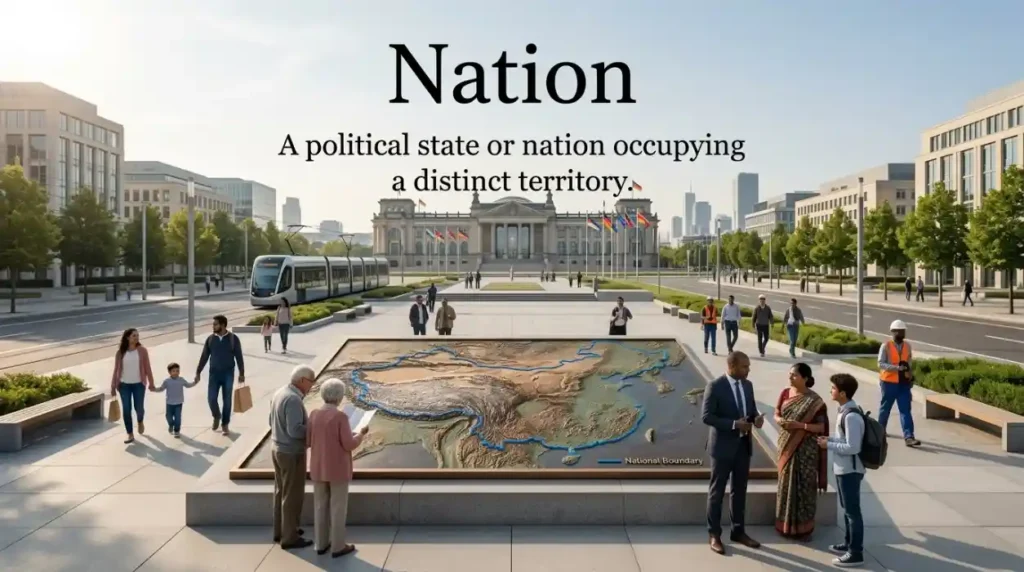
1. Country (Noun)
Meaning: A political state or nation occupying a distinct territory.
Tone/Register: General / Everyday
Examples:
- She traveled across the country during her summer vacation.
- Every country participated in the global climate summit.
2. State (Noun)
Meaning: An organized political community under one government system.
Tone/Register: Formal / Legal
Examples:
- The state declared a national holiday to honor public service.
- Officials managed the diplomatic relations between states.
3. Sovereign State (Noun)
Meaning: An independent political entity with full authority over its territory.
Tone/Register: Formal / Political
Examples:
- The island officially became a recognized sovereign state last year.
- International law protects the rights of every sovereign state.
4. Land (Noun)
Meaning: A country or nation considered as a physical territory or cultural home.
Tone/Register: Expressive / Literary
Examples:
- Travelers sang songs about their beloved distant land.
- The ancient land boasts a rich history of art and trade.
5. Realm (Noun)
Meaning: A kingdom or domain ruled by a sovereign power.
Tone/Register: Literary / Traditional
Examples:
- Peace endured across the entire realm for over five decades.
- The king protected the borders of his vast realm.
6. Homeland (Noun)
Meaning: The country where a person was born or holds deep heritage.
Tone/Register: Emotional / Warm
Examples:
- Immigrants often feel a deep connection to their native homeland.
- He returned to his homeland after twenty years abroad.
7. Fatherland (Noun)
Meaning: The native country of a person, often used in patriotic contexts.
Tone/Register: Patriotic / Traditional
Examples:
- Citizens pledged their loyalty to defend the fatherland.
- The historical monument stood as a tribute to the fatherland.
8. Motherland (Noun)
Meaning: One’s native land, expressed with deep affectionate respect.
Tone/Register: Personal / Patriotic
Examples:
- She wrote emotional poetry honoring her motherland.
- Soldiers marched proudly in defense of their motherland.
9. Republic (Noun)
Meaning: A state where supreme power rests with elected representatives.
Tone/Register: Political / Formal
Examples:
- The new republic established its constitution through public voting.
- Representatives gathered at the capital of the republic.
10. Kingdom (Noun)
Meaning: A country ruled officially by a king or queen.
Tone/Register: Traditional / Political
Examples:
- The kingdom celebrated the coronation of its new monarch.
- Visitors explored the historic castles across the kingdom.
11. Dominion (Noun)
Meaning: A self-governing territory under a central sovereign power.
Tone/Register: Historical / Legal
Examples:
- The territory gained status as an autonomous dominion.
- Historic maps outlined the vast extent of the dominion.
12. Commonwealth (Noun)
Meaning: An independent state or community united by shared goals.
Tone/Register: Formal / Diplomatic
Examples:
- Member countries met to discuss trade across the commonwealth.
- The nation joined the international commonwealth alliance.
13. Territory (Noun)
Meaning: An area of land under the jurisdiction of a ruler or state.
Tone/Register: Neutral / Geographic
Examples:
- Mapmakers marked the precise boundaries of the territory.
- The team crossed into neutral territory during their expedition.
14. Society (Noun)
Meaning: An organized group of people living together in a community.
Tone/Register: General / Academic
Examples:
- Modern society relies heavily on digital communication tools.
- Every democratic society values freedom of expression.
15. People (Noun)
Meaning: The entire body of persons constituting a community or nation.
Tone/Register: Warm / Human
Examples:
- The president addressed the people during the national broadcast.
- A resilient people built thriving towns across the valley.
16. Population (Noun)
Meaning: All the inhabitants of a particular town, area, or country.
Tone/Register: Analytical / Statistical
Examples:
- The city population grew rapidly following industrial expansion.
- Surveyors gathered accurate data on the local population.
17. Empire (Noun)
Meaning: An extensive group of states or countries under a single authority.
Tone/Register: Historical / Grand
Examples:
- The ancient empire expanded trade routes across three continents.
- Historians analyzed the rise and fall of the Roman Empire.
18. Principality (Noun)
Meaning: A state or territory ruled directly by a prince.
Tone/Register: Formal / Traditional
Examples:
- The small coastal principality attracted international tourists.
- Local laws governed business operations within the principality.
19. Power (Noun)
Meaning: A nation possessing significant political, economic, or military strength.
Tone/Register: Political / Strategic
Examples:
- Regional leaders negotiated terms with the dominant power.
- The industrial power influenced international trade policy.
20. Superpower (Noun)
Meaning: An extremely powerful nation capable of influencing world events.
Tone/Register: Modern / Political
Examples:
- Cold War history was shaped by two competing superpower blocs.
- The economic superpower invested heavily in green technology.
21. Federation (Noun)
Meaning: A group of states united under a central federal authority.
Tone/Register: Legal / Structural
Examples:
- The federation approved new interstate commerce guidelines.
- Regional governors attended the annual federation conference.
22. Confederation (Noun)
Meaning: An organization consisting of a number of parties united in an alliance.
Tone/Register: Political / Formal
Examples:
- Independent states formed a loose confederation for mutual defense.
- The confederation agreement boosted regional economic ties.
23. Union (Noun)
Meaning: A political unit consisting of a number of states joined together.
Tone/Register: Strong / Collaborative
Examples:
- Member states voted to strengthen economic cooperation across the union.
- The political union preserved peace throughout the region.
24. Polity (Noun)
Meaning: An organized society or government entity with a specific structure.
Tone/Register: Academic / Analytical
Examples:
- Scholars examined the legal structure of the ancient polity.
- Every stable polity requires a transparent rule of law.
25. Sovereign (Noun)
Meaning: A supreme power or self-governing political state.
Tone/Register: Legal / Elevating
Examples:
- The treaty recognized the community as a free sovereign.
- Delegates respected the authority of each attending sovereign.
26. Community (Noun)
Meaning: A group of people living in the same place or having shared values.
Tone/Register: Social / Positive
Examples:
- The international community offered emergency relief supplies.
- Local leaders worked hard to unite their diverse community.
27. Public (Noun)
Meaning: The general body of citizens living within a nation or society.
Tone/Register: General / Civic
Examples:
- The government sought public feedback on the proposed tax law.
- Health officials informed the general public about preventive safety.
28. Body Politic (Noun)
Meaning: The collective body of people forming a politically organized group.
Tone/Register: Formal / Philosophy
Examples:
- Voting allows every citizen to participate in the body politic.
- Social trust remains vital for a healthy body politic.
29. Duchy (Noun)
Meaning: The territory or state ruled historically by a duke or duchess.
Tone/Register: Historical / Rare
Examples:
- The medieval duchy expanded its agricultural trade networks.
- Tourists visited historic landmarks across the former duchy.
30. Monarchy (Noun)
Meaning: A nation governed by a king, queen, or royal family line.
Tone/Register: Traditional / Political
Examples:
- The constitutional monarchy balanced tradition with democratic voting.
- Historians documented the long lineage of the royal monarchy.
31. Sultanate (Noun)
Meaning: A state or territory governed by a sovereign sultan.
Tone/Register: Regional / Formal
Examples:
- The historic sultanate prospered through maritime spice trade.
- Ambassadors visited the capital of the peaceful sultanate.
32. Emirate (Noun)
Meaning: A domain or political state governed by an emir.
Tone/Register: Regional / Formal
Examples:
- The modern emirate developed modern urban infrastructure rapidly.
- International banks established headquarters in the wealthy emirate.
33. Province (Noun)
Meaning: A principal administrative division of a country or empire.
Tone/Register: General / Administrative
Examples:
- Heavy snow fell across the northern province overnight.
- Local officials managed public transit for the entire province.
34. Domain (Noun)
Meaning: A territory over which rule or ownership is exercised.
Tone/Register: Literary / Formal
Examples:
- The park ranger protected the natural wildlife across the domain.
- Ancient rulers established clear borders for their domain.
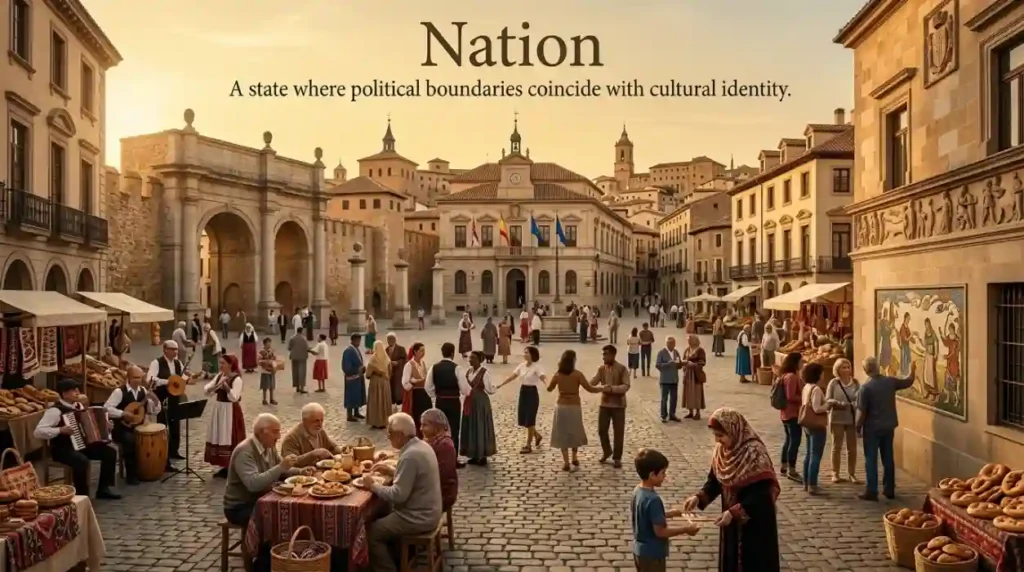
35. Nation-state (Noun)
Meaning: A state where political boundaries coincide with cultural identity.
Tone/Register: Academic / Precise
Examples:
- The modern nation-state model developed during the nineteenth century.
- Scholars studied cultural homogeneity within the nation-state.
36. Protectorate (Noun)
Meaning: A state controlled and protected by a stronger sovereign power.
Tone/Register: Historical / Legal
Examples:
- The island functioned as a self-governing protectorate for decades.
- The treaty defined the defense obligations toward the protectorate.
37. Colony (Noun)
Meaning: A country or area under full political control of another nation.
Tone/Register: Historical / Critical
Examples:
- The former colony gained full independence after years of movement.
- Historians researched trade restrictions placed on the colony.
38. Crew (Noun)
Meaning: A social group comprising families linked by social or blood ties.
Tone/Register: Cultural / Traditional
Examples:
- Elders shared traditional wisdom across the entire crew.
- The crew preserved its unique language through oral storytelling.
39. Clan (Noun)
Meaning: A close-knit group of interrelated families sharing ancestral roots.
Tone/Register: Social / Historical
Examples:
- Clan members gathered annually for a grand heritage festival.
- Historical tartans identified different family roots of each clan.
40. Folk (Noun)
Meaning: The traditional people or ethnic community forming a nation.
Tone/Register: Cultural / Informal
Examples:
- Local musicians celebrated the traditional songs of their folk.
- Storytellers preserved ancient legends among the local folk.
41. Nationality (Noun)
Meaning: The legal status or cultural identity of belonging to a nation.
Tone/Register: Legal / Official
Examples:
- She held dual nationality in both France and the United States.
- Travelers verified their nationality at the airport security desk.
42. Realm-state (Noun)
Meaning: A sovereign territorial state managed under centralized governance.
Tone/Register: Academic / Rare
Examples:
- Historical research compared the administrative power of each realm-state.
- The realm-state implemented unified taxation laws across regions.
43. Sovereign Nation (Noun)
Meaning: An independent nation holding supreme self-governing power.
Tone/Register: Formal / Diplomatic
Examples:
- The UN welcomed the newly recognized sovereign nation to the assembly.
- Every sovereign nation maintains the right to set domestic policy.
44. Geopolitical Entity (Noun)
Meaning: A defined political unit evaluated through global geographic impact.
Tone/Register: Analytical / Technical
Examples:
- Analysts evaluated the economic stability of the geopolitical entity.
- Energy trade heavily influenced every major geopolitical entity.
45. Government (Noun)
Meaning: The governing body or political agency managing a state.
Tone/Register: General / Official
Examples:
- The government introduced new economic relief measures today.
- Citizens voted in elections to choose their local government.
46. Regime (Noun)
Meaning: An authoritarian or specific system of government rule.
Tone/Register: Critical / Political
Examples:
- International sanctions aimed to pressure the authoritarian regime.
- Citizens celebrated the peaceful transition following the old regime.
47. Democracy (Noun)
Meaning: A nation governed through elected representatives of the populace.
Tone/Register: Positive / Political
Examples:
- Free press serves as a vital pillar in every healthy democracy.
- Voters actively participated in shaping their young democracy.
48. Hegemon (Noun)
Meaning: A supreme ruling state holding dominant political influence globally.
Tone/Register: Academic / Critical
Examples:
- The global hegemon shaped economic agreements across continents.
- Emerging markets sought to balance influence against the hegemon.
49. Ally (Noun)
Meaning: A state formally cooperating with another for strategic military goals.
Tone/Register: Strategic / Positive
Examples:
- The country proved to be a reliable strategic ally during the crisis.
- Joint defense exercises strengthened bonds with each foreign ally.
50. Sovereign Territory (Noun)
Meaning: Land under the official legal authority of an independent nation.
Tone/Register: Legal / Geographic
Examples:
- Foreign vessels were escorted away from the sovereign territory.
- Border patrols guarded the limits of the sovereign territory.
51. Borderland (Noun)
Meaning: A region or land straddling the boundary of a nation.
Tone/Register: Descriptive / Cultural
Examples:
- Unique cultural traditions flourished across the peaceful borderland.
- Trade markets connected communities living along the borderland.
52. Father country (Noun)
Meaning: A person’s native homeland, used in traditional legal contexts.
Tone/Register: Formal / Traditional
Examples:
- The expatriate retained strong financial ties to his father country.
- Legal documents cited allegiance to his ancestral fatherland.
53. Native Land (Noun)
Meaning: The country or region where a person was born and raised.
Tone/Register: Personal / Warm
Examples:
- She missed the vibrant music and cuisine of her native land.
- He wrote a memoir detailing his early childhood in his native land.
54. Home Country (Noun)
Meaning: The country from which a person or business originally hails.
Tone/Register: General / Business
Examples:
- Multinational companies often maintain headquarters in their home country.
- Students returned to their home country after finishing university.
55. Sovereign Body (Noun)
Meaning: An independent political group holding supreme legislative power.
Tone/Register: Legal / Formal
Examples:
- Parliament convened as the supreme sovereign body of the nation.
- The constitutional committee formed an independent sovereign body.
56. Sister Nation (Noun)
Meaning: A country sharing deep cultural, historical, or political ties.
Tone/Register: Friendly / Diplomatic
Examples:
- Leaders expressed strong solidarity with their sister nation.
- Both countries shared cultural celebrations as sister nations.
57. Member State (Noun)
Meaning: A country belonging officially to an international organization.
Tone/Register: Professional / Official
Examples:
- Every member state voted on the new global environmental charter.
- The alliance offered trade benefits to every participating member state.
58. Self-governing Territory (Noun)
Meaning: An autonomous region exercising control over domestic political affairs.
Tone/Register: Formal / Political
Examples:
- The island operates as a prosperous self-governing territory.
- Local authorities managed domestic law within the self-governing territory.
59. Realm power (Noun)
Meaning: A dominant state exerting monarchical or sovereign authority.
Tone/Register: Historical / Rare
Examples:
- Diplomatic envoys traveled directly to negotiate with the realm power.
- Treaties marked peace agreements made between each realm power.
60. Global Actor (Noun)
Meaning: A nation or state exercising significant influence on world affairs.
Tone/Register: Modern / Analytical
Examples:
- Emerging economies quickly gained status as key global actors.
- The summit brought together major global actors to discuss security.
Synonyms by Tone
Selecting the correct synonym depends on the political and emotional message you want to deliver.
Positive Tone
- Homeland
- Motherland
- Democracy
- Sister nation
- Ally
Neutral Tone
- Country
- State
- Nation-state
- Territory
- Member state
Negative / High-Pressure Tone
- Regime
- Hegemon
- Empire
- Colony
- Protectorate
Playful / Informal Tone
- Native land
- Home country
- Folk
- Realm
Why Tone Matters:
Choosing your word changes perception. Referring to a government as a “democracy” conveys respect, whereas calling it a “regime” carries immediate political criticism.
Mini Comparison
| Word | Core Meaning Focus | Tone & Register | Ideal Usage Context |
| Nation | Shared cultural identity, language, history, and people | Cultural / Warm | Speeches, cultural essays, historical books |
| Country | Geographic territory, land borders, and physical location | Everyday / General | Travel blogs, daily conversations, casual talk |
| State | Legal government structure, political authority, and laws | Formal / Political | International law, diplomatic news, official papers |
Context-Based Usage
Daily Conversation
In casual speech, stick to simple, clear terms like country, homeland, or home country to keep your dialogue natural and easy to follow.
Writing or Blogging
Bloggers engage readers using descriptive words like society, land, motherland, or community to make travel and news posts lively.
Professional or Academic Tone
Formal essays and diplomatic reports demand legal precision. Options like sovereign state, polity, nation-state, or member state convey authority.
Creative Writing
Fiction authors paint rich fictional worlds using evocative terms like realm, fatherland, empire, or borderland to deepen storytelling.
Common Mistakes & Native Usage

Misuse Scenarios
- Confusing Nation and Country: Remember that a “nation” refers to cultural unity among people, while a “country” refers to the physical territory.
- Confusing Nation and State: “State” refers strictly to the political governing organization, whereas “nation” centers on social identity.
- Overusing Political Jargon: Using “hegemon” or “polity” in casual travel conversations sounds overly stiff and unnatural.
Register Notes
- Use formal options (sovereign state, polity) in legal documents and academic political research.
- Use conversational options (country, homeland) in daily conversations and social posts.
- For more ways to discuss international relations, read our guide on synonyms for agreement.
Real-Life Mini Scenarios
- Workplace: The international trade manager organized logistics for shipments heading to three member states.
- Social Situations: Alex shared stories about his childhood upbringing while visiting his native land last month.
- Media / Pop Culture: News commentators analyzed how the diplomatic summit brought together major global actors.
- Writing & Storytelling: The epic fantasy novel recounted the long struggle to protect the borders of the realm.
Conclusion
Expanding your vocabulary with a synonym for nation gives you more ways to discuss countries, peoples, cultures, and national identities. Precise word choices can make your ideas easier to understand and help your writing sound more polished.
Different alternatives work well in different contexts. Words such as country, state, homeland, republic, and territory can describe specific aspects of a nation or its people. Using varied vocabulary can strengthen essays, articles, presentations, and everyday conversations while reducing unnecessary repetition.
Make these new words part of your everyday practice by using two or three in your next writing task or discussion. As you become familiar with their meanings and contexts, you can communicate geographical, cultural, and international ideas with greater accuracy and confidence.
Practice Exercise
Test your understanding of meaning, tone, and context with this practical scenario-based quiz.
1. Which synonym best describes an independent government entity in international law?
A) Borderland
B) Folk
C) Sovereign state
D) Colony
2. What term carries an affectionate, emotional tone when describing one’s ancestral birthplace?
A) Hegemon
B) Motherland
C) Regime
D) Duchy
3. Which word is best for describing a country governed through elected public representatives?
A) Sultanate
B) Hegemon
C) Protectorate
D) Democracy
4. Which negative political term describes an authoritarian government system?
A) Commonwealth
B) Sister nation
C) Regime
D) Union
5. What informal word best replaces “nation” when discussing physical geographic territory?
A) Polity
B) Country
C) Hegemon
D) Body politic
6. Which term describes a state sharing close cultural and political ties with another?
A) Hegemon
B) Protectorate
C) Colony
D) Sister nation
7. What formal academic term describes a state where political boundaries match cultural identity?
A) Duchy
B) Nation-state
C) Folk
D) Borderland
8. Which word best describes a nation exerting dominant global military and political influence?
A) Duchy
B) Crew
C) Superpower
D) Clan
9. What term fits an official country belonging to an international alliance like the UN?
A) Fatherland
B) Member state
C) Clan
D) Folk
10. Which word describes a kingdom ruled historically by a monarch?
A) Hegemon
B) Regime
C) Colony
D) Realm
Reflection Task:
Write two original sentences describing a peaceful international alliance using two new synonyms learned in this article.
Answer Key:
1C | 2B | 3D | 4C | 5B | 6D | 7B | 8C | 9B | 10D
Frequently Asked Questions
1. What is the difference between a nation, a country, and a state?
A “nation” refers to a group of people sharing culture, history, and identity. A “country” refers to the physical geographic land and borders. A “state” refers to the organized political government system controlling a territory.
2. What is the most common casual synonym for nation?
The most common casual synonym for “nation” in daily conversation is “country.” Native speakers use “country” when discussing location, travel, geography, and general international news in everyday speech.
3. Can “people” be used as a valid synonym for nation?
Yes. In political and historical contexts, “a people” refers directly to a unified national or ethnic group possessing a shared identity, history, and culture, such as “the people of the valley.”
4. What is a good academic synonym for nation in political science?
In political science and legal writing, strong academic synonyms include “sovereign state,” “nation-state,” “polity,” and “geopolitical entity,” depending on whether the emphasis is on law, governance, or culture.
5. Is “homeland” always a positive synonym for nation?
“Homeland” carries a warm, positive, and personal connotation associated with heritage, safety, and roots. However, in political rhetoric, it can sometimes be used in intense patriotic or defensive contexts.
6. How does a “nation-state” differ from a simple nation?
A “nation” is a cultural group of people. A “nation-state” occurs when that specific cultural group possesses its own defined physical boundaries and an independent political government system.

Jameel Hassan is the founder and lead writer at SynonymsCloud.com, a trusted online platform dedicated to English vocabulary and effective communication. He is passionate about helping students, writers, professionals, and lifelong learners discover the right words to express their ideas with clarity, precision, and confidence.
At SynonymsCloud.com, every article is thoroughly researched and carefully written to provide accurate, practical, and easy-to-understand guidance on synonyms, antonyms, word meanings, idioms, and vocabulary. With a strong commitment to quality, real-world usage, and clear explanations, the website helps readers expand their vocabulary, improve their writing, and communicate more effectively in both academic and professional settings.