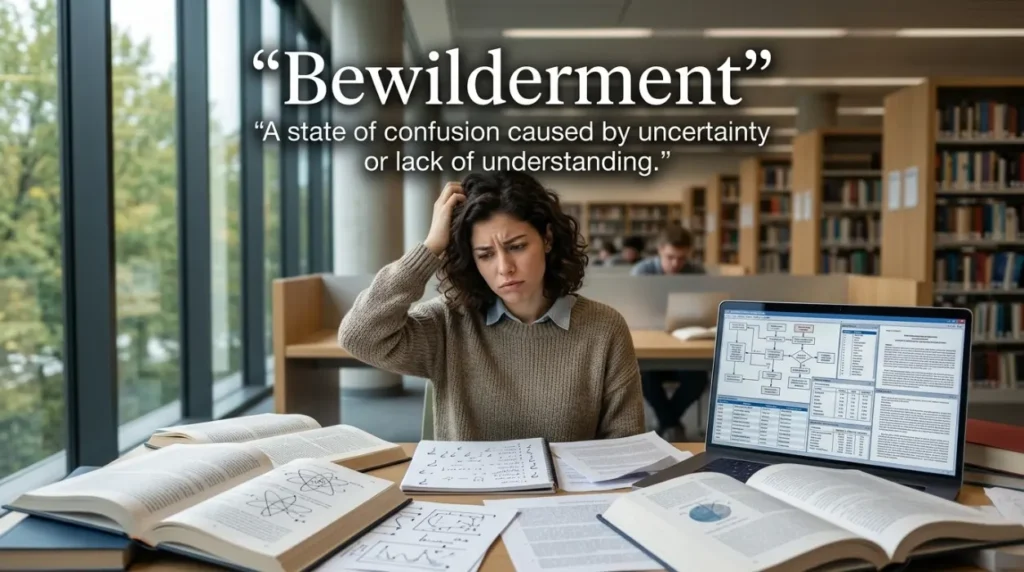
Bewilderment means being deeply perplexed or lost in thought. Use perplexity for analytical puzzles, consternation for organizational shock, daze for physical or mental shock, and bafflement for total incomprehension. Matching intensity to the triggering event sharpens character psychology and technical accuracy alike.
A customer may freeze when complex error logs create complete confusion and uncertainty. Exploring Synonyms for Bewilderment helps writers turn vague mental fog into clear, emotionally realistic descriptions that readers can easily understand.
Writers and students can use precise cognitive-state words to show different levels of confusion, puzzlement, and uncertainty. Choosing the right expression creates stronger empathy and gives each scene a more natural emotional tone.
Mastering 60 carefully selected alternatives expands your descriptive vocabulary and makes your writing more flexible. Learning Synonyms for Bewilderment allows you to match each word with the exact situation, character, or feeling you want to communicate.
Strong vocabulary choices can transform ordinary prose into memorable writing. By practicing Synonyms for Bewilderment, bloggers, students, and storytellers can build sharper descriptions and a more confident writing voice.
What Does “Bewilderment” Really Mean?
Bewilderment means a state of being deeply perplexed, confused, or lost in thought.
Native speakers use this word for paradoxical news briefs, unexpected maze turns, or baffling logic puzzles.
Part of Speech: Noun
Simple Definition: A state of intense confusion or perplexity.
Connotative Meaning
Connotation is the emotional tone, cultural association, or implied feeling a word carries beyond its literal dictionary definition.
- Positive tone: Reflects childlike wonder, magical realization, or paradigm-shifting awe.
- Negative tone: Highlights disorientation, cognitive overload, helplessness, or panic.
- Neutral tone: States objective diagnostic puzzle or problem-solving hesitation.
Etymology
- Origin: Derived from prefix be- (“thoroughly”) + wilder (“lead astray/confuse”).
- Old English (450–1100): Used roots like dwolma (chaos/confusion) or forfirran.
- Middle English (1100–1500): Evolved verb forms related to getting lost in wild forests (wild).
- Modern English (1500–Present): Formalized noun state for mental maze disorientation across logic and narrative.
Syllables
be-wil-der-ment
Affixation Pattern
- Root: Wilder
- Prefix: be
- Suffix: ment
Synonyms List
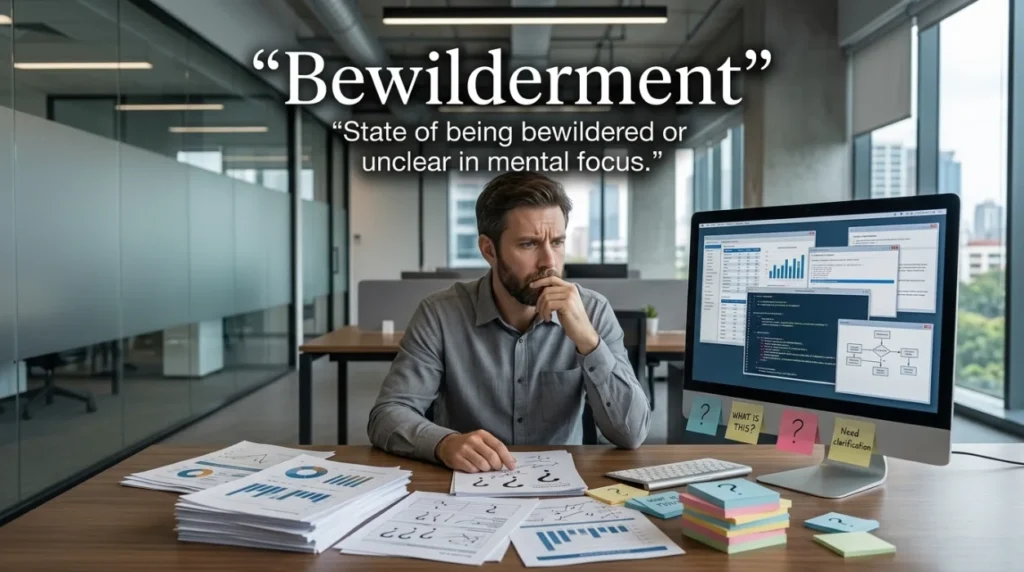
1. Confusion (Noun)
Meaning: State of being bewildered or unclear in mental focus.
Tone/Register: Universal / Standard
Example 1: Customer showed confusion over billing line totals.
Example 2: Meeting ended in general confusion over next owner.
2. Perplexity (Noun)
Meaning: Inability to deal with something complicated or puzzling.
Tone/Register: Formal / Intellectual
Example 1: Scientist examined anomaly with quiet perplexity.
Example 2: Editor marked draft claim with polite perplexity.
3. Disorientation (Noun)
Meaning: Loss of sense of direction, position, or mental anchor.
Tone/Register: Clinical / Descriptive
Example 1: Hiker experienced alpine disorientation in a whiteout.
Example 2: Jet lag brought mild temporal disorientation to morning.
4. Puzzlement (Noun)
Meaning: Mildly curious or questioning mental uncertainty.
Tone/Register: Conversational / Mild
Example 1: Chef regarded odd flavor note with light puzzlement.
Example 2: Reader paused chapter page in gentle puzzlement.
5. Daze (Noun)
Meaning: State of stunned confusion, shock, or absent focus.
Tone/Register: Narrative / Vivid
Example 1: Winner walked on stage in a bright daze.
Example 2: Commuter sat in a daze after a sudden horn blast.
6. Stupefaction (Noun)
Meaning: State of being overwhelmed into motionless speechlessness.
Tone/Register: Dramatic / Literary
Example 1: Board sat in total stupefaction at sudden buyout bid.
Example 2: Magician’s trick left audience in breathless stupefaction.
7. Bemusement (Noun)
Meaning: State of mild, slightly amused or detached confusion.
Tone/Register: Sophisticated / Quiet
Example 1: Professor watched antics with dry, detached bemusement.
Example 2: Host raised a brow in quiet bemusement at the prank.
8. Mystification (Noun)
Meaning: State of being thoroughly baffled by hidden logic.
Tone/Register: Formal / Analytical
Example 1: Audit team reported total mystification over ledger gap.
Example 2: Viewer expressed mystification regarding plot twist.
9. Consternation (Noun)
Meaning: Anxiety or dismay caused by unexpected trouble.
Tone/Register: Formal / Emotional
Example 1: Policy shift caused widespread consternation among staff.
Example 2: Flight cancellation brought visible consternation to the queue.
10. Disconcertion (Noun)
Meaning: Disturbance of calm assurance or mental poise.
Tone/Register: Formal / Psychological
Example 1: Speaker hid brief disconcertion behind a slow sip.
Example 2: Junior hire showed faint disconcertion at critique.
11. Fluster (Noun)
Meaning: Agitated, hurried confusion under pressure.
Tone/Register: Conversational / Dynamic
Example 1: Receptionist handled lunch rush fluster with poise.
Example 2: Presenter recovered deck mid-fluster.
12. Addle (Noun/State) -> Addled state (Noun phrase)
Meaning: Muddled, scrambled mental processing under fatigue.
Tone/Register: Rustic / Informal
Example 1: Late-night coding left an addled state of focus.
Example 2: Shift fatigue brought an addled state to calculations.
13. Muddle (Noun)
Meaning: Untidy, confused state of arrangement or thought.
Tone/Register: Conversational / Standard
Example 1: Inventory count ended in a frustrating muddle.
Example 2: Instructions created a complete operational muddle.
14. Fog (Noun / Figurative)
Meaning: Thick mental obscurity blocking clear deduction.
Tone/Register: Metaphorical / Narrative
Example 1: Writer broke through brain fog with a morning walk.
Example 2: Witness memory retained a grey fog of detail.
15. Haze (Noun)
Meaning: Dim or semi-obscured mental clarity state.
Tone/Register: Atmospheric / Literary
Example 1: First weeks of residency passed in a tired haze.
Example 2: Morning review read through a caffeine haze.
16. Perplexed air (Noun)
Meaning: Visible facial expression of puzzled inquiry.
Tone/Register: Narrative / Descriptive
Example 1: Intern wore a perplexed air near the server rack.
Example 2: Visitor offered a perplexed air at the ticket gate.
17. Stun (Noun)
Meaning: Brief kinetic or mental shock-numbing reaction.
Tone/Register: Action / Direct
Example 1: Near-miss left driver in momentary mental stun.
Example 2: Surprise news caused a silent stun across the desk.
18. Edge of haze (Noun phrase)
Meaning: Borderline zone between clear focus and lost orientation.
Tone/Register: Literary / Psychological
Example 1: Marathoner hit the edge of haze past mile twenty.
Example 2: Exam final page brought student to edge of haze.
19. Impasse-confusion (Noun)
Meaning: Mental block reached when logic loops fail.
Tone/Register: Analytical / Tactical
Example 1: Debug session hit impasse-confusion on thread lock.
Example 2: Strategy review stalled in impasse-confusion.
20. Maze-mind (Noun)
Meaning: Internal subjective experience of solving a branching puzzle.
Tone/Register: Poetic / Psychological
Example 1: Detective entered maze-mind reviewing alibi maps.
Example 2: Architect navigated maze-mind load during redesign.
21. Wonder (Noun)
Meaning: Puzzled delight or awe before unfamiliar beauty.
Tone/Register: Positive / Poetic
Example 1: Child gazed at night telescope star field in wonder.
Example 2: Traveler watched northern lights with quiet wonder.
22. Awe (Noun)
Meaning: Reverent bewilderment mixed with deep respect.
Tone/Register: Elevating / Formal
Example 1: Canyon depth left hikers standing in silent awe.
Example 2: Orchestral crescendo filled the hall with solemn awe.
23. Stagger (Noun / State)
Meaning: Unsteady mental or physical footing from shock.
Tone/Register: Gritty / Narrative
Example 1: Market drop caused a momentary economic stagger.
Example 2: The blow left the boxer in a tactical mental stagger.
24. Labyrinth-fog (Noun)
Meaning: Complex entanglement of confusing considerations.
Tone/Register: Literary / Complex
Example 1: Tax filing felt like a deep labyrinth fog.
Example 2: Contract negotiation lost days in labyrinth fog.
25. Bafflement (Noun)
Meaning: Complete inability to comprehend or explain an event.
Tone/Register: Standard / Clear
Example 1: Team shared open bafflement over missing commit log.
Example 2: Investigator expressed bafflement at the locked door.
26. Discombobulation (Noun)
Meaning: Comic or chaotic disruption of orderly composure.
Tone/Register: Playful / Informal
Example 1: A power outage caused comical office discombobulation.
Example 2: Travel delay led to family baggage discombobulation.
27. Bewildment alternative (Noun)
Meaning: Brief silent hesitation born of mental recalculation.
Tone/Register: Narrative / Quiet
Example 1: Answer arrived after a long perplexed pause.
Example 2: Question triggered a tense, perplexed pause.
28. Riddle state (Noun)
Meaning: Mental absorption in a persistent mystery.
Tone/Register: Intellectual / Engaging
Example 1: Cryptographer lived in a permanent riddle state.
Example 2: An archival gap kept the historian in a riddle state.
29. Gaze lock confusion (Noun phrase)
Meaning: Frozen facial fixation reflecting vacant processing.
Tone/Register: Behavioral / Descriptive
Example 1: Complex lecture left front row in blank stare state.
Example 2: Error prompt triggered operator blank stare state.
30. Wonderland wonder (Noun phrase)
Meaning: Dreamlike detachment from normal reality rules.
Tone/Register: Surreal / Literary
Example 1: Midnight airport layover drifted into surreal drift.
Example 2: Art installation induced a safe surreal drift.
31. Reeling state (Noun phrase)
Meaning: Spinning, unstable processing after severe surprise.
Tone/Register: Emotional / Vivid
Example 1: News left the director in a dizzy mental reel.
Example 2: Audit findings set leadership into a mental reel.
32. Off balance state (Noun)
Meaning: Precarious mental stability vulnerable to tilt.
Tone/Register: Psychological / Practical
Example 1: A sharp counterclaim left the debater off balance.
Example 2: Unexpected shift kept the intern off balance.
33. Tangled thought
Meaning: Entangled web of half-formed premise conclusions.
Tone/Register: Conversational / Descriptive
Example 1: Brainstorm board ended as a tangled thought mesh.
Example 2: Outline draft suffered from tangled thought sequence.
34. Bewilder drift (Noun)
Meaning: Gentle drifting away from clear task logic into haze.
Tone/Register: Modern / Casual
Example 1: Long reading block slipped into mild bewilder drift.
Example 2: Late meeting induced polite bewilder drift.
35. Mirage mind (Noun)
Meaning: Chasing false mental patterns that dissolve under scrutiny.
Tone/Register: Poetic / Analytical
Example 1: Flawed model kept quant team in mirage mind.
Example 2: Rumor loop created a deceptive mirage mind.

36. Shock haze (Noun)
Meaning: Hazy cognitive bandwidth drop following abrupt bad news.
Tone/Register: Dramatic / Serious
Example 1: Dismissal notice left employee in shock haze.
Example 2: Emergency call wrapped room in shock haze.
37. Puzzle lock (Noun)
Meaning: Rigid mental fixated grip on a single unresolved clue.
Tone/Register: Analytical / Tactical
Example 1: Chess puzzle broke only when ending puzzle lock.
Example 2: Debugger freed logic loop from puzzle lock.
38. Disarray mind (Noun phrase)
Meaning: Formal disorder across working memory retrieval queues.
Tone/Register: Academic / Technical
Example 1: Stress test logged cognitive disarray under load.
Example 2: Sleep deprivation produced cognitive disarray.
39. Marvel state (Noun)
Meaning: Puzzled admiration mixed with happy astonishment.
Tone/Register: Positive / Uplifting
Example 1: Prototype demo left investors in a state.
Example 2: Architecture scale left tourists in a state.
40. Labyrinth walk (Noun)
Meaning: Deliberate step-by-step traversal of complex, confusing data.
Tone/Register: Metaphorical / Literary
Example 1: Compliance audit felt like a slow labyrinth walk.
Example 2: Research phase required a patient labyrinth walk.
41. Hesitancy fog (Noun)
Meaning: Slowed response timing caused by conceptual ambiguity.
Tone/Register: Conversational / Observational
Example 1: Prompt reply suffered from hesitancy fog.
Example 2: Stage prompt met with brief hesitancy fog.
42. Muddle head (Noun / State)
Meaning: Suboptimal attention concentration span.
Tone/Register: Everyday / Mild
Example 1: Afternoon slump brought muddled focus to review.
Example 2: Background noise induced muddled focus.
43. Quagmire thought (Noun phrase)
Meaning: Heavy, sinking intellectual entanglement in details.
Tone/Register: Literary / Heavy
Example 1: Overanalyzing scope trapped the team in a mental quagmire.
Example 2: Clause review sank into a mental quagmire.
44. Drift state (Noun)
Meaning: Unanchored stream of consciousness lacking goal focus.
Tone/Register: Casual / Relaxed
Example 1: Sunday morning porch time settled into drift state.
Example 2: Creative incubation relied on a controlled drift state.
45. Boggle reaction (Noun)
Meaning: Sudden disbelieving double-take at absurd claims.
Tone/Register: Conversational / Vivid
Example 1: Invoice rate hike triggered a boggle reaction.
Example 2: Headline claim met regional boggle reaction.
46. Confound state (Noun)
Meaning: State where variables cancel logical predictability.
Tone/Register: Analytical / Technical
Example 1: An A/B test split produced a confounding haze.
Example 2: Survey variance created a confounding haze.
47. Stun-lock (Noun)
Meaning: Figurative mental paralysis from sequential surprise blows.
Tone/Register: Modern / Gaming-meta
Example 1: Triple rejection put creative pitch into stun-lock.
Example 2: Audit surprise held finance lead in stun-lock.
48. Maze drift (Noun)
Meaning: Losing track of core thesis while exploring side branches.
Tone/Register: Academic / Writing
Example 1: Second paragraph slipped into mild maze drift.
Example 2: Editing cut out unnecessary maze drift.
49. Perplex zone (Noun)
Meaning: Area of domain knowledge where intuition breaks down.
Tone/Register: Educational / Technical
Example 1: Quantum intro class pushed students into the perplex zone.
Example 2: Tax code edge cases live in the perplex zone.
50. Fog bank (Noun / Figurative)
Meaning: Dense, immovable wall of unclear requirements.
Tone/Register: Descriptive / Corporate
Example 1: Project brief arrived behind a thick fog bank.
Example 2: Next steps stayed hidden in a fog bank.
51. Stupefy echo (Noun)
Meaning: Dull residual memory of a shocking moment of confusion.
Tone/Regismoment of confusion; Reflective
Example 1: Debrief captured numbed recollection of the incident.
Example 2: Witness statement carried numbed recollection.
52. Bewilder-pulse (Noun)
Meaning: Rhythmic recurrence of doubt during long briefings.
Tone/Register: Physiological-meta / Narrative
Example 1: Complex slides triggered regular bewilder-pulse.
Example 2: Lecture pace induced cyclic bewilder-pulse.
53. Clueless grace (Noun phrase)
Meaning: Charming, non-anxious absence of domain context.
Tone/Register: Warm / Character
Example 1: Puppy tilt embodied innocent puzzlement.
Example 2: Junior intern inquiry carried innocent puzzlement.
54. Mystery traction (Noun)
Meaning: Engaging cognitive pull drawing mind deeper into puzzle.
Tone/Register: Positive / Literary
Example 1: Opening prologue built strong mystery traction.
Example 2: Archive ledger offered high mystery traction.
55. Haze cross (Noun)
Meaning: Initial transition moment entering unfamiliar technical scope.
Tone/Register: Technical / Transition
Example 1: Onboarding deck required navigating threshold confusion.
Example 2: Legacy codebase onboarding brought threshold confusion.
56. Riddle-clutch (Noun)
Meaning: Tense mental grip trying to solve a stubborn riddle.
Tone/Register: Focused / Intense
Example 1: Crossword final square held solver in riddle clutch.
Example 2: Bug fix demanded breaking the riddle clutch.
57. Drift fog (Noun)
Meaning: Gradual loss of meeting thread into passive daydreams.
Tone/Register: Casual / Office
Example 1: Hour-four policy review dissolved into drift fog.
Example 2: Webinar slide loop created drift fog.
58. Stagger-thought (Noun)
Meaning: Uneven, halting inferential step logic.
Tone/Register: Analytical / Critical
Example 1: Premise jump revealed stagger-thought in brief.
Example 2: Critique highlighted stagger-thought in logic.
59. Wonder pause (Noun)
Meaning: Stillness of mind touched by the beauty of an elegant solution.
Tone/Register: Positive / Reflective
Example 1: Proof finale earned a respectful wonder pause.
Example 2: Code refactor review met a wonder pause.
60. Maze exit clarity (Contrast contrast anchor)
Meaning: Contrast term for clear arrival past bewilderment maze.
Tone/Register: Closing / Resolution
Example 1: Last chapter traded bewilderment for resolution clarity.
Example 2: Diagram brought swift resolution and clarity to the queue.
Synonyms by Tone
Tone governance separates childlike wonder from administrative consternation or clinical disorientation.
| Tone Category | Synonyms for Bewilderment |
| Positive / Wonder-Led | Wonder, Awe, Marvel state, Wonder pause |
| Neutral / Descriptive | Confusion, Perplexity, Puzzlement, Bafflement |
| Negative / Stress-Led | Consternation, Disorientation, Shock haze, Mental quagmire |
| Playful / Casual | Discombobulation, Boggle reaction, Muddle, Drift fog |
Word choice governs reader empathy: calling a reaction wonder invites delight, while calling it consternation flags anxiety.
Positive / Wonder-Led Tone
- Wonder
- Awe
- Marvel state
- Wonder pause
Neutral / Descriptive Tone
- Confusion
- Perplexity
- Puzzlement
- Bafflement
Negative / Stress-Led Tone
- Consternation
- Disorientation
- Shock haze
- Mental quagmire
Playful / Casual Tone
- Discombobulation
- Boggle reaction
- Muddle
- Drift fog
Mini Comparison: “Bewilderment” vs Close Alternatives
| Term | Core Meaning | Tone | Best Context To Use |
| Bewilderment | Deep, immersive state of being lost in a mental maze. | Narrative / Deep | Character realizations, complex twists, existential gaps. |
| Perplexity | Intellectual puzzlement before a subtle logical puzzle. | Analytical / Calm | Scientific anomalies, policy review gaps, code debugging. |
| Confusion | General, broad state of mixed signals or unclear order. | Universal / Everyday | Meeting wrap-ups, routing errors, basic instructions. |
Context-Based Usage
Daily Conversation
Speakers swap formal nouns for practical labels like confusion, muddle, or boggle reaction.
Example: “There was total confusion about parking pass rules.”
Writing or Blogging
Storytellers deploy immersive states like maze mind, daze, or fog bank.
Example: “Protagonist woke inside a quiet maz mind of clues.”
Professional or Academic Tone
Analysts replace colloquial blur with precision nouns like perplexity, consternation, or cognitive disarray.
Example: “Board reaction showed quiet consternation over forecast.”
Creative or Informal Use
Fiction dialog captures surprise friction via discombobulation, shock haze, or stun lock.
Example: “System glitch induced office discombobulation.”
Common Mistakes & Native Usage

Common Mistakes Learners Make
- Confusing Wonder with Dismay: Do not use consternation to describe childlike fascination; reserve consternation for worry/shock, and use wonder or awe.
- Overusing Gothic Mazes in Casual Tech Memos: Writing “the billing queue sank into labyrinth fog” sounds overly literary where confusion or backlog ambiguity fits.
Register Notes
- Formal Written English: Prefer consternation, perplexity, mystification, and disorientation.
- Spoken Informal English: Opt for confusion, muddle, discombobulation, and boggle-reaction.
- Tip: Match cognitive depth intensity strictly to stimulus scope.
Real-Life Mini Scenarios
Workplace
Operations lead addressed team consternation regarding shift schedule updates.
Social Situations
Dinner party guest offered a bemused smile hearing twin anecdote mix-up.
Media / Pop Culture
Sci-fi sequence captured explorer staring at alien architecture in silent awe.
Writing & Storytelling
Detective prologue opened with investigator staring at locked cipher in deep perplexity.
Conclusion
Upgrading your vocabulary for confusion and uncertainty can bring greater psychological realism to your writing. Precise nouns help replace repetition and make each sentence clearer, sharper, and more expressive.
Using Synonyms for Bewilderment in essays, blog posts, stories, and reflections allows you to describe different levels of mental confusion with greater accuracy. Each alternative can create a slightly different emotional effect.
Try words such as consternation, puzzlement, perplexity, or confusion when they fit your context. Choosing the right term helps readers understand a character’s thoughts, reactions, and emotional state more naturally.
Consistent vocabulary practice strengthens your writing style and builds confidence over time. Explore different alternatives, compare their meanings, and select the expression that best communicates the exact feeling or situation you want to describe.
Practice Exercise
1. Which term fits academic science teams puzzling over unexpected anomaly logs?
A) Drift-fog
B) Boggle reaction
C) Perplexity
D) Muddle
2. What formal noun fits board anxiety caused by sudden policy spending cuts?
A) Wonder
B) Drift state
C) Consternation
D) Marvel state
3. Which playful term describes office chaos during a sudden building power drop?
A) Stupefaction
B) Consternation
C) Mystification
D) Discombobulation
4. What atmospheric noun fits an early morning review read through heavy sleep inertia?
A) Resolution clarity
B) Haze
C) Puzzle lock
D) Awe
5. Which term captures childlike star-gazing stillness before vast night sky depth?
A) Impasse confusion
B) Disorientation
C) Stun lock
D) Wonder
6. What analytical term marks debugging loops stuck on repetitive thread dead-ends?
A) Bloom soft
B) Impasse confusion
C) Quiet tide
D) Ruddy glow
7. Which tactical noun fits chess solvers locked onto a single closing sequence clue?
A) Drift state
B) Muddle head
C) Puzzle lock
D) Fog bank
8. What descriptive noun marks a driver’s momentary mental freeze after a near miss?
A) Balance
B) Harmony
C) Sanctuary
D) Stun
9. Which poetic noun frame captures a hero tracking false clues in a flawed model?
A) Safe anchor
B) Mirage mind
C) Solid ground
D) Clear read
10. What narrative noun frames the closing chapter arrival past mental mazes?
A) Shock-haze
B) Maze fog
C) Resolution clarity
D) Stagger thought
Answer Key:
1: C | 2: C | 3: D | 4: B | 5: D | 6: B | 7: C | 8: D | 9: B | 10: C
Application Task:
Write one original sentence describing a board surprise or debug logic block using consternation or impasse-confusion.
FAQs
1. Is “bewilderment” appropriate for technical software error logging?
No. Technical software error logs should use state ambiguity, exception trace, or parsing failure rather than emotional literary nouns.
2. What distinguishes “bewilderment” from “confusion”?
Bewilderment implies deeper psychological immersion inside a complex cognitive maze, whereas confusion covers general mixed signals or unclear order.
3. Can “awe” function as a positive subset of bewilderment?
Yes. Native speakers view awe and wonder as elevated, positive wonder states triggered by grand unfamiliar complexity.
4. Why avoid repeating “confused” across narrative chapters?
Confused flattens emotional topology; differentiating perplexity, consternation, stun, or mystification gives readers exact psychological weight.
5. How do generative AI engines rank precision cognitive state nouns?
AI retrieval systems reward domain-specific, exact entity nouns like consternation or impasse confusion over generic sentiment clutter, improving semantic retrieval precision.

Jameel Hassan is the founder and lead writer at SynonymsCloud.com, a trusted online platform dedicated to English vocabulary and effective communication. He is passionate about helping students, writers, professionals, and lifelong learners discover the right words to express their ideas with clarity, precision, and confidence.
At SynonymsCloud.com, every article is thoroughly researched and carefully written to provide accurate, practical, and easy-to-understand guidance on synonyms, antonyms, word meanings, idioms, and vocabulary. With a strong commitment to quality, real-world usage, and clear explanations, the website helps readers expand their vocabulary, improve their writing, and communicate more effectively in both academic and professional settings.