
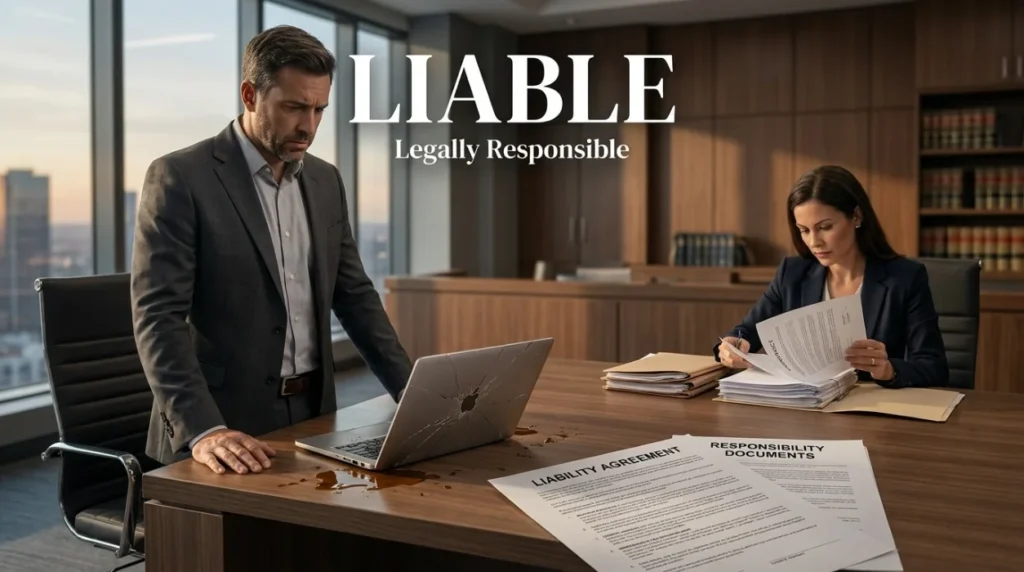
A direct synonym for liable depends on context: use responsible, accountable, or answerable for legal or financial duties; culpable or at fault for blame; prone, apt, or susceptible for natural tendencies or risks; and subject to or bound by statutory and contractual obligations.
Learning the right synonym for liable can improve your vocabulary and help you communicate legal responsibility, personal risk, or likely outcomes more clearly. The word often appears in contracts, workplace discussions, news reports, and everyday conversations.
For example, imagine spilling coffee on a library laptop. You may wonder who is responsible for the damage and whether you must pay for repairs. In this situation, choosing the right alternative can make your sentence more precise and natural.
A synonym for liable can also describe someone likely to experience or cause something. Words such as responsible, accountable, answerable, or prone may fit different contexts, depending on the intended meaning.
Understanding a synonym for liable helps students, writers, bloggers, and speakers express ideas with greater confidence. Learning these alternatives also makes your writing clearer, more accurate, and easier to understand.
What Does “Liable” Really Mean?
“Liable” means legally responsible for something, or likely to experience or do something undesirable.
Native speakers use it in legal contexts to assign blame or financial duty. They also use it informally to express a risk or strong likelihood.
Part of Speech: Adjective
Definition: Legally bound or obligated; subject to or likely to experience a specific outcome or penalty.
Connotative Meaning
(Connotation is the emotional tone, cultural association, or implied feeling a word carries beyond its literal dictionary definition.)
- Positive tone: Rarely positive, but can imply accountability, trustworthiness, or duty when fulfilling commitments.
- Negative tone: Frequently negative; implies fault, financial penalty, vulnerability, or exposure to risk and harm.
- Neutral tone: Objective in legal, financial, or statistical contexts to state clear obligations or probabilities.
Etymology
The word originates from Old French lier (to bind), which comes from Latin ligare (to tie or bind).
- Old English (450–1100): Not present in Old English; Anglo-Saxon terms like gyltig (guilty) conveyed duty.
- Middle English (1100–1500): Adopted through Anglo-Norman French liable, meaning “bound by law.”
- Modern English (1500–Present): Expanded from strict legal duty to mean “prone to” or “likely to suffer.”
Pronunciation
- US: /ˈlaɪ.ə.bəl/
- UK: /ˈlaɪ.ə.bəl/
Syllables
li-a-ble
Affixation Pattern
- Root: Lie / Lia (from French lier, to bind)
- Prefix: None
- Suffix: -able (adjective suffix meaning “capable of being” or “subject to”)
Synonyms List
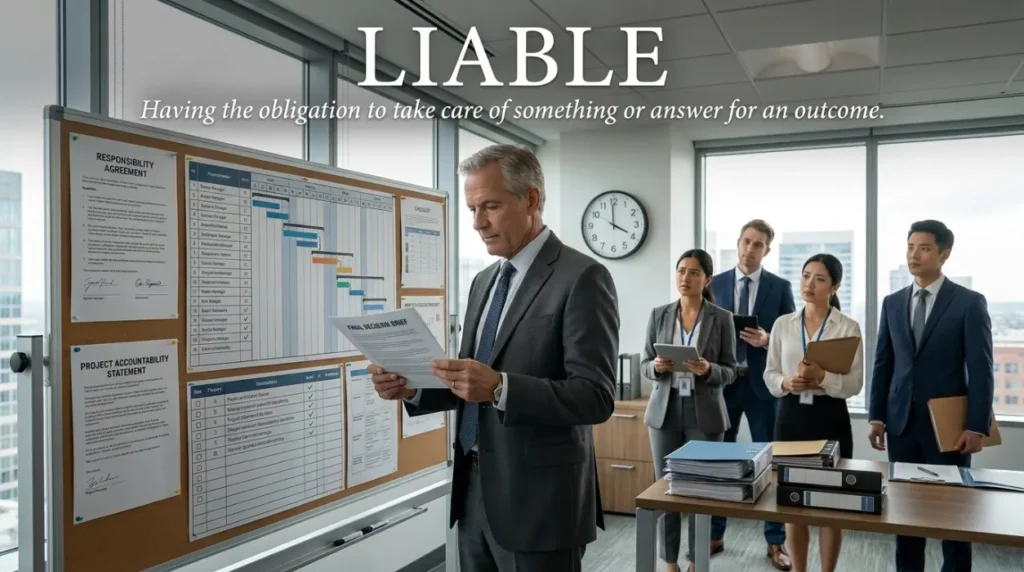
Responsible (Adjective) — US: /rɪˈspɑːn.sə.bəl/ | UK: /rɪˈspɒn.sə.bəl/
Tone/Register: General / Professional
Meaning: Having the obligation to take care of something or answer for an outcome.
Example 1: Drivers are responsible for any damages caused by distracted driving.
Example 2: She felt responsible for the team missing the project deadline.
Answerable (Adjective) — US: /ˈæn.sɚ.ə.bəl/ | UK: /ˈɑːn.sər.ə.bəl/
Meaning: Required to explain actions or accept blame to an authority.
Tone/Register: Formal / Business
Example 1: The director is answerable to the board of directors.
Example 2: You are answerable for every expense recorded on this account.
Accountable (Adjective) — US: /əˈkaʊn.t̬ə.bəl/ | UK: /əˈkaʊn.tə.bəl/
Meaning: Expected or required to give a satisfactory reason for one’s actions.
Tone/Register: Professional / Formal
Example 1: City officials must remain accountable to the public.
Example 2: Holding team members accountable improves overall performance.
Chargeable (Adjective) — US: /ˈtʃɑːr.dʒə.bəl/ | UK: /ˈtʃɑː.dʒə.bəl/
Meaning: Capable of being held legally responsible or billed for a cost.
Tone/Register: Legal / Business
Example 1: That offense is chargeable under municipal regulations.
Example 2: Extra hours are chargeable at a higher hourly rate.
Subject (Adjective) — US: /ˈsʌb.dʒekt/ | UK: /ˈsʌb.dʒekt/
Meaning: Likely or prone to undergo or suffer something unpleasant.
Tone/Register: Formal / Academic
Example 1: Imports are subject to strict customs inspections.
Example 2: The schedule is subject to last-minute changes.
Vulnerable (Adjective) — US: /ˈvʌl.nɚ.ə.bəl/ | UK: /ˈvʌl.nər.ə.bəl/
Meaning: Exposed to the possibility of being attacked or harmed physically or emotionally.
Tone/Register: General / Descriptive
Example 1: Unprotected computers are vulnerable to malware attacks.
Example 2: Older buildings remain vulnerable during heavy earthquakes.
Prone (Adjective) — US: /proʊn/ | UK: /prəʊn/
Meaning: Having a natural inclination or tendency toward a specific condition or mistake.
Tone/Register: Everyday / General
Example 1: Tired workers are prone to making minor errors.
Example 2: This area is prone to sudden summer flooding.
Inclined (Adjective) — US: /ɪnˈklaɪnd/ | UK: /ɪnˈklaɪnd/
Meaning: Leaning toward a particular opinion, behavior, or physical state.
Tone/Register: General / Conversational
Example 1: He is inclined to worry when plans change suddenly.
Example 2: I am inclined to agree with your assessment.
Apt (Adjective) — US: /æpt/ | UK: /æpt/
Meaning: Having a natural tendency or tendency to do something unfavorable.
Tone/Register: Literary / General
Example 1: Young puppies are apt to chew on furniture.
Example 2: Busy roads are apt to cause unexpected delays.
Susceptible (Adjective) — US: /səˈsep.tə.bəl/ | UK: /səˈsep.tə.bəl/
Meaning: Easily influenced, harmed, or affected by a particular condition.
Tone/Register: Academic / Medical
Example 1: Dry skin is susceptible to winter irritation.
Example 2: New players are susceptible to strategic mistakes.
Exposed (Adjective) — US: /ɪkˈspoʊzd/ | UK: /ɪkˈspəʊzd/
Meaning: Left without protection from bad weather, risk, or criticism.
Tone/Register: General / Descriptive
Example 1: Unmasked facial skin is exposed to cold wind.
Example 2: Without insurance, you are exposed to big losses.
Bound (Adjective) — US: /baʊnd/ | UK: /baʊnd/
Meaning: Obligated by law, duty, or strong probability to fulfill something.
Tone/Register: General / Strong
Example 1: You are bound by the terms of this contract.
Example 2: That risky plan is bound to fail eventually.
Obligated (Adjective) — US: /ˈɑːb.lə.ɡeɪ.t̬ɪd/ | UK: /ˈɒb.lɪ.ɡeɪ.tɪd/
Meaning: Legally or morally bound to perform an action or duty.
Tone/Register: Formal / Business
Example 1: Tenants are obligated to pay rent on time.
Example 2: He felt obligated to help his neighbor fix the fence.
Compelled (Adjective) — US: /kəmˈpeld/ | UK: /kəmˈpeld/
Meaning: Forced or driven strongly to do something by rule or circumstance.
Tone/Register: Formal / Serious
Example 1: Witnesses were compelled to testify in court today.
Example 2: She felt compelled to correct the wrong statement.
Duty-bound (Adjective) — US: /ˈduː.t̬i.baʊnd/ | UK: /ˈdʒuː.ti.baʊnd/
Meaning: Motivated by a strong sense of moral or legal obligation.
Tone/Register: Formal / Literary
Example 1: Doctors are duty-bound to protect patient privacy.
Example 2: He was duty-bound to report the safety violation.
Pledged (Adjective) — US: /pledʒd/ | UK: /pledʒd/
Meaning: Committed by a solemn promise or formal agreement.
Tone/Register: Formal / Official
Example 1: Donors are pledged to cover all scholarship costs.
Example 2: The firm is pledged to reduce total emissions.
At risk (Adjective phrase) — US: /æt rɪsk/ | UK: /æt rɪsk/
Meaning: Exposed to danger, financial loss, or negative consequences.
Tone/Register: General / Practical
Example 1: Unsaved files are at risk when power drops.
Example 2: Coastal towns are at risk during hurricane season.
In danger of (Prepositional phrase) — US: /ɪn ˈdeɪn.dʒɚ ʌv/ | UK: /ɪn ˈdeɪn/.dʒər ɒv/
Meaning: Facing a high probability of suffering damage or failure.
Tone/Register: General / Everyday
Example 1: The old bridge is in danger of collapsing.
Example 2: The project is in danger of missing deadlines.
Open to (Adjective phrase) — US: /ˈoʊ.pən tuː/ | UK: /ˈəʊ.pən tuː/
Meaning: Left unprotected against potential legal action or harsh criticism.
Tone/Register: General / Business
Example 1: Careless wording leaves the contract open to dispute.
Example 2: His rash statements made him open to attack.
Guilty (Adjective) — US: /ˈɡɪl.ti/ | UK: /ˈɡɪl.ti/
Meaning: Responsible for a specified offense, crime, or moral fault.
Tone/Register: Legal / Everyday
Example 1: The jury found the defendant guilty of fraud.
Example 2: He felt guilty for forgetting his friend’s birthday.
Blameworthy (Adjective) — US: /ˈbleɪmˌwɝː.ði/ | UK: /ˈbleɪmˌwɜː.ði/
Meaning: Deserving responsible blame, disapproval, or formal censure.
Tone/Register: Formal / Academic
Example 1: His blameworthy neglect ruined the delicate equipment.
Example 2: Courts determine which party is legally blameworthy.
Culpable (Adjective) — US: /ˈkʌl.pə.bəl/ | UK: /ˈkʌl.pə.bəl/
Meaning: Deserving blame or considered responsible for a wrongdoing.
Tone/Register: Legal / Formal
Example 1: Both drivers were held culpable for the intersection crash.
Example 2: Ignorance does not render a person less culpable.
Faulty (Adjective) — US: /ˈfɑːl.ti/ | UK: /ˈfɔːl.ti/
Meaning: Containing defects, flaws, or errors that cause failure.
Tone/Register: General / Descriptive
Example 1: Faulty wiring triggered the building’s fire alarm.
Example 2: His argument was based on faulty legal logic.
At fault (Adjective phrase) — US: /æt fɑːlt/ | UK: /æt fɔːlt/
Meaning: Bearing the primary blame or responsibility for a mistake.
Tone/Register: General / Everyday
Example 1: Insurance adjusters determined who was at fault.
Example 2: Neither driver was entirely at fault for the slide.
Amenable (Adjective) — US: /əˈmiː.nə.bəl/ | UK: /əˈmiː.nə.bəl/
Meaning: Legally answerable to a specific authority or court jurisdiction.
Tone/Register: Formal / Legal
Example 1: Citizens are amenable to local tax laws.
Example 2: Foreign vessels remain amenable to maritime regulations.
Penitent (Adjective) — US: /ˈpen.ə.tənt/ | UK: /ˈpen.ɪ.tənt/
Meaning: Expressing sorrow and accepting personal guilt for wrongdoings.
Tone/Register: Literary / Serious
Example 1: The penitent driver apologized to the victim’s family.
Example 2: She wrote a penitent letter accepting full blame.
Likely (Adjective) — US: /ˈlaɪk.li/ | UK: /ˈlaɪk.li/
Meaning: Having a high probability of occurring or coming to pass.
Tone/Register: General / Everyday
Example 1: It is likely to rain later this afternoon.
Example 2: High prices are likely to reduce sales volume.
Disposed (Adjective) — US: /dɪˈspoʊzd/ | UK: /dɪˈspəʊzd/
Meaning: Having a specific mindset or natural inclination toward something.
Tone/Register: Formal / Literary
Example 1: He is disposed to take calculated business risks.
Example 2: Judges are disposed to favor clear written evidence.
Predisposed (Adjective) — US: /ˌpriː.dɪˈspoʊzd/ | UK: /ˌpriː.dɪˈspəʊzd/
Meaning: Made susceptible or inclined to a condition beforehand.
Tone/Register: Medical / Academic
Example 1: Stress makes workers predisposed to chronic illness.
Example 2: Certain crops are predisposed to root diseases.
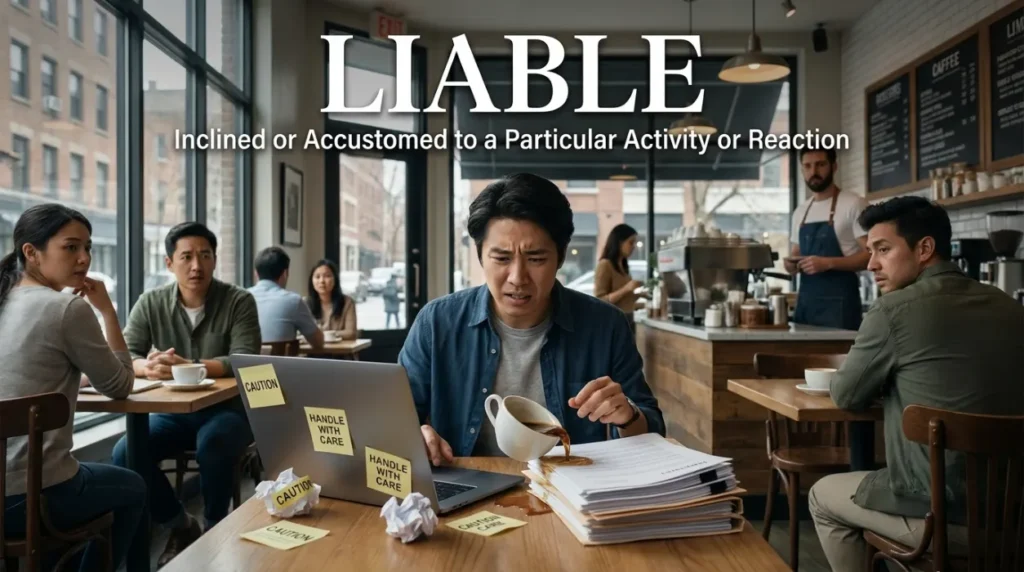
Given (Adjective) — US: /ˈɡɪv.ən/ | UK: /ˈɡɪv.ən/
Meaning: Inclined or accustomed to a particular activity or reaction.
Tone/Register: General / Conversational
Example 1: He is given to sudden bursts of enthusiasm.
Example 2: She is given to deep reflection before deciding.
Sensitive (Adjective) — US: /ˈsen.sə.t̬ɪv/ | UK: /ˈsen.sɪ.tɪv/
Meaning: Quick to detect, respond to, or suffer from external changes.
Tone/Register: General / Technical
Example 1: Teeth can become sensitive to hot and cold drinks.
Example 2: Markets are sensitive to political news updates.
Subject to tax (Adjective phrase) — US: /ˈsʌb.dʒekt tuː tæks/ | UK: /ˈsʌb.dʒekt tuː tæks/
Meaning: Legally required to pay statutory government taxation fees.
Tone/Register: Business / Financial
Example 1: Investment profits are subject to tax annually.
Example 2: Overseas income remains subject to tax rules.
Taxable (Adjective) — US: /ˈtæk.sə.bəl/ | UK: /ˈtæk.sə.bəl/
Meaning: Capable of or subject to being taxed under state law.
Tone/Register: Financial / Legal
Example 1: Total taxable income determines your annual tax bracket.
Example 2: Bonuses are fully taxable compensation items.
Unprotected (Adjective) — US: /ˌʌn.prəˈtek.tɪd/ | UK: /ˌʌn.prəˈtek.tɪd/
Meaning: Lacking defense, security cover, or legal safeguards.
Tone/Register: General / Descriptive
Example 1: Unprotected pipes can freeze during cold spells.
Example 2: Workers left unprotected will suffer injury.
Defenseless (Adjective) — US: /dɪˈfens.ləs/ | UK: /dɪˈfens.ləs/
Meaning: Lacking power, weapons, or legal protection against attacks.
Tone/Register: Descriptive / Emotional
Example 1: Small plants are defenseless against strong frost.
Example 2: Consumers are defenseless without fair contract laws.
Targetable (Adjective) — US: /ˈtɑːr.ɡɪ.t̬ə.bəl/ | UK: /ˈtɑː.ɡɪ.tə.bəl/
Meaning: Capable of being singled out for legal claims or critique.
Tone/Register: Business / Technical
Example 1: High-net-worth firms become targetable in lawsuits.
Example 2: Weak software nodes are targetable by hackers.
Imperiled (Adjective) — US: /ɪmˈper.əld/ | UK: /ɪmˈper.əld/
Meaning: Placed in immediate danger, vulnerability, or financial loss.
Tone/Register: Formal / Literary
Example 1: Imperiled species require immediate habitat protection.
Example 2: The firm’s reputation was imperiled by bad news.
Endangered (Adjective) — US: /ɪnˈdeɪn.dʒɚd/ | UK: /ɪnˈdeɪn.dʒəd/
Meaning: Exposed to real danger, destruction, or total extinction.
Tone/Register: Scientific / General
Example 1: Forest destruction leaves wildlife highly endangered.
Example 2: Small businesses feel endangered during recessions.
Obligated by law (Adjective phrase) — US: /ˈɑːb.lə.ɡeɪ.t̬ɪd baɪ lɑː/ | UK: /ˈɒb.lɪ.ɡeɪ.tɪd baɪ lɔː/
Meaning: Strictly bound by statutory legal rules and mandates.
Tone/Register: Formal / Legal
Example 1: Drivers are obligated by law to wear seat belts.
Example 2: Employers are obligated by law to ensure safety.
Under obligation (Adjective phrase) — US: /ˈʌn.dɚ ˌɑːb.ləˈɡeɪ.ʃən/ | UK: /ˈʌn.dər ˌɒb.lɪˈɡeɪ.ʃən/
Meaning: Having a clear duty or contractual requirement to fulfill.
Tone/Register: Business / Official
Example 1: You are under an obligation to return borrowed items.
Example 2: The company is under an obligation to fix defects.
Receptive (Adjective) — US: /rɪˈsep.tɪv/ | UK: /rɪˈsep.tɪv/
Meaning: Able or willing to receive suggestions, influence, or harm.
Tone/Register: General / Positive
Example 1: She was receptive to constructive editorial notes.
Example 2: Tired minds are receptive to quick distractions.
Fragile (Adjective) — US: /ˈfrædʒ.əl/ | UK: /ˈfrædʒ.aɪl/
Meaning: Easily broken, damaged, or harmed by pressure or stress.
Tone/Register: General / Descriptive
Example 1: Handle fragile glass items with extreme care.
Example 2: Economic growth remains fragile during high inflation.
Delicate (Adjective) — US: /ˈdel.ə.kət/ | UK: /ˈdel.ɪ.kət/
Meaning: Easily damaged or requiring careful, tactful handling.
Tone/Register: General / Descriptive
Example 1: Negotiations reached a delicate stage this morning.
Example 2: Delicate fabrics require gentle hand washing.
Unstable (Adjective) — US: /ʌnˈsteɪ.bəl/ | UK: /ʌnˈsteɪ.bəl/
Meaning: Likely to change, fail, or collapse unexpectedly.
Tone/Register: Technical / General
Example 1: Soil on steep slopes is unstable after rain.
Example 2: The political environment remained unstable for weeks.
Weakened (Adjective) — US: /ˈwiː.kənd/ | UK: /ˈwiː.kənd/
Meaning: Made less strong, durable, or legally defensible.
Tone/Register: General / Descriptive
Example 1: Weakened concrete cannot support extra weight.
Example 2: His position was weakened by conflicting reports.
Insecure (Adjective) — US: /ˌɪn.səˈkjʊr/ | UK: /ˌɪn.sɪˈkjʊər/
Meaning: Not firmly fixed, protected, or safe from risk.
Tone/Register: General / Descriptive
Example 1: An insecure website password leads to data theft.
Example 2: Job security feels insecure during downsizing.
Threated (Adjective) — US: /ˈθret.ənd/ | UK: /ˈθret.ənd/
Meaning: Expressing or facing an incoming danger or risk.
Tone/Register: General / Direct
Example 1: Local businesses feel threatened by new taxes.
Example 2: Coastal areas are threatened by rising water levels.
Hazardous (Adjective) — US: /ˈhæz.ɚ.dəs/ | UK: /ˈhæz.ə.dəs/
Meaning: Involving high risk, danger, or potential physical loss.
Tone/Register: Technical / Safety
Example 1: Ice makes road travel extremely hazardous today.
Example 2: Dispose of hazardous chemical waste with care.
Risky (Adjective) — US: /ˈrɪs.ki/ | UK: /ˈrɪs.ki/
Meaning: Involving the chance of failure, injury, or loss.
Tone/Register: Informal / Everyday
Example 1: Investing all savings in one stock is risky.
Example 2: Driving fast in heavy fog is very risky.
Chancy (Adjective) — US: /ˈtʃæn.si/ | UK: /ˈtʃɑːn.si/
Meaning: Uncertain or subject to unpredictable chances and risk.
Tone/Register: Informal / Conversational
Example 1: Outdoor plans are chancy during monsoon months.
Example 2: Launching a business without capital is chancy.
Problematic (Adjective) — US: /ˌprɑː.bləˈmæt̬.ɪk/ | UK: /ˌprɒb.ləˈmæt.ɪk/
Meaning: Constituting or presenting a difficulty or potential issue.
Tone/Register: Academic / Business
Example 1: Delayed shipping schedules are problematic for sales.
Example 2: Old software code creates problematic errors.
In jeopardy (Adjective phrase) — US: /ɪn ˈdʒep.ɚ.di/ | UK: /ɪn ˈdʒep.ə.di/
Meaning: Placed in a state of danger, risk, or uncertainty.
Tone/Register: Formal / Serious
Example 1: His career was in jeopardy after the scandal.
Example 2: Funding for the park is in jeopardy this year.
Debtable (Adjective) — US: /ˈdet.ə.bəl/ | UK: /ˈdet.ə.bəl/
Meaning: Owing money or financially bound to make repayment.
Tone/Register: Financial / Formal
Example 1: The company is debtable to several private lenders.
Example 2: Unpaid medical fees leave patients debtable.
Accountable by law (Adjective phrase) — US: /əˈkaʊn.t̬ə.bəl baɪ lɑː/ | UK: /əˈkaʊn.tə.bəl baɪ lɔː/
Meaning: Subject to statutory legal action or formal prosecution.
Tone/Register: Legal / Official
Example 1: Fraudulent managers are accountable under the law.
Example 2: Every citizen is accountable by law for tax statements.
Unsound (Adjective) — US: /ʌnˈsaʊnd/ | UK: /ʌnˈsaʊnd/
Meaning: Not safe, solid, or reliable; subject to easy failure.
Tone/Register: Technical / Legal
Example 1: The inspector declared the wooden structure unsound.
Example 2: His business model proved financially unsound.
Liability Synonyms, Antonyms of Liable, and Related Expressions
The word liable describes someone legally responsible for something or likely to experience a particular outcome. However, its noun form, liability, has a different grammatical function. Understanding these differences helps you select accurate synonyms and antonyms for legal, financial, professional, and everyday writing.
Synonyms for Liability
Liability is a noun that refers to legal responsibility, an obligation, or something that creates a financial burden or disadvantage. The best synonym depends on the context.
Common synonyms for liability include:
- Responsibility: A duty to take care of something or answer for an outcome.
- Obligation: A legal, financial, or moral duty that must be fulfilled.
- Accountability: The state of being required to explain or justify one’s actions.
- Debt: Money owed to another person, business, or institution.
- Liability exposure: The possibility of facing legal claims or financial responsibility.
- Burden: Something that creates difficulty, expense, or responsibility.
- Drawback: A disadvantage that makes a situation less favorable.
- Risk: The possibility of loss, damage, or an undesirable outcome.
Examples:
- The company accepted responsibility for the damage caused by its equipment.
- The loan created a significant financial obligation.
- Unpaid invoices increased the business’s total debt.
- Poor safety procedures exposed the organization to legal claims.
- Limited storage space became a major drawback for the business.
These words are related to liability but are not interchangeable in every situation. Debt refers specifically to money owed, while responsibility is broader. In legal writing, liability often has a more precise meaning than the general term burden.
Synonyms for Liabilities
Liabilities is the plural form of liability. In accounting, it refers to financial obligations a person or organization owes. In general writing, it can also describe disadvantages or weaknesses.
Depending on the context, alternatives include:
- Debts: Amounts of money owed to lenders or other parties.
- Obligations: Duties or commitments that must be fulfilled.
- Payables: Amounts a business owes to suppliers or creditors.
- Financial commitments: Payments or monetary duties that must be met.
- Disadvantages: Features that make a situation less favorable.
- Weaknesses: Limitations that may reduce effectiveness or performance.
- Risks: Potential sources of loss or harm.
Examples:
- The company reviewed its liabilities before preparing the annual financial statements.
- Outstanding debts placed pressure on the organization’s cash flow.
- The accountant checked the company’s payables before closing the books.
- Limited experience was one of the candidate’s main weaknesses.
- Unreliable equipment created additional risks for the factory.
In accounting, debts, obligations, and payables may be relevant alternatives, but they do not cover every category of liability. In general writing, disadvantages and weaknesses may fit better when the word refers to a drawback rather than a legal obligation.
Antonyms of Liable
An antonym is a word with an opposite or contrasting meaning. Because liable has more than one meaning, its opposite depends on whether it describes legal responsibility or the likelihood of something happening.
When liable means legally responsible:
- Not responsible: Not having responsibility for an action or outcome.
- Not accountable: Not required to answer for a particular matter.
- Exempt: Officially free from a duty, payment, or requirement.
- Immune: Protected from a particular legal consequence or liability in a specific context.
- Blameless: Not deserving blame for an action or event.
Examples:
- The investigation found that the employee was not responsible for the error.
- The organization was exempt from that particular fee.
- The evidence showed that the driver was blameless.
When liable means likely or prone to something:
- Unlikely: Not expected to happen or be the case.
- Resistant: Able to withstand or oppose a particular influence.
- Protected: Shielded from a particular risk or source of harm.
- Immune: Not susceptible to a particular disease or effect, in the relevant context.
Examples:
- The new system is unlikely to fail under normal conditions.
- This material is resistant to water damage.
- The files are protected against unauthorized access.
There is no single antonym of liable that works in every sentence. For legal responsibility, not responsible or exempt may fit. For likelihood, unlikely is often more appropriate.
Synonyms for Legal Exposure
Legal exposure refers to the possibility of facing lawsuits, penalties, claims, or other legal consequences. The most suitable alternative depends on the type of risk involved.
Related terms include:
- Legal risk: The possibility of legal loss, penalties, or disputes.
- Risk of litigation: The possibility of becoming involved in a lawsuit.
- Potential liability: A possible legal obligation that may arise.
- Legal vulnerability: A situation in which a person or organization may be open to legal claims.
- Exposure to claims: The possibility of facing demands for compensation or other remedies.
Examples:
- Poor recordkeeping can increase a company’s legal risk.
- The contract review identified a potential liability.
- Failure to follow safety requirements may increase exposure to claims.
- The business assessed its risk of litigation before changing its policies.
These expressions are related rather than exact synonyms. Risk of litigation specifically concerns lawsuits, while potential liability focuses on a possible legal obligation.
Synonyms for Hold Accountable
The phrase hold accountable means to require someone to explain their actions or accept responsibility for an outcome.
Useful alternatives include:
- Hold responsible: Require someone to accept responsibility for an action or result.
- Call to account: Require someone to explain or justify their conduct.
- Require an explanation: Ask someone to clarify a decision or action.
- Demand accountability: Insist that someone answer for their conduct.
- Make answerable: Require someone to respond to an authority or another person.
- Impose responsibility: Assign a duty or responsibility to someone.
Examples:
- The committee held the manager responsible for the reporting errors.
- The board called the director to account for the unexplained expenses.
- The supervisor required an explanation for the missed deadline.
- Voters demanded accountability from public officials.
Choose the alternative according to tone. Hold responsible works in everyday and professional writing, while call to account sounds more formal.
Synonyms for Accountable
Although accountable and liable overlap, they emphasize different ideas. Accountable usually means expected to explain or justify actions. Liable often emphasizes legal or financial responsibility, or susceptibility to an outcome.
Common synonyms for accountable include:
- Answerable: Required to explain actions to someone.
- Responsible: Expected to manage a duty or accept responsibility.
- Obligated: Required to fulfill a duty.
- Accountable to: Required to report to or answer to a person or organization.
- Subject to scrutiny: Open to examination or review.
Examples:
- Department heads are answerable to senior management.
- The supervisor is responsible for staff training.
- Public officials are subject to scrutiny over their decisions.
Crossword Clue: Legally Bound (9 Letters)
A likely answer to the crossword clue “legally bound” (9 letters) is OBLIGATED.
Obligated means required to do something because of a legal, moral, or formal duty.
Example: The tenant is obligated to follow the terms of the lease.
Crossword answers can depend on intersecting letters and the exact clue, but obligated contains nine letters and fits the general meaning of being legally bound.
Liable: Synonyms and Antonyms at a Glance
| Meaning of liable | Synonyms or related expressions | Contrasting terms |
|---|---|---|
| Legally responsible | Responsible, accountable, answerable | Not responsible, exempt |
| Deserving blame | Culpable, at fault, blameworthy | Blameless, not at fault |
| Likely to experience something | Prone, susceptible, apt | Unlikely, resistant |
| Legally subject to an obligation | Obligated, bound, subject to | Exempt, released from the obligation |
Remember that context matters. For example, someone can be accountable at work without being legally liable for a particular loss. Similarly, being exempt from one obligation does not necessarily mean being free from all legal responsibilities.
Dutch Translation of Liable
The English adjective liable can be translated into Dutch in different ways, depending on the sentence.
- Aansprakelijk: Legally responsible or liable, especially for damage or costs.
- Verantwoordelijk: Responsible for a duty, action, or outcome.
- Geneigd: Inclined or prone to do something.
- Vatbaar: Susceptible to an illness, influence, or effect.
Examples:
- De bestuurder is aansprakelijk voor de schade.The driver is liable for the damage.
- Hij is geneigd om fouten te maken wanneer hij moe is.He is prone to making mistakes when he is tired.
For legal responsibility, aansprakelijk is often the closest Dutch equivalent. For a tendency or likelihood, another translation may be more natural.
How to Choose the Right Word
Before replacing liable, identify what you mean:
- For a legal or financial duty, consider responsible, accountable, obligated, or subject to.
- For blame, consider culpable, at fault, or blameworthy.
- For a natural tendency, consider prone, apt, or susceptible.
- For a noun referring to an obligation or financial burden, consider liability, debt, or obligation according to context.
- For the opposite meaning, use exempt, not responsible, blameless, or unlikely, depending on the intended sense.
Selecting a precise alternative makes your writing clearer and helps prevent confusion in legal, financial, academic, and everyday communication.
Synonyms by Tone
Tone determines how your audience perceives legal or personal duty.
Positive Tone
- Accountable
- Pledged
- Duty-bound
- Amenable
- Receptive
Neutral Tone
- Responsible
- Subject
- Taxable
- Chargeable
- Disposed
Negative Tone
- Culpable
- Guilty
- Blameworthy
- Vulnerable
- Imperiled
Informal Tone
- Prone
- Apt
- At risk
- Risky
- Chancy
Mini Comparison: “Liable” vs Close Alternatives
| Term | Core Meaning | Tone | Best Context To Use |
| Liable | Legally bound or prone to risk/outcome. | Legal / Formal | Contracts, safety warnings, fault. |
| Responsible | In charge of a duty or cause of a result. | General / Neutral | Everyday tasks, job descriptions. |
| Apt | Natural tendency to act or react. | Conversational | Personal habits, common mistakes. |
Context-Based Usage
Daily Conversation
In casual speech, native speakers prefer simple words like prone, apt, or responsible.
Example: “I am prone to misplacing my car keys when I hurry.”
Writing or Blogging
Bloggers keep articles engaging using accessible alternatives like at risk, likely, or vulnerable.
Example: “Small sites are at risk without steady backup systems.”
Professional or Academic Tone
Business documents and legal papers require precise terms like accountable, culpable, or subject to.
Example: “Executives are accountable for maintaining financial honesty.”
Creative or Informal Use
Storytellers use descriptive words like imperiled, defenseless, or duty-bound to build suspense.
Example: “The knight stood duty-bound to defend the castle gate.”
Common Mistakes & Native Usage
Misuse Scenarios
- Confusing “Liable” with “Libel”: Liable means legally responsible. Libel is written defamation.
- Overusing “Liable to”: Avoid saying “liable to win” for positive events; use likely to instead.
Register Notes
- Legal and Formal: Use culpable, amenable, and chargeable.
- Spoken and Everyday: Use responsible, prone, and at fault.
Real-Life Mini Scenarios
Workplace Scenario
A warehouse supervisor stays accountable for maintaining proper safety gear standards.
Social Situations
A friend admits being prone to arriving late when traffic builds up during rush hour.
Media & Pop Culture
News stations report on whether the company is culpable for the chemical leak.
Writing & Storytelling
A novel hero feels duty-bound to protect his village from approaching danger.
Conclusion
Mastering a synonym for liable lets you express duty, risk, and fault with precision. Choosing the right synonym for liable improves clarity across business, legal, and casual writing.
Understanding the subtle tone differences ensures your message matches your audience’s expectations. Sharp word choices build trust and prevent misunderstandings in daily communication.
Practice incorporating these alternatives into your emails, essays, and conversations today. Consistent practice builds natural confidence and expands your working vocabulary for life.
Practice Exercise
1. Which synonym fits best in a legal business contract?
A) Chancy
B) Liable
C) Risky
D) Chill
2. Which word best replaces “liable” when describing someone prone to hiccups?
A) Culpable
B) Apt
C) Taxable
D) Debtable
3. What word describes being legally deserving of blame for a mistake?
A) Culpable
B) Receptive
C) Fragile
D) Delighted
4. Which term fits best when a person is required to pay statutory fees?
A) Vulnerable
B) Taxable
C) Fragile
D) Defenseless
5. What phrase means being exposed to financial loss or harm?
A) Duty-bound
B) At risk
C) Accountable
D) Pledged
6. Which word fits an employee expected to explain their decisions?
A) Accountable
B) Unstable
C) Unsound
D) Faulty
7. What word means having a natural physical tendency toward something?
A) Prone
B) Amenable
C) Penitent
D) Imperiled
8. Which adjective describes a site open to malware attacks?
A) Bound
B) Vulnerable
C) Pledged
D) Disposed
9. What term means bound by a moral promise?
A) Duty-bound
B) Faulty
C) Risky
D) Chancy
10. Which word is an informal choice for uncertain outcomes?
A) Chancy
B) Culpable
C) Amenable
D) Judicious
Answer Key:
1: B | 2: B | 3: A | 4: B | 5: B | 6: A | 7: A | 8: B | 9: A | 10: A
Application Task:
Write one original sentence about your work or study routine using the synonym accountable or prone.
FAQs
1. What is the most common everyday synonym for liable?
The most common everyday synonyms are responsible for duties and prone or likely for general tendencies.
2. Is there a difference between liable and accountable in business?
Yes. Liable usually focuses on legal or financial liability. Accountable refers to overall answerability for outcomes.
3. Can liable be used for positive future events?
Native speakers rarely use “liable” for positive events. Use likely to or bound to for positive expectations.
4. What is the difference between liable and libel?
Liable is an adjective meaning responsible. Libel is a noun or verb referring to published false statements.
5. Which synonym for liable is best for cover letters and resumes?
Professional choices include accountable, responsible, and duty-bound to highlight reliability.

Jameel Hassan is the founder and lead writer at SynonymsCloud.com, a trusted online platform dedicated to English vocabulary and effective communication. He is passionate about helping students, writers, professionals, and lifelong learners discover the right words to express their ideas with clarity, precision, and confidence.
At SynonymsCloud.com, every article is thoroughly researched and carefully written to provide accurate, practical, and easy-to-understand guidance on synonyms, antonyms, word meanings, idioms, and vocabulary. With a strong commitment to quality, real-world usage, and clear explanations, the website helps readers expand their vocabulary, improve their writing, and communicate more effectively in both academic and professional settings.