
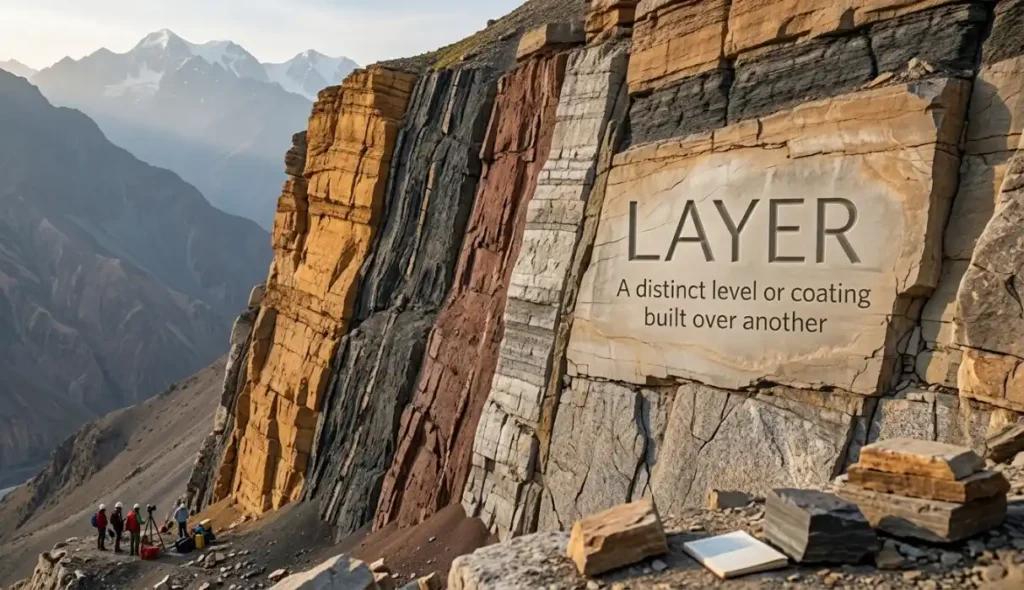
To describe structural levels or coatings with precision, top alternatives for layer include coat or coating (outer covering), sheet (broad thin expanse), and level (relative rank). In specialized contexts, use stratum for geological or social rock beds, tier for organized hierarchies, and substrate for underlying foundations.
A synonym for layer helps you describe physical coverings or abstract levels with greater precision. Think of slicing a birthday cake, where each section forms a distinct level, or wearing several layers of clothing during winter.
Learning synonyms for layer expands your everyday vocabulary and helps you avoid repeating the same words in your writing. Different alternatives can make your descriptions clearer, more natural, and more engaging for readers.
The word layer appears across many fields, including geology, cooking, clothing, technology, and digital design. It describes things that stack, overlap, surround, or create different levels within a structure.
Exploring a synonym for layer helps students, bloggers, and content writers express ideas with confidence. English learners can also improve their speaking and writing by choosing words that fit different contexts naturally.
What Does “Layer” Really Mean?
Layer refers to a single thickness, sheet, or level of material spread over a surface. It can also describe a level within a complex system or idea. Native speakers use it for both physical objects and abstract concepts.
You will encounter it in cooking, graphic design, geology, and fashion. The word suggests organization, depth, and structured accumulation.
Part of Speech: Noun / Verb
Definition: A single sheet, quantity, or thickness of material covering a surface or forming a level within a structure.
Connotative Meaning
(Connotation is the emotional tone or cultural association a word carries beyond its literal definition.)
- Positive tone: Imparts ideas of richness, protection, depth, and thoughtful organization.
- Negative tone: Can suggest concealment, heavy buildup, or overwhelming complexity.
- Neutral tone: Standard descriptive term used in science, construction, and daily speech.
Etymology
The term originates from the Middle English word leyer, derived from leyen (meaning “to lay”).
- Old English (450–1100): Rooted in lecgan, meaning to place down flat.
- Middle English (1100–1500): Evolved into leyer, referring to someone or something that lays items down.
- Modern English (1500–Present): Shifted to mean a distinct horizontal stratum, coating, or level.
Pronunciation
- US: /ˈleɪ.ɚ/
- UK: /ˈleɪ.ər/
Syllables
lay-er
Affixation Pattern
- Root: Lay
- Prefix: None
- Suffix: -er (noun-forming suffix)
Synonyms List
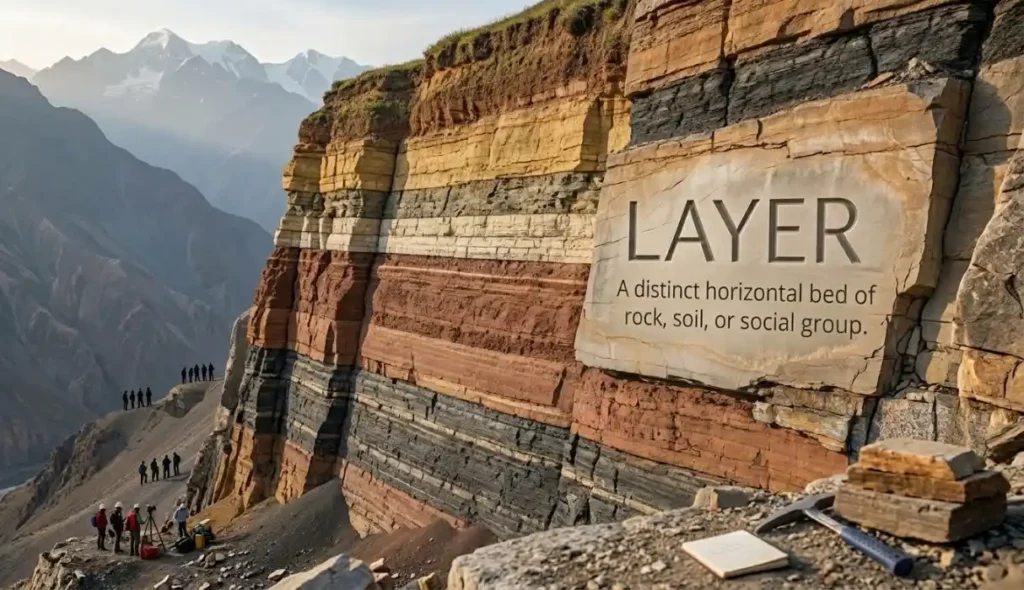
Stratum (Noun) — US: /ˈstræt̬.əm/ | UK: /ˈstrɑː.təm/
Meaning: A distinct horizontal bed or layer of rock, soil, or social group.
Tone/Register: Formal / Academic
Example 1: Geologists examined the ancient rock stratum for fossil remains.
Example 2: The policy target benefited a specific economic stratum of the population.
Tier (Noun) — US: /tɪr/ | UK: /tɪər/
Meaning: One of a series of rows or levels placed one above another.
Tone/Register: Professional / General
Example 1: We purchased tickets for the upper tier of the stadium.
Example 2: The company introduced a new pricing tier for small businesses.
Sheet (Noun) — US: /ʃiːt/ | UK: /ʃiːt/
Meaning: A broad, thin piece or expanse of any material.
Tone/Register: General / Everyday
Example 1: A thin sheet of ice covered the driveway this morning.
Example 2: Place a baking sheet on the middle oven rack.
Coat (Noun) — US: /koʊt/ | UK: /kəʊt/
Meaning: An outer layer of paint, finish, or protective material.
Tone/Register: General / Practical
Example 1: Apply a second coat of blue paint to the wall.
Example 2: The wooden desk received a clear coat of varnish.
Coating (Noun) — US: /ˈkoʊ.t̬ɪŋ/ | UK: /ˈkəʊ.tɪŋ/
Meaning: A thin layer covering a surface for protection or decoration.
Tone/Register: Technical / General
Example 1: The crisp fried chicken has a flavorful batter coating.
Example 2: Waterproof coating prevents rust on metal outdoor furniture.
Film (Noun) — US: /fɪlm/ | UK: /fɪlm/
Meaning: An extremely thin layer or skin covering a surface.
Tone/Register: Descriptive / Scientific
Example 1: A light film of dust settled over the old books.
Example 2: The oil spill left an oily film across the water.
Ply (Noun) — US: /plaɪ/ | UK: /plaɪ/
Meaning: A single layer or thickness of folded or laminated material.
Tone/Register: Industry / Commercial
Example 1: Choose two-ply tissues for better strength and softness.
Example 2: The builder used heavy four-ply plywood for the subfloor.
Level (Noun) — US: /ˈlev.əl/ | UK: /ˈlev.əl/
Meaning: A relative position or rank in a graded system or structure.
Tone/Register: General / Business
Example 1: Water reached a dangerous level during the heavy rain.
Example 2: She reached a senior management level after years of hard work.
Lamina (Noun) — US: /ˈlæm.ə.nə/ | UK: /ˈlæm.ɪ.nə/
Meaning: A thin plate, scale, or layer, especially in biological tissue or rock.
Tone/Register: Scientific / Medical
Example 1: The microscope revealed a delicate lamina of plant cells.
Example 2: Mineral deposits created a crystalline lamina inside the stone.
Blanket (Noun) — US: /ˈblæŋ.kɪt/ | UK: /ˈblæŋ.kɪt/
Meaning: A thick, continuous covering layer spread over an area.
Tone/Register: Descriptive / Literary
Example 1: A thick blanket of fresh snow covered the quiet village.
Example 2: Dense fog laid a heavy blanket across the morning bay.
Veneer (Noun) — US: /vəˈnɪr/ | UK: /vəˈnɪər/
Meaning: A thin decorative layer of fine wood or material facing a surface.
Tone/Register: Technical / Figurative
Example 1: The oak cabinet features a beautiful cherry wood veneer.
Example 2: He maintained a calm veneer despite feeling anxious inside.
Lamination (Noun) — US: /ˌlæm.əˈneɪ.ʃən/ | UK: /ˌlæm.ɪˈneɪ.ʃən/
Meaning: A structure formed by bonding thin layers of material together.
Tone/Register: Technical / Industrial
Example 1: The plastic lamination protects the ID card from water damage.
Example 2: Inspect the surfboard for signs of outer lamination peeling.
Skin (Noun) — US: /skɪn/ | UK: /skɪn/
Meaning: A thin outer layer or surface covering of an object.
Tone/Register: General / Engineering
Example 1: Technicians repaired the aluminum skin of the aircraft wing.
Example 2: A tough skin formed over the cooling hot chocolate.
Membrane (Noun) — US: /ˈmem.breɪn/ | UK: /ˈmem.breɪn/
Meaning: A thin, pliable layer of tissue or synthetic material acting as a boundary.
Tone/Register: Scientific / Medical
Example 1: Cell walls contain a protective semi-permeable membrane.
Example 2: Roofing crews installed a waterproof membrane under the shingles.
Shell (Noun) — US: /ʃel/ | UK: /ʃel/
Meaning: A hard, protective outer layer enclosing something inside.
Tone/Register: General / Natural
Example 1: The turtle retracted its head inside its hard outer shell.
Example 2: Workers completed the concrete shell of the new skyscraper.
Overlay (Noun) — US: /ˈoʊ.vɚ.leɪ/ | UK: /ˈəʊ.və.leɪ/
Meaning: Something laid on top of something else as a cover or decoration.
Tone/Register: Design / Digital
Example 1: The map app features a traffic overlay over street views.
Example 2: She added a lace overlay to her festive evening dress.
Cover (Noun) — US: /ˈkʌv.ɚ/ | UK: /ˈkʌv.ər/
Meaning: Something put on or over a thing to protect or hide it.
Tone/Register: General / Everyday
Example 1: Keep a protective cover over the outdoor barbecue grill.
Example 2: Dense trees provided natural cover from the hot afternoon sun.
Covering (Noun) — US: /ˈkʌv.ɚ.ɪŋ/ | UK: /ˈkʌv.ər.ɪŋ/
Meaning: A layer of material that coats or protects a surface.
Tone/Register: Neutral / Practical
Example 1: The floor covering cushioned noise in the busy apartment hallway.
Example 2: Snow created a brilliant white covering over the garden lawn.
Crust (Noun) — US: /krʌst/ | UK: /krʌst/
Meaning: A hard outer layer forming on the surface of something soft.
Tone/Register: General / Geology
Example 1: Earth’s crust contains many valuable minerals and rock formations.
Example 2: Bake the pie until the pastry crust turns golden brown.
Facade (Noun) — US: /fəˈsɑːd/ | UK: /fəˈsɑːd/
Meaning: The principal front layer of a building, or a deceptive outward appearance.
Tone/Register: Architecture / Figurative
Example 1: Restoration workers cleaned the historic brick facade of the museum.
Example 2: Her cheery demeanor was just a facade masking stress.
Plate (Noun) — US: /pleɪt/ | UK: /pleɪt/
Meaning: A flat, rigid layer or sheet forming part of a structure or armor.
Tone/Register: Technical / Geological
Example 1: Tectonic plate movements trigger earthquakes along fault lines.
Example 2: Armorers attached a steel plate to the chest guard.
Band (Noun) — US: /bænd/ | UK: /bænd/
Meaning: A strip or stripe of material or color forming a distinct layer.
Tone/Register: Descriptive / General
Example 1: A wide band of red clay ran through the exposed hillside.
Example 2: The sweater features a thick navy band around the waist.
Zone (Noun) — US: /zoʊn/ | UK: /zəʊn/
Meaning: A specific region or level distinguished by special characteristics.
Tone/Register: Academic / Geographic
Example 1: Divers explored the dark twilight zone of the deep ocean.
Example 2: The city designated the area as a residential construction zone.
Bed (Noun) — US: /bed/ | UK: /bed/
Meaning: A horizontal layer of rock, soil, or foundation material.
Tone/Register: Geology / Construction
Example 1: Workers laid a solid bed of gravel before pouring concrete.
Example 2: Fossils were preserved inside an ancient seabed formation.
Deposit (Noun) — US: /dɪˈpɑː.zɪt/ | UK: /dɪˈpɒz.ɪt/
Meaning: An accumulated layer of mineral, sediment, or substance.
Tone/Register: Technical / Scientific
Example 1: Heavy rain left a muddy deposit along the river bank.
Example 2: Dentists remove plaque deposits to keep teeth healthy.
Flake (Noun) — US: /fleɪk/ | UK: /fleɪk/
Meaning: A small, flat, thin piece or scale detached from a layer.
Tone/Register: Descriptive / Everyday
Example 1: A loose flake of paint peeled off the wooden door frame.
Example 2: Salt flake garnish added crunch to the grilled steak.
Scale (Noun) — US: /skeɪl/ | UK: /skeɪl/
Meaning: A small, thin, rigid plate forming an outer protective coating.
Tone/Register: Natural / Technical
Example 1: Each scale on the fish overlapped smoothly along its body.
Example 2: Hard mineral scale built up inside the old water pipe.
Sheet (Noun) — US: /ˈʃiː.t̬ɪŋ/ | UK: /ˈʃiː.tɪŋ/
Meaning: Material formed or applied in continuous wide sheets.
Tone/Register: Industrial / Construction
Example 1: Plastic sheeting shielded the renovated room from airborne dust.
Example 2: Roofers nailed ply sheeting across the rafters before tiling.
Wrapper (Noun) — US: /ˈræp.ɚ/ | UK: /ˈræp.ər/
Meaning: A protective outer layer wrapped around an item.
Tone/Register: Everyday / Commercial
Example 1: Toss the candy wrapper into the recycling container.
Example 2: The cigar features a smooth tobacco wrapper leaf.
Wrap (Noun) — US: /ræp/ | UK: /ræp/
Meaning: A flexible outer layer wrapped around an object.
Tone/Register: Everyday / Informal
Example 1: Secure the leftovers tightly with plastic wrap.
Example 2: The custom vinyl wrap gave the car a matte finish.

Facing (Noun) — US: /ˈfeɪ.sɪŋ/ | UK: /ˈfeɪ.sɪŋ/
Meaning: An outer layer of material applied to cover a building surface.
Tone/Register: Architecture / Tailoring
Example 1: Masons applied stone facing over the exterior concrete walls.
Example 2: The tailor pressed the coat collar facing flat with steam.
Lining (Noun) — US: /ˈlaɪ.nɪŋ/ | UK: /ˈlaɪ.nɪŋ/
Meaning: An inner layer of material covering an inside surface.
Tone/Register: General / Tailoring
Example 1: The winter jacket features a soft silk lining inside.
Example 2: Replace the worn brake lining to ensure safe stopping.
Substrate (Noun) — US: /ˈsʌb.streɪt/ | UK: /ˈsʌb.streɪt/
Meaning: An underlying layer or substance upon which another layer is applied.
Tone/Register: Scientific / Technical
Example 1: Prime the drywall substrate before applying decorative paint.
Example 2: Moss grew rapidly across the moist rock substrate.
Stratification (Noun) — US: /ˌstræt̬.ə.fəˈkeɪ.ʃən/ | UK: /ˌstræt.ɪ.fɪˈkeɪ.ʃən/
Meaning: The state or process of forming distinct structural layers.
Tone/Register: Academic / Scientific
Example 1: Thermal stratification occurs when lake water separates by temperature.
Example 2: The report analyzed social stratification in urban cities.
Overcoat (Noun) — US: /ˈoʊ.vɚ.koʊt/ | UK: /ˈəʊ.və.kəʊt/
Meaning: An added protective outer coat of paint, sealant, or garment.
Tone/Register: Practical / General
Example 1: Painters applied a protective clear overcoat to shield against rain.
Example 2: Wear a warm overcoat over your suit for a winter commute.
Undercoat (Noun) — US: /ˈʌn.dɚ.koʊt/ | UK: /ˈʌn.də.kəʊt/
Meaning: A layer of paint or primer applied beneath a top finishing coat.
Tone/Register: Practical / Industrial
Example 1: Apply a seal undercoat before spreading top enamel paint.
Example 2: The dog shed its thick woolly undercoat during spring.
Underlayer (Noun) — US: /ˈʌn.dɚˌleɪ.ɚ/ | UK: /ˈʌn.dəˌleɪ.ər/
Meaning: A layer positioned beneath another surface or garment.
Tone/Register: Descriptive / Practical
Example 1: Hikers wear a thermal underlayer to retain body heat in cold weather.
Example 2: A foam underlayer makes the carpet soft to walk on.
Topcoat (Noun) — US: /ˈtɑːp.koʊt/ | UK: /ˈtɒp.kəʊt/
Meaning: The final finishing layer of paint, polish, or sealant.
Tone/Register: Practical / Cosmetology
Example 1: Apply a glossy topcoat to protect your manicured nails.
Example 2: The automotive shop sprayed a clear topcoat over metallic paint.
Leveling (Noun) — US: /ˈlev.əl.ɪŋ/ | UK: /ˈlev.əl.ɪŋ/
Meaning: A layer used to smooth out or equalize an uneven surface.
Tone/Register: Construction / Technical
Example 1: Contractors poured a self-leveling compound across the concrete floor.
Example 2: Precision leveling prevents gaps beneath installed tile flooring.
Sheath (Noun) — US: /ʃiːθ/ | UK: /ʃiːθ/
Meaning: A close-fitting outer protective covering or envelope layer.
Tone/Register: Technical / Botanical
Example 1: Rubber sheath insulation covers electric copper wiring.
Example 2: A protective leaf sheath encloses young bamboo shoots.
Envelope (Noun) — US: /ˈen.və.loʊp/ | UK: /ˈen.və.ləʊp/
Meaning: An outer layer or membrane enclosing a structure or building.
Tone/Register: Architecture / Biology
Example 1: The building envelope keeps heat inside during icy winters.
Example 2: The viral envelope shields genetic material from external immune responses.
Stratum-corneum (Noun) — US: /ˈstræt̬.əm kɔːrˈni.əm/ | UK: /ˈstrɑː.təm kɔːˈni.əm/
Meaning: The outermost dead skin layer acting as a barrier.
Tone/Register: Medical / Dermatological
Example 1: Moisturizers hydrate the stratum corneum to reduce skin flaking.
Example 2: Exfoliating removes dull cells from the stratum-corneum surface.
Sub-layer (Noun) — US: /ˈsʌbˌleɪ.ɚ/ | UK: /ˈsʌbˌleɪ.ər/
Meaning: A secondary layer nested within a broader structural layer.
Tone/Register: Technical / Digital
Example 1: Designers edited text inside a sub-layer of the image graphic file.
Example 2: Soil analysis revealed a dense clay sub-layer below topsoil.
Interface (Noun) — US: /ˈɪn.t̬ɚ.feɪs/ | UK: /ˈɪn.tə.feɪs/
Meaning: A surface layer forming a common boundary between two spaces or phases.
Tone/Register: Technical / Scientific
Example 1: Chemical reactions happen at the fluid interface between oil and water.
Example 2: The touch interface responds instantly to finger taps.
Floor (Noun) — US: /flɔːr/ | UK: /flɔː/
Meaning: A horizontal surface layer or story within a multi-level building.
Tone/Register: Everyday / General
Example 1: Our new office sits on the fifth floor of the building.
Example 2: The ocean floor contains vast unexplored volcanic mountain chains.
Tiering (Noun) — US: /ˈtɪr.ɪŋ/ | UK: /ˈtɪər.ɪŋ/
Meaning: An arrangement of items into organized levels or systematic ranks.
Tone/Register: Business / Academic
Example 1: Data tiering moves older files to low-cost cloud storage.
Example 2: Educational tiering groups students based on reading progress.
Seam (Noun) — US: /siːm/ | UK: /siːm/
Meaning: A thin layer or stratum of mineral embedded in surrounding rock.
Tone/Register: Mining / Geology
Example 1: Miners discovered a thick seam of coal underground.
Example 2: A seam of quartz ran through the granite rock face.
Film-strip (Noun) — US: /ˈfɪlm.strɪp/ | UK: /ˈfɪlm.strɪp/
Meaning: A thin sequence layer of images processed on photographic film.
Tone/Register: Media / Photography
Example 1: Archival teams restored the fragile vintage film-strip carefully.
Example 2: The projection booth unreeled the long film strip onto light lenses.
Screen (Noun) — US: /skriːn/ | UK: /skriːn/
Meaning: A flat surface layer or partition used for shielding or projection.
Tone/Register: General / Digital
Example 1: A mesh screen kept flying insects out of the window frame.
Example 2: The phone display screen uses durable scratch-resistant glass.
Skin-coat (Noun) — US: /skɪn-koʊt/ | UK: /skɪn-kəʊt/
Meaning: A very thin finishing layer of plaster applied to a wall.
Tone/Register: Construction / Practical
Example 1: Plasterers applied a smooth skin-coat over damaged drywall.
Example 2: Allow the skin-coat layer to dry completely before sanding.
Overlayment (Noun) — US: /ˈoʊ.vɚ.leɪ.mənt/ | UK: /ˈəʊ.və.leɪ.mənt/
Meaning: A specialty compound layer applied to resurface worn floors.
Tone/Register: Construction / Industrial
Example 1: Workers spread a concrete overlayment over the cracked driveway.
Example 2: Decorative overlayment refreshed the tired patio surface.
Ply-layer (Noun) — US: /plaɪ-ˈleɪ.ɚ/ | UK: /plaɪ-ˈleɪ.ər/
Meaning: A single laminate thickness within composite structural materials.
Tone/Register: Manufacturing / Industrial
Example 1: Carbon fiber ply-layer sheets increase airplane wing durability.
Example 2: Check each ply-layer for defects before bonding boards.
Level-set (Noun) — US: /ˈlev.əl.set/ | UK: /ˈlev.əl.set/
Meaning: An established baseline layer or benchmark across an organization.
Tone/Register: Corporate / Business
Example 1: The kickoff meeting served as a level-set for project targets.
Example 2: Team leaders conducted a level-set on compliance expectations.
Coating-film (Noun) — US: /ˈkoʊ.t̬ɪŋ-fɪlm/ | UK: /ˈkəʊ.tɪŋ-fɪlm/
Meaning: A cured thin protective layer formed by liquid paint or sealants.
Tone/Register: Technical / Manufacturing
Example 1: The clear coating-film protects car paint against UV rays.
Example 2: Measure coating-film thickness using an electronic gauge.
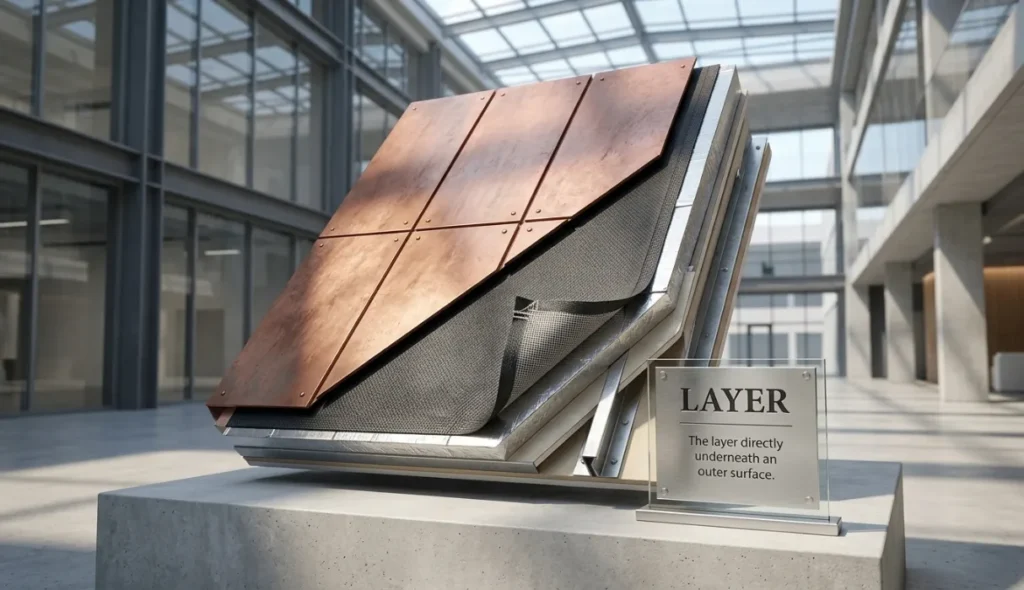
Sub-surface (Noun) — US: /ˈsʌbˌsɝː.fɪs/ | UK: /ˈsʌbˌsɜː.fɪs/
Meaning: The layer positioned directly underneath an outer surface.
Tone/Register: Geological / Scientific
Example 1: Ground radar detected water pipes in the sub-surface soil.
Example 2: Scratches damaged the car’s clear coat without penetrating the sub-surface.
Synonyms by Tone
Positive Tone
- Veneer
- Lining
- Blanket
- Overcoat
Neutral Tone
- Stratum
- Tier
- Sheet
- Coat
- Coating
- Level
- Substrate
- Deposit
Negative Tone
- Facade
- Film
- Deposit
- Scale
Playful / Informal Tone
- Wrap
- Wrapper
- Shell
Mini Comparison: “Layer” vs Close Alternatives
| Term | Core Meaning | Tone | Best Context To Use |
| Layer | General term for any thickness covering a surface or level. | Neutral / General | Everyday items, clothing, cake, geology, digital design. |
| Stratum | A formal horizontal layer of rock, soil, or social class. | Academic / Formal | Geology, sociology, historical research reports. |
| Tier | A structured rank or level arranged in a hierarchy. | Professional / Business | Pricing plans, stadium seating, organizational structures. |
Context-Based Usage
Daily Conversation
When speaking casually, choose accessible everyday words like coat, wrap, sheet, or cover.
Example: “Put on a thick coat before stepping outside in the cold.”
Writing or Blogging
Content writers often need descriptive words to create clear mental imagery. Great options include blanket, veneer, or tier.
Example: “A heavy blanket of fog settled over the quiet harbor.”
Professional or Academic Tone
In formal business, technical, or scientific writing, select structured terms like stratum, substrate, tier, or lamina.
Example: “Researchers analyzed soil samples from the lowest stratum.”
Creative or Informal Use
Storytellers and creative writers rely on evocative language. Useful terms include facade, film, or crust.
Example: “Her cheerful smile was merely a thin facade hiding her worry.”
Common Mistakes & Native Usage
Misuse Scenarios
- Using “Stratum” for Simple Everyday Items: Avoid calling a coat of paint a “stratum.” Save stratum for geological rock beds or social classes.
- Confusing “Tier” with “Layer”: Use tier when describing ranked or hierarchical structures like pricing plans or stadium rows. Use layer for physical thicknesses.
Register Notes
- Formal Written English: Use terms like stratum, substrate, lamina, and stratification.
- Spoken Informal English: Use clear options like coat, sheet, wrapper, or wrap.
Enhance your overall writing precision with our guides on master vocabulary building.
Real-Life Mini Scenarios
Workplace Scenario
A graphic designer works on a client logo in editing software. She organizes the typography on a separate digital tier to adjust colors without altering background graphics.
Social Situations
During a winter ski trip, friends pack warm clothing. Everyone wears a thermal underlayer beneath waterproof jackets to stay dry and comfortable.
Media & Pop Culture
A documentary explores Earth’s geological history. The host highlights how rock stratum formations reveal ancient climate shifts over millions of years.
Writing & Storytelling
A novelist writes a mystery scene set in an abandoned house. She describes a thick film of dust covering old furniture to highlight decades of neglect.
Conclusion
Expanding your vocabulary provides tools for clearer self-expression. Choosing the right synonym for layer allows you to convey physical depth and abstract structure accurately.
Mastering synonyms for layer and subtle word differences improves your confidence across all communication styles. Whether writing essays, professional emails, or creative stories, precise vocabulary makes your work compelling.
Start using these new terms in your daily writing and conversation today. Consistent practice transforms fresh vocabulary into a permanent skill for clear expression.
Practice Exercise
1. Which synonym best describes a rock bed analyzed by geologists?
A) Wrapper
B) Stratum
C) Facade
D) Undercoat
2. Which word fits best when describing a business pricing structure?
A) Scale
B) Tier
C) Film
D) Flake
3. What term is used for an inner fabric layer of a winter jacket?
A) Facade
B) Lining
C) Substrate
D) Crust
4. Which informal word describes protective plastic placed over food?
A) Lamina
B) Wrap
C) Stratum
D) Bed
5. What is the root word of “layer”?
A) Lay
B) Er
C) Leyer
D) Layering
6. Which term fits best in a painter’s recommendation for wood prep?
A) Undercoat
B) Facade
C) Tier
D) Band
7. A fake, deceptive outer appearance is best described as a:
A) Substrate
B) Facade
C) Sheet
D) Deposit
8. Which word carries a mostly formal academic tone?
A) Wrapper
B) Stratification
C) Wrap
D) Shell
9. Which term describes a broad, thin piece of paper or ice?
A) Sheet
B) Tier
C) Substrate
D) Scale
10. The protective outer surface of skin is biologically known as the:
A) Sub-layer
B) Stratum-corneum
C) Overlayment
D) Skin-coat
Answer Key:
1: B | 2: B | 3: B | 4: B | 5: A | 6: A | 7: B | 8: B | 9: A | 10: B
Application Task:
Write one original sentence about baking or cooking using the synonym coating or crust.
FAQs
1. What is the most common synonym for layer in daily speech?
The most popular everyday synonyms for layer are coat, sheet, and cover. People frequently use these words to describe paint, clothing, food, and protective coverings.
2. What is the difference between a tier and a layer?
A layer refers to physical thickness or a covering placed over a surface. A tier refers to structured, ranked, or elevated arrangements, such as stadium seating rows or subscription levels.
3. Which synonym for layer works best in academic writing?
In scientific or formal writing, choose terms like stratum, substrate, lamina, or stratification. These words convey technical precision when describing physical or social systems.
4. Is the word “facade” a negative synonym for layer?
Yes, facade often carries a negative or deceptive connotation. While it literally means a building’s front, it frequently describes a fake outward appearance hiding true feelings.
5. How does choosing precise synonyms improve your writing?
Using specific alternatives prevents repetition and paints clearer mental pictures. Selecting words like blanket for fog or coating for paint gives your writing descriptive power.

Jameel Hassan is the founder and lead writer at SynonymsCloud.com, a trusted online platform dedicated to English vocabulary and effective communication. He is passionate about helping students, writers, professionals, and lifelong learners discover the right words to express their ideas with clarity, precision, and confidence.
At SynonymsCloud.com, every article is thoroughly researched and carefully written to provide accurate, practical, and easy-to-understand guidance on synonyms, antonyms, word meanings, idioms, and vocabulary. With a strong commitment to quality, real-world usage, and clear explanations, the website helps readers expand their vocabulary, improve their writing, and communicate more effectively in both academic and professional settings.