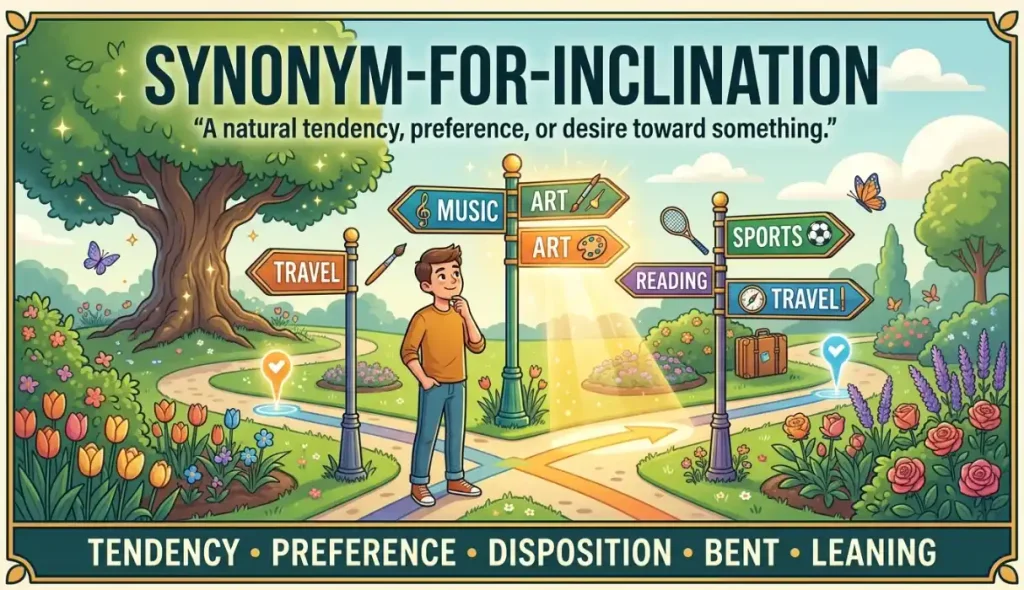
The best synonyms for inclination are tendency, propensity, penchant, predilection, and proclivity. Use tendency for general behavioral patterns, penchant for a refined personal liking, and propensity when describing a natural, habitual leaning toward specific actions or outcomes.
Synonym for inclination is a top search term when you need to describe a natural tendency or preference without repeating phrases across your text. Imagine drafting a personal growth essay about creative hobbies and reusing the same word in every paragraph. Finding alternative expressions keeps your narrative varied, fluid, and engaging for readers.
Writers look for a synonym for inclination to add descriptive nuance and precise psychological context to professional essays, self-improvement guides, and lifestyle blogs. Expanding your vocabulary helps you express innate leanings or personal tendencies with absolute clarity.
Students, bloggers, content writers, and daily English users find this vocabulary study very useful. Precise word choices prevent text from feeling repetitive. Using a synonym for inclination ensures your professional articles truly stand out.
Developing a diverse vocabulary transforms your writing style completely. When you master alternative words for preference and tendency, your professional reports and personal career stories become far more persuasive and engaging.
Core Meaning: What Does “Inclination” Really Mean?
Inclination is a noun that means a natural tendency, propensity, or urge to act or feel in a particular way. It denotes a person’s habitual disposition or a gentle slope in physical structures.
Connotative Meaning
- Positive tone: Represents natural talent, creative passion, intellectual curiosity, and healthy preference.
- Negative tone: Implies stubborn bias, unreasoned prejudice, or unfavorable predisposition.
- Neutral tone: Used when objectively analyzing statistical tendencies, behavioral patterns, or physical angles.
Etymology
- Source Language: Derived from Latin inclinatio, stemming from inclinare (to bend or lean toward).
- Old English (450–1100): Early Germanic terms expressed physical bending and leaning before Latinate mental concepts entered speech.
- Middle English (1100–1500): Adopted through Old French to describe both physical slopes and moral leanings of the human soul.
- Modern English (1500–Present): Standardized into the common noun inclination for psychological, behavioral, and general descriptive writing.
Pronunciation & Syllables
- US: /ˌɪn.klɪˈneɪ.ʃən/
- UK: /ˌɪn.klɪˈneɪ.ʃən/
- Syllables: in-cli-na-tion (4 syllables)
- Affixation Pattern: Prefix + Root + Suffix
- Root: clinare (to bend/lean)
- Prefix: in- (toward)
- Suffix: -ation (noun-forming suffix)
Synonyms List
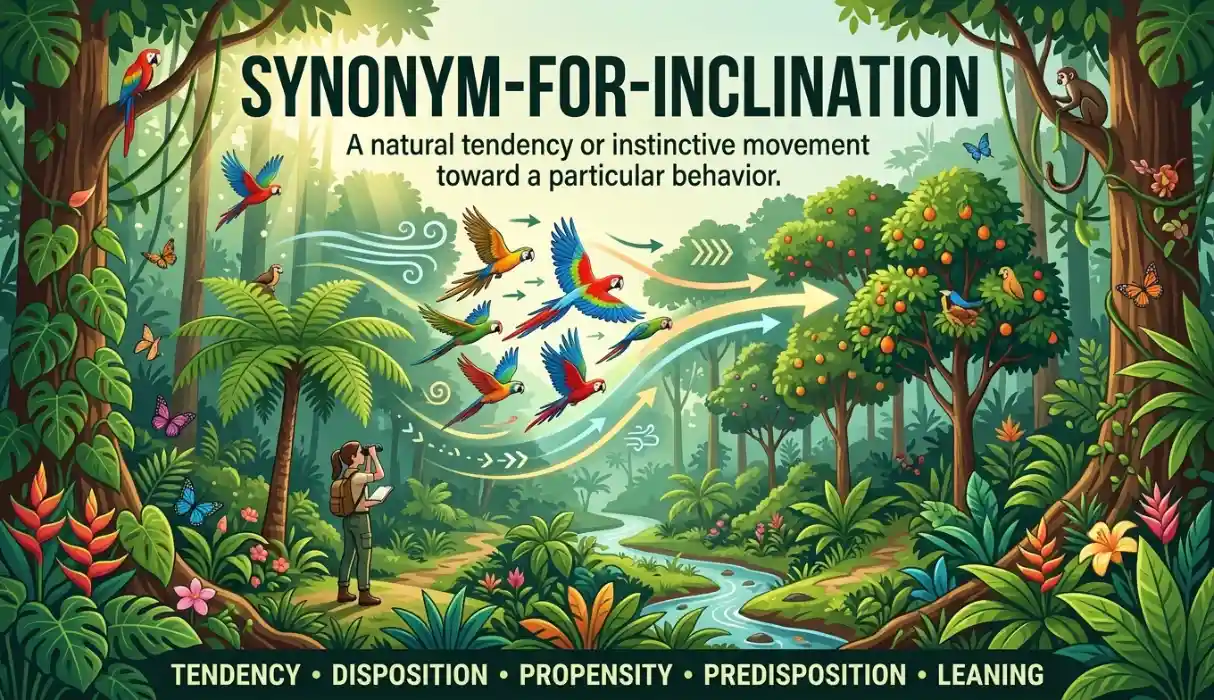
Tendency (Noun) — US: /ˈtɛn.dən.si/ | UK: /ˈtɛn.dən.si/
- Meaning: An inherent inclination or natural movement toward a particular type of behavior.
- Tone/Register: Standard / Professional
- Example: He showed a tendency to arrive early for meetings.
- Example: Market prices had a tendency to rise in spring.
Propensity (Noun) — US: /prəˈpɛn.ə.ti/ | UK: /prəˈpɛn.ɪ.ti/
- Meaning: An often natural inclination or habitual preference for something.
- Tone/Register: Formal / Academic
- Example: She demonstrated a propensity for solving complex math puzzles.
- Example: The company had a propensity for launching innovative tech.
Proclivity (Noun) — US: /prəˈklɪv.ə.ti/ | UK: /prəˈklɪv.ɪ.ti/
- Meaning: A tendency to choose or do something regularly; an inclination.
- Tone/Register: Formal / Literary
- Example: The artist shared a proclivity for vibrant oil colors.
- Example: Historians noted his proclivity for detailed archival research.
Penchant (Noun) — US: /ˈpɑːn.tʃənt/ | UK: /ˈpɑ̃ː.ʃɒ̃/
- Meaning: A strong or habitual liking for something or tendency to do something.
- Tone/Register: Elegant / Professional
- Example: The chef had a penchant for spicy Mediterranean dishes.
- Example: She maintained a penchant for reading classic poetry.
Predilection (Noun) — US: /ˌprɛd.əlˈɛk.shən/ | UK: /ˌpriː.dɪˈlɛk.ʃən/
- Meaning: A preference or special liking for something; a bias in favor of.
- Tone/Register: Formal / Academic
- Example: His predilection for modern architecture shaped office designs.
- Example: Scholars showed a predilection for historical fiction.
Bias (Noun) — US: /ˈbaɪ.əs/ | UK: /ˈbʌɪ.əs/
- Meaning: Prejudice in favor of or against one thing, person, or group.
- Tone/Register: Standard / Critical
- Example: Editors worked hard to remove personal bias from news articles.
- Example: Testing software helped eliminate unconscious hiring bias.
Predisposition (Noun) — US: /ˌpriː.dɪs.pəˈzɪʃ.ən/ | UK: /ˌpriː.dɪs.pəˈzɪʃ.ən/
- Meaning: A liability or tendency to suffer from a particular condition or hold a view.
- Tone/Register: Medical / Formal
- Example: Genetic factors created a predisposition toward heart conditions.
- Example: Cultural background created a predisposition toward teamwork.
Leaning (Noun) — US: /ˈliː.nɪŋ/ | UK: /ˈliː.nɪŋ/
- Meaning: A tendency or partiality towards a particular belief or activity.
- Tone/Register: Standard / Common
- Example: Political leanings varied across different voter demographics.
- Example: Her artistic leanings led her to study graphic design.
Disposition (Noun) — US: /ˌdɪs.pəˈzɪʃ.ən/ | UK: /ˌdɪs.pəˈzɪʃ.ən/
- Meaning: A person’s inherent qualities of mind and character; natural outlook.
- Tone/Register: Formal / Psychological
- Example: The friendly puppy had a cheerful and playful disposition.
- Example: His calm disposition helped resolve team disputes quickly.
Affinity (Noun) — US: /əˈfɪn.ə.ti/ | UK: /əˈfɪn.ɪ.ti/
- Meaning: A spontaneous or natural liking or sympathy for someone or something.
- Tone/Register: Professional / Standard
- Example: Software engineers shared an affinity for open-source code.
- Example: She felt an immediate affinity for mountain hiking trails.
Partiality (Noun) — US: /ˌpɑːr.ʃiˈæl.ə.ti/ | UK: /ˌpɑː.ʃiˈal.ɪ.ti/
- Meaning: A particular liking or fondness for something; bias.
- Tone/Register: Formal / Academic
- Example: The judge denied showing any partiality toward local firms.
- Example: His partiality for sweet desserts was well known.
Fancy (Noun) — US: /ˈfæn.si/ | UK: /ˈfan.si/
- Meaning: A short-lived desire or inclination; a liking.
- Tone/Register: Informal / Literary
- Example: Buying the expensive watch was just a passing fancy.
- Example: She indulged her fancy for traditional watercolor painting.
Whim (Noun) — US: /wɪm/ | UK: /wɪm/
- Meaning: A sudden desire or change of mind, especially one that is unusual or unexplained.
- Tone/Register: Casual / Conversational
- Example: They booked weekend trips on a sudden travel whim.
- Example: Management refused to alter schedules on a whim.
Impulse (Noun) — US: /ˈɪm.pʌls/ | UK: /ˈɪm.pʌls/
- Meaning: A sudden strong and unreflective urge to act.
- Tone/Register: Psychological / Standard
- Example: Resisting the impulse to buy snacks required focus.
- Example: He acted on an impulse to help strangers.
Urge (Noun) — US: /ɜːrdʒ/ | UK: /əːdʒ/
- Meaning: A strong desire or impulse.
- Tone/Register: Common / Standard
- Example: Writers felt a strong urge to finish chapter drafts.
- Example: She fought the urge to check phone messages during dinner.
Desire (Noun) — US: /dɪˈzaɪər/ | UK: /dɪˈzʌɪə/
- Meaning: A strong feeling of wanting to have something or wishing for something to happen.
- Tone/Register: Standard / Emotional
- Example: Their primary desire was to expand community outreach programs.
- Example: He harbored a deep desire to learn piano.
Wish (Noun) — US: /wɪʃ/ | UK: /wɪʃ/
- Meaning: A desire or hope for something to happen.
- Tone/Register: Common / Friendly
- Example: Birthday guests made a quiet wish before blowing out the candles.
- Example: Fulfilling client wishes remained a top corporate priority.
Longing (Noun) — US: /ˈlɔːŋ.ɡɪŋ/ | UK: /ˈlɒŋ.ɡɪŋ/
- Meaning: A yearning desire, often accompanied by sadness.
- Tone/Register: Literary / Emotional
- Example: She felt a deep longing for quiet country life.
- Example: Travel restrictions created a longing for overseas adventures.
Yearning (Noun) — US: /ˈjɜːr.nɪŋ/ | UK: /ˈjəː.nɪŋ/
- Meaning: A feeling of intense longing for something.
- Tone/Register: Literary / Expressive
- Example: Poets expressed a yearning for lost childhood summers.
- Example: His artistic yearning inspired new canvas paintings.
Craving (Noun) — US: /ˈkreɪ.vɪŋ/ | UK: /ˈkreɪ.vɪŋ/
- Meaning: A powerful desire for something, typically food.
- Tone/Register: Common / Conversational
- Example: Afternoon work breaks triggered cravings for dark chocolate.
- Example: She satisfied her craving for spicy Thai noodles.
Appetite (Noun) — US: /ˈæp.ə.taɪt/ | UK: /ˈap.ə.tʌɪt/
- Meaning: A natural desire or longing for something, especially food or knowledge.
- Tone/Register: Standard / Common
- Example: Reading books built an insatiable appetite for history.
- Example: Hard workouts stimulated a healthy physical appetite.
Stomach (Noun – used figuratively) — US: /ˈstʌm.ək/ | UK: /ˈstʌm.ək/
- Meaning: The ability to endure or face something unpleasant; inclination or tolerance.
- Tone/Register: Idiomatic / Standard
- Example: Investors lacked the stomach for high-risk stock markets.
- Example: He had little stomach for corporate political debates.
Gusto (Noun) — US: /ˈɡʌs.toʊ/ | UK: /ˈɡʌs.təʊ/
- Meaning: Enjoyment and vigor in doing something.
- Tone/Register: Enthusiastic / Expressive
- Example: Volunteers tackled community cleanups with great gusto.
- Example: She sang folk songs with impressive musical gusto.
Relish (Noun) — US: /ˈrɛl.ɪʃ/ | UK: /ˈrɛl.ɪʃ/
- Meaning: Great enjoyment or zest; a marked inclination to enjoy.
- Tone/Register: Literary / Standard
- Example: He debated historical philosophies with intellectual relish.
- Example: The detective investigated clues with professional relish.
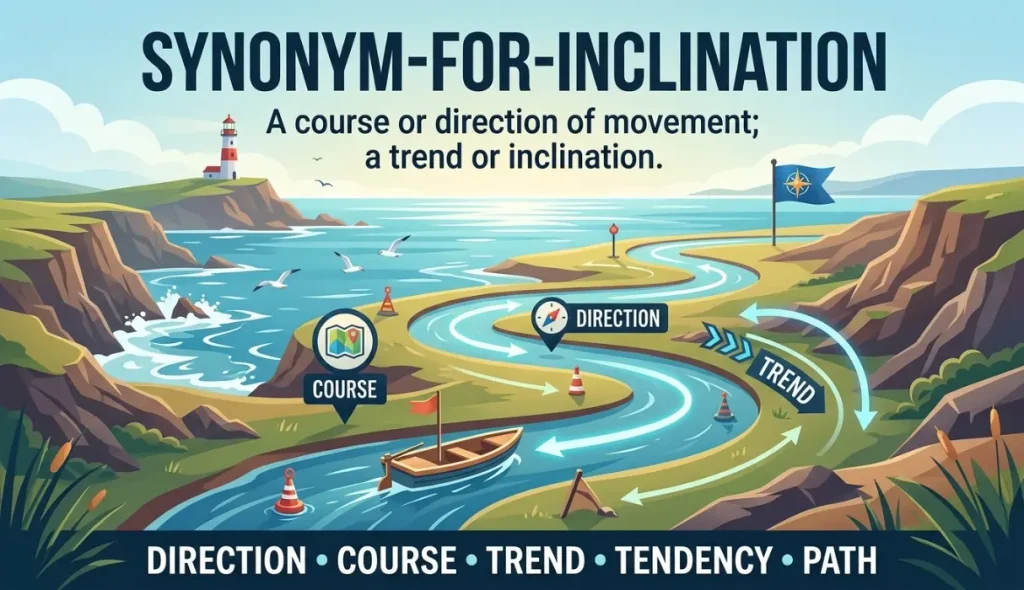
Direction (Noun) — US: /dɪˈrɛk.ʃən/ | UK: /dɪˈrɛk.ʃən/
- Meaning: A course along which someone or something moves; trend or inclination.
- Tone/Register: Professional / Standard
- Example: Company leadership decided on a new digital marketing direction.
- Example: Creative directions shifted following audience feedback.
Orientation (Noun) — US: /ˌɔːr.i.ənˈteɪ.ʃən/ | UK: /ˌɔː.ri.ənˈteɪ.ʃən/
- Meaning: The relative physical or mental position or inclination of something.
- Tone/Register: Formal / Technical
- Example: New employee orientation sessions took place on Mondays.
- Example: Solar panels featured an adjustable tilt orientation.
Drift (Noun) — US: /drɪft/ | UK: /drɪft/
- Meaning: A gradual movement, change, or general direction of meaning.
- Tone/Register: Conversational / Standard
- Example: Listeners caught the general drift of his economic speech.
- Example: Snow drifts blocked rural mountain highway roads.
Trend (Noun) — US: /trɛnd/ | UK: /trɛnd/
- Meaning: A general direction in which something is developing or changing.
- Tone/Register: Business / Standard
- Example: Digital marketing trends favored short-form video content.
- Example: Economic trends pointed toward sustainable energy investments.
Current (Noun) — US: /ˈkɜːr.ənt/ | UK: /ˈkəː.rənt/
- Meaning: A body of water or air moving in a definite direction; underlying trend.
- Tone/Register: Literary / Technical
- Example: Swimmers fought against strong ocean rip currents.
- Example: Cultural currents favored minimalist interior design.
Tide (Noun) — US: /taɪd/ | UK: /tʌɪd/
- Meaning: A pattern or tendency characterized by alternating movement.
- Tone/Register: Literary / Expressive
- Example: Political tides shifted during national election cycles.
- Example: High tides flooded coastal fishing docks.
Set (Noun – psychological) — US: /sɛt/ | UK: /sɛt/
- Meaning: A mental attitude or disposition that predetermines responses.
- Tone/Register: Psychological / Technical
- Example: Psychologists studied cognitive set patterns in decision-making.
- Example: The team approached challenges with a positive problem-solving set.
Momentum (Noun) — US: /moʊˈmɛn.təm/ | UK: /məʊˈmɛn.təm/
- Meaning: The impetus gained by a moving object or developing trend.
- Tone/Register: Business / Sports
- Example: The clean energy startup gained market sales momentum.
- Example: Cyclists built speed momentum down steep hills.
Vector (Noun) — US: /ˈvɛk.tɚ/ | UK: /ˈvɛk.tə/
- Meaning: A quantity having direction and magnitude; path or inclination.
- Tone/Register: Technical / Scientific
- Example: Engineers calculated wind vector paths for flight testing.
- Example: Growth strategies shifted toward a mobile-first vector.
Bearing (Noun) — US: /ˈbɛr.ɪŋ/ | UK: /ˈbɛə.rɪŋ/
- Meaning: A person’s way of standing or behaving; direction or orientation.
- Tone/Register: Formal / Descriptive
- Example: Her professional bearing commanded respect in boardrooms.
- Example: Sailors checked compass bearings during heavy fog.
Habit (Noun) — US: /ˈhæb.ɪt/ | UK: /ˈhab.ɪt/
- Meaning: A settled or regular tendency or practice, hard to give up.
- Tone/Register: Standard / Common
- Example: Early morning running became a daily health habit.
- Example: Checking emails before sleep proved a hard habit to break.
Routine (Noun) — US: /ruːˈtiːn/ | UK: /ruːˈtiːn/
- Meaning: A sequence of actions regularly followed.
- Tone/Register: Standard / Common
- Example: Office workers maintained a structured morning coffee routine.
- Example: Gymnasts practiced complex floor exercise routines.
Custom (Noun) — US: /ˈkʌs.təm/ | UK: /ˈkʌs.təm/
- Meaning: A traditional and widely accepted way of behaving or doing something.
- Tone/Register: Cultural / Formal
- Example: Village elders maintained seasonal harvest celebration customs.
- Example: Exchanging small gifts was a local wedding custom.
Practice (Noun) — US: /ˈpræk.tɪs/ | UK: /ˈpræk.tɪs/
- Meaning: The actual application or use of an idea, belief, or method.
- Tone/Register: Professional / Standard
- Example: Sustainable farming practices protected local river water.
- Example: Lawyers followed standard corporate governance practices.
Convention (Noun) — US: /kənˈvɛn.ʃən/ | UK: /kənˈvɛn.ʃən/
- Meaning: A way in which something is usually done, especially within a society.
- Tone/Register: Formal / Academic
- Example: Literary conventions required specific chapter structuring rules.
- Example: Business etiquette followed strict handshake conventions.
Tradition (Noun) — US: /trəˈdɪʃ.ən/ | UK: /trəˈdɪʃ.ən/
- Meaning: The transmission of customs or beliefs from generation to generation.
- Tone/Register: Cultural / Standard
- Example: Family reunions remained a cherished summer holiday tradition.
- Example: University graduation ceremonies honored ancient academic traditions.
Rule (Noun) — US: /ruːl/ | UK: /ruːl/
- Meaning: One of a set of explicit or understood regulations governing conduct.
- Tone/Register: Standard / Legal
- Example: Library rules required quiet study across all floors.
- Example: Traffic rules prevented highway collisions.
Norm (Noun) — US: /nɔːrm/ | UK: /nɔːm/
- Meaning: Something that is usual, typical, or a standard.
- Tone/Register: Academic / Sociological
- Example: Remote working became the post-pandemic corporate norm.
- Example: Environmental standards established a new manufacturing norm.
Pattern (Noun) — US: /ˈpæt.ɚn/ | UK: /ˈpat.ən/
- Meaning: A repeated decorative design or consistent behavioral trend.
- Tone/Register: Standard / Technical
- Example: Meteorologists tracked recurring seasonal storm weather patterns.
- Example: Consumer purchasing patterns shifted toward online stores.
Susceptibility (Noun) — US: /səˌsɛp.təˈbɪl.ə.ti/ | UK: /səˌsɛp.təˈbɪl.ɪ.ti/
- Meaning: The state or fact of being likely or liable to be influenced.
- Tone/Register: Medical / Technical
- Example: Cold weather increased susceptibility to winter flu viruses.
- Example: Older building materials showed structural susceptibility to rust.
Vulnerability (Noun) — US: /ˌvʌl.nɚ.əˈbɪl.ə.ti/ | UK: /ˌvʌl.nər.əˈbɪl.ɪ.ti/
- Meaning: The quality or state of being exposed to the possibility of being attacked.
- Tone/Register: Technical / Professional
- Example: Cybersecurity audits uncovered software system vulnerabilities.
- Example: Coastal towns faced severe vulnerability during storm surges.
Proneness (Noun) — US: /ˈproʊ.nəs/ | UK: /ˈprəʊ.nəs/
- Meaning: The likelihood of suffering from or experiencing something.
- Tone/Register: Formal / Medical
- Example: Fatigue increased driver proneness to highway errors.
- Example: Dry timber showed high proneness to summer fires.
Aptitude (Noun) — US: /ˈæp.tɪ.tuːd/ | UK: /ˈap.tɪ.tjuːd/
- Meaning: A natural ability to do something; inclination or talent.
- Tone/Register: Academic / Professional
- Example: High school tests measured student aptitude for science.
- Example: She demonstrated a natural aptitude for foreign languages.
Talent (Noun) — US: /ˈtæl.ənt/ | UK: /ˈtal.ənt/
- Meaning: Natural aptitude or skill.
- Tone/Register: Common / Standard
- Example: The young musician showed extraordinary piano talent.
- Example: Companies actively recruited creative design talent.
Genius (Noun) — US: /ˈdʒiː.njəs/ | UK: /ˈdʒiː.njəs/
- Meaning: Exceptional intellectual or creative power or natural ability.
- Tone/Register: Expressive / Formal
- Example: Historical scientists possessed a rare mathematical genius.
- Example: The sculpture displayed brilliant artistic genius.
Gift (Noun) — US: /ɡɪft/ | UK: /ɡɪft/
- Meaning: A natural ability or talent; an endowment.
- Tone/Register: Expressive / Common
- Example: She possessed a natural gift for public speaking.
- Example: Writing stories was a special childhood gift.
Synonyms by Tone
- Positive / Academic: Aptitude, Talent, Penchant, Affinity, Propensity.
- Neutral / Standard: Tendency, Inclination, Trend, Orientation, Direction.
- Negative / Critical: Bias, Partiality, Susceptibility, Vulnerability.
Mini Comparison
Inclination vs. Tendency vs. Penchant
- Inclination: Focuses on an inner mental leaning, preference, or gentle pull toward a choice or action.
- Tendency: Describes a repeated behavioral pattern or statistical likelihood of acting in a certain way.
- Penchant: Highlights a strong, refined personal liking or habitual preference for a specific activity.
Natural Inclination Synonyms, Antonyms, and Examples
What Is Another Word for Natural Inclination?
A natural inclination is an instinctive tendency, preference, or interest in a particular activity, behavior, or idea. Common synonyms include natural tendency, innate preference, predisposition, propensity, aptitude, and penchant. Each word has a slightly different meaning depending on the context.
For example, aptitude describes a natural ability, while penchant refers to a strong personal liking. Similarly, predisposition suggests an existing tendency to develop a particular behavior or condition.
Examples:
- She had a natural inclination toward creative writing.
- His natural aptitude for mathematics helped him excel in school.
- The child showed an innate preference for solving puzzles.
- Her propensity for helping others made her a trusted friend.
What Is a Synonym for Inclining?
Inclining is the present participle of incline. It can describe physically leaning in a particular direction or becoming more willing to accept an idea, make a choice, or take action.
Depending on the context, synonyms for inclining include leaning, tilting, sloping, tending, favoring, and being disposed toward.
Examples:
- The tree was leaning toward the sunlight.
- The committee was leaning toward approving the proposal.
- She was inclined to accept the job offer.
- The manager appeared favorably disposed toward the new strategy.
Remember that inclining and inclination have different grammatical functions. Use inclining to describe an ongoing action or process, and inclination when referring to a tendency, preference, or disposition.
What Does “Inclined to a Specific Attitude, Action, or Condition” Mean?
Being inclined toward a specific attitude, action, or condition means having a tendency, willingness, or preference to think, feel, or behave in a particular way. It can describe someone’s natural personality, developing opinion, or likelihood of taking action.
Depending on the sentence, suitable alternatives include disposed toward, prone to, likely to, naturally drawn to, and having a tendency to.
Examples:
- She is inclined to help people who need support.
- He is naturally inclined toward careful decision-making.
- The manager was inclined to agree with the team’s recommendation.
- Some people are predisposed to prefer familiar routines.
The phrase does not always describe an inborn characteristic. Someone may become inclined toward an idea because of experience, circumstances, or new information.
What Is an Unfair Inclination Called?
An unfair inclination toward or against a person, group, or idea is commonly described as bias, prejudice, partiality, or favoritism. These terms suggest that someone’s judgment may be influenced by personal preferences rather than fairness or objective evidence.
Examples:
- The hiring manager worked to eliminate bias during interviews.
- The organization introduced fair procedures to prevent favoritism.
- The judge was expected to make decisions without prejudice.
- The investigation examined possible partiality in the selection process.
Although inclination can be neutral or positive, bias and prejudice usually carry negative implications when they involve unfair judgment. Use the more specific word when you want to emphasize a lack of impartiality.
What Are the Antonyms of Inclination?
The antonyms of inclination depend on whether the word refers to a preference, willingness, or physical direction. When describing a person’s desire or willingness to do something, common opposites include aversion, reluctance, disinclination, unwillingness, and resistance.
| Antonym | Meaning | Example |
|---|---|---|
| Aversion | A strong dislike of something | She had an aversion to unnecessary arguments. |
| Reluctance | Hesitation or unwillingness | His reluctance to speak surprised his colleagues. |
| Disinclination | A lack of desire or willingness | She felt a disinclination to attend the event. |
| Unwillingness | The state of not wanting to do something | His unwillingness to cooperate delayed the project. |
| Resistance | Opposition to an action or change | Employees showed resistance to the new policy. |
For example, an inclination to help suggests a willingness to assist, whereas a reluctance to help indicates hesitation. Similarly, penchant expresses a strong liking, while aversion expresses a strong dislike.
There is no single antonym that fits every use of inclination. When the word refers to a physical slope or angle, the appropriate opposite depends on the direction and structure being described.
Inclination Examples in Everyday English
The noun inclination can describe a personal preference, a behavioral pattern, a willingness to act, or a physical slope. These examples demonstrate how to use the word naturally in different situations.
- Personal preference: She inclines toward classical music.
- Natural ability: His inclination for scientific research became clear during university.
- Behavioral tendency: He inclines to arrive early for meetings.
- Willingness: I have little inclination to argue over minor disagreements.
- Career interest: Her inclination toward teaching influenced her career choice.
- Social behavior: He showed an inclination to help new employees.
- Physical slope: The steep inclination of the road made cycling difficult.
- Creative interest: The student’s inclination toward painting inspired her to join an art class.
When choosing a synonym, consider the exact meaning. Use penchant for a strong personal liking, tendency for a recurring pattern, aptitude for natural ability, and reluctance when describing an opposite feeling.
Inclination Synonyms in Polish, Italian, and French
The English word inclination has equivalents in other languages. However, the most suitable translation depends on whether the intended meaning is a preference, tendency, natural ability, or physical slope.
Polish: Skłonność po angielsku
The Polish word skłonność can be translated into English as inclination, tendency, propensity, or predisposition. For example, naturalna skłonność do muzyki can express a natural inclination toward music.
Italian: Inclinazione sinonimo
In Italian, inclinazione can refer to a tendency, preference, or natural ability. Related synonyms include tendenza (tendency), predisposizione (predisposition), and propensione (propensity or inclination).
French: Inclination synonyme
The French noun inclination has related words such as penchant (a liking or leaning), tendance (tendency), and prédisposition (predisposition). The best choice depends on the sentence and the intended meaning.
These translations are useful when comparing vocabulary across languages, but they are not interchangeable in every context. Always consider the sentence before selecting a synonym or translation.
Context-Based Usage
- Daily Conversation: Use everyday words like leaning, habit, or urge when talking about casual personal preferences.
- Writing or Blogging: Elevate career essays and lifestyle blogs by swapping basic terms for penchant, propensity, or tendency.
- Professional or Academic Tone: Opt for formal vocabulary such as predisposition, proclivity, or aptitude in research papers.
- Creative or Informal Use: Lean into expressive descriptors like gusto, whim, or fancy when telling engaging stories.
Common Mistakes & Native Usage
- Confusing Inclination with Bias: Inclination is a neutral or positive leaning toward something, whereas bias usually implies unfair or prejudiced favoritism.
- Overusing Formal Terms: Avoid using overly academic words like proclivity in casual text message chats with friends.
- Register Mismatch: Do not use casual slang like whim when drafting formal academic research evaluations.
Real-Life Mini Scenarios
- Workplace: The software engineer showed a natural propensity for troubleshooting complex coding bugs.
- Social Situations: Friends debated their travel plans based on sudden weekend whims.
- Media / Pop Culture: Market analysts noted a growing consumer trend toward sustainable fashion.
- Writing or Storytelling: The novelist described the protagonist’s secret penchant for solving intricate mysteries.
Conclusion
Expanding your vocabulary with precise alternatives transforms how you write business reports, professional emails, and educational essays. Exploring different phrases helps you convey exact nuances of tendency and preference across various publishing formats.
Integrating these terms into your daily messages makes your communication engaging and memorable. Thoughtful word choices elevate your articles far above standard, repetitive phrasing. Take time to practice these dynamic words in your emails, essays, and everyday conversations today.
Embracing a richer vocabulary unlocks new levels of confidence and clarity in your writing journey, ensuring your synonym for inclination searches always lead to exceptional creative results.
Practice Exercise
- Which synonym best describes an inherent mental leaning or preference toward an activity?
- A) Inclination
- B) Dirt
- C) Cloud
- D) Rock
- What is the best academic term for a natural habitual preference or tendency?
- A) Propensity
- B) Puddle
- C) Shadow
- D) Brick
- Which formal term denotes a strong, refined personal liking for something specific?
- A) Penchant
- B) Branch
- C) Wall
- D) Leaf
- If you want a formal academic term for a medical or psychological liability toward a condition, which option works best?
- A) Predisposition
- B) Hammer
- C) Nail
- D) Screw
- Which word describes a sudden urge or unreflective desire to act immediately?
- A) Impulse
- B) Famine
- C) Drought
- D) Storm
- What term captures a general market direction or consumer habit?
- A) Trend
- B) Silence
- C) Darkness
- D) Noise
- Which term describes a natural aptitude or skill for learning languages?
- A) Aptitude
- B) Window
- C) Door
- D) Floor
- How would an analyst describe an unfair prejudice favoring one company?
- A) Bias
- B) Penalty
- C) Fine
- D) Debt
- Which term describes an enjoyment and vigor in tackling work tasks?
- A) Gusto
- B) Invoice
- C) Bill
- D) Receipt
- What is a suitable formal term for a literary or artistic leaning?
- A) Proclivity
- B) Gift
- C) Donation
- D) Prize
Reflection Task:
Write one original sentence using the synonym penchant to describe someone’s strong liking for classical music.
Answer Key:
1: A | 2: A | 3: A | 4: A | 5: A | 6: A | 7: A | 8: A | 9: A | 10: A
FAQs
Why do essay writers search for alternatives to inclination?
Essay writers search for alternatives because repeating words like inclination makes personal reflection papers and psychological reviews sound monotonous. Swapping basic terms for precise semantic variants improves writing style.
Is there a difference between inclination and penchant in English?
Yes, inclination refers broadly to any mental leaning or tendency, whereas penchant specifically highlights a strong, refined personal liking for a specific pursuit.
How does understanding word register improve professional writing?
Understanding register helps authors select phrases that reflect professional polish accurately, distinguishing between casual spoken words and formal academic terms.
Can I use casual words like whim in formal executive reports?
Informal expressions like whim sound too casual for strict executive reports. Professional writing prefers objective terms like tendency, propensity, or trend.
What is the quickest way to remember new vocabulary terms?
The most effective retention strategy is writing original personal sentences mirroring real-life workplace or storytelling scenarios, helping you master tone, context, and register with ease.

Jameel Hassan is the founder and lead writer at SynonymsCloud.com, a trusted online platform dedicated to English vocabulary and effective communication. He is passionate about helping students, writers, professionals, and lifelong learners discover the right words to express their ideas with clarity, precision, and confidence.
At SynonymsCloud.com, every article is thoroughly researched and carefully written to provide accurate, practical, and easy-to-understand guidance on synonyms, antonyms, word meanings, idioms, and vocabulary. With a strong commitment to quality, real-world usage, and clear explanations, the website helps readers expand their vocabulary, improve their writing, and communicate more effectively in both academic and professional settings.